At a glance
Contrast hydrotherapy alternates warm and cool water exposure. Temperature gradients influence heat transfer, while immersion adds hydrostatic pressure, approximately 9.8 kPa per metre of water depth. Small controlled exercise studies report selected recovery outcomes, but protocols vary and evidence does not establish universal clinical benefits.
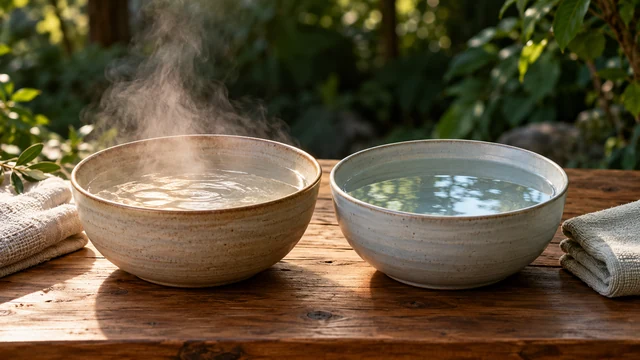
Arrows show net heat transfer at the contact surface.
A simplified physical relationship. At equal local temperatures there is no net heat transfer caused by a temperature difference. Whole-body responses also depend on circulation, duration and conditions.
Δp = ρgh
View calculated values
| Depth (m) | Additional pressure (kPa) |
|---|---|
| 0 | 0.0 |
| 0.5 | 4.9 |
| 1 | 9.8 |
| 1.5 | 14.7 |
| 2 | 19.6 |
Calculation: fresh-water density ρ = 1,000 kg/m³; g = 9.8 m/s². Δp is relative to the surface and excludes atmospheric pressure. The plotted depths are not instructions to immerse, and the curve is not a clinical result.
Contrast hydrotherapy uses a sequence of warmer and cooler water exposures. In sport, it is usually discussed as a recovery practice; in rehabilitation, local contrast bathing may be offered for a particular limb and purpose. These contexts share water and temperature changes, but their aims and practical demands differ. A comfortable hand bath after clinical assessment is a different intervention from stepping between deep communal pools after hard exercise.
The most useful way to understand the practice is to keep three questions separate. What physical exposure reaches the body? What outcome has a study actually measured? Does that outcome address the person's reason for using it? A change in skin temperature can answer the first question without answering the third. Likewise, feeling refreshed can be a worthwhile experience without establishing that damaged muscle has repaired more quickly.
This article examines exercise recovery and the interpretation of research. It does not set out a personal rehabilitation programme or a universal temperature schedule. The aim is to make discussion with a physiotherapist, coach or other appropriately qualified professional more precise.
Heat Transfer and Hydrostatic Pressure
Water exchanges heat with the body through contact with the skin. The direction of net heat transfer depends on the temperature difference: warmer water can supply heat, while cooler water can remove it. The amount transferred also depends on time, exposed surface area, water movement and the changing temperatures of the water and body. Useful reporting therefore specifies temperature in degrees Celsius, exposure time in minutes and immersed surface area in square metres, where measured. A description such as “cold treatment” therefore leaves much of the actual exposure unspecified.
Consider two hypothetical settings. In one, a person places a hand in a small basin. In the other, the person enters water to the chest. Even if both vessels begin at the same temperature, the exposed area and water volume differ substantially. Movement can replace water next to the skin, while an unmoving layer behaves differently. A small container may also change temperature during use. These are ordinary features of heat exchange, and they help explain why a headline temperature cannot define a complete intervention.
Temperature measured at the skin is not automatically the temperature inside a working muscle. Different tissues occupy different depths, have different blood supplies and exchange heat over different timescales. An immediate surface sensation gives useful information about comfort, but it cannot map the temperature of every underlying structure. When a study reports a thermal response, readers should check where the measurement was taken and when it was recorded.
Immersion adds another physical exposure: hydrostatic pressure. In still water, the additional pressure due to depth is approximately density multiplied by gravitational acceleration multiplied by depth: p = ρgh. Using fresh water at roughly 1,000 kilograms per cubic metre gives about 9.8 kilopascals per metre below the surface. This is pressure above the pressure already present at the surface. It is a simplified physical calculation, not a clinical dose or a recommendation to immerse to a particular depth.
Pressure is greater at the bottom of an immersed limb than near the water surface. Changing from a shallow basin to a deep pool changes this pressure distribution even if the temperature is identical. By contrast, alternating warm and cool water at the same depth does not create a large alternating pressure merely because the temperature changed. The temperature sequence and the pressure exposure need to be described separately.
This distinction matters when hydrotherapy is described as a “pump”. Blood vessels may respond to heating and cooling, but a convincing clinical pumping claim needs more than that plausible mechanism. It requires evidence about which fluid compartment changes, how the change was measured, and whether symptoms or function improve. The pressure equation alone cannot demonstrate lymphatic drainage, clearance of unnamed toxins or accelerated tissue repair.
A small physiological study illustrates the boundary. Shadgan and colleagues examined ten healthy adults using near-infrared spectroscopy around the calf. Contrast bathing produced changes in local haemodynamic and oxygenation measures. These observations establish that a measurable tissue response occurred under the study conditions. They do not show that the intervention treats a particular injury or speeds an athlete's return to competition. [06-01]
Near-infrared spectroscopy estimates characteristics of light passing through superficial tissues; it is not a direct camera of healing. Similarly, a blood-flow observation, a pressure calculation and a person's report of easier movement each describe a different part of the experience. Bringing them together can generate a sensible research hypothesis. Treating them as interchangeable would give the hypothesis more certainty than the measurements support.
Contrast Bathing Versus Cold Immersion
Contrast bathing alternates temperatures. Cold-water immersion uses a predominantly cold exposure. Warm-water immersion supplies a predominantly warm exposure. Aquatic rehabilitation may involve supervised movement, unloading and functional exercise in water. These labels can overlap in practice, but they do not identify identical treatments. Evidence should follow the actual intervention rather than the shared word “hydrotherapy”.
A comparison with cold immersion can ask whether alternating temperatures adds anything useful. A comparison with warm immersion can ask a different question. A comparison with passive rest asks whether the whole experience, including immersion, attention and expectations, is better than the selected resting condition. If researchers compare only contrast bathing with sitting quietly, the findings cannot identify which component of the bathing experience caused the difference.
Local and whole-body applications also need their own context. A local bath permits a person to remain seated and observe the treated area. Whole-body facilities introduce transfers, greater exposed area, shared-water hygiene and a different thermal burden. A shower does not reproduce the same depth-dependent pressure as immersion. Calling all three “contrast therapy” is convenient conversationally, but it loses information needed for safe use and evidence appraisal.
The Cambridge University Hospitals leaflet on hand and wrist contrast bathing is an example of context-specific guidance. It concerns local rehabilitation and includes suitability cautions and advice to stop if symptoms worsen. Its existence does not establish a general programme for sports pools, cold plunges or treatment of an undiagnosed swollen limb. The setting and purpose remain part of the guidance. [06-02]
An exercise recovery study also answers a different question from an injury rehabilitation study. Researchers may deliberately use unfamiliar exercise to produce delayed soreness in otherwise healthy volunteers. That model helps standardise a temporary response for measurement. It does not reproduce the full assessment of a sprain, a tendon disorder, an infected wound or persistent unexplained pain. Similar discomfort does not make the underlying situations equivalent.
There can still be a place for personal preference. A person may find a supervised bathing routine pleasant, sociable or helpful in marking the end of training. Those are understandable reasons to value the experience. They should be described as experience and preference unless the additional claim concerns an outcome that has been tested. Someone who dislikes the process has no obligation to adopt it simply because it is popular in elite sport.
For a team, convenience may be a significant practical factor. The time needed to reach a facility, change clothes, clean equipment and return home can affect the total recovery routine. An intervention that appears brief in a study may require considerably more time outside the laboratory. This practical burden belongs in the decision alongside comfort, cost and any demonstrated benefit.
Comparison also needs to match the decision. If the real alternatives are a quiet evening at home and a lengthy visit to a spa, a study comparing two closely supervised laboratory baths provides only part of the answer. If the question is whether a prescribed hand treatment helps a particular rehabilitation goal, whole-body athlete studies offer indirect background. Identifying the real alternative prevents the evidence from drifting away from the person's circumstances.
Muscle Soreness, Strength and Recovery Outcomes
Recovery is an umbrella term. Soreness, maximal strength, jump performance, range of movement and readiness to train are related but distinct outcomes. Laboratory markers add another category. Force may be measured in newtons, power in watts and soreness with a specified rating scale; these units describe different outcomes. A person can report less soreness without recovering every aspect of performance, while a functional test may improve without a noticeable change in discomfort. Research is more informative when it names the outcome rather than declaring that “recovery improved”.
A 2007 crossover study by Vaile and colleagues involved thirteen recreational athletes after an exercise bout designed to induce muscle soreness. Contrast water therapy showed advantages for selected strength measurements compared with passive recovery. The authors did not find significant treatment differences in perceived pain or creatine kinase. This mixed pattern matters: the study supports a narrower interpretation than improvement in every aspect of muscle damage and recovery. [06-03]
A related 2008 investigation studied thirty-eight strength-trained men across hydrotherapy and passive-recovery conditions; fifteen were assigned to the contrast-water group. Selected strength, power and soreness outcomes favoured contrast treatment, but the results were not uniform across every measure or intervention. An erratum corrected printing errors in a table; readers using that table should consult the correction. These findings concern a particular exercise model and sample, not a universal response in all ages, health conditions or sports. [06-04] [06-05]
The distinction between a group average and an individual result is especially useful here. A trial may estimate a modest average difference while participants vary considerably. The estimate does not tell a reader that they personally will experience the same change. Nor does a single satisfying session confirm a study's average effect. Research estimates and personal observations can inform a discussion without being mistaken for each other.
The wider trial literature has also been reviewed. Bieuzen and colleagues' 2013 systematic review included eighteen studies, all judged at high risk of bias. Some pooled soreness and strength outcomes favoured contrast water therapy over passive recovery. Evidence that it outperformed other recovery approaches was less clear. The review offers a structured overview of those trials, with limitations that prevent confident claims about an optimal method. [06-06]
More recent adjacent evidence helps explain why a plausible temperature mechanism is insufficient on its own. In a 2025 randomised trial involving thirty healthy women, cold or hot immersion changed acute physiological measurements but did not accelerate the measured recovery from exercise-induced muscle damage compared with the control condition. This trial tested separate cold and hot immersion, not alternating contrast therapy. Its relevance is the distinction between a thermal response and a recovery benefit. [06-07]
Blood markers deserve particularly careful language. Creatine kinase can be measured after exercise, but a laboratory value is not a complete account of how a muscle performs or how a person feels. Even where an intervention changes a marker, the next question is whether a useful functional outcome follows. Conversely, an unchanged marker does not erase a genuine change in an independently measured outcome. Each result needs its own interpretation.
Timing changes the meaning of a result as well. A report immediately after bathing answers a different question from performance the following day. A short-lived reduction in discomfort could matter before a particular activity, yet it would not establish faster biological repair over several days. A study with no later follow-up cannot tell us whether an apparent early difference persists.
For readers comparing findings, a simple outcome map is helpful: record the participants, exercise task, comparator, measurement and follow-up time. Then state the result in one sentence without using the general word “recovery”. For example, “participants reported less soreness at the selected follow-up” is precise. “The treatment repaired muscle” requires substantially different evidence. Clear language protects the practical value of a finding by keeping it connected to what was actually observed.
Protocol Variation and Limits of the Evidence
Contrast protocols vary in the temperatures used, the length of each exposure, the number of alternations, the final exposure, the depth of immersion and the timing relative to exercise. Some treat only a limb; others involve much more of the body. A pooled estimate across these approaches may describe an average research result, but it does not turn all of them into equivalent prescriptions.
A 2025 scoping review by Leonardi and colleagues mapped seven trials across several musculoskeletal conditions and thermal methods. It found substantial protocol variation and rated the included trials as poor quality. Its scope included techniques beyond water immersion, so it cannot settle the best bathing sequence for athletes. The review concluded that comparative effectiveness and clear clinical guidance remain uncertain. It reported support from the Italian Ministry of Health and no declared conflicts of interest. [06-08]
Variation creates a common reading error. A promising result from one study is paired with a convenient schedule from another source, and the combination is presented as if it had been tested. The resulting routine may be perfectly recognisable as contrast bathing, yet it is a new combination. Any claimed benefit should be tied to the actual programme studied, with its participant group and comparator stated.
The final temperature is sometimes given special status in popular advice. A claim that one ending is always superior would need direct comparative evidence with outcomes relevant to the user. A physiological story about warmth or cooling cannot settle the question by itself. The same applies to claims that more alternations, colder water or a more intense sensation must produce a larger benefit. Greater exposure is not the same thing as greater usefulness.
Blinding is difficult in this research: participants can usually tell whether they are sitting in warm water, cool water or no water. Expectations, familiarity and preference can therefore influence subjective outcomes. That does not make soreness reports worthless. It means the study should also describe expectations where possible, use suitable comparison conditions and distinguish subjective measures from independently assessed performance.
Crossover designs, where people experience more than one condition, can help account for differences between individuals. They also need to manage order effects and sufficient separation between exercise bouts. Familiarity with a task can change the response to repeating it. The statistical design and practical schedule therefore matter, even when the bathing equipment looks simple.
Small studies can be useful for testing methods and identifying possible effects. They also produce less stable estimates and may miss differences that matter. A statistically non-significant result is not automatically proof that two treatments are equivalent. Equally, one favourable result among many measurements needs to be read in the context of the whole study, including whether that result was a pre-specified primary outcome.
Reporting the size of a difference is often more useful than reporting only its statistical label. Readers need to know whether an observed change is large enough to affect the activity they care about. A difference detectable on a laboratory instrument may have limited practical consequence. A modest difference might matter to a tightly scheduled competition context but have little value for someone taking recreational exercise at a comfortable pace.
The available evidence does not justify presenting a single online routine as the established best approach for everyone. For an individual, the decision can instead begin with a clearly stated goal and an assessment of suitability. If the goal is managing a diagnosed condition, the appropriate professional can help determine which outcomes and alternatives matter. If the goal is enjoyment after exercise, the claim can remain proportionate to that experience.
Contraindications and Individual Assessment
The safety question begins with the person and setting, not with whether water is described as natural. Temperature changes, immersion, standing up, stepping between containers and shared surfaces all create practical demands. A programme considered for one healthy athlete cannot establish suitability for a person with a cardiovascular condition, a circulation problem, impaired sensation or a current wound.
The Cambridge hand and wrist leaflet specifically identifies open wounds, exposed surgical wires, current infection and certain cardiovascular issues among reasons the treatment may be unsuitable. It also highlights reduced sensation and circulation conditions as reasons for caution or advice. These are indications for individual assessment, not an invitation to find a less intense internet version of the same treatment. [06-02]
Sensation matters because a person needs reliable information about discomfort and temperature. A plan that relies on “stop when it feels too hot or cold” is inadequate if that feedback is impaired. The relevant clinician can consider the underlying condition, the area affected and the practical method. A device reading or another person's reassurance cannot substitute for that assessment.
Unexplained symptoms also need a clear boundary. A newly swollen, markedly painful or otherwise concerning limb should not be treated as an ordinary recovery experiment. Contrast bathing cannot identify why the symptom is present. Trying successive wellness routines before establishing the cause can make it harder to judge what is happening and what care is needed.
For someone already receiving rehabilitation, useful discussion points include the intended purpose, how progress will be measured, what would make the approach unsuitable and what to do if symptoms worsen. The question is not simply whether the practice is “good”. It is whether it belongs in this person's plan, at this stage, with a clear method of review. Follow the clinician's individual guidance rather than combining several unrelated protocols.
The environment also deserves attention. Stable access, a non-slip route, clean equipment and the ability to leave the water comfortably are part of the experience. Supervision in a research or clinical setting is an element of that setting, not an incidental detail that automatically transfers to home use. Whole-body exposure requires particular care; this article supplies no cold-water challenge or immersion schedule.
A useful review of any optional recovery practice asks whether it helps the stated goal, remains comfortable and is worth its practical burden. Keep observations simple: the relevant activity, any symptoms and whether the experience was manageable. Repeatedly testing harder exposures to chase a stronger sensation does not answer those questions more reliably. A professional assessment can provide a better next step when the outcome remains uncertain.
Contrast hydrotherapy is best understood as a family of temperature and immersion procedures with context-dependent evidence. Its physical effects are real, and selected exercise studies offer reasons for further investigation. The decision to use it should remain attached to a defined purpose, a suitable person and an honest account of what the research has measured. Those foundations are more useful than a promise that one bathing sequence will optimise every form of recovery.
Evidence at a glance
| Evidence | What was measured | Useful interpretation | Main limit |
|---|---|---|---|
| Local contrast-bath physiology, 2018 [06-01] | Calf haemodynamics and oxygenation in ten healthy adults | Temperature alternation can produce measurable local responses | No direct clinical healing outcome |
| Exercise crossover study, 2007 [06-03] | Strength, pain and creatine kinase after unfamiliar exercise | Selected strength findings favoured contrast water therapy | Small sample; not all outcomes differed |
| Hydrotherapy study, 2008 [06-04] [06-05] | Performance and soreness in strength-trained men | Selected recovery outcomes favoured contrast exposure | Population-specific; corrected table requires care |
| Systematic review, 2013 [06-06] | Eighteen contrast-water trials | Some results favoured contrast bathing over passive recovery | High risk of bias; uncertain superiority to other methods |
| Cold or hot immersion in women, 2025 [06-07] | Physiology and recovery over follow-up | Physiological changes did not imply faster recovery | Adjacent evidence; no alternating contrast condition |
| Scoping review, 2025 [06-08] | Seven trials across musculoskeletal conditions | Updates the map of methods and evidence gaps | Poor trial quality; includes non-water thermal methods |
Common questions
What is contrast hydrotherapy?
It alternates warm and cool water exposure. Local contrast bathing, whole body immersion and aquatic rehabilitation require separate evaluation.
Does pressure during immersion prove a drainage benefit?
No. Hydrostatic pressure is a physical property of immersion. It does not establish a clinically meaningful drainage effect or removal of unspecified toxins.
Is there one protocol suitable for everyone?
No. Research protocols vary, and suitability depends on the person and context. Medical conditions, impaired sensation, wounds or infection require individual advice.
Sources & further reading
Study results apply to the participants, comparison and outcomes described. Source links open the original record.
- [06-01] Contrast Baths, Intramuscular Hemodynamics, and Oxygenation as Monitored by Near-Infrared Spectroscopy (2018)primary physiological study
- [06-02] Contrast bathing for the hand and wristofficial NHS patient information
- [06-03] The effect of contrast water therapy on symptoms of delayed onset muscle soreness (2007)primary crossover exercise study
- [06-04] Effect of hydrotherapy on the signs and symptoms of delayed onset muscle soreness (2008)primary controlled exercise study
- [06-05] Erratum to: Effect of hydrotherapy on the signs and symptoms of delayed onset muscle soreness (2008)publisher correction
- [06-06] Contrast Water Therapy and Exercise Induced Muscle Damage: A Systematic Review and Meta-Analysis (2013)systematic review of controlled trials
- [06-07] No acceleration of recovery from exercise-induced muscle damage after cold or hot water immersion in women: A randomised controlled trial (2025)primary randomised controlled trial; adjacent evidence
- [06-08] Mechanisms and Efficacy of Contrast Therapy for Musculoskeletal Painful Disease: A Scoping Review (2025)scoping review of randomised trials
Pomocnicze streszczenie
Najważniejsze informacje po polsku
To streszczenie, nie pełne tłumaczenie artykułu. Szczegóły, ograniczenia badań i źródła znajdują się w tekście angielskim.
To polskie streszczenie pomocnicze artykułu, a nie jego pełne tłumaczenie. Hydroterapia kontrastowa polega na naprzemiennym stosowaniu cieplejszej i chłodniejszej wody. W badaniach sportowych dotyczy regeneracji po wysiłku, natomiast w rehabilitacji może obejmować miejscową kąpiel dłoni lub innej części ciała. Tych sytuacji nie należy traktować jako jednego, identycznego zabiegu. Cel, obszar zanurzenia, temperatura, czas oraz stan zdrowia osoby wpływają na znaczenie całej procedury.
Woda wymienia ciepło z ciałem, a zanurzenie dodatkowo wiąże się z ciśnieniem hydrostatycznym. W wodzie słodkiej wzrasta ono w przybliżeniu o 9,8 kPa na każdy metr głębokości. Jest to zależność fizyczna, a nie zalecenie dotyczące zanurzania ani dowód skutecznego drenażu. Sama zmiana ukrwienia, temperatury skóry czy lokalnego natlenowania nie potwierdza szybszego gojenia mięśni. Trzeba osobno sprawdzić, czy zmieniają się ból, siła, sprawność lub inne istotne dla człowieka wyniki.
Niewielkie badania wysiłkowe wskazują na możliwe korzyści dotyczące wybranych pomiarów regeneracji. Nie wszystkie wskaźniki poprawiały się równocześnie. W badaniu z 2007 roku korzystniejsze wyniki nie obejmowały każdej miary bólu i uszkodzenia mięśni. Przegląd badań z 2013 roku wykazał ograniczenia jakości dostępnych prób. Badanie kobiet opublikowane w 2025 roku dotyczyło oddzielnie zimnej i ciepłej immersji, dlatego nie może być przedstawiane jako bezpośredni test kąpieli naprzemiennych. Pokazuje jednak, że reakcja fizjologiczna na wodę nie musi oznaczać przyspieszenia regeneracji.
Przegląd zakresowy z 2025 roku również wskazuje na różnorodność procedur i słabą jakość prób. Obejmował różne metody termiczne, więc nie wyznacza najlepszego schematu kąpieli dla sportowców.
W praktyce warto najpierw nazwać cel. Mniejsze odczucie bolesności, lepszy wynik skoku oraz powrót do zwykłej aktywności to różne rezultaty. Przyjemne doświadczenie po treningu może mieć osobistą wartość, ale nie stanowi automatycznie dowodu leczenia urazu. Znaczenie mają także dojazd, koszt, czas potrzebny na zabieg i komfort. Nie ma obowiązku wybierania tej metody tylko dlatego, że korzystają z niej sportowcy.
Nie istnieje jeden schemat odpowiedni dla wszystkich. Artykuł nie zawiera indywidualnego programu rehabilitacji ani zalecanych temperatur i czasów ekspozycji. Choroby układu krążenia, zaburzenia czucia, problemy z krążeniem obwodowym, rany oraz zakażenie wymagają oceny odpowiednio wykwalifikowanego specjalisty. Niewyjaśnionego obrzęku lub niepokojącego bólu nie należy traktować jak zwykłej bolesności potreningowej. Ważne są również bezpieczne wejście i wyjście z wody, stabilne podłoże oraz higiena. Jeśli zabieg stanowi część rehabilitacji, jego cel i sposób oceny efektów powinny wynikać z uzgodnionego planu. Pogorszenie objawów jest powodem przerwania zabiegu i kontaktu z osobą prowadzącą terapię.