At a glance
Qigong combines gentle movement, breathing and attention. Clinical studies assess outcomes such as fatigue, quality of life and circulating C reactive protein, measured in mg/L. These measurements concern observable physiology; neither improved questionnaire scores nor archived intelligence reports establish an externally transmitted therapeutic energy field.
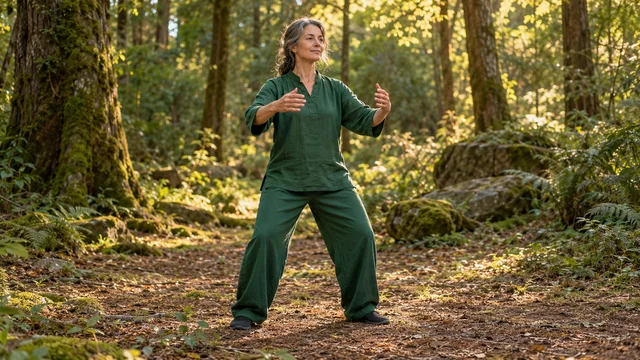
Conceptual overlap only. Specific routines and study outcomes vary. The diagram does not represent an externally transmitted energy field. Practice overview [08-01]
Qigong brings movement, breathing and sustained attention into the same practice. For a reader exploring natural medicine, its appeal may be very ordinary: a quieter way to move, a class that feels approachable, or time spent noticing the body without competing against a score. Its cultural language can also be meaningful. Understanding what a practice offers becomes easier when the experience, the traditional explanation and the research question are each allowed their own space.
This guide focuses on Qigong that people practise themselves. It examines selected clinical trials, explains why a blood marker cannot establish every proposed mechanism, and offers a way to read historical documents without turning their archival status into a medical recommendation. It does not assess an individual’s symptoms or prescribe a programme. The useful question is specific: which form of Qigong, for which person, compared with which alternative, and with which outcome?
Movement, Breathing and Attention in Qigong
Qigong is a broad family of Chinese practices rather than one standard exercise. The US National Center for Complementary and Integrative Health describes the coordination of posture and movement, breathing and mental attention. Some forms emphasise gentle movement; others place more emphasis on stillness. The label alone therefore gives limited information about the actual demands of a class. [08-01]
What a session asks you to do
Think of a simple movement as having several layers. There is a visible action, such as raising and lowering the arms. There is the effort needed to support the posture. There is a breathing rhythm, which may be coordinated with movement. Finally, there is the instruction about attention: following sensations, visualising an image or simply noticing when the mind wanders. Two sessions can look similar on a short video while differing considerably in these layers.
This distinction matters when choosing a teacher. A class description should explain whether practice is mostly seated, standing or moving through the room; whether the teacher offers alternatives; and whether breath is left comfortable or deliberately controlled. The atmosphere may be contemplative without requiring acceptance of a particular spiritual explanation. A participant should be able to ask what an instruction means and decline an element that feels unsuitable.
Learning also has a practical component that impressive promotional videos rarely show. You need to hear the instructions, see a demonstration, have enough space and understand how to pause. A useful beginner class makes the next action clear. It should not make a person feel that reproducing a deep stance, a large range of movement or a long hold is a test of commitment. Accessibility is part of the quality of teaching.
Breathing without a performance target
When movement and breathing are coordinated, there is no need to interpret the longest breath as the best one. Forced breathing can turn an otherwise gentle activity into an uncomfortable task. A teacher who works with individual limits can explain whether to breathe naturally during a difficult movement and how to return to a resting position. Dizziness, chest discomfort or unusual breathlessness are reasons to stop and seek appropriate advice, not milestones to push through.
For people with an existing condition, the relevant question is how the particular movements fit their circumstances. A person recovering from surgery may have restrictions that are not apparent to an instructor. Someone with balance problems may need support or a seated option. People receiving cancer treatment should discuss suitable activity with their clinical team. General information about a tradition cannot identify these individual limits. [08-02]
A way to describe your experience
It is reasonable to say that a session felt calming, engaging or enjoyable. These are meaningful observations. They become more useful when described concretely: “I found the pace manageable” says more than “my energy was corrected”. Equally, feeling frustrated with a sequence does not establish that the practice failed medically. Enjoyment, skill acquisition, symptoms and clinical outcomes are different things to track.
Before committing to a course, consider the practical outcome you want. You might want an accessible movement class, a regular social activity, or a structured time for attention. These goals can be discussed directly with a teacher. They do not require buying devices, pursuing unusual sensations or adopting a fixed identity as a particular kind of practitioner. Ask about fees, cancellation terms and how the class accommodates changing ability. A sustainable arrangement is one you can understand and revise.
Make the first conversation specific
A short conversation with the instructor can reveal more than a list of broad benefits. Describe the activity you hope to join and ask what a typical lesson actually involves. Ask how instructions are adapted when someone cannot comfortably stand for the whole class, follow a fast sequence or coordinate movement with a set breathing pattern. These questions help establish whether the service being offered matches your needs.
You can also agree on a modest way to review the experience. For example, after an introductory period, consider whether the instructions remain clear, whether attendance is practical and whether you feel free to rest. This is a review of fit, not a self-administered clinical trial. If a teacher interprets every difficulty as proof that you need more sessions or a more expensive programme, ask for a clearer explanation before committing further time or money.
Clinical Trials and Patient Reported Outcomes
Clinical research can ask whether a defined programme helps a defined group. It cannot make every version of Qigong interchangeable. The examples below come largely from supportive cancer care, an area in which fatigue and quality of life have been studied. They are selected examples for reading evidence, not a systematic review of all Qigong research or a recommendation for treating cancer.
Comparisons worth distinguishing
In a trial reported by Oh and colleagues in 2010, 162 adults with different cancers were allocated to medical Qigong or usual care. At ten weeks, the researchers reported better quality of life, fatigue and mood results in the Qigong group, alongside a difference in C-reactive protein. This was an encouraging supportive-care finding. The usual-care comparison did not isolate the contributions of group contact, attention and movement, and the study did not establish an effect on cancer survival. [08-03]
Larkey and colleagues studied Qigong/Tai Chi Easy against a gentle movement comparison that omitted its particular breathing and meditative emphasis. The trial randomised 101 women; 87 were included in the analysis. Fatigue results favoured the Qigong/Tai Chi Easy programme after twelve weeks and at follow-up, while depression and sleep did not show the same between-group advantage. The distinction between randomised and analysed participants matters when judging the findings. [08-04]
A 2023 pilot by Zimmerman and colleagues compared Qigong with an exercise and nutrition programme. Forty-one women were randomised and twenty-four contributed to the principal analysis. Fatigue improved in both groups without a statistically significant difference between them. The small study cannot establish that the approaches are equivalent; it provides estimates and feasibility information for larger research. [08-05]
The 2025 Project HERO trial adds an important counterweight. Kinney and colleagues enrolled 113 male cancer survivors aged 55 or over in Tai Chi Qigong, intensity-matched exercise or usual care. The programmes lasted twelve weeks. At the prespecified primary endpoint, three months after the intervention, neither activity showed a significant or clinically meaningful fatigue advantage over usual care. Improvements within the exercise groups immediately after classes did not establish a lasting comparative benefit. [08-09]
Chen and colleagues randomised 96 women receiving breast-cancer radiotherapy to Qigong or a waiting list. Classes accompanied five or six weeks of treatment. Depressive symptoms improved over time in the Qigong group; fatigue and quality-of-life advantages were particularly apparent among women with higher depressive symptoms at baseline. These findings should not be rewritten as an equal benefit for every participant or as evidence that radiotherapy can be replaced. [08-10]
These studies ask different questions. A usual-care comparison asks what happens when an additional programme is offered. An active comparison asks whether one programme brings advantages beyond another credible activity. A pilot often asks whether a larger study can be conducted and how outcomes behave. A headline that simply says “Qigong works” loses these distinctions.
What a recent review adds
A 2025 systematic review by Dalmedico and colleagues included eight studies of Qigong in women with breast cancer. Although the abstract describes a meta-analysis, the results explain that differences in programmes and outcomes prevented statistical pooling. The review identifies encouraging findings alongside weaknesses in allocation methods and calls for more robust research. Reading that qualification is more informative than treating every favourable result as an independent confirmation of one standard treatment. [08-11]
A review also cannot turn closely related publications into separate populations. When reading a table of papers, check whether more than one article reports outcomes from the same participants. The number of publications and the number of independent trials can differ. Likewise, a review limited to women with breast cancer does not answer the question tested in older male survivors. Population and follow-up remain relevant when findings are synthesised.
Relate the study to the decision
Before using a trial to choose a class, write down the decision you are actually making. Joining an introductory movement session is different from choosing a rehabilitation programme or paying for a claim of disease treatment. The evidence needed should match the importance of that decision. A promising symptom study may justify a discussion with a clinical team; it does not automatically justify a commercial promise. This also helps you compare alternatives fairly. Ask what practical benefit you hope for, what other options exist, and whether the proposed programme resembles the one investigated closely enough for the comparison to be informative.
Why self-reported outcomes matter
Fatigue, pain and quality of life include experiences that only the participant can report. A questionnaire is therefore not an inferior substitute for a laboratory result. The question is whether it measures the intended experience consistently, whether changes are large enough to matter, and whether the comparison allows a fair conclusion. A person’s ability to complete an ordinary task may matter more to them than an impressive-looking graph.
Imagine a study in which participants report less fatigue after joining a class. Several explanations remain possible: the practice may help, the social setting may help, expectations may influence reporting, or other care may have changed during the same period. Random allocation and an appropriate comparison reduce some uncertainties. They do not make every measurement immune to bias. This is a methodological explanation, not a claim about what happened to any particular participant in the trials above.
The timing of measurement matters too. Feeling different immediately after a class is a separate outcome from feeling different a month later. A questionnaire completed during a good week may not capture whether the activity is manageable through a difficult treatment cycle. Research with longer follow-up can address durability, but a reader should check whether people continued practising and how many remained available for assessment.
Reading a result beyond the headline
Start with the population and the comparison. Next identify the primary outcome, which should be specified before results are known. Then look for the size and uncertainty of the difference, withdrawals, adverse events and follow-up. Statistical significance alone does not tell you how much everyday life changed. A non-significant result also does not prove that two options are identical; the study may be too small to distinguish them reliably.
Notice how a paper handles participants who stop attending. Reporting only committed completers can give a different picture from reporting everyone originally allocated. Attendance itself may reveal whether a programme fits real life. Travel, work, fatigue and caregiving can all influence participation. These are relevant considerations for deciding whether the research setting resembles your own situation, even when a study reports favourable average results.
The source of a claim is worth checking as well. A research paper should identify its authors, funding and any declared interests. A course advertisement may cite the same paper while omitting the comparison or limits. Read the original description of the intervention before deciding that it matches the service being offered. A teacher’s participation in research can be relevant expertise, but it does not turn every course they sell into a clinically tested programme. Evidence belongs to the intervention and outcome actually investigated.
Finally, keep supportive outcomes in their proper place. A programme that improves comfort or fatigue can be worth studying and discussing without being presented as a disease cure. The strongest interpretation is usually narrower than a promotional slogan, and it is more useful precisely because it tells you what the evidence actually addresses.
Inflammatory Markers and Physiological Interpretation
The body can be measured at many levels: a person’s report, their ability to perform a task, the concentration of a blood protein, or an electrical signal. These measurements answer related but distinct questions. The attraction of a biomarker is that it appears objective. Its interpretation still depends on why it was measured, how it changes and what other events could explain the result.
What CRP can and cannot tell you
C-reactive protein, usually abbreviated to CRP, is produced by the liver and can rise with inflammation. A clinical test may help investigate or monitor an inflammatory process, but the result alone does not locate the cause or establish a diagnosis. Infection, injury and other conditions can be relevant to its interpretation. Laboratory context and the clinician’s assessment remain necessary. [08-06]
CRP may be reported in milligrams per litre. The unit describes a concentration in a sample; it is not a direct score for a person’s overall resilience or the balance of a traditional energy system. When comparing reports, check both the unit and the type of test. A change in a measurement can be real without answering the wider question attached to it.
Suppose a programme is followed by a difference in a biomarker. There are several stages between that observation and a strong explanatory claim. Was the difference present between groups, rather than only within one group over time? Was it one of many measurements? Was it large relative to normal variation? Did it accompany a meaningful improvement? Could medication, illness, activity or another change have contributed? Each question narrows what can reasonably be concluded.
A pathway is a hypothesis until tested
One proposed explanation for a movement practice might involve changes in activity, sleep or stress-related behaviour. Another might focus on breathing and cardiovascular regulation. A trial that records a symptom and a blood marker does not automatically identify which pathway produced the result. Demonstrating a mechanism requires measurements designed to test the proposed chain of events and to challenge alternative explanations.
This is especially relevant when two measurements change together. If a participant reports feeling better and a laboratory value changes, the first change need not have caused the second. Both might reflect a third factor. Establishing mediation is a specific research task. A photograph of two lines moving in the same direction is not enough to settle it.
The same care applies to a measurement that does not change. A person may value a class even when a selected biomarker remains stable. The marker may not represent the aspect of experience that changed. Conversely, a laboratory change should not persuade someone to continue an activity that is painful, exhausting or incompatible with their care. The person’s functioning and safety remain part of the assessment.
Avoid turning practice into unnecessary testing
There is no reason to order blood tests solely to give an enjoyable movement class a medical narrative. Tests should answer an appropriate clinical question and be interpreted in context. If fatigue is persistent, new or affecting daily life, a clinical assessment is more useful than choosing a marker from a wellness advertisement. A practice can sit alongside that assessment without becoming a substitute for it.
For ordinary self-observation, a brief description may be enough: what you attended, whether it was comfortable, what you enjoyed and whether symptoms changed. Keep the language descriptive rather than diagnostic. Bring concerning changes to the relevant clinician. A diary helps a conversation when it records what happened; it becomes misleading when every entry is assigned to an unverified biological mechanism.
Biochemical Energy and Traditional Qi Concepts
The word “energy” can refer to different things in different conversations. In everyday language, it may mean motivation or the feeling of having enough capacity for the day. In physiology, energy transfer has defined chemical and physical meanings. In traditional Chinese thought, qi belongs to a wider explanatory vocabulary. Treating these meanings as identical can create confusion even when everyone is speaking sincerely.
Learning a tradition in its own language
A teacher may use imagery of gathering, sinking or circulating qi to organise attention and movement. A learner can ask what the instruction is intended to accomplish in the session. Is it a metaphor for posture? A way of directing attention? A statement within the teacher’s traditional framework? Or a claim that something measurable is being transmitted? Clarifying this does not diminish the tradition. It makes the lesson more intelligible.
The World Health Organization’s terminology work provides a shared vocabulary for describing traditional Chinese medicine. Standardised terminology helps readers and practitioners communicate; it does not establish that every concept has a validated biomedical counterpart. A definition and an efficacy finding are different kinds of information. [08-07]
A culturally respectful account therefore avoids two shortcuts. It does not translate every traditional term into a modern nerve, hormone or molecule, and it does not assume that a concept has no cultural meaning unless it can be reduced to a laboratory variable. The task is to say which kind of explanation is being offered and what evidence would be needed for any clinical claim attached to it.
Biochemistry has a defined meaning
ATP, adenosine triphosphate, participates in energy transfer that supports processes including muscle contraction and cell signalling. Cellular respiration connects the processing of nutrients with ATP production, with mitochondria playing an important role. This is the biochemical sense in which a moving body uses energy. It describes ordinary cellular processes, not a measurement of qi or evidence for an additional energy source acquired during a class. [08-12]
What a physical energy claim would require
In science, a claim about physical energy needs an operational definition: what quantity is measured, in which unit, with what instrument and under which conditions? The body certainly uses chemical energy and produces heat. Those familiar facts do not identify an additional therapeutic field. Naming ATP, mitochondria or electricity in an explanation does not by itself connect a particular practice to a demonstrated clinical effect.
Consider the statement that a practitioner “transmits energy”. To evaluate it physically, the proposed signal would need to be distinguished from heat, movement, sound, ordinary electrical interference and the expectations of participants. To evaluate it clinically, a study would need suitable outcomes and controls. These are separate requirements. Even a reproducible physical signal would not, by itself, show that the signal improves health.
Self-practised movement and externally administered “qi healing” should consequently be assessed separately. A trial of people moving and breathing in a class does not test a remote intervention that they receive without moving. Borrowing evidence from the first to advertise the second changes the intervention while keeping the favourable result. A careful reader checks this match before accepting a claim.
Space for experience without overinterpretation
Warmth, tingling, a sense of heaviness or an unusual awareness of breathing can feel striking during a focused practice. The experience is real as an experience. Its cause cannot be identified solely from how it feels. Avoid using an unusual sensation as proof that a hidden blockage has been removed or that a medical condition is improving. If a sensation is concerning or persists, describe it plainly to an appropriate professional.
A participant also does not need to experience anything dramatic for a class to be worthwhile. The ability to follow a sequence, enjoy movement, practise attention or share an activity can be sufficient. This gives people room to learn without comparing their sensations with someone else’s account or feeling pressured to report a transformation.
When a course uses spiritual language, informed choice includes knowing this in advance. A teacher can explain their tradition and its expectations while allowing questions. A learner can appreciate the cultural setting and still decline a health claim. Respect works best when neither cultural belonging nor scepticism is turned into a condition for receiving clear information.
Reading Declassified Archives Without Overstating Evidence
Documents held in intelligence or government archives attract attention because their provenance can feel unusually authoritative. Archival preservation is valuable, but it answers a historical question: what material was collected, produced, circulated or later released? It does not remove the need to evaluate the document’s methods, authorship and purpose.
Start with the document, not the stamp
When reading a historical report, identify its author and date before drawing conclusions. Distinguish an original experiment from a translation, a summary of someone else’s work, an analyst’s note or a proposal for future investigation. Ask whether the document contains data, whether those data can be examined, and whether the conclusions follow from the methods described. A release stamp gives information about access, not a substitute for these details.
A quotation deserves the same care. A sentence may describe a claim someone made rather than a conclusion the institution accepted. An intriguing passage may appear in a section that discusses uncertainty. Read surrounding pages and preserve the distinction between the document’s voice and the voice it reports. If the original cannot be inspected, the safest description is that the content remains unverified.
The recovered scan of CIA-RDP96-00792R000300440002-5 contains five pages of an English-language historical summary, plus a separate archive credit page. On printed page 18, it describes EEG observations in thirty people practising relaxation Qigong and a comparison involving ten experienced practitioners and ten controls. Later pages discuss cerebral circulation measurements and skin responses. These are accounts of several investigations, not one experiment conducted by the CIA. [08-08]
The stamp dated 11 August 2000 records approval for release, not the date of the studies. The excerpt lacks the larger work’s title page and bibliography, so its author, original publication date and translation provenance remain unresolved. It can now be cited for what the surviving pages report; it cannot establish the reliability of the underlying experiments or a clinical benefit. [08-08]
A separate archival source is the abstract collection from the Second World Conference on Academic Exchange of Medical Qigong, held in Beijing on 15–18 September 1993. Yang and colleagues describe an EEG investigation involving 32 trainees and 35 controls over one year. The abstract gives named authors and an outline of the procedure, but it is not a full study report. This collection neither identifies the parent work of the earlier excerpt nor establishes a clinical benefit. [08-14]
An EEG is a recording, not an explanation by itself
An electroencephalogram records brain electrical activity using electrodes on the scalp. Movement can affect the recording, and patterns vary with wakefulness and sleep. Those basic features matter when reading a claim that a practice changed an EEG: the recording conditions and the comparison must be known. A change in an electrical pattern does not, by itself, identify an external therapeutic field or demonstrate a health benefit. [08-13]
For an archival EEG claim, a useful verification record would link the image of the relevant page to the transcription, identify the recording procedure and show whether the comparison was simultaneous or sequential. Missing information should remain marked as missing. It should not be reconstructed from an enthusiastic later retelling. Inspection of this excerpt resolves the access gap. Completing its bibliographic context and assessing the original methods and replication remain separate tasks.
What would make a historical finding more informative?
A historical experiment becomes easier to assess when its procedure is clear enough to repeat. Relevant questions include how participants were selected, whether observers knew the expected result, whether equipment was calibrated, and how unsuccessful attempts were recorded. Independent replication is particularly useful when a claim depends on exceptional performance or a small number of participants. These questions apply whatever institution stores the document.
The next step is to distinguish the historical claim from the present-day offer. A report about a laboratory observation does not establish the effectiveness of a modern course. A document about one practitioner does not validate every practitioner using the same term. A measurement of a physical process does not establish a medical benefit. Keeping the chain of inference visible protects both the historical record and the reader.
For a person deciding whether to try Qigong, the most practical information remains close to the activity itself: the movements, the teacher’s approach, accessibility, relevant health considerations and realistic expectations. Clinical findings can inform that discussion. Cultural history can enrich it. Neither needs to be enlarged into a guarantee. A well-described practice gives you enough information to decide whether it fits your life, and enough freedom to change your mind.
Evidence at a glance
| Source | Participants and comparison | Finding relevant here | Limit of interpretation |
|---|---|---|---|
| Oh et al., 2010 [08-03] | 162 adults with cancer; Qigong versus usual care | Selected symptom, quality-of-life and CRP outcomes favoured Qigong at ten weeks. | Supportive outcomes; usual-care control does not isolate each programme component. |
| Larkey et al., 2015 [08-04] | 101 randomised; 87 analysed; Qigong/Tai Chi Easy versus gentle movement comparison | Between-group advantage for fatigue, not depression or sleep. | Defined survivor population and analysed sample; avoid extending to all practices. |
| Zimmerman et al., 2023 [08-05] | 41 randomised; 24 analysed; Qigong versus exercise/nutrition | Fatigue improved in both groups without a significant between-group difference. | Small pilot; equivalence not established. |
| Kinney et al., 2025 [08-09] | 113 older male cancer survivors; Tai Chi Qigong, matched exercise or usual care | No significant fatigue advantage at the primary three-month post-intervention endpoint. | Immediate within-group improvement does not establish sustained comparative benefit. |
| Chen et al., 2013 [08-10] | 96 women during radiotherapy; Qigong versus waiting list | Reported benefits varied with baseline depressive symptoms. | Subgroup findings cannot be assumed for everyone; supportive outcomes only. |
Common questions
What does movement based Qigong involve?
It combines posture, movement, breathing and attention. Programmes differ, so research on one form cannot establish identical effects for every practice.
Do clinical findings demonstrate an external qi field?
No. Questionnaire scores or laboratory changes do not by themselves establish an externally transmitted therapeutic energy field.
Does a declassified CIA document validate a therapy?
No. Archival release documents the availability of a record. Clinical validity depends on study methods, appropriate controls and independent replication.
Sources & further reading
Study results apply to the participants, comparison and outcomes described. Source links open the original record.
- [08-01] Qigong: What You Need To Knowofficial health information
- [08-02] Chronic Pain and Complementary Health Approaches: Usefulness and Safetyofficial health information
- [08-03] Impact of Medical Qigong on quality of life, fatigue, mood and inflammation in cancer patients: a randomized controlled trial (2010)randomised controlled trial
- [08-04] Randomized Controlled Trial of Qigong/Tai Chi Easy on Cancer-Related Fatigue in Breast Cancer Survivors (2015)randomised controlled trial
- [08-05] A Randomized Controlled Pilot Trial Comparing Effects of Qigong and Exercise/Nutrition Training on Fatigue and Other Outcomes in Female Cancer Survivors (2023)pilot randomised controlled trial
- [08-06] C-Reactive Protein (CRP) Test (2025)official laboratory information
- [08-07] WHO international standard terminologies on traditional Chinese medicine (2022)terminology standard
- [08-08] The Effects of the Practice of Qigong on the EEG — CIA-RDP96-00792R000300440002-5 (historical excerpt; scan inspected)historical secondary summary — scanned excerpt
- [08-09] Project HERO: a randomized trial of Tai Chi qigong versus intensity-matched exercise and usual care for fatigue in older male cancer survivors (2025)randomised controlled trial
- [08-10] Qigong improves quality of life in women undergoing radiotherapy for breast cancer: results of a randomized controlled trial (2013)randomised controlled trial
- [08-11] Evidence on the benefits of mind-body Qigong exercise in women with breast cancer (2025)systematic review
- [08-12] Science Snippet: ATP’s Amazing Power (2022)official physiology information
- [08-13] EEG — MedlinePlus Medical Encyclopedia (2025)official measurement information
- [08-14] The Second World Conference on Academic Exchange of Medical Qigong (1993), abstract 1-5: The Influence of Qigong Training on Coherence of EEG During One Year Period (1993)historical conference abstract — scanned collection
Pomocnicze streszczenie
Najważniejsze informacje po polsku
To streszczenie, nie pełne tłumaczenie artykułu. Szczegóły, ograniczenia badań i źródła znajdują się w tekście angielskim.
Streszczenie pomocnicze po polsku — nie jest pełnym tłumaczeniem artykułu.
Qigong to rodzina chińskich praktyk łączących ruch, postawę, oddech i uwagę. Poszczególne szkoły mogą znacząco różnić się intensywnością, sposobem prowadzenia oraz używanym językiem. Przed zapisaniem się na zajęcia warto ustalić, czy odbywają się głównie na stojąco czy siedząco, jakie istnieją modyfikacje i czy można swobodnie przerwać ćwiczenie. Przy chorobie, rekonwalescencji lub leczeniu onkologicznym dobór aktywności należy omówić z zespołem prowadzącym.
Badania opisane w artykule dotyczą przede wszystkim wsparcia osób z doświadczeniem choroby nowotworowej. Oceniają zmęczenie, jakość życia i inne konkretne wyniki, a nie skuteczność leczenia nowotworu. Próba Oh i współpracowników porównywała program Qigong ze zwykłą opieką. Badanie Larkey porównywało Qigong/Tai Chi Easy z inną łagodną aktywnością ruchową. W małym pilotażu Zimmerman poprawę zmęczenia obserwowano w obu badanych grupach, bez potwierdzonej różnicy pomiędzy nimi. Brak istotnej różnicy nie dowodzi równoważności metod. Uzupełniające badania obejmują również starszych mężczyzn oraz kobiety w trakcie radioterapii; wyniki zależą od populacji i terminu oceny.
Przy lekturze wyników trzeba sprawdzić, kogo badano, z czym porównywano praktykę, jaki był główny wynik i ilu uczestników uwzględniono w analizie. Liczba osób przydzielonych do grup może różnić się od liczby osób, które ukończyły badanie. Kwestionariusze mają znaczenie, ponieważ zmęczenie i jakość życia obejmują osobiste doświadczenia. Jednocześnie poprawa samopoczucia nie ustala automatycznie mechanizmu biologicznego.
CRP jest laboratoryjnym wskaźnikiem związanym z zapaleniem. Nie wskazuje samoistnie jego przyczyny ani nie stanowi miernika qi. Zmiana stężenia białka we krwi i poprawa codziennego funkcjonowania to odrębne wyniki. Zbieżność ich zmian nie przesądza, że jedno spowodowało drugie. Nie warto zamawiać badań laboratoryjnych wyłącznie po to, aby nadać zajęciom ruchowym medyczne uzasadnienie.
Artykuł rozróżnia tradycyjne pojęcie qi, codzienne odczucie energii oraz energię w znaczeniu fizycznym i biochemicznym. Można szanować kulturowy język praktyki, jednocześnie pytać o podstawy przypisywanych jej efektów. Badanie samodzielnego ruchu i oddechu nie jest badaniem zdalnego przekazywania energii. Ciepło czy mrowienie odczuwane podczas ćwiczenia nie pozwala samo w sobie określić mechanizmu ani potwierdzić poprawy zdrowia.
Ostatnia część pokazuje, jak czytać odtajnione archiwa: sprawdzić autora, datę, rodzaj dokumentu, metody i niezależne powtórzenia. Sam fakt przechowywania lub udostępnienia dokumentu przez instytucję państwową nie jest oceną kliniczną. Odczytano pięć stron skanu CIA-RDP96-00792R000300440002-5, zawierających historyczne omówienia obserwacji EEG, pomiarów krążenia mózgowego i reakcji skóry. Nie jest to jedno badanie wykonane przez CIA. Data 11 sierpnia 2000 r. dotyczy zgody na udostępnienie. Brak strony tytułowej i bibliografii nadal uniemożliwia ustalenie pełnego pochodzenia opracowania; sam skan nie potwierdza skuteczności klinicznej.
Dodatkowym źródłem historycznym jest zbiór streszczeń konferencji Medical Qigong w Pekinie z 15–18 września 1993 r. Streszczenie Yang i współpracowników opisuje roczne badanie EEG z udziałem 32 ćwiczących i 35 osób kontrolnych. To odrębny dokument: nie uzupełnia brakującej bibliografii wcześniejszego fragmentu i nie zastępuje pełnej publikacji badania.
Praktyczna decyzja może opierać się na jasnym celu: przyjemnym ruchu, nauce uwagi albo odpowiednio dostosowanych zajęciach. Nie trzeba doświadczać niezwykłych doznań ani kupować dodatkowych urządzeń. Ważne są zrozumiałe instrukcje, możliwość zadawania pytań oraz brak presji na kontynuowanie ćwiczenia mimo niepokojących objawów.