The long history of an unthinking promise
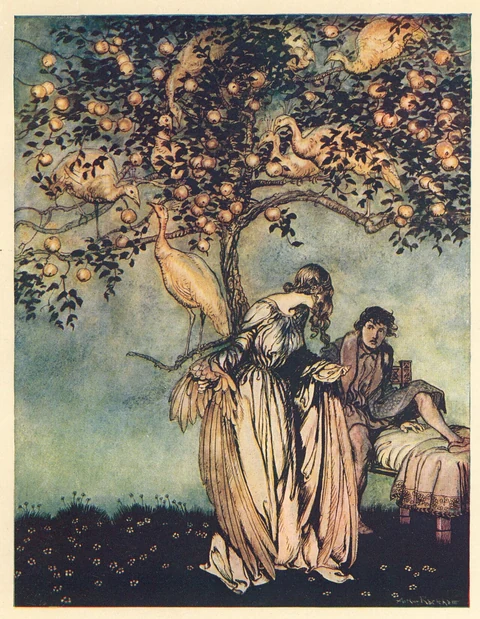
The Water King's claim begins before the prince knows that he has been promised away. His father spares an eaglet and feeds it for years at enormous expense. Once strong enough to fly, the bird takes the king on a journey that includes frightening drops towards the sea. The king experiences something of the fear he once caused when he aimed his weapon at the young bird.
Hospitality then becomes another test. Some of the eagle's relatives welcome the bird but mistreat the human guest; a later household receives both. From this journey the king gains two coffers and a warning not to open them before reaching home.
The prologue establishes a world governed by obligations that outlast an encounter. Food, protection, welcome and promises all create consequences. The central bargain will exploit that same structure.
Sources: [R]
What the king does not know he owns
Curiosity leads the king to open a coffer on an island. A vast herd emerges, far too large to pack away by ordinary means. A man from the water offers help in return for whatever the king has at home without knowing it.
The king agrees because he assumes there can be little he does not already know. On his return he discovers a newborn son. His attempt to solve an immediate material problem has placed another person's future in danger.
For a time prosperity distracts him: cattle fill the household and the second coffer supplies a magnificent garden. The debt nevertheless returns when the water figure reminds him. The parents and child must confront a promise made without the child's knowledge or consent.
Sources: [R]
Advice on the road and a troubling first encounter
Left near the river, the prince finds a Baba Yaga who gives him food and advice. Here she functions as a helper. That role is a useful reminder that a familiar supernatural name does not guarantee the same behaviour in every tale.
Following her instructions, the prince takes the clothing of the eldest of twelve bird-maidens while they bathe. She is Vasilissa the Wise, daughter of the Water King, and promises assistance in return for its restoration. The scene creates their alliance through an unequal encounter; describing it as uncomplicated romantic courtship would conceal how the bargain is obtained.
The prince also acquires companions with extraordinary capacities for eating, drinking and producing cold. Their initially excessive abilities will prove exactly suited to dangers that ordinary strength cannot overcome.
Sources: [R]
Vasilissa makes impossible work possible
The Water King demands a crystal bridge in a single night, then a mature garden filled with blossom, fruit and birds. Failure threatens the prince's life. Vasilissa tells him to sleep and summons the necessary workers herself.
At morning the prince appears with a broom, giving the completed work its last outward touches. The contrast is almost comic: he receives praise for achievements organised by someone whose power remains hidden from her father. The tale makes his dependence unmistakable.
A further test requires him to identify Vasilissa repeatedly among twelve identical sisters. She supplies small signals that distinguish her. Recognition comes through communication, not through a mysterious ability to know a beloved face when all faces look alike.
Sources: [R]
A wedding does not end the father's hostility
Marriage is followed by demands to consume impossible amounts of food and drink. The prince's companions dispose of them effortlessly. A fiercely heated iron bathhouse then becomes another trap, defeated by the companion who brings cold.
The sequence transforms hospitality into menace. A feast and a bath should mark welcome or celebration, yet the father uses their scale and temperature to threaten his son-in-law. The helpers reverse that logic by making excess manageable.
Vasilissa recognises that successful performance will not secure lasting safety. Her father continues to seek a way to harm the prince. She proposes departure, and the couple leave together. Escape is her decision as well as her technical achievement.
Sources: [R]
A pursuit across changing forms
Vasilissa hears pursuit before the prince can detect it. She changes the travellers and their horses into scenes that seem to belong to another time: an old man by a well, then an old priest beside an ancient church. Pursuers accept appearances and return without understanding what they have seen.
The church is part of the tale's actual imaginative equipment. Its presence is no less important than the transformations into birds or water. The recorded narrative is not sealed off from Christianity.
When the Water King pursues in person, Vasilissa creates a river of honey with banks of kissel and turns herself and the prince into waterfowl. The king's appetite defeats him: he consumes until he bursts. Food, which opened the story through the eagle's hunger, again becomes the means by which power changes hands.
Sources: [R]
The danger of arriving home
Near the prince's home, Vasilissa tells him to go ahead but warns him not to kiss his sister. He ignores the warning and forgets his wife. The danger has shifted from pursuit to the erasure of a relationship.
Vasilissa waits, then enters the town in poor clothing and lodges with an old woman. Meanwhile another wedding is prepared for the prince. The woman who secured his survival now stands outside the public story of his return.
The episode gives the tale a second emotional centre. Escape from an enemy is not enough if the rescued person fails to remember the helper. The prince's earlier dependence makes his forgetting particularly severe.
Sources: [R]
The eagle makes the father experience the fear he caused
The long eagle episode is easy to omit when the story is shortened, yet it prepares the moral structure of the bargain. The king first possesses the power to kill a vulnerable bird. Later, carried high above the sea, he depends on that bird and experiences repeated terror when it lets him fall before catching him. The change of position makes another creature's fear intelligible through his own body.
Feeding the eagle is also expensive and prolonged. Help is not a single effortless gesture rewarded immediately with treasure. The household must sustain the bird before it can carry the king into a different world. Hospitality among the eagle's relatives then tests whether a human companion will be included in the welcome.
These scenes anticipate the prince's later dependence on Vasilissa and the extraordinary companions. Across generations, the story repeatedly asks what happens when someone who seems powerful must rely on a being whose needs or abilities he previously underestimated. The father's careless promise becomes especially consequential because the prologue has already shown him the seriousness of obligation.
Sources: [R]
Two coffers offer different kinds of abundance
The coffers concentrate wealth into portable objects, but opening one at the wrong time makes that wealth unmanageable. The released herd exceeds the king's ability to recover it. The water figure can solve the problem because it controls what the king cannot contain. The bargain is therefore produced by a failure of restraint as much as by misfortune.
At home, the second coffer's garden and the cattle create prosperity. This makes forgetting the promise plausible within the story: visible benefits arrive immediately, while the cost is deferred and attached to a child. The father enjoys the gain before the person most affected can understand the transaction.
The distinction gives the tale an ethical problem that survives outside its magic. An agreement can be convenient for the person making it while placing its burden on somebody else. The prince's journey is not punishment for his own broken promise. Vasilissa's later interventions repair consequences created before he had any voice in them.
Sources: [R]
A snake husband produces a different water-marriage story
Ralston's nearby tale The Water Snake also begins with clothing withheld at a bathing place. A girl promises marriage to recover her garment, treating the agreement as impossible to fulfil. The snakes later carry her below the water, where they take human form. When she visits her mother after several years, she says that her life below is good and brings two children with her.
The mother's response creates the catastrophe. She discovers how the husband is summoned and kills him while her daughter sleeps. The grieving wife then transforms herself and her children into birds. This ending differs sharply from Vasilissa's successful escape from a hostile father.
The comparison does not excuse the coercion that begins either relationship. It shows that stories can change the location of danger as they unfold. In one, the underwater ruler remains an enemy; in the other, violence comes from the family above the water after the daughter has made a life below it. The same boundary can hold captivity, kinship and loss in different narrative arrangements.
The unknown child can be claimed by other beings
Among Ralston's variants, the parent may be seized by the beard while drinking, and the claimant may be a King-Bear or a water monster rather than the ruler of the main tale. In the King-Bear account, twins have been born during the father's absence. Attempts to conceal them underground fail, and their eventual escape depends on animal assistance.
Another variant gives the prince a captive enchantress who can become a ring. These changes matter: Vasilissa is not always a king's daughter, and the helper need not always be introduced through twelve identical bird-maidens. A motif can persist while kinship and the form of concealment change.
The variants therefore help explain why the Water King should not be treated as a deity with a single stable biography. The role of claiming an unknown child can be filled by different supernatural figures. What remains comparable is the structure of a promise made under pressure and the younger generation's difficult attempt to escape its consequences.
Sources: [R2]
Recognition is something Vasilissa repeatedly has to produce
Vasilissa supplies signals so that the prince can identify her among identical sisters. Later she creates disguises that prevent pursuers from recognising the fugitives. Finally she sends speaking birds into a wedding feast to make a forgetful husband recognise the relationship he has lost. Recognition is not an automatic property of love in this tale; it is work repeatedly performed by the heroine.
The three situations use different media. A small agreed gesture overcomes visual sameness, a transformed landscape defeats an enemy's reading of appearances, and a public verbal exchange restores memory. Vasilissa's expertise lies as much in controlling information as in commanding miraculous labour.
This pattern gives the forgotten-wife ending a close connection to the earlier adventures. The court's failure is another failure to see what is already present: the person responsible for the prince's survival remains outside the account of his success. The pie does not simply add a final trick. It gives her hidden contribution a voice in the very public setting where another marriage would erase it.
Sources: [R]
A pie speaks the missing history
Guests are expected to bring pies to the wedding. Vasilissa uses that invitation to send her story into the feast. Two live doves emerge from her pie; their exchange about sharing curds names the prince's forgetting of Vasilissa. He remembers and brings her to his side.
The device is theatrical but precise. A domestic gift becomes a public act of recognition, and the birds speak what the absent wife has been unable to make the court hear. The narrative restores the relationship through memory rather than another contest of strength.
Ralston's source note locates this version in Voronezh province. Its Water King is a particular tale ruler, not a complete description of every Slavic water spirit. Its lasting interest lies in the unequal promises and hidden labour that Vasilissa repeatedly has to repair.
Sources: [R]
Sources
- [R] W. R. S. Ralston. Russian Folk-Tales (first published 1873; online transcription of a Hurst reprint). The Water King and Vasilissa the Wise, pp. 130–141; note 143 cites Afanasyev V, no. 23, Voronezh province
The eagle prologue, bargain, helpers, tasks, transformations and forgotten-wife ending
Translated nineteenth-century tale, not an eyewitness report of supernatural events or a uniform Slavic religious system.
- [R2] W. R. S. Ralston. Russian Folk-Tales (first published 1873; online transcription of a Hurst reprint). The Water Snake, pp. 126–129; comparisons and variants after The Water King, pp. 141–144
Contrasting water marriage, variants of the unknown-child bargain, transformations and the limits of a unified water-spirit category
Some comparisons are Ralston's summaries of other collections; their original texts were not independently checked for this article.