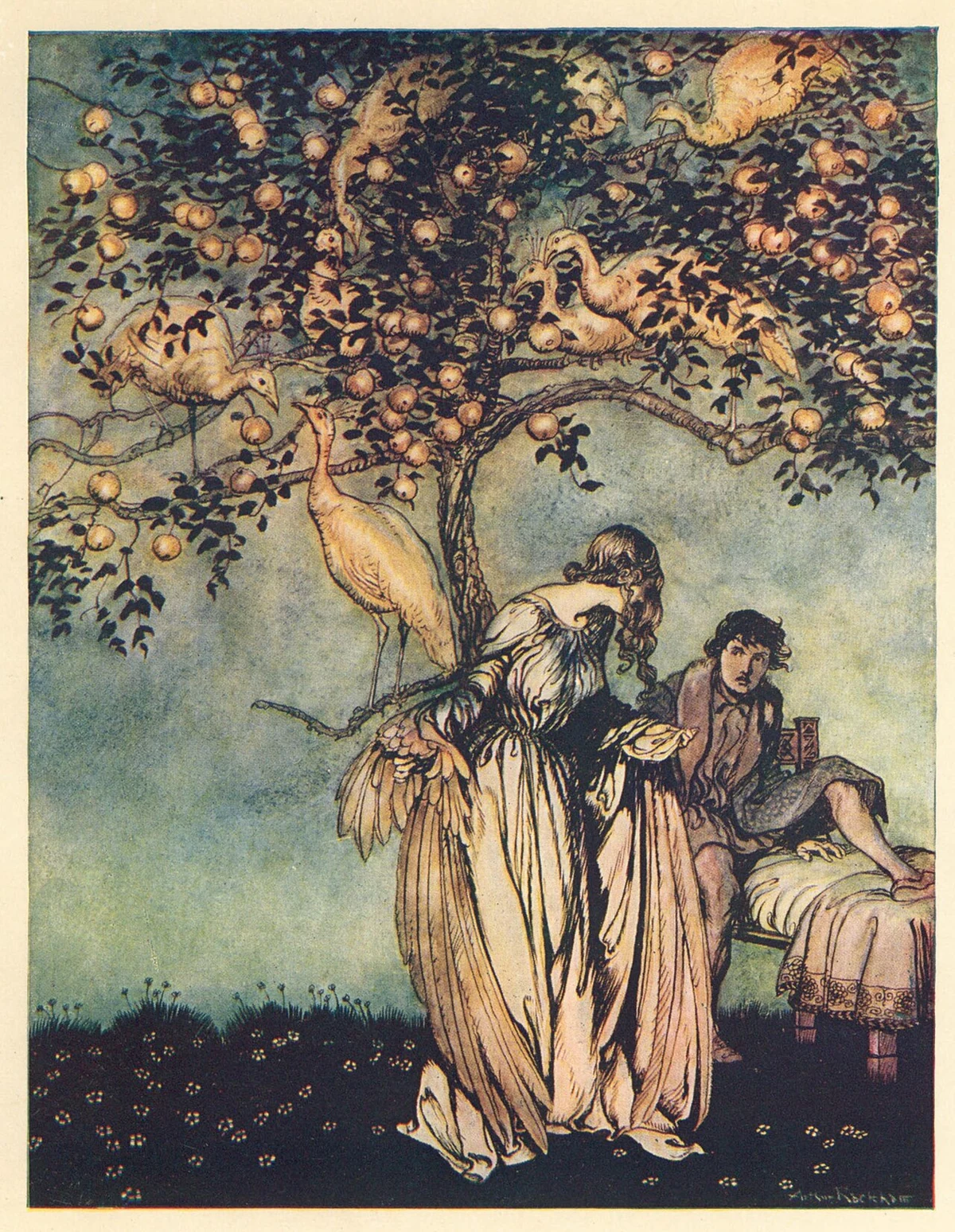
The prince and figures beneath the apple tree in Arthur Rackham's illustration of the nine peahens tale in The Allies Fairy Book, 1916. Resized and converted to WebP; no cropping or content edits.
Arthur Rackham · Public domain · Source · EXIF orientation respected; resized without cropping or upsampling; converted to WebP at quality 88. No other content edits.


A tree that completes its year in a night
Before a king's palace stands an apple-tree that flowers, bears golden fruit and loses it all within one night. The mystery is practical as well as marvellous: the king wants to know who takes the harvest. His elder sons fail to keep watch, while the youngest wakes in time to see nine peahens arrive.
Eight settle in the branches. The ninth comes to the prince and becomes a beautiful young woman. Their meetings allow him to bring two apples to his father, one for each of them. He succeeds through a relationship with the visitor rather than by trapping or killing the apparent thief.
The tree supplies the first point of contact between two worlds. Its compressed cycle makes abundance visible but difficult to possess. The prince's willingness to converse opens a possibility that ordinary guarding did not.
Sources: [M]
Envy interrupts the night meetings
The elder brothers enlist an old woman to discover their brother's secret. Hidden beneath his bed, she cuts a lock of the visitor's hair. The woman immediately becomes a peahen again and leaves with the others, ending the meetings.
The prince reacts with extreme violence against the intruder. That punishment belongs to the text's harsh world of retaliation; it should not be softened or admired as proof of noble character. His subsequent grief does not erase it.
He leaves home to search for the peahen, despite his father's offer to find another bride. The lost relationship is particular and cannot be replaced by the most suitable woman available within the kingdom. The search begins where dynastic convenience fails.
Sources: [M]
The lake and the servant who prevents recognition
At a lakeside palace, an older queen offers the prince her own daughter and wealth. When he remains intent on the peahens, she bribes his servant to make him sleep whenever they arrive. Three opportunities for reunion are sabotaged in this way.
The beloved tries to wake him and leaves messages through the very servant responsible for the failure. The repetition turns sleep into a barrier maintained by another person's interest. The prince is physically present but unable to respond.
A cryptic final message leads him to identify and kill the servant. Again the narrative uses lethal punishment to remove a betrayer. An encounter with a hermit then gives him directions to the peahens' city, where the queen recognises him and their marriage appears to resolve the quest.
Sources: [M]
The forbidden cellar changes the meaning of curiosity
The queen leaves the prince with keys and warns him not to open one cellar. He does so and finds a barrel bound by iron hoops. A voice begs for water; each drink breaks a restraint until a dragon escapes and carries the queen away.
The episode complicates a simple opposition between kindness and cruelty. Giving water to a thirsty captive looks merciful, but the prince has ignored information entrusted to him. His action releases a danger that someone else had contained.
The story does not explain every part of the dragon's imprisonment. Its function is to make the prince responsible for a second loss. The search now becomes an attempt to repair harm caused by his own decision, rather than only by jealous brothers or a corrupt servant.
Sources: [M]
Small rescues prepare a larger one
On his next journey, the prince helps a stranded fish, a trapped fox and a trapped wolf. Each offers a small token through which assistance can later be requested. These encounters establish a network of help before he understands how it will be needed.
He finds the queen and attempts to escape, but the dragon's horse easily catches them. The dragon spares him because of the water he once gave. The same act that caused the disaster therefore also preserves a chance to repair it.
The queen obtains information about the source of the dragon's horse. A still better animal can be won from an old woman by guarding her mare and foal through three nights. The route to freedom depends on knowledge from the captive as well as help from the rescued animals.
Sources: [M]
Guarding what can change its shape
The old woman's yard displays the fate of earlier unsuccessful servants. Nevertheless, the prince accepts the task. Each night he falls asleep and wakes holding a bridle without the mare. She and her foal have hidden among other creatures by changing form.
The fish, fox and wolf identify them in their respective worlds. What the prince cannot discover through vigilance, he recovers through relationships. The old woman's instructions to the mare escalate the concealment, but each new hiding place matches a helper already gained.
The pattern gives the earlier rescues a precise purpose. Compassion is not merely praised in a separate moral aside; it becomes the practical means by which an impossible service is completed.
Sources: [M]
The neglected horse and the captor's final weakness
As his reward, the prince chooses the poor-looking horse in the stable's corner, despite pressure to take a more impressive animal. The queen's information has taught him to distinguish appearance from capability. Once cared for, the horse reveals its extraordinary quality.
The couple flee again. This time the dragon's horse admits that it cannot overtake them. When the two horses come close enough to speak, the stronger one challenges its brother's willingness to carry the captor. The dragon is thrown off and dies.
The final escape is therefore not won by the prince striking a decisive blow. It depends on the animals changing their relationship to the rider. The queen and prince return to her kingdom, where the story gives them a shared and prosperous rule.
Sources: [M]
The prince first succeeds by accepting a limited share
The golden tree's loss appears to demand an efficient guard. Yet the youngest prince does not solve the mystery by securing the entire crop for his father. His meeting with the transformed peahen produces two apples, a small share accompanied by a relationship he values more than possession of every fruit. The apparent failure of ownership becomes the beginning of the romance.
This contrasts with the elder brothers' response. Their interest shifts towards discovering and disrupting what makes the youngest successful. The old woman they employ intrudes on a meeting whose terms they do not understand. Cutting the visitor's hair changes the situation irreversibly.
The tree thus establishes two different approaches to the marvellous: encounter and appropriation. The distinction is an interpretation of the actions, not an ancient rule about golden apples. It helps explain why the father's offer of another bride cannot solve the son's grief. What has been lost is not a generic reward for guarding property, but a particular person encountered through the mystery.
Sources: [M]
Sleep is a recurring failure with different causes
At the lake, the prince's sleep is deliberately induced by the bribed servant. Later, while guarding the old woman's mare, he again falls asleep despite his determination to remain mounted and alert. The two episodes look similar from the outside: he is present at the right place but unable to keep control of the moment. Their causes and remedies differ.
At the lake, removing the treacherous intermediary ends the immediate obstruction, although the prince's violent response belongs to the tale's harsh moral world. At the mare's pasture, no amount of stated resolve proves sufficient. He needs the fish, fox and wolf to recover what has vanished.
The repetition gradually changes the kind of heroism required. Vigilance alone cannot sustain the relationship or complete the service. Information from others and remembered obligations become more reliable than the prince's confidence in his own attention. The tale repeatedly places him close to success, then shows why being physically close is not enough.
Sources: [M]
The queen's palace is a centre of authority
When the prince reaches the city, guards question him and announce him to the queen. She runs to receive him and brings him inside. This is her court and her recognised position of authority before the marriage occurs. The story does not initially make her a nameless woman awaiting rescue in someone else's household.
The cellar warning likewise concerns a danger contained within that palace. She knows the restriction and entrusts him with the keys while setting a boundary. His decision to ignore it breaks the arrangement and enables the dragon to seize her outside. The later rescue is therefore also an attempt to restore the security he has damaged.
These details give the queen more narrative weight than a summary centred only on the prince's journey might allow. She receives him, warns him and later gathers information essential to escape. Her captivity does not erase her capacity to act. The final return to her kingdom completes a movement away from, and back towards, an authority she possessed at the story's middle.
Sources: [M]
An appeal to brotherhood can be sincere or deceptive
The imprisoned voice asks for water in the language of urgent need and brotherly obligation. Later, the trapped animals use comparable appeals when requesting help. The prince cannot distinguish every encounter simply by whether the speaker sounds vulnerable or invokes kinship. The same language can lead to a destructive release or to an enduring alliance.
The animals' promises are fulfilled when the mare hides among their kind. Their small tokens preserve the relationship across distance, making a fish scale or a hair a reminder that assistance can be called upon. The dragon also acknowledges a debt for the water, but limits it to sparing the prince after a failed escape. Gratitude does not turn the captor into a safe companion.
This variation gives the story a more demanding account of generosity than a formula in which every kind act produces the same reward. Acts create obligations, but those obligations are interpreted by beings with different aims. The prince must learn what a relationship can and cannot provide.
Sources: [M]
True Steel offers a close comparison with a different solution
The collection's True Steel tale also gives a prince forbidden access to a restrained prisoner, repeated pleas for water and a released enemy who carries away his wife. It too allows the captor to repay the water with reprieves. Those similarities invite comparison, but the later solutions differ.
In the peahen story, escape depends on obtaining a better horse and on a conversation between the two related horses. In True Steel, repeated flight and allied force fail until the captive discovers where the enemy's strength is hidden. One narrative changes the means of pursuit; the other changes the target of attack.
The distinction is particularly valuable because it prevents the dragon from being casually renamed as True Steel or Koshchei. Similar episodes can be combined into different long tales. Here the horses' final refusal to sustain the captor brings the history of animal help to its fullest point: the prince's success depends not only on owning a superior mount, but on non-human beings recognising and acting upon a relationship of their own.
Keeping the peahen queen's identity open
The tale identifies the woman through her transformations, her queenship and her actions. It does not require that every supernatural bird-maiden be classified as a vila, or that the golden fruit be assigned to a named deity. Such labels can obscure the actual narrative.
The collection's provenance connects it with Serbian-language material, while leaving the individual telling's precise location unspecified. Its motifs can be compared with other European tales without assuming a proven direction of borrowing.
What distinguishes this version is the succession of broken and repaired relationships. Envy, bribery and disobedience repeatedly separate the couple; advice, remembered kindness and animal solidarity bring them together. The golden apple-tree starts the story, but keeping a promise and accepting help carry it to its end.
Sources: [M]
Sources
- [M] Elodie Lawton Mijatovich, translator; W. Denton, editor. Serbian Folk-lore (second edition, 1899). The Golden Apple-Tree, and the Nine Peahens, pp. 42–57; introduction pp. 2–3
Complete narrative sequence, bird-maiden, interrupted meetings, dragon, animals and horses
English selection from Serbian and Bosnian collections; the introduction names Karadžić 1853 and the Bosnian collection 1870, but does not give a precise collection village for this individual tale.
- [B] Elodie Lawton Mijatovich, translator; W. Denton, editor. Serbian Folk-lore (second edition, 1899). Bash-Chalek; or, True Steel, pp. 139–164
Comparison of a forbidden chamber, water given to a prisoner, abduction, reprieves and a changed rescue strategy
A separate tale in the same collection, not another chapter in the peahen queen's story.