The sisters' marriages create a hidden alliance
A dying king orders his three sons to give their sisters to the first suitors who ask for them. Terrifying visitors arrive amid noise and light, and only the youngest brother insists on carrying out the instruction. Each sister disappears into an unknown marriage.
The brothers later set out to find them. Their anxiety gives the opening a tension that a bare summary of obedience would miss: the command has been fulfilled, but the family does not know where the women have gone or what their lives are like.
Those marriages will eventually supply the strongest allies in the story. The opening therefore establishes a network of kinship whose significance remains hidden until much later. It also belongs to a narrative world in which the sisters' own choices are not given the prominence a present-day reader might expect.
Sources: [M]
The youngest brother becomes a hero before meeting True Steel
During successive night watches, each brother defeats a monster emerging from a lake. On the youngest's watch the fire goes out, sending him in search of another flame. He discovers giants who prey on a nearby city and survives by pretending to join them.
He then kills the giants as they cross the city wall and saves a sleeping princess from a serpent. Returning quietly to his brothers, he initially leaves these achievements unannounced. Recognition comes later through a conversation at an inn and evidence left at the palace.
This extended first adventure matters. By the time the prince encounters True Steel, he has already demonstrated courage, deception and physical skill. His later failure cannot be explained simply by inexperience or cowardice. The new enemy requires a different kind of solution.
Sources: [M]
Water breaks the prison
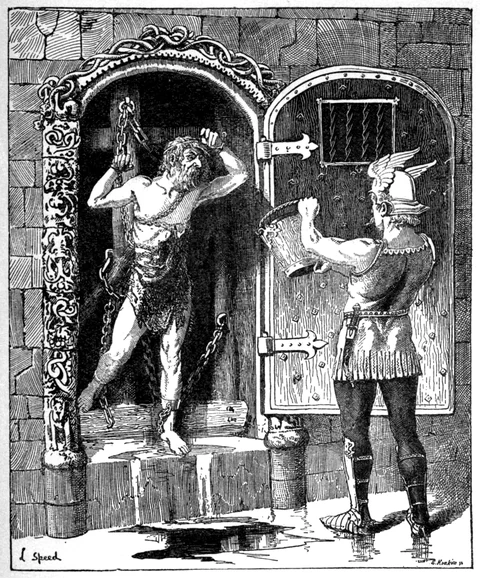
Married to the rescued princess, the prince receives keys and a prohibition against opening one room. Inside it he finds a man heavily restrained, with water visible but beyond reach. The prisoner appeals to charity and promises additional lives in exchange for help.
The prince gives water repeatedly. The final act breaks the restraints, and the prisoner reveals his power by flying away with the princess. His name is True Steel, the title's Bash-Chalek.
The scene exploits the difference between an immediate appearance and a wider history. A thirsty captive seems deserving of relief, while the king's warning reflects the effort previously required to contain him. The prince acts without understanding that history and must now confront the consequences.
Sources: [M]
The missing sisters become hosts
Searching for his wife, the prince finds his sisters married to the rulers of dragons, falcons and eagles. Each sister first protects him from a potentially hostile husband, then secures his welcome. The husbands distinguish him from his elder brothers because he enabled the marriages.
They warn that True Steel is beyond ordinary force. Their own hosts have already failed against him. Nevertheless, each provides a feather that can summon assistance in a crisis.
The sisters are therefore essential intermediaries. The prince does not simply acquire armies by being brave. He gains access through their households and through the memory of an earlier family decision. Kinship, hospitality and obligation become resources as important as weapons.
Sources: [M]
Three lives are not three victories
The prince repeatedly attempts to carry his wife away. True Steel catches them and spares him in fulfilment of the promised lives. Each reprieve encourages another attempt, even when the woman recognises that the same method will fail again.
The repetition exposes the limits of persistence without learning. The prince treats the extra lives as a reserve that makes another attempt affordable. His wife, meanwhile, is repeatedly taken back into captivity.
On a further attempt he burns the feathers, but the helpers arrive too late to prevent his death. Their combined attack still cannot defeat the captor. The narrative has now exhausted both individual force and the straightforward use of allied armies.
Sources: [M]
The Jordan and the restoration of the body
The supernatural brothers-in-law obtain water from the River Jordan and use it to restore the prince. The Christian sacred geography is explicit in this version. It should not be removed simply because the same story contains dragons and a winged antagonist.
The episode also changes the advice the prince receives. Instead of encouraging another chase, the allies tell him to have his wife discover where True Steel's strength actually resides. Survival now opens the possibility of a different strategy.
This is a tale's miraculous restoration, not a historical medical practice. Its narrative purpose is to permit a hero who has reached the end of force to continue through knowledge and cooperation.
Sources: [M]
The captive asks the question armies cannot answer
The princess questions True Steel about his strength. He first names his sword, then his bow and arrows. Her apparent reverence for these objects helps expose the answers as evasions. He suspects that someone has taught her to ask, so the process requires repeated attempts rather than one instantly successful trick.
Eventually he reveals a distant mountain, a fox within it, a heart within the fox and a bird within the heart. His strength lies in the bird. The fox can change form, making the secret difficult to reach even after it is known.
The eagle, falcon and dragon forces now perform complementary tasks, pursuing the creature through changing shapes and environments. The hidden bird is destroyed, True Steel dies and the couple can return home. Intelligence gives the allies a target their earlier attacks lacked.
Sources: [M]
A long tale changes the kind of competence it rewards
True Steel contains enough adventures to resist being reduced to its final secret. The lake watches, giants, sleeping princess, marriage, forbidden room, visits to the sisters and repeated escapes each test a different relation between courage and information. The prince does not begin as someone incapable of heroic action. He defeats dangers before reaching the enemy who gives the tale its name.
That earlier competence makes his later failure more consequential. A method that works against giants or a threatening serpent does not work against True Steel. The narrative requires a successful fighter to recognise the limits of fighting. His allies, too, possess formidable forces without knowing the decisive vulnerability.
The final discovery therefore changes more than the odds of a battle. It changes what counts as useful knowledge. The captive wife's conversation and the coordinated capacities of several helpers become more important than another display of individual strength. The long structure gives that change weight because the reader has already seen how far ordinary heroic methods can carry him—and where they stop.
Sources: [M]
The first marriages create obligations before they create comfort
The dying father's command requires the sons to accept the first suitors for their sisters, even when those visitors are terrifying. The youngest insists on obedience while the others resist. Much later, the supernatural husbands remember that distinction and extend protection to him. The opening decision has created a debt that the hero could not calculate at the time.
The sisters then make the alliance usable. They receive their brother, manage the danger of his arrival and speak to their husbands. Kinship is not merely a chart connecting powerful men: women perform the work that turns a potentially threatening connection into hospitality.
The tale also leaves an uncomfortable silence around the sisters' original consent. Their eventual positions in powerful households do not retrospectively make the father's command a freely chosen arrangement. A full reading can recognise their later agency while retaining that limitation. The story's family network is both a source of constraint and the means by which the youngest brother eventually survives.
Sources: [M]
A promise can be honoured by an enemy and still remain dangerous
True Steel keeps the promised reprieves after receiving water, even while continuing to hold the princess. This is not simple gratitude that transforms him into a friend. It is a limited obligation operating within an ongoing conflict. The prince repeatedly benefits from it, but each spared life leaves the central problem unresolved.
The pattern complicates a neat division between truthful heroes and lying monsters. The captor can honour one promise while deceiving his captive about the source of his power. Conversely, the prince can act mercifully towards a thirsty man while disregarding the warning that protected the household. Conduct must be judged through the particular relation, not through a character's label alone.
The reprieves also make repetition costly. The wife is repeatedly returned to captivity, and the available margin narrows with each attempt. Persistence becomes ineffective when it reproduces the same failure. The story eventually requires the hero to stop treating survival as evidence that his strategy will succeed next time.
Sources: [M]
The visible weapons are convincing false answers
When the princess asks where True Steel's strength resides, the sword and then the bow and arrows provide plausible answers because they are visible instruments of force. Her reverent treatment of them helps maintain the conversation, but the replies do not yield the real vulnerability. The secret lies far from the equipment a warrior displays.
This distance gives the final search its distinctive shape. The allies must reach a creature capable of changing form, then obtain what is concealed within it. Their capacities become useful only after the question has been answered correctly. Knowledge and force are not opposites here; knowledge directs force towards something it can actually affect.
The princess's role is therefore strategic, even though her questions occur within captivity and danger. She must manage the captor's suspicion while obtaining information he has reason to protect. The narrative's decisive conversation takes place away from the heroic battlefield, in the constrained space where the apparent victim has access to the enemy's speech.
Sources: [M]
The editor's comparison is part of the tale's later history
Denton's introduction explicitly compares True Steel with Russian material translated by Ralston, especially Marya Morevna. It treats similar episodes as pieces of older stories assembled into new wholes and describes Jordan water as a Christianised form of the water of life. These observations show how a nineteenth-century editor wanted English readers to understand the collection.
They should remain attributed interpretations. The Christian name of the river is certainly present in this version, but the text alone cannot establish when it entered the story or recover a single original form before that change. Likewise, resemblance between captors does not by itself demonstrate that they were one ancient divine figure.
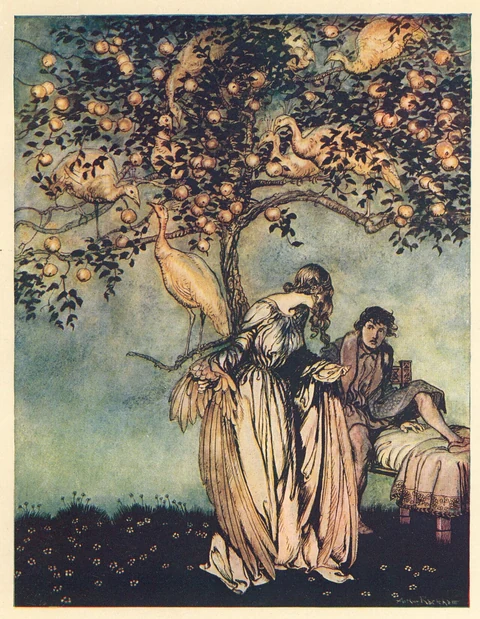
The parallel with The Golden Apple-Tree is easier to observe within the same volume: water releases a prisoner and the rescuer must repair the resulting loss. Yet that tale resolves its pursuit through extraordinary horses, while True Steel locates strength within a hidden bird. Comparing those choices preserves the creative work of each narrative instead of treating one as merely an imperfect copy of another.
A comparison that keeps the differences
Koshchei's death in an egg offers a useful parallel to True Steel's strength in a bird. Both stories place decisive vulnerability outside an apparently invincible body. Both also require information from a captive and assistance beyond the hero's own power.
The differences remain substantial. This tale gives the prince supernatural brothers-in-law, a sequence of spared lives and restoration with Jordan water. Its hidden chain ends in a bird within a fox's heart, not the egg sequence of the cited Perm Koshchei variant.
Calling the two figures versions of one ancient god would go beyond this evidence. The more useful comparison concerns how stories imagine power: visible weapons can mislead, repeated courage can fail, and the person held captive may possess the best route to freedom.
Sources
- [M] Elodie Lawton Mijatovich, translator; W. Denton, editor. Serbian Folk-lore (second edition, 1899). Bash-Chalek; or, True Steel, pp. 139–164; introduction pp. 2–3
Full sequence from the sisters' marriages through the hidden-strength ending
English version from a mixed Serbian/Bosnian collection; no precise village or narrator supplied for this tale.
- [R] W. R. S. Ralston. Russian Folk-Tales (1873; Hurst reprint transcribed online). Koshchei the Deathless, pp. 111–118, note 112
A bounded comparison with the hidden death of Koshchei
Similarity of a narrative mechanism does not establish identity of figures or a direction of borrowing.
- [P] Elodie Lawton Mijatovich, translator; W. Denton, editor. Serbian Folk-lore (second edition, 1899). The Golden Apple-Tree, and the Nine Peahens, pp. 42–57; editorial comparative introduction pp. 16–17
A parallel prisoner-and-water episode and evidence of the editor's own comparison with Russian tales
The introduction's claims of identity and transmission are historical interpretation, not independently established conclusions; individual narrative details must be checked against the tales.