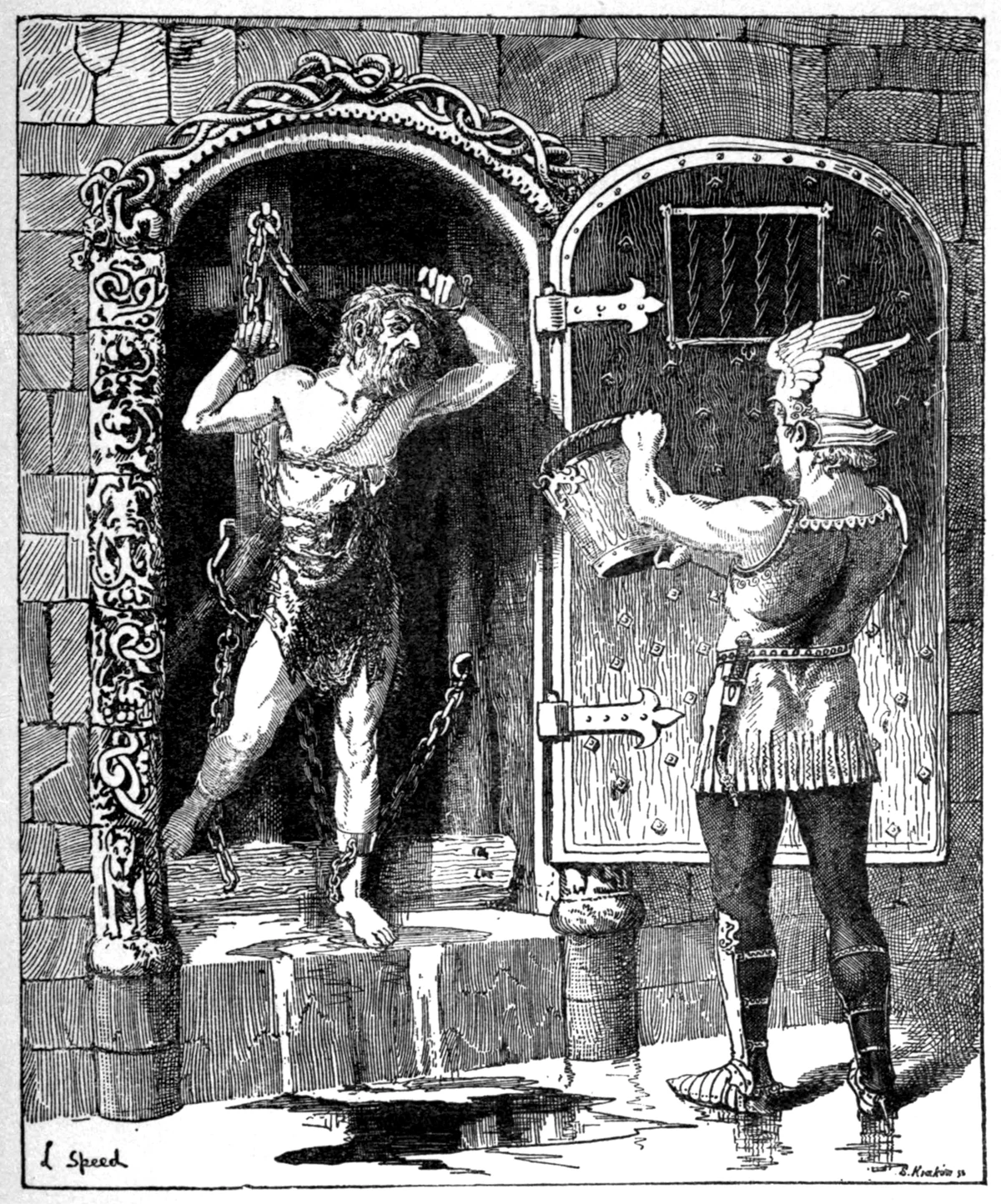
Lancelot Speed's illustration for The Death of Koschei the Deathless in The Red Fairy Book, 1890; a literary illustration from another edition of the Koshchei tale. Resized and converted to WebP; no cropping or content edits.
L Speed · Public domain · Source · EXIF orientation respected; resized without cropping or upsampling; converted to WebP at quality 88. No other content edits.
A rescue begins with the youngest son
Koshchei has carried away a king's wife. Her two elder sons depart to find her and fail to return; the youngest, Prince Ivan, insists on following. His father's fear is understandable, but Ivan makes clear that he will go with or without permission. A blessing accompanies a decision already made.
The beginning establishes a family obligation rather than a search for fame. Ivan's mother is the captive, and the absence of his brothers deepens the loss. The story will eventually question which members of that family deserve trust.
This is the tale Ralston identifies with a Perm-province source in Afanasyev. It should remain distinct from Marya Morevna and other narratives in which Koshchei appears. A shared antagonist does not make all their events parts of one continuous biography.
Sources: [R]
Strength is useful only after listening
Ivan cannot find a horse strong enough to carry him. When an old woman asks why he is troubled, he initially answers with an ugly threat. Only when she approaches again does he consider that she might help. His change of attitude opens the road.
She directs him to an underground place where a heroic horse stands chained. Ivan gains suitable equipment, compensates her and asks forgiveness and a blessing. The episode makes advice from an apparently powerless stranger indispensable to the powerful young man.
Later, strength does matter. Ivan can move the enormous obstruction that opens a way up a mountain and handle weapons beyond ordinary human capacity. Yet the tale repeatedly shows physical ability working alongside information received from others.
Sources: [R]
Captives who know the hidden world
On the mountain Ivan finds another captive, a princess, who explains how to enter an apparently closed enclosure. She tests whether he can lift Koshchei's heavy sword before allowing hope of success. When he reaches his mother, she hides him and obtains the crucial secret.
Koshchei suspects a human presence, but the mother deflects his suspicion and questions him affectionately. His death, he says, lies within an egg, inside a duck, inside a hare, inside a casket beneath an oak. The body that seems invulnerable depends on something elsewhere.
The captive woman's knowledge and performance are as necessary as Ivan's strength. She does not simply wait while a hero does everything. The rescue depends on her ability to speak to the captor in a way that reveals what force alone cannot discover.
Sources: [R]
Hunger tests a different kind of power
Searching for the hidden death, Ivan becomes desperately hungry. He has opportunities to kill a young wolf, a crow and a young pike. Each encounter brings a plea and a promise of later help, and each time he refrains.
The decisions cost him immediate relief. They also establish relationships across the land, air and water that his journey will require. The pike provides a crossing; the wolf can pursue what runs; the crow can follow what flies. The helpers' abilities are suited to different failures of human reach.
This is more specific than a general moral that kindness is rewarded. The story organises its obstacles so that each spared life becomes necessary. Ivan's eventual success is built from capacities he does not possess himself.
Sources: [R]
Opening the nest of containers
When Ivan reaches the casket, the secret does not simply lie still for him. The hare escapes, then the duck flies out, and the egg is later lost in the sea. Each layer generates a fresh crisis just when the goal seems close.
The wolf, crow and pike recover what Ivan cannot. The sequence turns Koshchei's security into a journey across several environments. A hero who had eaten the possible helpers would have reached the secret without the means to keep it.
In this particular variant, the decisive object is the egg. It should not automatically acquire a needle or another inner object from a different retelling. Folktale details vary, and preserving the exact sequence lets readers compare versions instead of receiving a synthetic version that no cited source actually tells.
Sources: [R]
The deathless figure bargains
Ivan returns with the egg. As he squeezes it, Koshchei weakens; when confronted, the captor offers an alliance and shared domination. His apparent invulnerability has been replaced by negotiation.
Ivan refuses and breaks the egg. The story's title becomes a paradox resolved by knowledge: Koshchei is deathless only while the location of his death remains beyond reach. He is defeated through the combined work of a captive, an adviser, a hero and animal helpers.
That mechanism makes him a striking tale antagonist. It does not, by itself, establish a historical cult of Koshchei or a doctrine once held by all Slavs. The narrative can explore power stored outside the body without being treated as a fragment of a lost religious manual.
Sources: [R]
Victory does not make the way home safe
Ivan brings his mother and the princess towards the descent. The princess asks him to retrieve her wedding dress, ring and seamless shoes. While he is away, his brothers cut the ladder and force the women to conceal what happened.
The betrayal shifts the danger from an extraordinary captor to familiar relatives. The brothers want the rewards of a rescue they did not accomplish, and the women's threatened silence allows them to claim success. The homeward journey is therefore a second test, not a brief conclusion.
A ring summons helpers who carry Ivan down from the mountain. He reaches his own city without announcing himself and stays with an old woman. The rescue must now be recognised publicly before its rightful outcome can be secured.
Sources: [R]
The secret can be concealed by a false confession
In a variant summarised by Ralston, Koshchei first tells his captive that his death is in a broom or a fence. She decorates the named object with gold as an apparent token of affection. Only later does he reveal a sequence involving an egg, a duck and a log floating on the sea. The exchange becomes a test of whether a confession can be trusted.
This version gives the captive more conversational work than a brief summary of the motif suggests. She must respond convincingly to false information and sustain the relation long enough to obtain something useful. The revelation is not simply a password waiting for the hero to ask the correct question.
The variant also changes the geography. The main tale's casket and oak are not obligatory features of every Koshchei story. Their replacement by a floating log shows how a stable problem—power protected elsewhere—can be staged through different objects. A careful retelling keeps the versions separate so that the variation itself remains available to readers.
Egg, stone and the action that ends the threat
Ralston's comparisons include a version in which the egg is used to strike Koshchei's forehead, and another concerning a Snake whose vulnerability lies in a small stone within an egg. The nested sequence in that account also differs from the casket beneath an oak. What looks like one famous formula is therefore a family of arrangements.
The distinction between possessing the object and acting upon it is equally important. The main tale lets pressure on the egg visibly affect Koshchei before its destruction ends him. Another version may use a blow or the removal of strength. These are different narrative mechanisms, even when modern retellings group them under an external-death motif.
The object need not be treated as an anatomical heart in every text. Ralston sometimes uses that language comparatively, but the tale's own wording concerns death or strength located outside the apparent body. Preserving those terms allows the story's strange logic to remain precise instead of turning a useful scholarly comparison into a literal doctrine attributed to all its tellers.
The cut rope and the oath in a neighbouring rescue tale
In Prince Arikad, as Ralston summarises it, a Whirlwind has carried away the mother. The youngest son climbs with iron hooks and lowers rescued women on a rope made from strips of hide. His brothers cut the rope and impose silence through an oath accompanied by eating earth. This is a close comparison for the betrayed rescuer, but its captor and equipment are different.
The oath supplies a more explicit explanation for the women's silence than an account that merely says they were threatened. It makes a bodily act part of the promise. The source does not allow us to generalise from that scene to an obligatory oath practice throughout Slavic-speaking societies. It is a detail within a collected story and its editorial comparison.
The parallel nevertheless clarifies the second half of the Koshchei tale. Removing the supernatural enemy does not settle the distribution of credit. The return journey introduces human competition, coerced speech and the possibility that a family will prefer a convenient false account to the difficult truth of who performed the rescue.
The old woman's success carries a risk Ivan does not share
When Ivan persuades his hostess to offer the required ring at court, the king threatens her with death if she fails. She returns terrified, while Ivan can sleep because he already possesses the object. The scene is comic in its contrast of knowledge, but it also exposes an unequal distribution of risk. The intermediary is frightened by a danger that the concealed prince understands differently.
Ivan instructs her to accept only a small payment and to claim that she made the object herself. Her successful deliveries then bring the dress and seamless shoes into the same pattern. The heroine recognises what she requested, while the court sees a seemingly improbable craftswoman.
This episode gives the old woman a more complicated place than that of a neutral messenger. She acts, worries, receives money and later revises her view of her lodger when he appears in princely clothing. The tale repeatedly makes status an unreliable guide to what a person knows or can provide. Recognition depends on objects and events before it depends on a publicly announced name.
Comparison widens the motif without dissolving the local tale
Ralston places Koshchei beside accounts from several other language traditions. One of his European comparisons locates strength in an egg within a duck and a stag; another puts a giant's heart in an egg associated with a well, church and island. These summaries show why the external-vulnerability pattern interested nineteenth-century comparatists.
They do not make the Perm-province tale culturally empty. Its own arrangement of mother, brothers, captive princess, animal helpers and objects of recognition remains specific and worth following. A widely travelling narrative problem can acquire different domestic and social emphases in different tellings.
Nor does resemblance establish which version came first or how one reached another region. Ralston's search for ancient myth behind the stories belongs to his scholarly moment. The safer conclusion is both narrower and more useful: readers can identify related solutions to the problem of apparently invulnerable power, then compare the particular relationships through which each story makes that power vulnerable.
Objects carry the truth into the wedding
The princess demands the ring, dress and shoes before marrying the elder brother. Ivan supplies them through his hostess, who becomes another intermediary between an overlooked person and the court. The objects delay a false marriage and create a path for recognition.
Ivan finally appears at the ceremony and marries the princess. Once the truth is known, the elder brothers are banished and Ivan becomes heir. The ending gives family authority a new arrangement based on revealed conduct rather than age alone.
The egg is the most famous object in the tale, but it is not the only one that matters. Horse, sword, ladder, ring, clothing and shoes each control access or recognition. Together they make a rescue story about the distribution of power: who knows, who helps, who claims credit and who is finally believed.
Sources: [R]
Sources
- [R] W. R. S. Ralston. Russian Folk-Tales (first published 1873; online transcription of a Hurst reprint). Koshchei the Deathless, pp. 111–118; note 112 cites Afanasyev II, no. 24, Perm province
The captive mother, hidden death, animal assistance, fraternal betrayal and recognition ending
English literary translation and selection from nineteenth-century collections; the cited edition's notes provide provenance, not proof of ancient cult or a complete regional belief system.
- [R2] W. R. S. Ralston. Russian Folk-Tales (first published 1873; online transcription of a Hurst reprint). Comparative discussion following Koshchei the Deathless, pp. 119–121; main recognition scene pp. 117–118
Prince Arikad's rope and oath variant, false locations of death, alternative nested objects and the old woman's risk at court
Other variants are summarised by Ralston rather than independently checked in their original editions; comparisons do not prove a common cult or a route of diffusion.