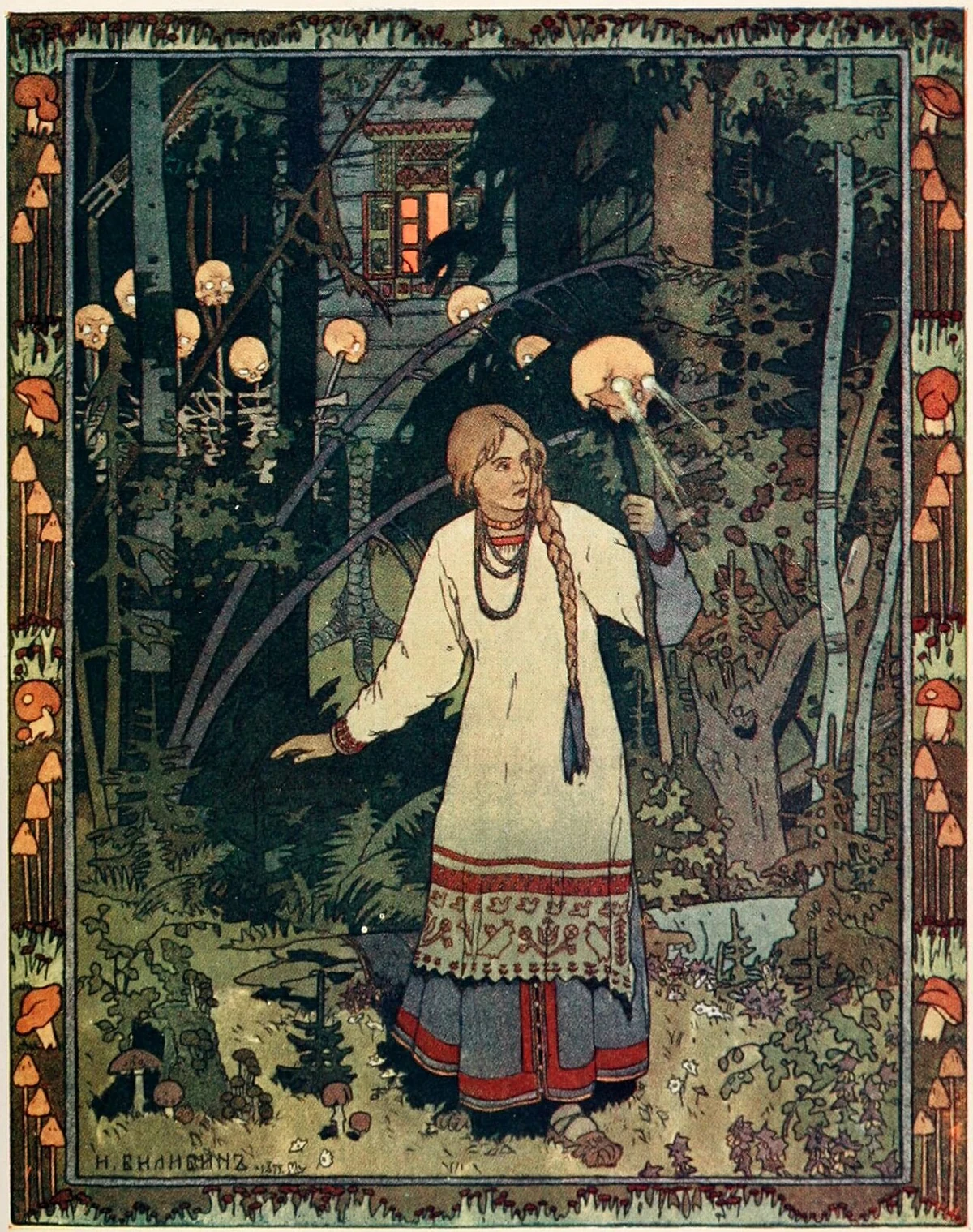
Vasilissa at Baba Yaga's hut in a historical illustration by Ivan Bilibin, reproduced in Russian Wonder Tales. Resized and converted to WebP; no cropping or content edits.
Ivan Bilibin · Public domain · Source · EXIF orientation respected; resized without cropping or upsampling; converted to WebP at quality 88. No other content edits.


A mother's gift before the forest
The story begins with a death in an ordinary household. Vasilissa is eight when her mother gives her a small doll, a blessing and instructions to feed the doll and seek its advice in trouble. The gift makes care portable: after the mother's death, something associated with her remains close enough to be carried in a pocket.
The father's remarriage brings a stepmother and two stepsisters whose hostility grows as Vasilissa grows. Work becomes their weapon. They try to exhaust her and spoil her appearance, while reserving ease for themselves. The doll secretly completes tasks and offers counsel.
This beginning matters because the forest danger does not arrive in an otherwise safe life. Vasilissa already inhabits a threatening household. Baba Yaga's dwelling will magnify conditions—unequal labour, hunger, fear—that the girl has encountered at home.
Sources: [R]
A light deliberately extinguished
During an autumn evening of textile work, the remaining candle is put out as part of the family's plan. The stepsisters invent reasons why they need not fetch a new light and send Vasilissa to Baba Yaga. The errand sounds domestic, but they know it may kill her.
Before leaving, Vasilissa feeds the doll and receives reassurance. She crosses herself and enters the forest. These Christian gestures belong to the recorded tale. Removing them to create a supposedly untouched pagan version would alter the evidence.
Light becomes the object that joins the two houses. Its absence sends the girl out; its recovery will bring her back. Yet the light she obtains will not behave like an ordinary candle. The story builds its ending into the practical need that starts the journey.
Sources: [R]
Three riders and a house made frightening
On the way, Vasilissa sees a white rider as day breaks, a red rider as the sun rises, and later a black rider as night arrives. Their colours are matched by horses and clothing. The sequence gives time a moving, embodied form before its meaning is explained.
Baba Yaga's enclosure is assembled from human remains: bones, skulls and bodily forms stand where ordinary architectural parts would be. The skulls illuminate the clearing after dark. Domestic space has become both recognisable and horrifying.
Yaga arrives in a mortar, driving herself with a pestle and sweeping away her traces with a broom. These familiar implements are enlarged into a mode of travel. The image makes her power memorable without requiring a reconstructed genealogy or a fixed place in a pantheon.
Sources: [R]
Hospitality under threat
Vasilissa addresses Yaga as granny and explains the errand. Yaga offers light on condition that the girl work for her; failure means being eaten. Food is abundant, but it is not shared equally. Yaga consumes a prodigious meal, leaving scraps from which Vasilissa still feeds the doll.
The work combines ordinary housekeeping with impossible quantities and precision. The girl must clean, cook and prepare linen, then separate unwanted material from grain. A later task requires removing earth from poppy seed. The doll's intervention makes completion possible.
The tale places miraculous assistance inside the texture of repetitive domestic labour. Sorting grain is not a grand battle, but the threat attached to it makes it a matter of life and death. Vasilissa's survival depends on a relationship of care that her hostile employers cannot see.
Sources: [R]
Knowing what to ask
Vasilissa eventually asks about the riders. Yaga identifies them with her day, sun and night. The answers confirm a connection between the household and the daily movement of light. They do not provide a complete cosmology for all tales in which Yaga appears.
The girl also sees mysterious disembodied hands carrying out work, but chooses not to question them. Yaga approves this restraint and warns against excessive curiosity. In this encounter, knowledge has boundaries set by a dangerous host.
When asked how she completes the tasks, Vasilissa credits her mother's blessing. Yaga reacts by expelling the blessed girl, but gives her the promised light: a burning-eyed skull on a stick. The gift is both fulfilment of the bargain and removal of someone whose protection Yaga does not welcome.
Sources: [R]
The return is not a simple happy homecoming
Vasilissa reaches home to discover that the household has been unable to keep any light burning. The skull therefore seems useful, and for once the stepfamily welcomes her. Its gaze then follows the stepmother and stepsisters wherever they try to hide, destroying them by morning while leaving Vasilissa unharmed.
This is a violent resolution to domestic persecution. It should not be softened into a harmless lantern scene or recast as a practical ritual. The story allows the instrument of danger to become the means by which the threatened girl is released from her tormentors.
Vasilissa subsequently buries the skull and leaves the house. She does not settle into Yaga's dwelling or permanently carry its destructive light. The extraordinary object has completed its narrative work.
Sources: [R]
The second ending: cloth, skill and recognition
The tale continues beyond the forest episode. Living with an older woman in town, Vasilissa produces exceptionally fine linen, aided by the doll's provision of a loom. The cloth reaches the king, but its quality creates a further problem: a suitably skilled person must make it into shirts.
Vasilissa completes that work and is summoned to court. Marriage follows, her father returns, and the older woman remains within her new household. The doll stays with her for the rest of her life.
This conclusion returns to the textile labour of the opening. Work first used to oppress her becomes a means of recognition, although magical help remains essential. The lasting possession is the mother's gift, not the skull. Care and skill outlive the spectacular encounter with terror.
Sources: [R]
Another niece survives by changing the household's loyalties
In the separate tale titled The Baba Yaga, a stepmother sends a girl to fetch a needle and thread from a supposed aunt. Before going, the girl consults a kinder relative and takes suitable gifts. At Yaga's house she gives food to animals, oil to door hinges, a ribbon to a birch and a handkerchief to the servant. These acts later make her escape possible.
The household explains its behaviour when Yaga angrily demands an account. The cat has received bacon after long neglect; the dogs have been fed; the doors and tree have been treated with care. Their refusal to stop the girl is not presented as arbitrary magic. It follows a contrast between an ungenerous mistress and a visitor who notices their needs.
This version illuminates Vasilissa's story without supplying missing episodes to it. Vasilissa relies chiefly on her mother's doll, whereas the escaping niece creates a network of helpers inside the dangerous house. Both narratives make small acts of care more effective than the persecutor expects, but they distribute assistance differently.
A comb and a towel turn domestic equipment into distance
The cat in the escaping-niece tale gives the girl a towel and a comb. Cast behind her, they become a river and a dense forest. Yaga overcomes the first obstacle with her animals, but the forest finally defeats the pursuit. The girl survives by making space between herself and the house, rather than by killing its owner in a direct contest.
The objects belong to ordinary personal and household care. Their enlarged effects make an imaginative relation between small things held in the hand and great features of the landscape. Ralston proposes explanations for that relation, but the tale itself does not pause to offer a theory of how transformation works.
Vasilissa's skull-light follows a different direction: it is carried home and acts there. Comparing the two gifts shows that Yaga tales do not all conclude with the same kind of release. One heroine escapes a pursuing household; the other brings an extraordinary object back into the household that sent her away. The direction of movement changes the story's answer to domestic danger.
The blue coffer and the red coffer
Ralston also summarises a tale in which a girl must prepare a bath and tend Yaga's strange children. A sparrow supplies practical advice when the assigned materials seem impossible to use. The girl accepts the advice and treats the children carefully, although they appear as small creatures that might ordinarily provoke disgust. Yaga rewards her with a blue coffer containing money.
A second girl is sent in hope of obtaining the same reward. She rejects the sparrow and injures the children. Her red coffer releases destructive fire. The two visits establish a comparison of conduct within the tale, rather than a rule that Yaga must always be purely benevolent or purely hostile.
The scene also makes hospitality reversible. A guest has obligations towards the inhabitants of the unfamiliar house, and those inhabitants judge how they are treated. Vasilissa's story likewise includes work, feeding and a consequential gift, but it does not reproduce this paired experiment. The shared motifs are a basis for comparison, not permission to combine the plots into a single definitive biography of Yaga.
The doll belongs to a wider family of speaking figures
After Vasilissa's tale, Ralston examines kukla, the word for a puppet or representational figure. He places the life-long pocket companion beside tales in which several constructed figures speak on behalf of a girl escaping an unwanted incestuous marriage. In one such account, the figures' repeated cries open the earth so that she can disappear from her pursuer.
These comparisons prevent the doll from being explained too narrowly. In Vasilissa it carries a mother's blessing, receives food and performs tasks. Elsewhere, figures may answer in an absent person's place or help create an escape. A resemblance of material form does not establish an identical religious function.
Nor do the stories by themselves demonstrate a household cult of dolls. They show the narrative power of making an object speak and act for someone whose own power is constrained. The figures can extend a protective relationship or give a threatened person time and space. That is a strong literary observation even where the historical practices behind the motif cannot be reconstructed.
Two kinds of household expertise frame Vasilissa's journey
Vasilissa's tasks at Yaga's house emphasise exact separation: useful grain must be distinguished from unwanted matter, and tiny seeds must be cleared of earth. Her later work with linen emphasises fineness, proportion and skilled manufacture. Both stages demand attention to materials, but the social return changes dramatically. Under threat, success merely postpones being eaten; in town, exceptional work creates recognition.
The doll assists throughout, so the tale does not offer a simple lesson that individual diligence alone overcomes adversity. It joins skill with inherited care and help that outsiders cannot see. The older woman who carries the cloth to court also matters: the maker needs an intermediary before the value of her work becomes public.
This continuity gives the final marriage more substance than an abrupt reward for beauty. The narrative has already taught the reader to notice labour that hostile households exploit or overlook. Its most durable transformation is the change in how that labour is received. The forest's spectacular terror remains memorable, but cloth and companionship determine the life that follows it.
Sources: [R]
Which Baba Yaga does this tale preserve?
Ralston's note points to a particular Afanasyev tale. That is the proper scale of the claim. Here Yaga threatens, tests, commands strange servants and supplies a dangerous gift. Other stories may distribute those functions differently.
Readers can interpret the journey as a passage through grief, household conflict or growing competence. Such interpretations are valuable when presented as readings of the narrative. This text alone cannot prove that Yaga was universally a death goddess, an initiation priestess or a benevolent ancestral mother.
Its particular achievement is more precise: it brings a child's continuing bond with her mother into a terrifying household where labour, questions and light can decide her fate.
Sources: [R]
Sources
- [R] W. R. S. Ralston. Russian Folk-Tales (first published 1873; online transcription of a Hurst reprint). Vasilissa the Fair, pp. 158–167; note 182 cites Afanasyev IV, no. 44
The plot, doll, riders, tasks, skull-light and textile-work conclusion
English literary translation and selection from nineteenth-century collections; the cited edition's notes provide provenance, not proof of ancient cult or a complete regional belief system.
- [R2] W. R. S. Ralston. Russian Folk-Tales (first published 1873; online transcription of a Hurst reprint). The Baba Yaga, pp. 148–151; related variants pp. 151–158; discussion of puppets pp. 167–169
Comparison with the escaping niece, neglected servants, rewarding and destructive gifts, and speaking puppets in other tales
Variants are encountered through Ralston's translations and summaries; his comparative mythology is not adopted as established ancient history.