An orphan meets someone who needs him
An orphan boy searches for work and reaches a lonely dwelling beneath a wood. An old man sits there unable to take his goats to pasture because his eyes have been taken. The boy offers both to tend the animals and to help him.
The meeting creates a household through mutual need. The boy requires a livelihood; the older man requires assistance with work he can no longer perform. Neither begins with the wealth or rank of a prince.
This modest setting gives the tale its particular stakes. The eventual victory will not bring a kingdom or a royal marriage. It will make ordinary tasks possible again and allow two isolated people to live together with greater security.
Sources: [W]
A warning about one part of the landscape
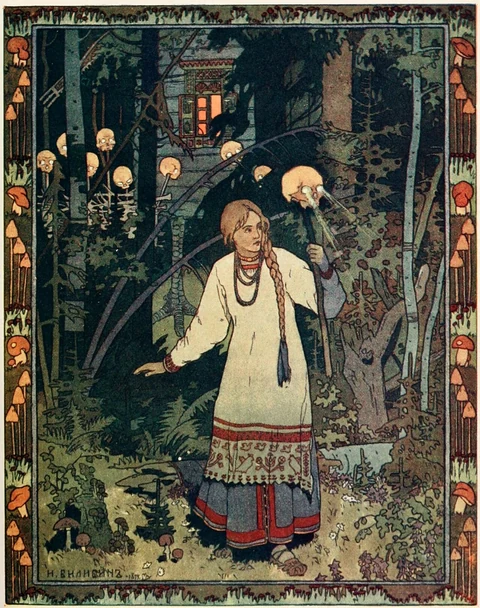
The old man warns the boy not to take the goats to a particular hill in the forest. The Jezinkas live there; they can put a person to sleep and steal his eyes. The warning comes from someone who has already suffered the danger he describes.
For two days the boy keeps to safer pasture. On the third, he decides that the better grazing is worth approaching the forbidden place. He breaks off three green bramble shoots and carries them in his hat.
The story does not present the forest as uniformly evil. A specific hill creates the boundary between routine work and danger. The boy's choice is partly practical—better pasture for the goats—although confidence also leads him beyond the limit his employer set.
Sources: [W]
An apple, a rose and an offer to comb his hair
Three beautiful young women approach in sequence. The first offers an apple, the second invites him to smell a rose, and the third proposes to arrange his hair. Each gesture appears friendly and concerns an ordinary pleasure: taste, scent or personal care.
The boy refuses the first two politely, claiming that his employer has still finer fruit and flowers. The answers preserve the form of courtesy while declining the encounter. With the third visitor, physical proximity becomes unavoidable, and he acts.
The progression is carefully built. A gift can be rejected at a distance; an offer to comb someone's hair brings the stranger close to the head and eyes. The danger grows through increasingly intimate forms of apparent kindness.
Sources: [W]
Why the bramble matters inside the tale
The boy strikes the third woman with a bramble shoot and binds her hands with it. Her sisters cannot comfortably release her because the thorns hurt their tender hands. When they attempt to help, he captures them too.
The material reverses the earlier invitations. Smooth beauty, fragrant flowers and desirable fruit have offered comfort; the rough, prickly plant supplies resistance. An ordinary hedge plant becomes more effective than an impressive weapon.
This is a narrative property, not proof that bramble physically restrains supernatural beings or that the passage preserves a usable magical technique. Its symbolic force comes from the contrast between attractive surfaces and an unglamorous object that the boy brought with him.
Sources: [W]
A cavern full of other people's sight
The boy fetches the old man and demands the return of his eyes. A Jezinka leads them to a cavern containing a heap of eyes of many sizes and colours. The image gives the old man's loss a larger scale: he is not the only victim.
The first replacement makes him see owls; the next makes him see wolves; a later pair makes him see pike. Sight is not interchangeable. Restoring any pair of eyes does not restore the person's own relationship with the world.
The strange mismatch is one of the tale's most memorable inventions. It turns identity into something embodied and particular. The boy must obtain the right eyes, not merely something that resembles what was taken.
Sources: [W]
The rescue carries a violent price
The boy threatens the captives and drowns two after they supply the wrong eyes. The youngest finally reveals the proper pair when faced with the same fate. The old man's sight returns, and the surviving Jezinka no longer appears on the hill.
The violence is part of the recorded story. It should neither be hidden beneath a gentle fairy-tale summary nor treated as a model for responding to real people suspected of harmful magic. The narrative makes coercion and punishment the means by which the stolen eyes are recovered.
A modern reader can recognise the boy's loyalty to the old man while remaining troubled by the methods the tale rewards. Those responses are compatible. Reading inherited stories does not require accepting every action of their successful characters.
Sources: [W]
The ending is cheese and shared work
After the extraordinary encounter, the boy pastures the goats and the old man makes cheese. They eat together and live happily. The conclusion returns directly to the problem established at the beginning: a household needed the ability to work and sustain itself.
This small-scale resolution distinguishes the story from royal rescue tales. The reward is not expansion into a palace but the restoration of an existing dwelling. The older man's renewed capacity means the relationship can include complementary work rather than assistance flowing only one way.
Food closes the narrative without becoming a magical object. The cheese is made through ordinary labour. Its simplicity gives weight to the return from the cavern's horror to a manageable daily life.
Sources: [W]
Another Bohemian child takes goats into the wood
The next tale in Wratislaw's collection, The Wood-Lady, also begins with a poor household dependent on goats. Betty, the daughter of a widow, takes two animals to pasture and carries spinning work with her. Her day combines watching the goats, finding food, drawing flax into thread and returning with a full spool. The forest is a workplace before it becomes a place of wonder.
Johnny's story concentrates on the old man's lost capacity; Betty's shows how several tasks must fit into one child's day. She shares her bread with the goats and leaves crumbs for birds. These small acts make her existing life tangible before a supernatural visitor changes it.
The comparison brings out an important social setting without turning either narrative into a statistical account of childhood. The collected tales imagine children whose movements follow household needs, not leisure alone. A meeting in the wood interrupts work with consequences at home. The fear of returning with unfinished spinning is therefore as real within Betty's story as Johnny's responsibility for the animals and his employer's warning.
Beautiful forest women do not all make the same offer
The Wood-Lady appears in a light white dress, with golden hair and a wreath. She invites Betty to dance, and birds provide music from the surrounding trees. Betty becomes absorbed in the movement until evening. The encounter initially threatens her day's work, but the lady later completes the spinning and gives her a basket whose contents can become gold.
The Jezinkas also approach through beauty and apparently pleasant offers. Their gifts conceal an assault on sight. The contrast warns against identifying a being's role solely by white clothing, a woodland setting or an attractive female appearance. Similar descriptive features can introduce very different relationships.
Even the helpful lady is not reduced to uncomplicated safety. At the end, Betty's mother describes wood-ladies as generous towards girls but dangerous to boys. That statement belongs to the mother's explanation inside this particular tale. It should not be imposed on every forest encounter in the collection. Johnny's success among the Jezinkas and Betty's experience with the dancer remain separate narratives, each establishing its own conditions and consequences.
The difficult journey from seeing to being believed
Johnny does not simply retrieve a pair of eyes and carry them home as a trophy. He brings the old man into the encounter, and the successive attempts at restoration are judged through the man's own experience. His descriptions reveal that something is wrong even when the objects outwardly resemble what was stolen. The victim's account is essential to recognising success.
Betty's difficulty is almost the reverse. She has seen and experienced something extraordinary, but initially gives her mother only partial explanations for the unfinished work. When the miraculous thread appears, the mother can test its abundance by winding it, although she has not seen the woman who spun it.
Both tales move between private experience and another person's judgement. Neither treats the first attractive appearance as sufficient evidence. Johnny has to listen to the old man; Betty and her mother have to make sense of changes in ordinary household objects. The comparison is a reading of the narratives, not an endorsement of their supernatural events. It shows how carefully their marvels are connected to questions of trust, recognition and shared knowledge.
Leaves, thread and bramble belong to a working landscape
The materials in these stories are close to the characters' daily surroundings. Johnny uses living bramble shoots rather than a forged ceremonial weapon. Betty handles flax, a spindle, a spool and a basket. The wood-lady's extraordinary spinning is described through these familiar objects, and a birch stem forms part of the scene.
When Betty receives leaves, she cannot at first see their value. She throws some away, keeping the rest because they might at least serve as litter for the goats. Her judgement follows household usefulness. The later discovery of gold makes that ordinary calculation suddenly inadequate, but it also explains why the basket is not emptied completely.
Bramble, by contrast, succeeds precisely through an ordinary feature: its thorns hurt the Jezinkas' tender hands. The tale magnifies that property into a means of capture. These different transformations should not be collapsed into a list of supposedly universal magical plants. Each material gains significance from its particular use in the plot. The stories make wonder legible through the things their characters already know how to carry, gather or work.
A restored household and a happiness that still feels incomplete
The Wood-Lady's gifts eventually allow Betty's mother to buy property, cattle and clothes. The child no longer needs to take the goats to pasture. Yet she continues to miss the dancing and returns to the wood in the hope of meeting her companion again. The improvement in material conditions does not fully replace the experience she has lost.
The Jezinkas ends with a more settled satisfaction: goats are pastured, cheese is made and the two companions eat together. Its extraordinary journey repairs the ordinary world. Betty's adventure changes that world so thoroughly that one of its former routines disappears, taking with it the possibility of the encounter she loved.
These endings give two distinct answers to what a successful supernatural adventure can mean. Security and shared work are enough to close Johnny's story. Wealth does not close every desire in Betty's. Reading them together broadens the picture of Bohemian storytelling beyond a single category of helpful or harmful forest spirits. The consequences for the human household, including what remains wanted after danger or poverty has passed, are equally central to the tales.
Keeping the Jezinkas local
Wratislaw places the story among Bohemian tales and credits Erben. Retaining the name Jezinkas, related to Czech Jezinky, preserves that textual and regional identity. Translating them simply as fairies or witches may be convenient, but can conceal the specific actions this tale gives them.
The text does not establish that every forest woman in Slavic folklore belongs to the same species of being. It also does not provide evidence for a cult, a named goddess or a uniform ancient initiation ceremony. Those larger claims would need additional sources.
What the story does offer is unusually concrete: the vulnerability of an isolated household, seductive approaches disguised as kindness, the particularity of stolen sight and a young worker's fierce loyalty. The forest encounter matters because it changes what two people can do together when they return home.
Sources: [W]
Sources
- [W] A. H. Wratislaw. Sixty Folk-Tales from Exclusively Slavonic Sources (1889). V, The Jezinkas, pp. 36–39; contents credit K. J. Erben
The orphan's service, three encounters, stolen eyes and restoration of the household
English translation selected through Erben's 1865 reader; collector and regional labels do not identify every original narrator or performance.
- [L] A. H. Wratislaw, translator; tale attributed to Božena Němcová. Sixty Folk-Tales from Exclusively Slavonic Sources (1889). VI, The Wood-Lady, pp. 40–46; contents attribution to Němcová
Comparison with Betty's goat pasturing, spinning, dancing, supernatural gifts and final longing
A separate Bohemian tale; the mother's explanation of wood-ladies is a character's speech, not a universal classification of forest beings.