Foodborne infections are not all alike
Trichinella infection follows consumption of infected meat. Treatment exists, and early assessment matters; an old claim that there is no treatment is obsolete. Some species associated with game resist freezing, so freezing is not a universal substitute for safe cooking. P19 P20
Taenia solium illustrates a frequent mistake. Eating infected undercooked pork can produce an adult intestinal tapeworm. Cysticercosis follows ingestion of eggs shed by a human carrier, with larvae developing in tissues. The same parasite name therefore covers different routes and potentially very different disease. P21
Echinococcosis can involve cysts in organs. Specialist management may include observation, medicines or interventions depending on the lesion and stage. A stool cleanse does not address an organ cyst. P22
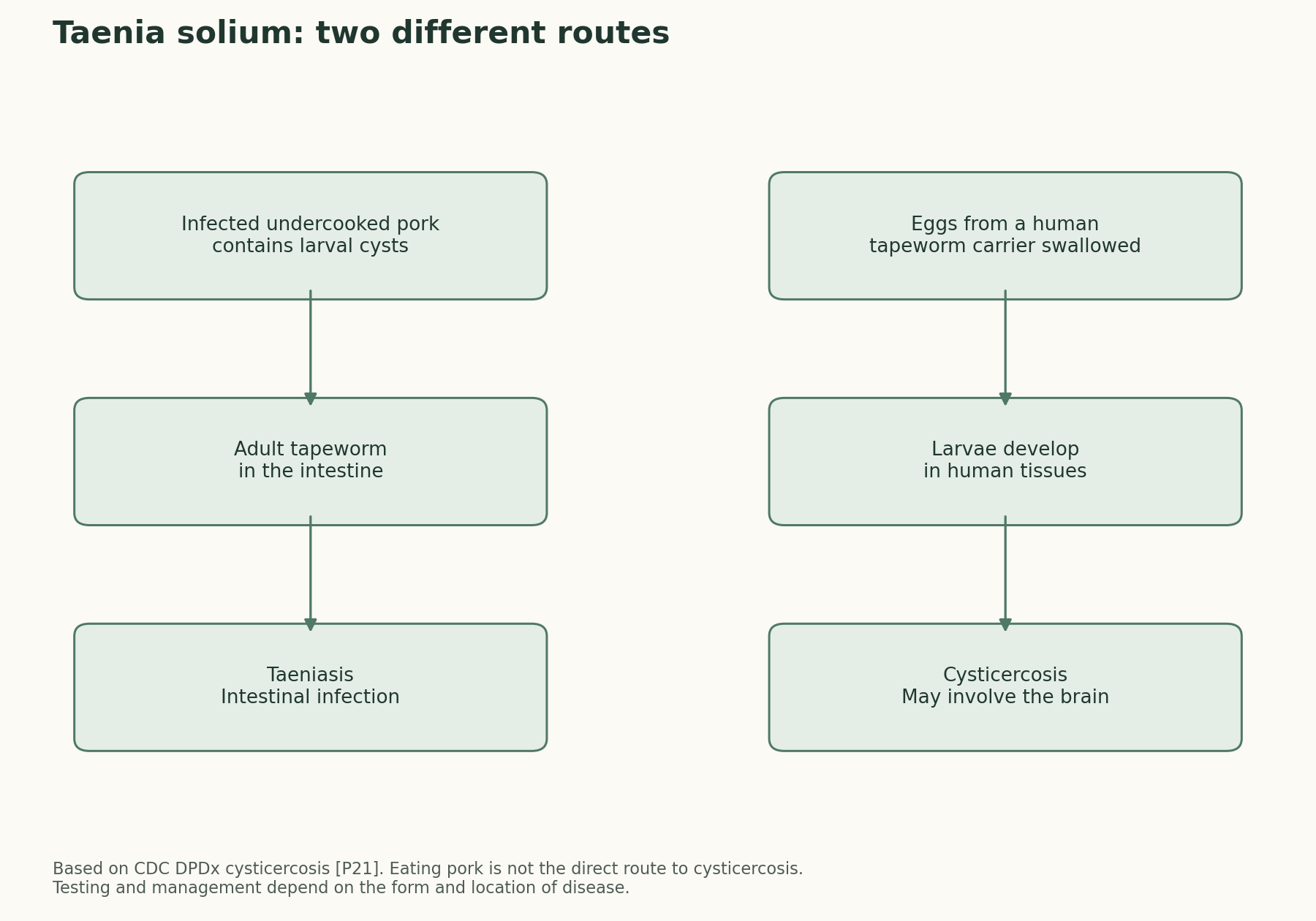
Based on CDC DPDx cysticercosis [P21]. Eating pork is not the direct route to cysticercosis. Testing and management depend on the form and location of disease.
Pregnancy and toxoplasmosis
Prevention concerns food and soil as well as cats. Cook meat appropriately, wash produce and hands, and use gloves for gardening. The risk question is exposure to infective material, not merely whether a household owns a cat. Discuss possible infection during pregnancy with the maternity team rather than interpreting a single antibody value alone. P20 P30
Travel history remains relevant after returning home
Fever after travel to a malaria area is urgent. Previous prophylaxis does not exclude malaria. Other infections require different histories and tests; a broad symptom quiz cannot replace travel-informed clinical assessment. P09 P31
Strongyloides may persist for many years. Corticosteroids and other forms of immune suppression can precipitate dangerous hyperinfection in an infected person. Report relevant residence or travel before starting such treatment. This is a reason for targeted assessment, not a reason to self-administer a mushroom extract. P10
Skin parasites and tick bites
Scabies management includes the affected person and relevant close contacts. It is not a judgement about cleanliness. For attached ticks, follow current mechanical-removal guidance; historical instructions to apply turpentine should not be repeated. Lyme disease is caused by bacteria transmitted by ticks, so calling every tick-borne condition a parasitic infection is inaccurate. P18 P28
Sources & access limits
Results remain specific to the preparation, study population and outcomes described.
- [P19] CDC, Clinical Care of TrichinellosisPublic-health, institutional or source documentation.
- [P20] CDC, Preventing ToxoplasmosisPublic-health, institutional or source documentation.
- [P21] CDC, DPDx - CysticercosisPublic-health, institutional or source documentation.
- [P22] WHO, EchinococcosisPublic-health, institutional or source documentation.
- [P30] CDC DPDx, Detection of Antibodies - General InformationPublic-health, institutional or source documentation.
- [P09] CDC Yellow Book, Post-Travel Parasitic Disease Including Evaluation of EosinophiliaPublic-health, institutional or source documentation.
- [P31] HSE, Malaria - SymptomsPublic-health, institutional or source documentation.
- [P10] CDC, Clinical Overview of Strongyloides; aktualizacja 11.02.2026Public-health, institutional or source documentation.
- [P18] HPSC, Lyme disease factsheet - prawidłowe usuwanie kleszczaPublic-health, institutional or source documentation.
- [P28] HSE, ScabiesPublic-health, institutional or source documentation.
Pomocnicze streszczenie
Najważniejsze informacje po polsku
Sytuacje szczególne: mięso i ryby, toksoplazmoza, bąblowica, malaria oraz węgorek przed immunosupresją.
Pełny tekst, ograniczenia badań i źródła znajdują się powyżej.