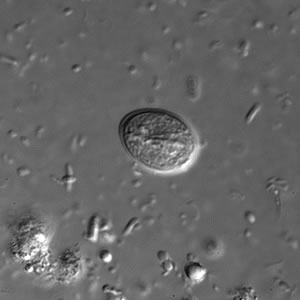
Start with the organism and the exposure
Parasites include protozoa, helminths and organisms living on the skin. Giardia is a microscopic intestinal protozoan; a threadworm is a nematode; a scabies mite is an ectoparasite. Their life cycles determine how infection happens and what a useful test or treatment looks like. There is no single parasite test or universal deworming programme for every person. P01 P05
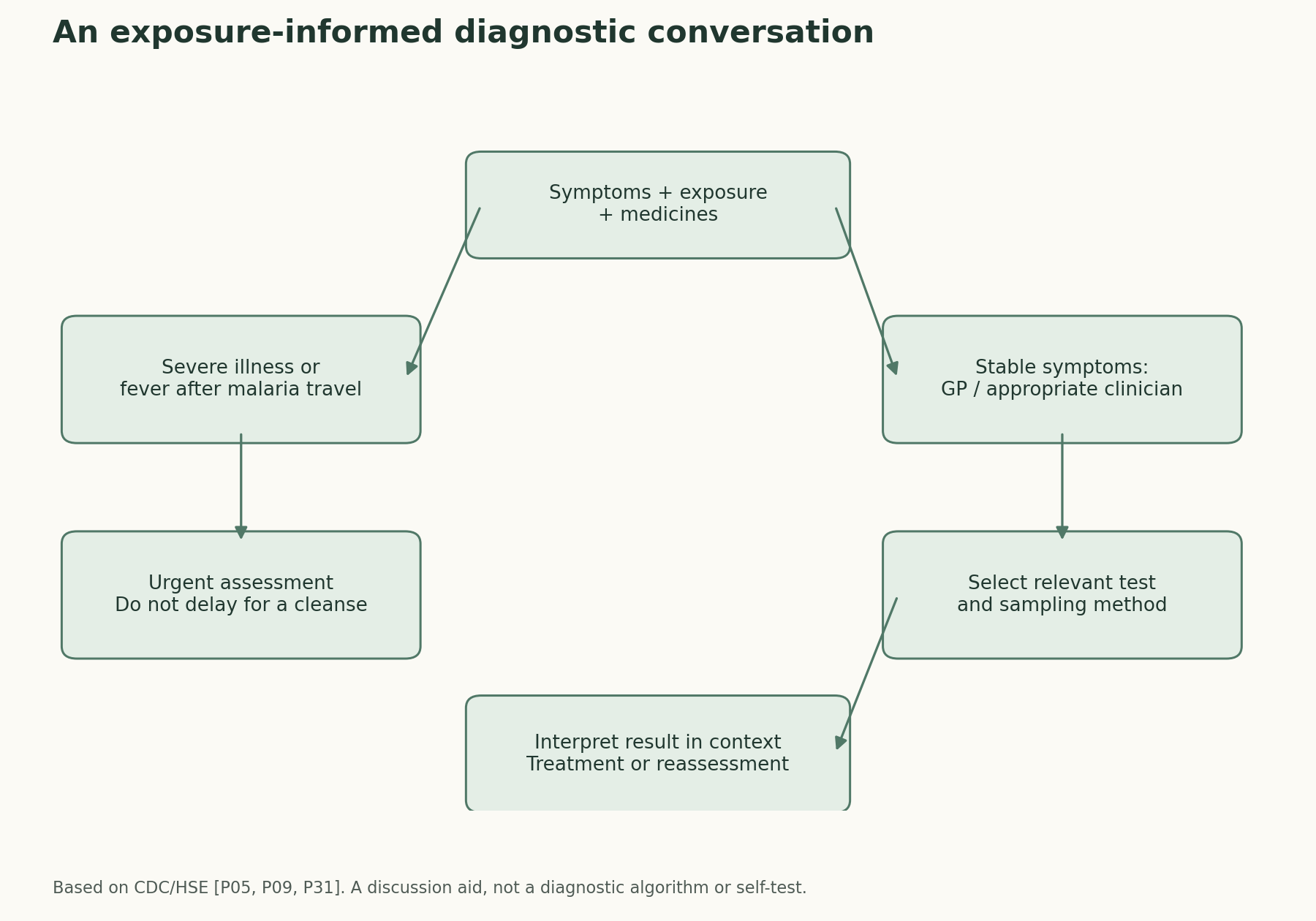
An exposure history often matters more than a long symptom checklist. Relevant questions include untreated water, travel, household itching, raw fish or meat, contact with soil and farm animals, and medicines that suppress immunity. Bloating, fatigue or a change in appetite can have many explanations. They do not establish infection or identify a species. P05 P09
A practical atlas
| Organism or group | Exposure and main concern | Diagnostic direction |
|---|---|---|
| Giardia duodenalis | Faecal contamination of water, food or hands; diarrhoea and malabsorption | Appropriate stool antigen, molecular or microscopy testing P04 P08 |
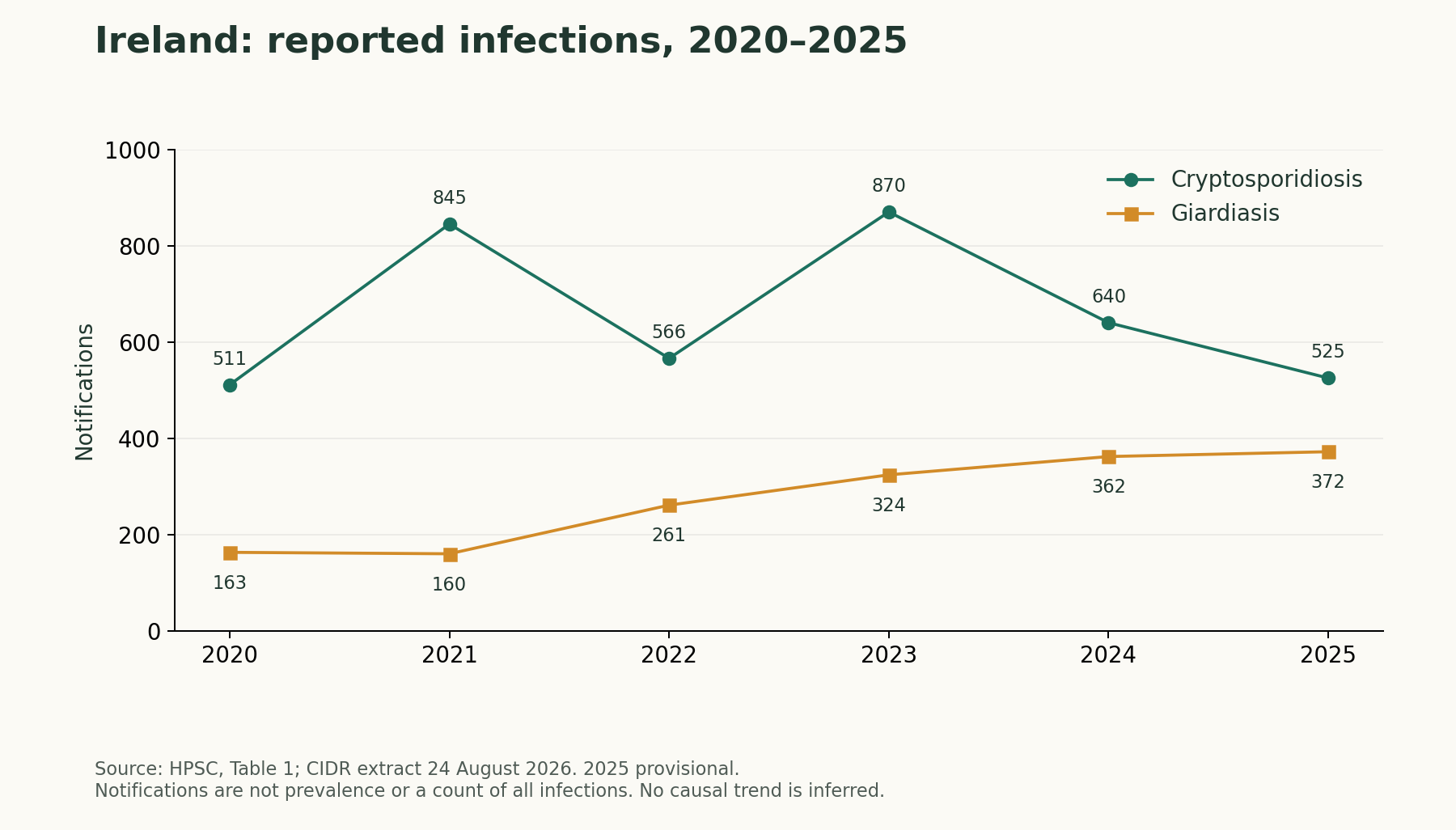
| Cryptosporidium | Water, animals and person-to-person spread; watery diarrhoea | Stool testing which specifically includes this organism P23 P24 |
| Enterobius vermicularis | Threadworms spread easily in households; night-time anal itching | Perianal tape sampling, rather than relying on ordinary stool testing P06 P07 |
| Ascaris lumbricoides | Ingestion of infective eggs in contaminated environments | Exposure-informed stool assessment P11 |
| Trichuris trichiura | Soil-transmitted whipworm; heavy infection can cause significant illness | Stool examination in the appropriate setting P11 |
| Hookworms | Infective larvae can enter through exposed skin; blood loss in substantial infection | Stool tests and assessment of anaemia P11 |
| Strongyloides stercoralis | Soil exposure; infection may persist through autoinfection | Specialist-directed stool and/or antibody tests; tell the clinician about steroid use P10 |
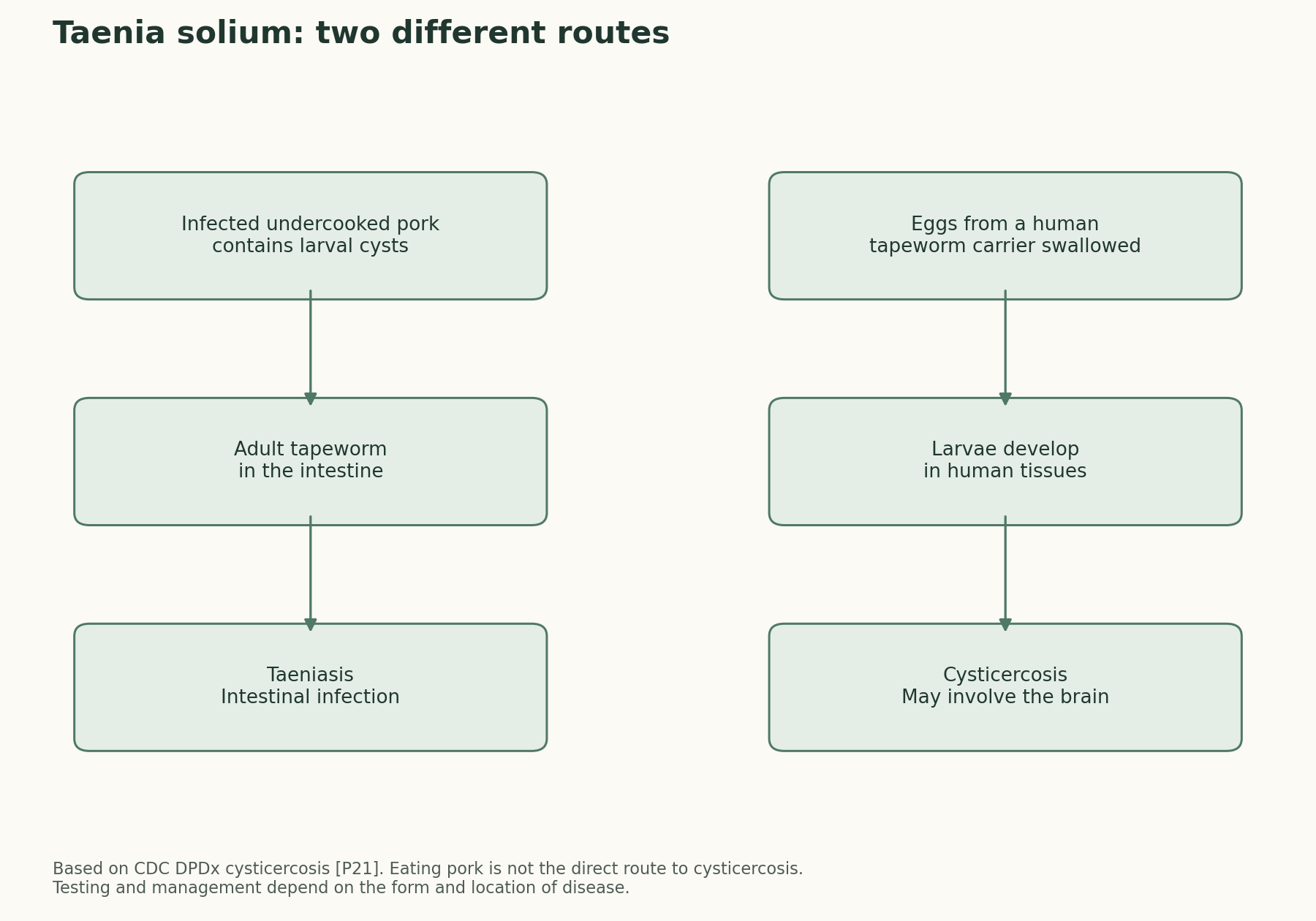
| Taenia solium | Intestinal infection after eating infected undercooked pork; tissue infection follows ingestion of eggs | The suspected form changes the investigations P21 |
| Echinococcus | Ingestion of eggs; cysts may develop in organs | Imaging and specialised assessment, not a generic cleanse P22 |
| Trichinella | Infected meat, including game; systemic illness after exposure | Clinical history and laboratory assessment P19 |
| Toxoplasma gondii | Meat, soil, food or water contaminated with the organism; pregnancy and immunity matter | Testing is selected for the individual clinical situation P20 |
| Plasmodium | Mosquito-transmitted malaria; fever after travel can be urgent | Prompt clinical assessment and malaria testing P31 |
| Sarcoptes scabiei | Scabies spreads through close contact; itching and rash | Examination and coordinated management of relevant contacts P28 |
| Head lice and ticks | External parasites; ticks may also transmit other pathogens | Direct examination and organism-specific advice P01 P18 |
| Blastocystis | Frequently detected organism with uncertain clinical significance in some cases | A positive result alone does not prove the cause of symptoms P25 |
Symptoms, severity and the next step
Some infections cause no symptoms. Others lead to diarrhoea, itching, anaemia, fever or organ-specific problems. Severity depends on the organism, infection burden and host. A negative test may need interpretation against the method and timing; it is not a reason to assume hidden parasites indefinitely. P05 P09
Seek prompt medical advice for bloody or persistent diarrhoea, dehydration, severe pain or deterioration. Fever after a stay in a malaria area warrants urgent assessment even after preventive medication. Pregnancy, infancy and immune suppression lower the threshold for obtaining advice. If someone is severely unwell, use emergency services. P29 P31
What prevention can achieve
Safe water, appropriate food preparation and handwashing interrupt specific transmission routes. Hand sanitiser is not an effective substitute for soap and water against Cryptosporidium. Keep raw meat separate from ready-to-eat foods and wash produce. Management of threadworms or scabies may involve household contacts, but the measures are different for each infection. P07 P20 P23 P28
WHO mass-deworming programmes target defined populations in endemic settings. They should not be translated into a blanket recommendation for every reader in Ireland. The sensible question is which exposure and diagnosis apply to this person. P11
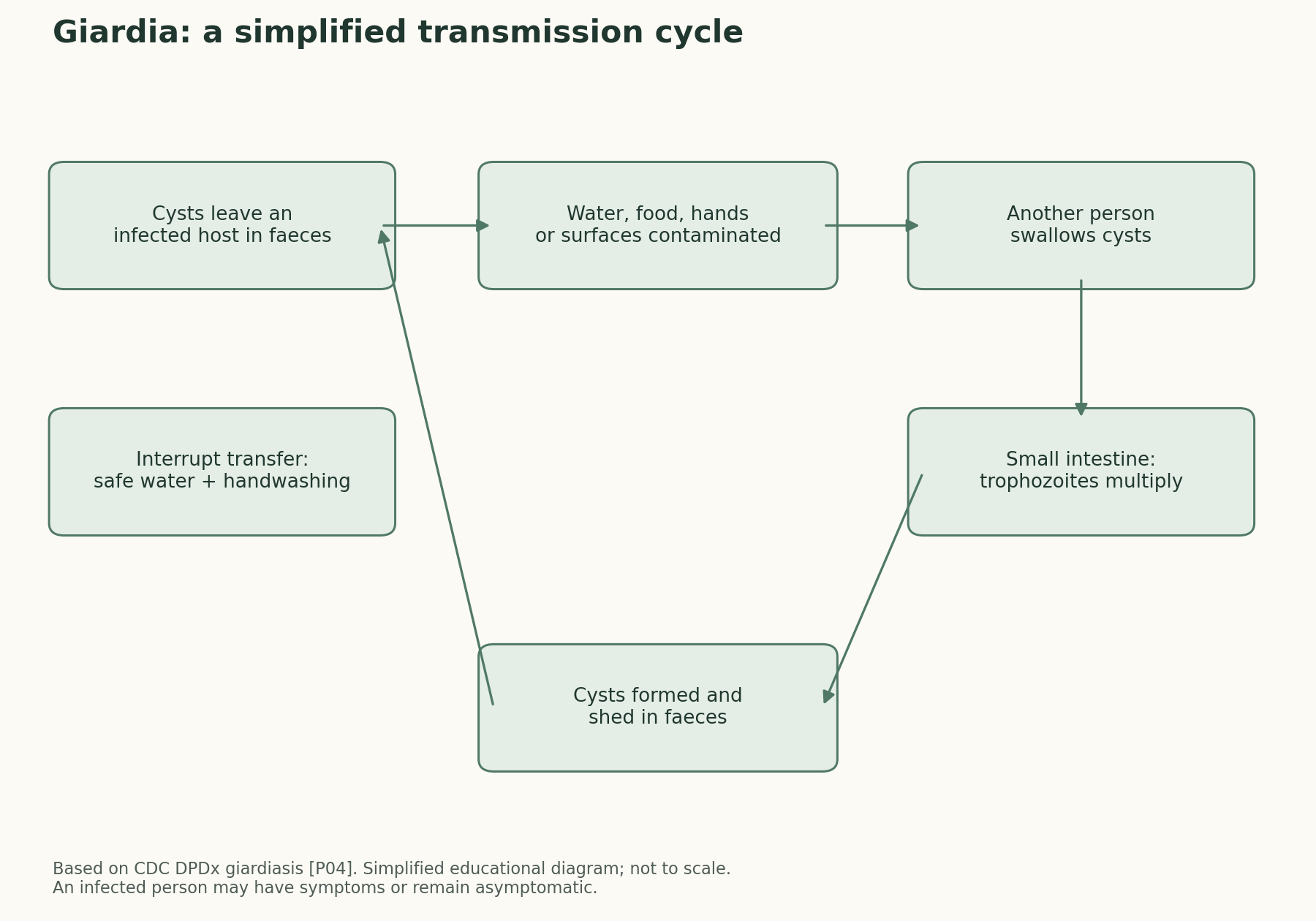
Based on CDC DPDx giardiasis [P04]. Simplified educational diagram; not to scale. An infected person may have symptoms or remain asymptomatic.
Sources & access limits
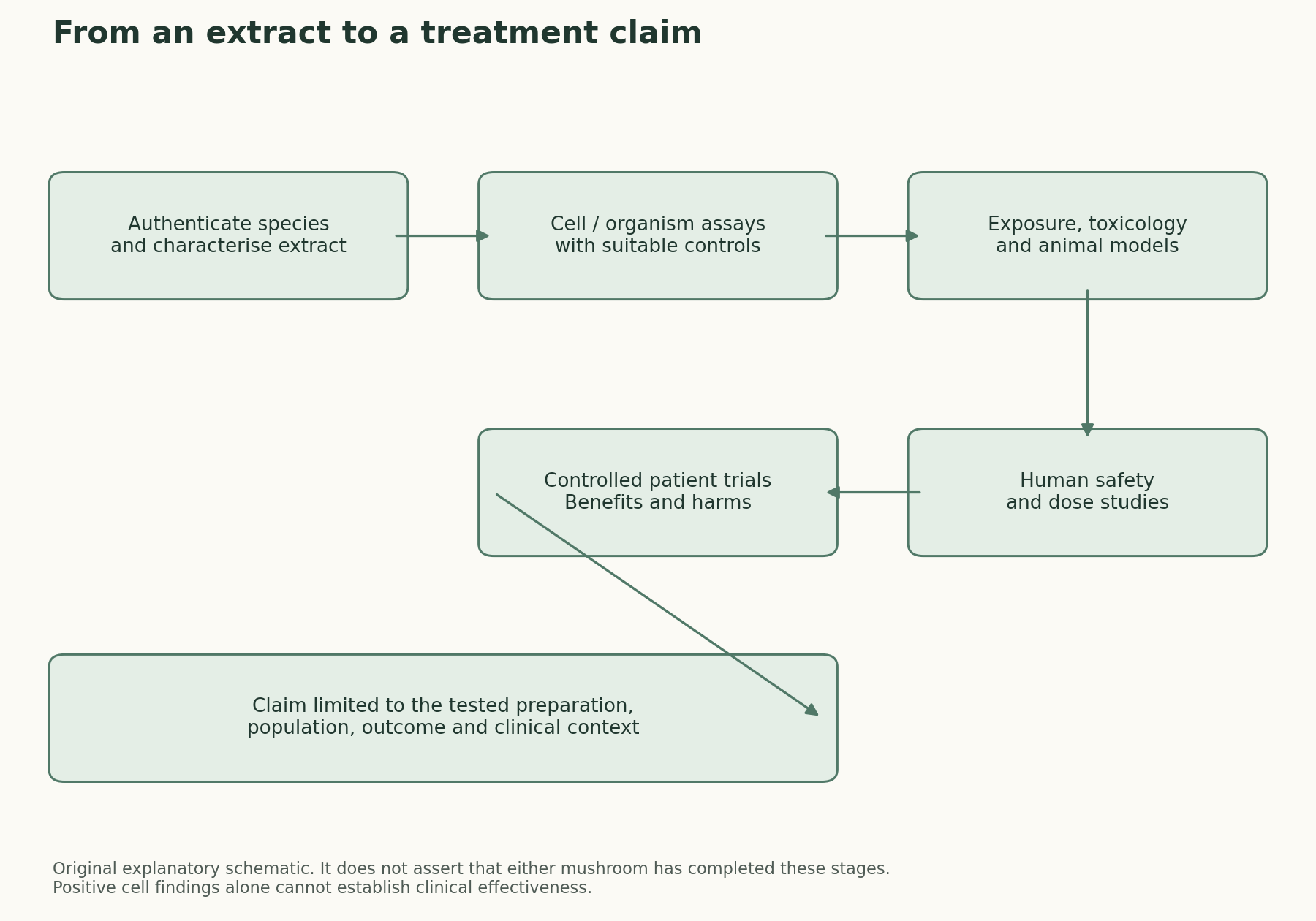
Results remain specific to the preparation, study population and outcomes described.
- [P01] CDC, About ParasitesPublic-health, institutional or source documentation.
- [P05] CDC, Diagnosis of Parasitic DiseasesPublic-health, institutional or source documentation.
- [P09] CDC Yellow Book, Post-Travel Parasitic Disease Including Evaluation of EosinophiliaPublic-health, institutional or source documentation.
- [P04] CDC, DPDx - GiardiasisPublic-health, institutional or source documentation.
- [P08] CDC, Clinical Testing and Diagnosis for Giardia InfectionPublic-health, institutional or source documentation.
- [P23] CDC, Preventing Crypto; 08.05.2025Public-health, institutional or source documentation.
- [P24] CDC, Treating Crypto; 04.06.2025Public-health, institutional or source documentation.
- [P06] CDC, Diagnosing PinwormsPublic-health, institutional or source documentation.
- [P07] HSE, Threadworms; przegląd 23.03.2026Public-health, institutional or source documentation.
- [P11] WHO, Soil-transmitted helminth infectionsPublic-health, institutional or source documentation.
- [P10] CDC, Clinical Overview of Strongyloides; aktualizacja 11.02.2026Public-health, institutional or source documentation.
- [P21] CDC, DPDx - CysticercosisPublic-health, institutional or source documentation.
- [P22] WHO, EchinococcosisPublic-health, institutional or source documentation.
- [P19] CDC, Clinical Care of TrichinellosisPublic-health, institutional or source documentation.
- [P20] CDC, Preventing ToxoplasmosisPublic-health, institutional or source documentation.
- [P31] HSE, Malaria - SymptomsPublic-health, institutional or source documentation.
- [P28] HSE, ScabiesPublic-health, institutional or source documentation.
- [P18] HPSC, Lyme disease factsheet - prawidłowe usuwanie kleszczaPublic-health, institutional or source documentation.
- [P25] CDC, Clinical Care of BlastocystosisPublic-health, institutional or source documentation.
- [P29] NHS, GiardiasisPublic-health, institutional or source documentation.
Pomocnicze streszczenie
Najważniejsze informacje po polsku
Pasożyty człowieka: główny dział edukacyjny, grupy organizmów, ekspozycje, objawy, diagnostyka i profilaktyka.
Pełny tekst, ograniczenia badań i źródła znajdują się powyżej.