Match the test to a question
A stool test is not a search for every possible human parasite. Microscopy, antigen tests and molecular panels cover different organisms. Tissue or blood infections may require completely different investigations. Tell the GP or laboratory what exposure is suspected and follow the sampling instructions supplied for that test. P05
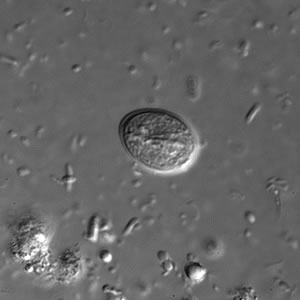
For ova-and-parasite microscopy, CDC describes three or more stool samples collected on separate days. This is not a universal rule that every modern PCR panel must be repeated three times. For Giardia, CDC lists several diagnostic approaches and recommends collecting three stool samples over several days for accurate results. The clinician selects the appropriate route. P05 P08
Threadworms are an instructive exception: eggs are deposited around the anus. The tape test is performed in the morning before washing, using the toilet or dressing, usually on three consecutive mornings under the instructions supplied. P06
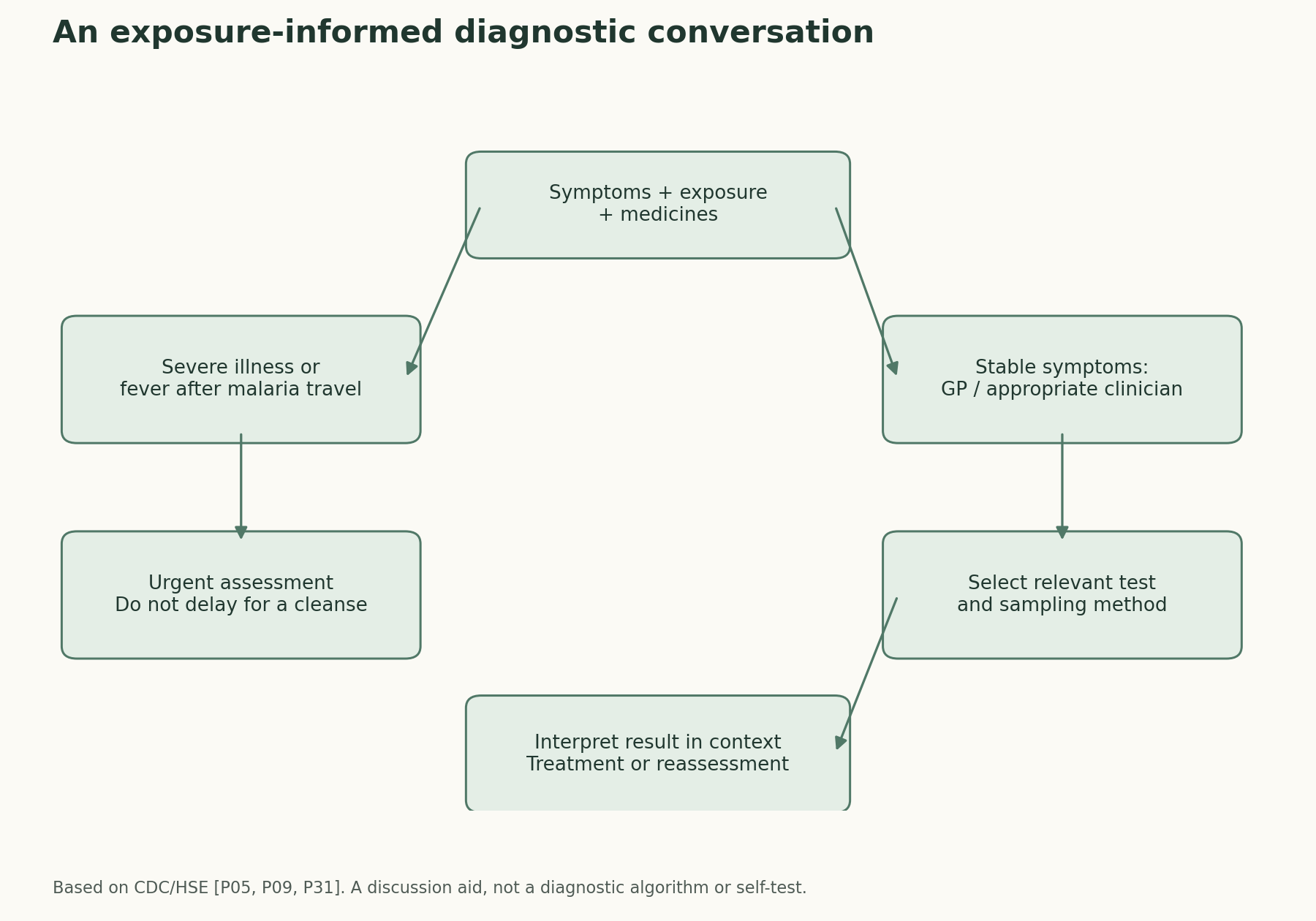
Based on CDC/HSE [P05, P09, P31]. A discussion aid, not a diagnostic algorithm or self-test.
Blood tests are specific too
Antibody tests answer questions about particular infections. Antibodies may persist after an earlier infection, so a positive result is not automatically proof of active disease. There is no single blood test which detects all parasites. Eosinophilia can occur with some helminth infections but also with allergies and other conditions; a normal eosinophil count does not exclude infection. P05 P09 P30
Strongyloides deserves special attention before significant immune suppression in someone with relevant exposure. Its ability to persist and cause hyperinfection changes the clinical risk. Tell the prescriber about travel and residence history; do not change prescribed steroids without medical advice. P10
After treatment
Symptoms can persist for weeks or months after Giardia has cleared. Reinfection, incomplete treatment and other causes need to be considered before repeating medication. A photograph of stool cannot reliably distinguish parasites from mucus, fibres or food, and a change in bowel movements is not a laboratory endpoint. P05 P27
Prepare for an appointment
Bring a dated timeline of symptoms, countries visited, drinking-water sources, relevant food exposures, household symptoms, current medicines and supplements, and copies of actual laboratory reports. Record the organism and test method, not simply “parasites positive”. This makes follow-up more useful and reduces unnecessary repetition.
Sources & access limits
Results remain specific to the preparation, study population and outcomes described.
- [P05] CDC, Diagnosis of Parasitic DiseasesPublic-health, institutional or source documentation.
- [P08] CDC, Clinical Testing and Diagnosis for Giardia InfectionPublic-health, institutional or source documentation.
- [P06] CDC, Diagnosing PinwormsPublic-health, institutional or source documentation.
- [P09] CDC Yellow Book, Post-Travel Parasitic Disease Including Evaluation of EosinophiliaPublic-health, institutional or source documentation.
- [P30] CDC DPDx, Detection of Antibodies - General InformationPublic-health, institutional or source documentation.
- [P10] CDC, Clinical Overview of Strongyloides; aktualizacja 11.02.2026Public-health, institutional or source documentation.
- [P27] CDC, Patient Care for Giardia InfectionPublic-health, institutional or source documentation.
Pomocnicze streszczenie
Najważniejsze informacje po polsku
Dobór badań: kał, testy antygenowe i PCR, taśma na owsiki, serologia oraz ograniczenia eozynofilii.
Pełny tekst, ograniczenia badań i źródła znajdują się powyżej.