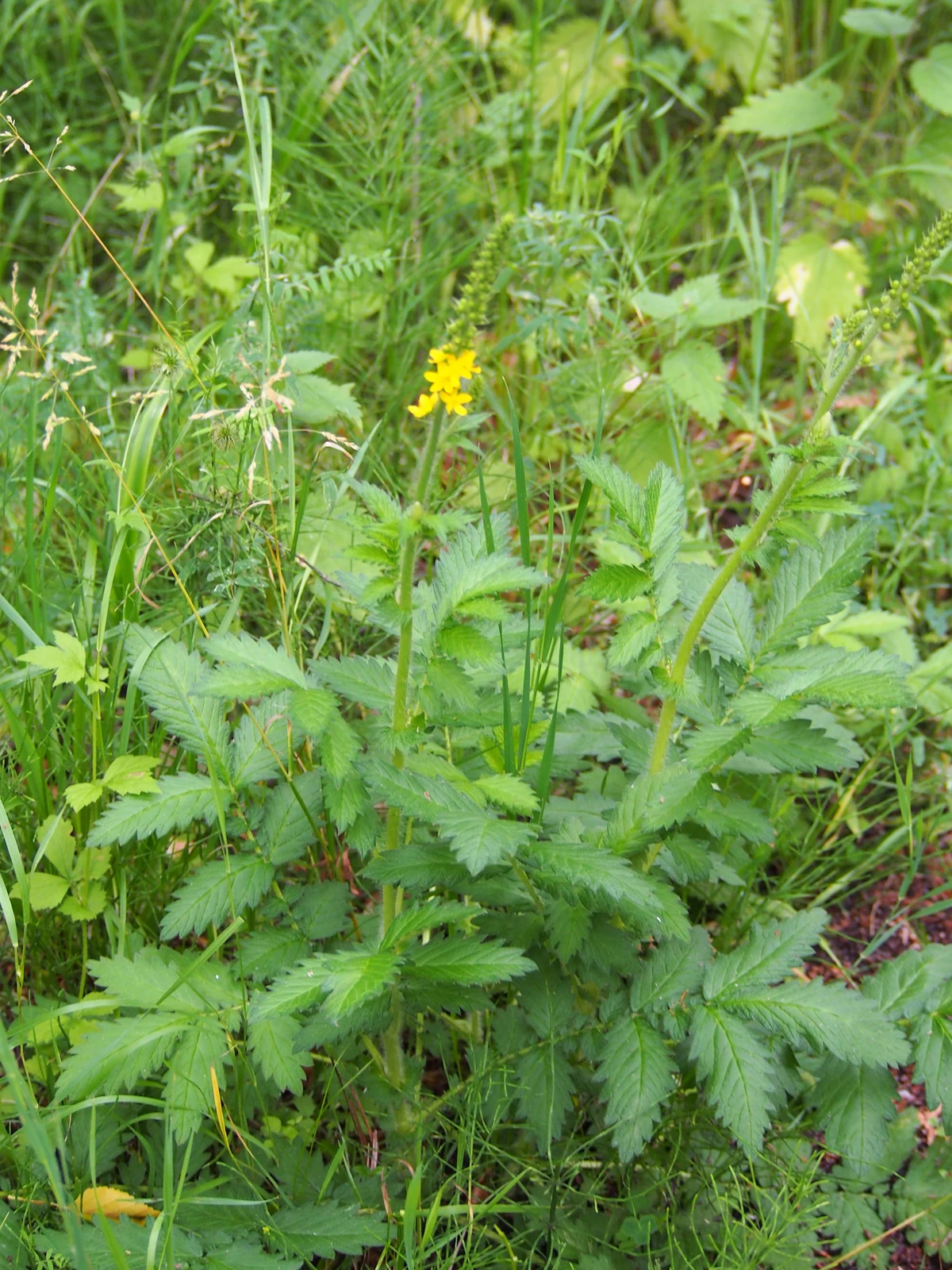
Agrimony (Agrimonia eupatoria): yellow flowers and pinnate leaves. Resized and converted to WebP; no cropping or content edits.
Agnieszka Kwiecień, Nova · CC BY-SA 4.0 · Source · EXIF orientation respected; resized without cropping or upsampling; converted to WebP at quality 88. No other content edits.
Yellow flowers and clinging fruits
Agrimony is a perennial of European banks, grasslands and hedgerow margins, with divided leaves and slender spikes of small yellow flowers. Its hooked fruiting structures cling to passing animals or clothing. Culpeper's description gives both features, helping explain the burr-related names used in the tradition.
The species here is Agrimonia eupatoria, a rose-family plant. Hemp agrimony, Eupatorium cannabinum, belongs to a different family and has its own separate history. Both Culpeper and Fernie move between similarly named plants, and the transition between them is marked here. The flowering aerial parts are the relevant material for agrimony tea and rinses.
Binding, cleansing and the old liver claim
Culpeper calls agrimony drying and binding and recommends decoctions, syrups, ointments and distilled water. His explanation gives the liver a central role in producing blood. Fernie is more sceptical about a direct liver effect and suggests that yellow flowers may have helped sustain the reputation through the doctrine of signatures.
That disagreement is worth preserving: historical herbalism was not a body of unanimous testimony, and the same plant could keep its household use while authors disputed why it worked. Gargles, bowel complaints and external preparations run through the whole record.
Krzepik and the meaning of a strengthening bath
Udziela records local names krzepik and krzepnik around Kraków. His entry describes baths for weakness at Wiśniowa and for consumption at Dobczyce, together with a striking belief at Radziszów that a sick child's fate would be hastened after bathing. The account is a record of uncertainty, care and prognosis in a historical community.
He also records herb blessing on 15 August and preparations given to cattle after calving. Human medicine, animal care and ritual used overlapping materials. Keeping each place and purpose visible gives a richer account than calling agrimony simply a Slavic tonic.
Sources: [U]
Harvest and preparation routes
Editorial collection guidance: Gather healthy flowering upper parts from a positively identified plant at a clean permitted site. Flowering extends through summer in many European regions, but local conditions determine timing. Avoid uprooting and leave plenty of flowers and fruits. Dry loose material with airflow, remove coarse stems as appropriate and label the dried herb clearly.
A household infusion extracted the flowering herb in hot water. A gargle was strained carefully, used comfortably warm and spat out after rinsing, while a drinking tea had its own directions.
Fernie connects agrimony with compound arquebusade water used for injuries. That historical name refers to a preparation of several herbs, named after the arquebus whose wounds it was meant to treat. Tinctures, syrups and fatty ointments each had their own specifications.
Present-day editorial handling guidance, not a recipe or a claim attributed to the historical author. Historical source supports identity, part and use only.
Church steeples, yellow dye and disputed liver medicine
Fernie records the name church steeples for the flower spikes and compares their scent with apricots. These observations give the plant a recognisable presence before any medical claim is made. The flowers and root also enter his account of a yellow dye. The dye is a material use, separate from the signature reading of yellow flowers that Fernie discusses.
Culpeper's liver argument is explicit: the liver forms blood, blood nourishes the body, and agrimony strengthens the liver. The conclusion belongs to a physiological system in which the organ's role helps explain a broad range of effects. Fernie doubts a direct liver action and suggests a signature-based explanation of the reputation. The two accounts therefore disagree about the meaning of the same inherited use.
This disagreement is historically productive. It shows an author selecting and reinterpreting tradition rather than merely copying it. Fernie retains gargles and astringent preparations while questioning the grander liver explanation. Folk and learned herbal medicine held more than one theory at once.
What strengthening meant in a farm household
The local names krzepik and krzepnik sit beside Udziela's reports of strengthening baths. At Radziszów the striking statement about a child recovering or dying more quickly gives the bath a prognostic as well as a restorative role. It is a report of belief in a time of uncertain illness.
The cattle uses are more specific than a general tonic label suggests. At Brzezowa a mixture given after calving was expected to produce thick yellow cream and attractive yellow butter. At Dobczyce infused stems were given after calving and at other times with the aim of increasing the cream on milk. The desired result concerned a household food product as well as the animal. These details connect plant practice with dairying, colour and the visible quality of fat.
The same source records blessing with other herbs in August. The ethnographic unit is therefore a mixture of named plants, local expectations and religious practice. Each effect belonged to the mixture as a whole. This is particularly relevant when comparing the farm mixtures with Fernie's compound arquebusade water: in both settings, the individual herb belonged to a preparation whose other components mattered.
Gargle, tea and bath
The European Medicines Agency's monograph on agrimony, written for traditional herbal medicinal products, records the traditional gargle for minor inflammation of the mouth and throat as 1.5 g of cut herb in 150 ml of boiling water, used two to four times daily. The agency's general procedure describes the method: the herb is covered with freshly boiled water, left covered for five to fifteen minutes, strained, cooled to a comfortable temperature and spat out after gargling. The same monograph gives different amounts for a drinking tea and for skin decoctions, and describes liquid extracts and tinctures as further preparations.
The historical contrast remains valuable: a table tea, a mouth rinse, a strengthening bath and an injury water all used water in some form, each with its own purpose, part and route.
Binding, strengthening and blessing
Agrimony's record runs from the hedgerow to the farmyard. Culpeper made it a drying and binding herb in decoctions, syrups, ointments and distilled water. Fernie knew its spikes as church steeples, smelled apricots in its flowers, dyed with it, gargled with it and found it in arquebusade water. Around Kraków, krzepik strengthened the weak in the bath, went to cows after calving for richer cream and yellow butter, and was blessed in August. Today the European Medicines Agency describes agrimony preparations within its traditional-use framework for mild diarrhoea, mouth and throat inflammation and minor skin complaints, with its own conditions of age and use.
Its old reputation for binding and strengthening runs through every part of that record.
Sources
- [C] Nicholas Culpeper. The Complete Herbal (1850). Agrimony, pp. 4–5; not Water Agrimony
Historical herbal description and preparations
Expanded historical edition, not current treatment guidance.
- [F] William Thomas Fernie. Herbal Simples Approved for Modern Uses of Cure, second edition (1897). Agrimony, printed pp. 18–20; Agrimonia subsection
Period preparation and custom
Obsolete medical claims; practical harvesting and hygiene advice is editorial.
- [U] Seweryn Udziela. Rośliny w wierzeniach ludu krakowskiego, Lud 30 (1931). Entry 5, Agrimonia eupatorium [historical spelling], printed p. 38; fieldwork 1894–1899
Local ethnographic practices
Regional observation and reported belief, not proof of efficacy.
- [E] European Medicines Agency, HMPC. Agrimoniae herba: public summary (2015). Overview and safety, accessed 29 October 2026
Defined traditional-use preparations
Does not validate all historical uses.
- [M] European Medicines Agency, HMPC. European Union herbal monograph on Agrimonia eupatoria L., herba (2015). Preparation routes, pp. 2–4; precautions, pp. 5–6
Measured gargle and distinction from drinking tea and skin decoction
Specified traditional uses, not validation of serious wound or consumption treatments.
- [T] European Medicines Agency, HMPC. Draft template for a European Union herbal monograph: herbal teas (2016). Infusion procedure, pp. 4–7
General preparation and cooling procedure
Not a species-specific dose.