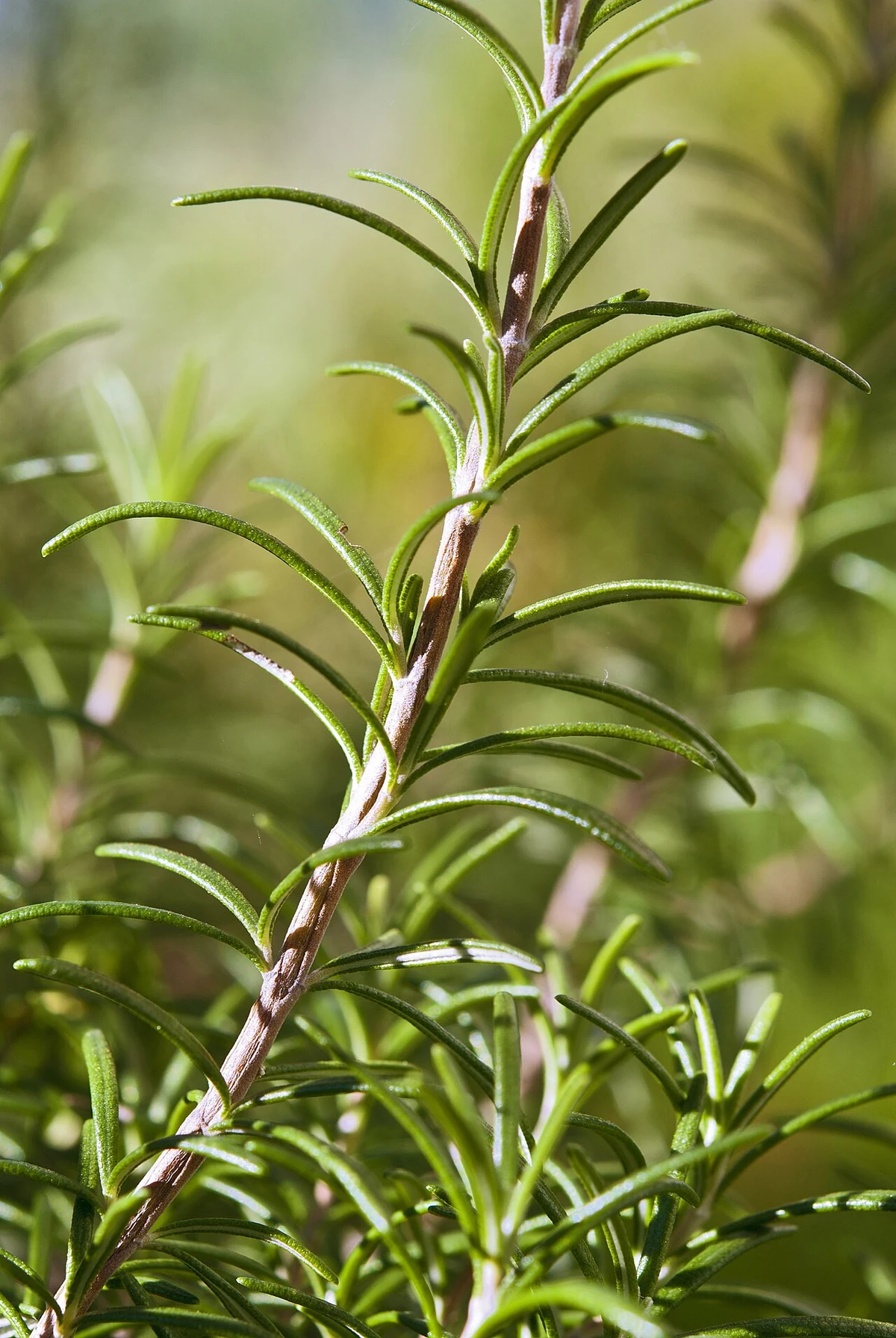
A rosemary shoot with narrow leaves, labelled Rosmarinus officinalis, a synonym of Salvia rosmarinus. Resized and converted to WebP; no cropping or content edits.
T137 · CC BY-SA 3.0 · Source · EXIF orientation respected; resized without cropping or upsampling; converted to WebP at quality 88. No other content edits.
A Mediterranean shrub carried north
Rosemary is an evergreen aromatic shrub with narrow leaves, rolled margins and pale undersides. Its flowers are commonly blue to lilac, although cultivars vary. It belongs naturally to Mediterranean landscapes and has long been grown in European gardens farther north. Leaves and flowering shoots are the material discussed in old household remedies; their survival through winter helped make rosemary available when softer herbs had disappeared.
Older texts use Rosmarinus officinalis, while modern botanical usage often places it in Salvia. That name change does not mean the old herb has become an unfamiliar plant. Much more consequential is Fernie's inclusion of a separate wild rosemary, Ledum palustre, now generally placed in Rhododendron. Its historical remedies belong to that plant, not to kitchen rosemary.
Remembrance at weddings and graves
Fernie connects rosemary with both marriage and burial: bridal wreaths, gifts to guests and sprigs carried by mourners. His literary examples show a plant communicating memory and affection as well as offering a scent. Such associations are recorded for particular European settings.
Culpeper calls it useful for civil as well as physical purposes and gives memory a prominent place in its medicinal reputation. His household world did not sharply separate a comforting fragrance, a symbol and a treatment. He also recommended rosemary for many serious complaints, including loss of speech, seizures and paralysis, which shows the high standing the herb enjoyed.
The same branch at a wedding and a funeral
Rosemary's appearance at both marriage and burial can seem contradictory until the material practice is considered. A small evergreen sprig can be held, worn, carried, scented and distributed. Fernie describes bridal wreaths dipped in scented water, branches given to guests and, when means allowed, gilding. The ornament makes the herb a public token of relationship rather than a medicine taken privately. At a funeral the branch is carried by mourners and thrown into the grave: a related object serves a different moment in the community's life.
Fernie also connects funeral rosemary with the old belief that aromatic plants offered protection against harmful emanations from a corpse. That explanatory layer sat beside remembrance: people could value a sprig as a token of affection and believe its smell protective at the same time. Burning rosemary in a sickroom belonged to the same period practice of managing the atmosphere and smell around illness.
The literary references make the symbolism legible to readers: rosemary accompanies the corpse in Romeo and Juliet and remembrance in Hamlet. Fernie's quotations show how familiar these associations had become in English writing. They show the custom at home in English literature and life.
Wine, sweet preserves and the famous royal water
The surviving descriptions distinguish several processes often compressed into the word extract. Fernie's rosemary wine uses chopped sprigs steeped in white wine and then strained after two or three days. His Hungary-water account instead begins with flowering tops in spirit and proceeds to distillation. The resulting aromatic water or spirit was a distilled product, distinct from rosemary wine. A royal cure story, in which paralysis was said to have been reversed, gave the water its fame.
Culpeper gives another sweet form, a conserve made from flowers, alongside leaf baths, ointments and wine preparations. Fernie mentions flower lozenges made with sugar and a preserve used with beef. Taken together, these passages show how preserving, flavouring and medicinal purposes overlapped. Sugar could carry delicate plant material, wine could act as both a drink and an extracting medium, and an ointment could keep a preparation in contact with the skin.
A short Polish counterpart appears in Udziela: at Wieliczka rosemary soaked in wine was externally applied for swelling. The preparation was applied to the body, not drunk. The entry gives the method and purpose rather than amounts, and shows that wine-based external preparations also belonged to village practice around Kraków.
Maintaining a supply in a northern garden
Grieve's cultivation account helps explain how a Mediterranean shrub entered northern household practice. She favours a sheltered position and relatively light, dry ground, and describes propagation by cuttings and by layering low branches into soil. Her August cutting schedule is a period British horticultural direction, not a compulsory calendar for every European climate. A wall or sheltered border is part of the story: the household creates a place in which the aromatic shrub can persist.
There is a useful distinction between maintaining the living plant and selecting material for a preparation. Fernie emphasises the fragrant calyces when discussing flowering tops; the leaf monograph concerns dried leaf. A harvest intended for a flowering-top historical display therefore differs from the leaf material weighed for tea. Labelling the plant part preserves that distinction after drying, when flowers, needles and woody fragments might otherwise be mixed anonymously.
The older sources also expose the limits of names. Fernie's final discussion of wild rosemary changes to Ledum palustre and a different medical tradition. Grieve's webpage has a conflicting illustration caption even though its main botanical heading correctly gives Rosmarinus officinalis. Neither an attractive common name nor a nearby picture should override the identified plant used in the actual preparation.
Gathering leaves and flowering tops
Editorial collection guidance: Clip clean leafy tips from a correctly identified cultivated plant, leaving plenty of green growth. Flowers may appear in spring and again later in a favourable climate; Culpeper's English April–May observation is a local record, not a pan-European harvest rule. A cool northern garden and a warm coastal site can differ markedly.
Dry small sprigs with airflow and away from harsh light, then separate leaves from coarse wood. Keep the material dry, labelled and protected from kitchen steam. Fernie emphasises the fragrant flower structures when discussing storage. For a historical display, retain a labelled flowering specimen alongside the dried leaves: it makes clear which part a recipe originally requested. Do not strip wild shrubs or assume collection is permitted in protected Mediterranean habitats.
Present-day editorial handling guidance, not a recipe or a claim attributed to the historical author. Historical source supports identity, part and use only.
From leaf water to Hungary water
An infusion was made by pouring freshly boiled water onto the leaves and straining after steeping. The European Medicines Agency's monograph on rosemary leaf, written for traditional herbal medicinal products, records the traditional tea as 1–2 g of dried leaf in 150–250 ml of boiling water for adults and adolescents.
Fernie describes rosemary wine, washes and alcoholic spirits. His Hungary water combined flowering tops, spirit and distillation, and its royal cure narrative made it a famous aromatic preparation. Culpeper's external ointments and leaf baths reveal another route: plant material incorporated into an oily base or into bathing water. He also describes an unusual extraction using the heat of the sun, a technique of his own period. Smoking rosemary and fumigating a sickroom complete the historical range of its uses.
Memory, scent and the household
Rosemary's record joins the household and the community. Culpeper gave it a place in memory and in many remedies; Fernie followed it into wedding wreaths, mourners' sprigs, rosemary wine, flower lozenges and Hungary water; at Wieliczka it was soaked in wine and applied to swellings. Today the European Medicines Agency describes rosemary leaf preparations within its traditional-use framework, with its own conditions of age and use.
A cooking sprig, a leaf tea, a wine, a distilled water and a sprig thrown into a grave were each a different use of the same evergreen shrub, and together they explain why rosemary stood for remembrance.
Sources
- [C] Nicholas Culpeper. The Complete Herbal (1850). Rosemary, printed pp. 155–156, digitised 1850 edition
Period uses and forms of preparation
An expanded historical edition, not a current treatment guide.
- [F] William Thomas Fernie. Herbal Simples Approved for Modern Uses of Cure, second edition (1897). Rosemary, printed pp. 470–475
Nineteenth-century herbal practice and reported customs
Medical claims and historical anecdotes require critical reading; harvesting and hygiene advice is editorial.
- [E] European Medicines Agency, HMPC. European Union herbal monograph on Rosmarinus officinalis L., folium, revision 1 (2024). Preparation definitions and safety sections; accessed 29 October 2026
Safety boundary for specified preparations
Not evidence that all historical remedies work.
- [U] Seweryn Udziela. Rośliny w wierzeniach ludu krakowskiego, Lud 30 (1931). Entry 100, Rosmarinus officinalis; field collection 1894–1899
A Wieliczka report of rosemary steeped in wine and externally applied for swelling
One short local observation; no amounts, treatment duration or evidence of effectiveness.
- [G] Maud Grieve. A Modern Herbal: Rosemary (1931). Cultivation and History sections, online transcription
Cultivation by cuttings and layering, sheltered growing position and rosemary's domestic symbolism
Historical compilation, not independent confirmation of every quoted anecdote; page illustration caption incorrectly says Hyssopus and is not used for identification.