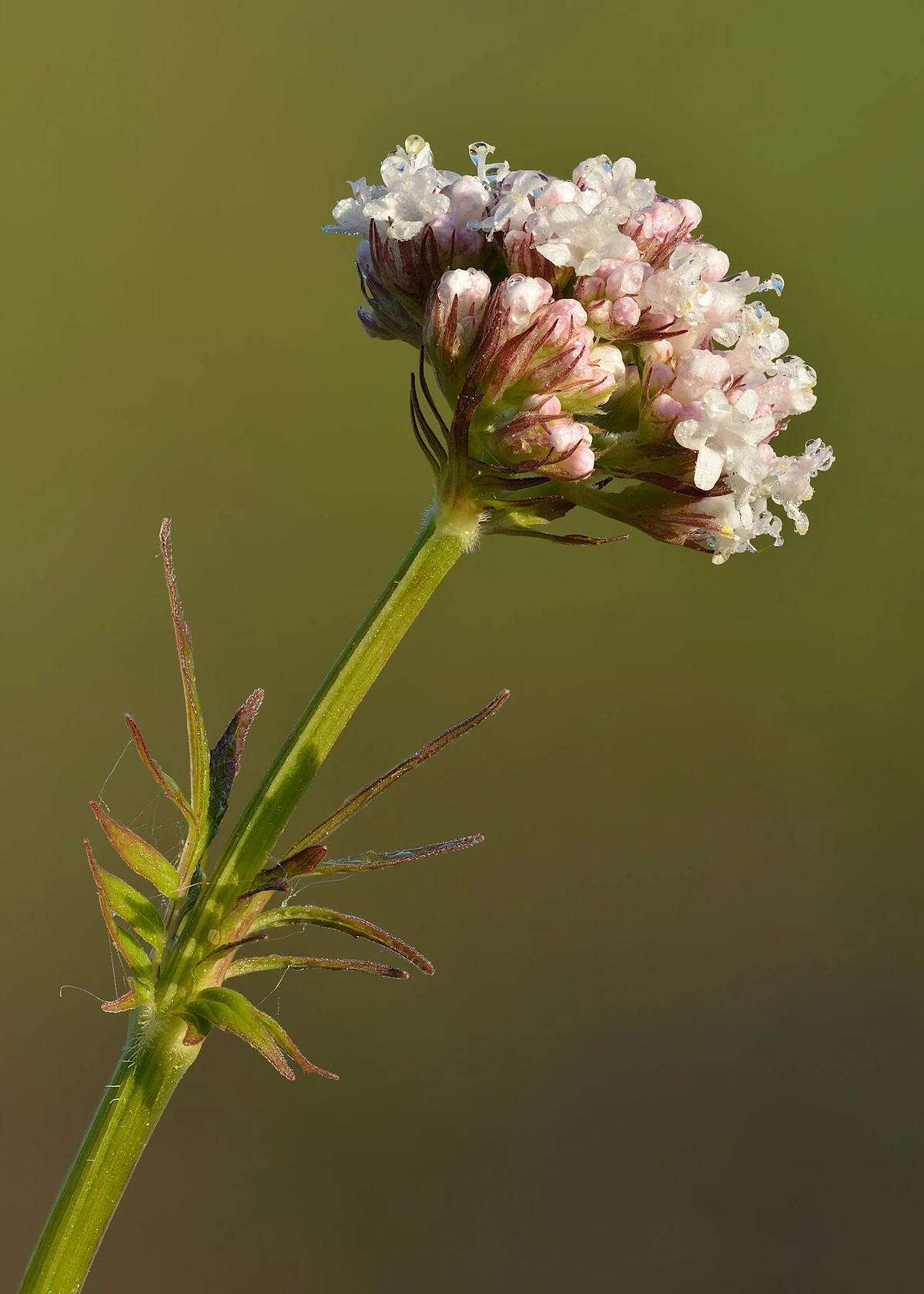
Valerian (Valeriana officinalis): a cluster of pale flowers and pink buds. Resized and converted to WebP; no cropping or content edits.
Ivar Leidus · CC BY-SA 4.0 · Source · EXIF orientation respected; resized without cropping or upsampling; converted to WebP at quality 88. No other content edits.
The useful part is mostly underground
Common valerian is a European perennial with divided leaves and clusters of small pale flowers. It is associated with damp ground, stream margins and woodland edges, and has also been cultivated for medicinal material. The underground parts, commonly labelled root but including the rhizome and associated roots, are central to its herbal history.
Culpeper notes the stronger smell of the root compared with leaf and flower. Fernie discusses cultivation near Chesterfield as well as wild growth. He also moves into red valerian and Greek valerian, names applied to different plants. The red-flowered wall plant Centranthus and Jacob's ladder, Polemonium, are different plants from Valeriana officinalis.
An old nerve remedy with a much wider past
Fernie places valerian among remedies for nervous complaints, headache and conditions then described as hysteria. He also repeats claims about epilepsy, constipation and other disorders. These reveal how the nineteenth-century dispensary understood the root.
Culpeper's garden-valerian entry has a different emphasis: warming action, urine, chest preparations, wounds and antidotes. The familiar image of an evening sleep herb took shape over time. A plant's medicinal identity can shift as practitioners, preparations and diagnostic categories change.
The older name Garden Valerian is not a secure modern botanical identification. Its indications belong to the history of plants called valerian. Fernie and the modern root monograph provide the more explicit connection with the species discussed here.
Cats, charms and the smell of a root
Fernie describes cats' strong attraction to valerian and reports a speculative connection with the Pied Piper story. The animal response and the literary conjecture are different kinds of statement; the latter is Fernie's own conjecture. He also records protective associations in European tradition.
The conspicuous smell helped make valerian a memorable household object. A root could be recognised by scent, valued by an apothecary and surrounded by stories. In a historical cabinet, a labelled specimen and its provenance completed what the aroma began.
Sources: [F]
Harvesting and making a water preparation
Editorial collection guidance: Use cultivated or reliably supplied root material. Identify the living plant before any digging, and obtain permission where required. A practical root harvest usually takes place as growth dies back or before strong spring growth, adjusted to the local cultivation cycle. Digging removes the plant, so wild populations should not be treated as an unlimited source.
Wash away soil, divide thick material for even drying and dry promptly with ventilation. Keep it labelled and dry. The strong smell is normal for well-dried root.
Fernie lists ordinary tincture, ammoniated tincture, essential oil and powder. Each was a distinct product, and the ammoniated tincture belonged to a specific pharmaceutical tradition.
Present-day editorial handling guidance, not a recipe or a claim attributed to the historical author. Historical source supports identity, part and use only.
A Derbyshire crop in a European web of names
Fernie's reference to cultivation near Chesterfield places valerian in a commercial landscape as well as a wild one. The medicinal root was something growers could produce for an apothecary, rather than an exclusively secret woodland remedy. He contrasts plants in damp places with smaller plants on drier ground, and discusses differences in aroma. Those observations reveal nineteenth-century ideas about quality.
His northern English name setwall opens another historical strand. He quotes an older account of its place in broth and pottage. Because vernacular names travel and the chapter moves among several plants, that passage is evidence of a named culinary tradition. The same chapter compares valerian with nard and spikenard, linking biblical perfume, Asian aromatic roots and European valerian through their smell.
The contrast is especially visible in the regional names of red valerian. Fernie locates names associated with sailors and soldiers around Plymouth and mentions Bouncing Bess in west Devon. These colourful names belong to a different plant. Greek valerian, meanwhile, is Jacob's ladder, with its own story about quarrelling couples. These neighbouring traditions belong to other plants.
Sources: [F]
Protection, animal attraction and changing explanations
Roots hanging at doors and windows belong to a protective use reported in Fernie's discussion of the old name phu. His account also mentions German beliefs about frightening away imps. Here the root works as a conspicuous object at a boundary, rather than as an ingredient dissolved in a drink. The account gives fragments of a varied reputation assembled by a Victorian medical writer.
Cats' attraction supplied another memorable quality. Fernie used it in an imaginative suggestion about the Pied Piper. An animal's interest, a household charm and a patient's experience of a preparation are three different kinds of record, and together they explain why the plant accumulated so many stories.
The medical language changed too. Culpeper's garden-valerian entry places the plant in a warming and cleansing framework and invokes older authorities for urinary, chest and wound uses. Fernie concentrates much more on nervous disorders and pharmacy. Reading the two in sequence gives a history of changing emphasis.
The root cup and the pharmacist's tincture
The European Medicines Agency's monograph on valerian root records an infusion of 0.3–3 g of comminuted root in 150 ml of boiling water. The agency's general tea procedure describes the method: the measured root is covered with freshly boiled water, left covered for five to fifteen minutes and strained. The underground part was cut for infusion rather than milled into powder.
Fernie's ordinary spirit tincture and ammoniated tincture belonged to different apothecary preparations, each defined by the proportion of starting material and the extraction liquid. A concentrated dry extract had undergone further processing again.
The characteristic strong odour was expected of correctly supplied valerian. Keeping the supplier's identity and the preparation directions with the material connects the historically distinctive root to the actual substance in the jar.
The scented root through the centuries
Valerian's history changed with the centuries. Culpeper's garden valerian was a warming plant for urine, the chest, wounds and antidotes. Fernie's root from the Chesterfield fields served nervous complaints and headache; protective roots hung at doors and windows, cats were drawn to its smell, and northern broths knew it as setwall. Today the European Medicines Agency describes valerian root preparations with its own conditions of age and use.
The evening cup that many people now associate with valerian is the latest chapter in a long and varied story of the scented root.
Sources
- [C] Nicholas Culpeper. The Complete Herbal (1850). Garden Valerian, pp. 186–187
Period herbal description and preparation history
Expanded 1850 edition. The pre-Linnaean label Garden Valerian is not securely equated here with modern Valeriana officinalis; this entry supplies comparative historical context, not species-specific validation.
- [F] William Thomas Fernie. Herbal Simples Approved for Modern Uses of Cure, second edition (1897). Valerian, printed pp. 583–586
Historical preparation and folklore
Contains obsolete claims and botanical conflations; practical harvest and hygiene notes are editorial.
- [E] European Medicines Agency, HMPC. Valerian root: public assessment summary, updated March 2026 (2026). Definitions and safety sections, accessed 29 October 2026
Current boundary around specified preparations
Not validation of all historical claims.
- [M] European Medicines Agency, HMPC. European Union herbal monograph on Valeriana officinalis L., radix (2016). Corrected 2017 text, pp. 3–7
Root infusion, distinct extract types and safety
Preparation-specific medicinal guidance, not validation of earlier antidote or neurological claims.
- [T] European Medicines Agency, HMPC. Draft template for a European Union herbal monograph: herbal teas (2016). Infusion preparation, pp. 4–7
General covered infusion procedure
General method; valerian quantity comes from its own monograph.