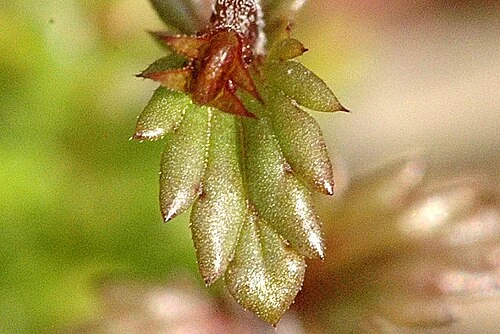
Close-up of a fruit of eyebright, identified by the source as Euphrasia officinalis. Resized and converted to WebP; no cropping or content edits.
James K. Lindsey · CC BY-SA 3.0 · Source · EXIF orientation respected; resized without cropping or upsampling; converted to WebP at quality 88. No other content edits.
A small plant with a large reputation
Eyebright is a low annual of open grassland and heath, with small pale flowers marked by purple lines and a yellow patch. Fernie describes its attachment to neighbouring roots: these plants are hemiparasites, obtaining part of their resources from hosts while retaining green leaves. This makes the meadow community part of the plant's biology, not merely a picturesque backdrop.
Older Euphrasia officinalis commonly covers a group of difficult species and hybrids. Flowering aerial parts are the material discussed in herbal accounts.
How a flower became associated with sight
Fernie discusses the resemblance between the marked flower and an eye, placing eyebright within the doctrine of signatures: visible features were interpreted as clues to a plant's appointed use. Culpeper's account makes extravagant claims about restoring sight in old age and reducing the need for spectacles. Those statements reveal the author's confidence and his understanding of nature.
The story is useful precisely because the chain of reasoning is visible. A striking flower suggested an organ; repeated recommendation then helped give the plant a durable medicinal identity. Literary references and a memorable English name strengthened that identity.
The preparation cupboard
Culpeper lists juice and distilled water, preparations in wine or broth, a conserve of flowers, powdered herb mixed with sweet ingredients and a place in fermented drink. Fernie adds later tincture and lotion traditions. These are several different products. An infusion extracts into hot water; a tincture uses alcohol; a conserve preserves plant material in sugar; a distilled water is collected during distillation. They cannot be exchanged spoon for spoon.
The old sources also describe putting preparations into the eyes. Eye lotions, drops and washes were a central part of the tradition, recorded alongside the drinks.
Collection as a botanical practice
Editorial collection guidance: For study, record the site, date, habitat and identification, photograph the plant in flower, and gather only where lawful and plentiful. Because eyebright depends partly on neighbouring vegetation, uprooting a patch is particularly poor collection practice. A small cultivated or responsibly sourced sample is preferable to stripping a meadow.
Dry flowering material promptly in a thin, shaded, ventilated layer; label the identification as an aggregate if that is all that can be established. Historical harvest descriptions should also be read locally: an English flowering season does not fix a date for every European altitude and latitude.
Present-day editorial handling guidance, not a recipe or a claim attributed to the historical author. Historical source supports identity, part and use only.
Icelandic juice and a Highland milk preparation
Fernie's geographical examples are specific about the carrier. He reports expressed juice in Iceland and an infusion in milk among Scottish Highlanders, both associated with eye complaints. These are not two names for the same preparation. Pressing produces plant juice, while milk supplies a separate medium into which material is steeped.
The regional names reinforce the visual reputation in different languages. Fernie gives the German Augentrost, conveying consolation for the eye, and the French casse-lunettes, linking the plant with spectacles. Such names show how widely the reputation travelled, through learned and popular traditions alike.
His own nineteenth-century discussion adds a spirit tincture and rosewater lotion. That brings the plant into a different pharmaceutical setting from a local milk infusion. A scented water made an application pleasant and familiar, and the contrast between these carriers is a practical part of the plant's history.
Sources: [F]
Spectacles, memory and the authority of poetry
Culpeper imagines eyebright competing with the spectacle maker. His language sets natural recovery against an artificial aid and offers the reader a hopeful alternative to declining sight. His reference to an older authority who reportedly restored sight extends the chain of testimony.
The promise also reaches memory. Eyebright appears in broth, sweet electuaries and fermented drink with the expectation of helping a weak brain as well as the eyes. These associations connect sight and understanding in the old herbal imagination. The historical category of a weak brain was broad.
Fernie strengthens the literary side with Milton's use of euphrasy in Paradise Lost, where an angel prepares Adam to see more. A poem can use a plant's reputation to make a scene intelligible and resonant. Fernie's playful suggestion that eyebright explained a nursery rhyme about eyes lost and restored in a hedge is his own conjecture. Poetry, folklore and medicine each carried the plant's reputation in their own way.
The flower in a living grassland
The partly parasitic habit recorded by Fernie changes how the plant should be understood in the field. It is not simply a miniature garden herb that can be removed from its surroundings without consequence. Neighbouring roots and the open vegetation are part of its life. A botanical photograph should therefore include the surrounding sward as well as a close view of the marked flower. This is an editorial observation method, useful for preserving context rather than diagnosing a species from one image.
For a study collection, separate a pressed voucher from any purchased medicinal material. Label the former with the most cautious identification available, the place and the flowering date. The flower markings that prompted the eye comparison are especially worth recording before drying alters their appearance.
The preparation history can then be studied from the text. A conserve retains plant material in a sugar matrix; an electuary mixes powder into a sweet paste; a fermented preparation begins with a living brewing process. These distinctions explain what the old household actually handled.
Names, flowers and the hope of clear sight
Eyebright's history joins a small meadow flower to one of the oldest hopes in medicine. Its marked petals suggested an eye, and the doctrine of signatures did the rest. Culpeper promised it would restore sight in old age and help a weak brain, through juices, distilled waters, wine, broth, conserves and ale; Iceland pressed its juice and the Scottish Highlands steeped it in milk; Fernie's century added tinctures and rosewater lotions; and the names Augentrost and casse-lunettes carried its reputation across languages, while Milton's angel cleared Adam's sight with euphrasy.
Few plants show so clearly how appearance, naming and household preparation together created a medicinal identity.
Sources
- [C] Nicholas Culpeper. The Complete Herbal (1850). Eyebright, printed p. 71
Historical botanical description, attributed uses and preparation forms
Thomas Kelly expanded edition; not a modern treatment recommendation.
- [F] William Thomas Fernie. Herbal Simples, second edition (1897). Eyebright, pp. 175–179
Nineteenth-century account of names, signature theory and preparations
Includes obsolete medical and homoeopathic claims.