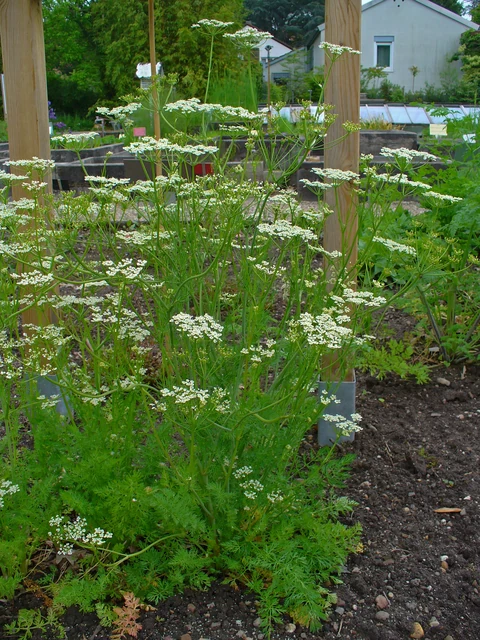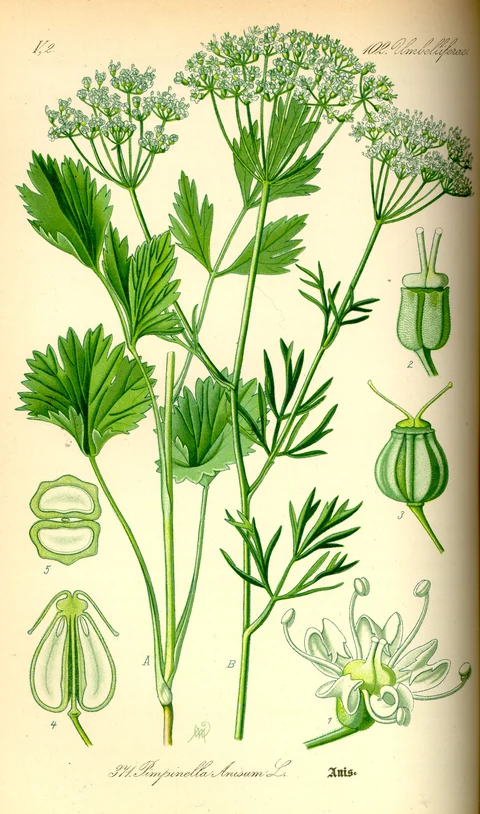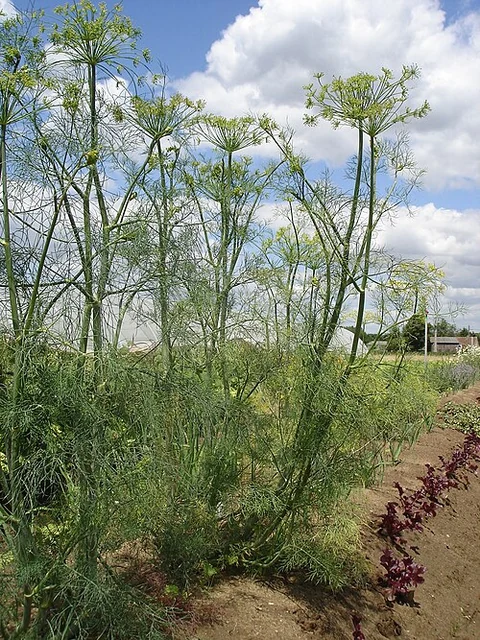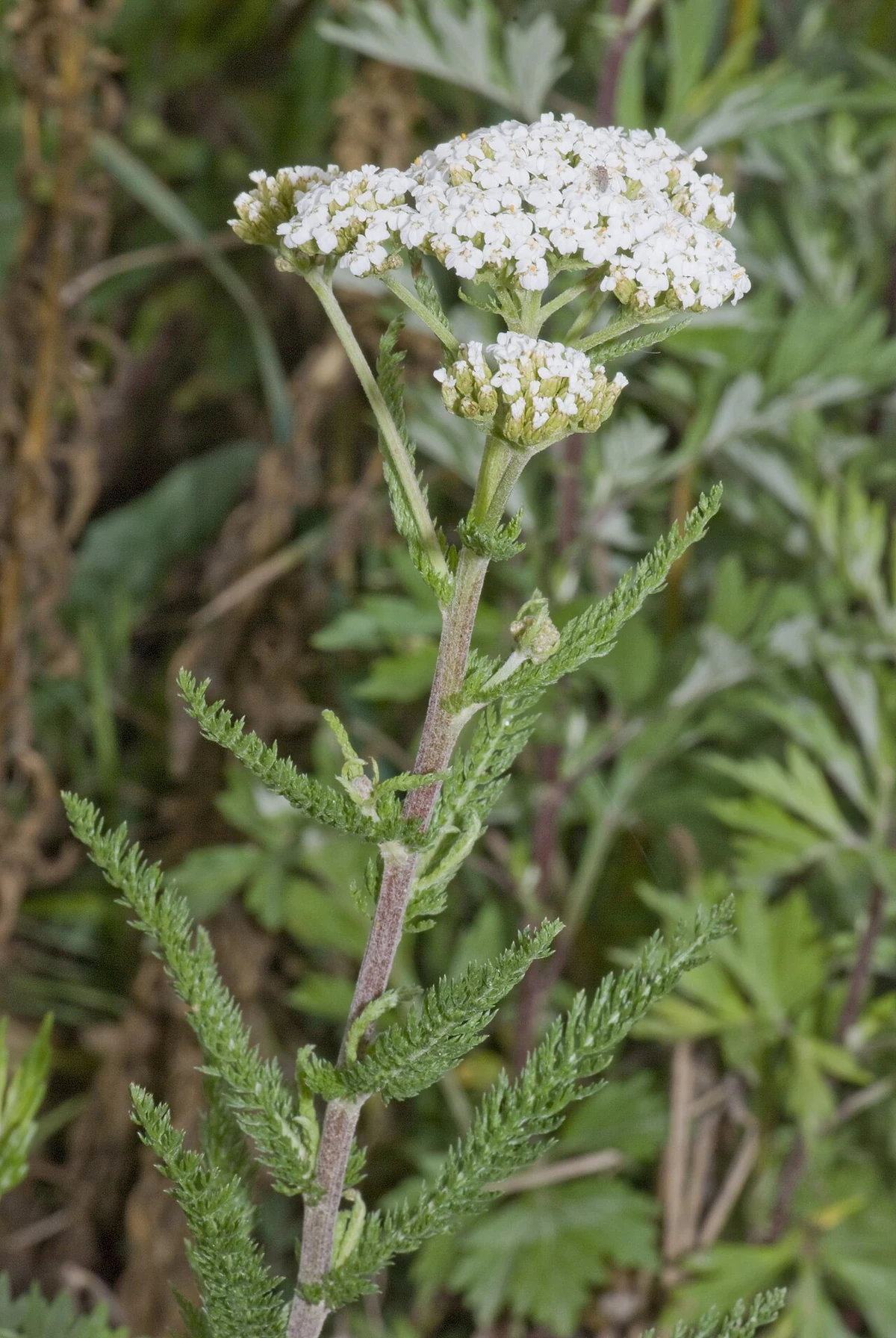
Yarrow (Achillea millefolium): pale flower clusters and finely divided leaves. Resized and converted to WebP; no cropping or content edits.
O. Pichard · CC BY-SA 3.0 · Source · EXIF orientation respected; resized without cropping or upsampling; converted to WebP at quality 88. No other content edits.
A thousand leaves and many names
Yarrow's finely divided leaves explain the old name milfoil. A flowering stem carries a relatively flat cluster of many small composite heads, usually white or pink in common wild plants. It is widespread in European grasslands and waysides. The flowering aerial parts are the relevant material here; ornamental Achillea varieties and related species are separate plants.
Culpeper describes the divided leaves and clustered flowers, then records a late-August flowering time. That is an observation from his own English setting. Fernie's entry adds names associated with soldiers, carpenters and blood. The names record the plant's reputation as a herb for wounds and bleeding.
The soldier's herb and the household cut
The story of Achilles learning the herb's virtues from Chiron gave yarrow a prestigious ancient ancestry. Both writers recount this association. The myth explained both the plant's Latin name and its reputation.
Culpeper favours an ointment for wounds and a decoction for several complaints he interprets as requiring a drying or binding action. Fernie records bruised herb, poultices, lotions and ointments. These accounts document a long external wound-herb tradition, and both authors extend the herb to internal bleeding and serious disease as well.
A second history: love, luck and contradiction
Fernie's account preserves a striking contradiction in the name nosebleed: yarrow was said both to check bleeding and to provoke it when put into the nose. A love-divination verse used the latter result as an omen. The physical irritation and the interpretation of a sign belonged to the same practice.
He also reports wedding associations in parts of England and amuletic use against ague. His discussion eventually shifts to sneezewort, Achillea ptarmica, in a witchcraft account. That story belongs to sneezewort rather than yarrow. Folk use was not a single consistent system; a plant could be medicine, charm and social symbol at once.
Sources: [F]
Krwawnik, rannik and the village wound herb
Udziela records the widespread name krwawnik, alongside rannik at Dobczyce and sierpownik at Polanka Haller. The first two names echo blood and wounds. His informants also distinguished red and white forms by flower colour.
At Dobczyce fresh leaf juice was expressed onto recent injuries, while notes from Bieżanów and Wieliczka describe leaves rubbed in the hands and applied to a wound. The distinction between expressed liquid and crushed plant tissue is small but real: one removes some solid material, while the other places it directly on the skin. The record shows a quick household response to an injury, using a plant that grew close at hand.
Other uses move beyond injuries. Dobczyce informants put the herb into baths for weak children or adults; Wieliczka notes mention a drink for the stomach and for dysentery. At Polanka Haller chopped sierpownik was mixed with egg or bread for young turkeys, particularly when they digested poorly. It is a farmyard remedy, kept here beside the human ones as Udziela recorded it.
Sources: [U]
A medicine carried rather than swallowed
Fernie's amuletic examples change what preparation means. He reports yarrow carried in a little bag over the stomach against ague, with the anecdote associated with Boyle. In another account a packet of dried herb promises success through a secret Christian story about the young Jesus. Neither action depends on extracting a constituent into water or alcohol. Drying, enclosing and carrying the plant are the meaningful operations.
That difference is useful when interpreting folk medicine. An amulet and an infusion might be used for the same named complaint while relying on different explanations. The first involves protection, story and the authority of a transmitted secret; the second involves a swallowed substance. Both belong to folk medicine, and both are preserved in the record.
The regional social customs add a further layer. Fernie reports double-flowered yarrow at weddings in Gloucestershire and elsewhere, and a Cheshire children's game using its tingling contact with the face. The wedding association concerns a particular cultivated form, while the game involves a sensory effect and a local name. Each custom belongs to its own region, and both are separate from the sneezewort episode in his witchcraft discussion.
Sources: [F]
The old preparations and their names
Culpeper's drying and binding description links yarrow with ointments, wine decoctions and several conditions involving unwanted discharge. Fernie preserves a stronger simmered preparation, fresh juice and a tincture framed partly through homeopathic ideas. Each belongs to its own medical system and is described here in its own terms.
The European Medicines Agency's monograph lists the modern preparation categories separately: expressed fresh juice, a liquid extract, specified tinctures and dry extracts. A concentrated dry extract's ratio refers to the plant material represented in the extract. Seen beside these, the old herbals show how many of the same forms, from juice and simmered preparations to tinctures, were already part of the tradition.
Collecting and preparing the flowering herb
Editorial collection guidance is to choose healthy, positively identified flowering tops from a clean, permitted location, leaving roots and much of the flowering population intact. Gather when surface moisture has gone, dry loose material with ventilation and keep the finished herb labelled and protected from damp. Local flowering stage matters more than Culpeper's late-August observation.
The European Medicines Agency's monograph on yarrow, written for traditional herbal medicinal products, records the traditional adult infusion as 1.5–4 g of the dried, cut herb in 150–250 ml of boiling water, within traditional use for poor appetite and mild digestive complaints. The agency's tea-preparation template describes the method: the herb is covered with freshly boiled water, left covered for five to fifteen minutes and strained. It continues the stomach drink recorded at Wieliczka.
A decoction continues heating and may reduce the liquid. Fernie calls one such concentrated preparation an infusion, so the method described matters more than the label alone. His juice, alcoholic tincture and ointment are separate products: pressing, solvent extraction and incorporation into fat do different jobs.
Wound herb, bitter tea and charm
Yarrow's two strongest threads run unbroken through the sources: the wound plant and the bitter household herb. Culpeper and Fernie record its ointments, poultices and decoctions. Udziela's villagers pressed its juice onto fresh cuts, bathed weak children and adults in it and drank it for the stomach, and English custom carried it in amulets, wedding flowers and love divination. Today the European Medicines Agency describes specified yarrow preparations on a traditional-use basis for temporary poor appetite, mild digestive complaints, minor menstrual cramps and small superficial wounds, with its own conditions of age and use.
The names that link it with soldiers, carpenters, blood and wounds, krwawnik and rannik among them, say the rest: this was the plant people reached for when blood was drawn.
Sources
- [C] Nicholas Culpeper. The Complete Herbal (1850). Yarrow, called Nose-bleed, Milfoil and Thousand-leaf, pp. 198–199
Historical descriptions and uses
Medical claims are historical; publication is the expanded 1850 edition.
- [F] William Thomas Fernie. Herbal Simples Approved for Modern Uses of Cure, second edition (1897). Yarrow, printed pp. 616–619
Period practices and attributed customs
Not current medical advice; botanical errors are corrected in the article. Harvest and food-hygiene instructions are editorial.
- [E] European Medicines Agency, HMPC. Millefolii herba: public summary (2020). Preparation and safety sections; accessed 29 October 2026
Boundaries of specified traditional-use products
Does not verify broad historical cure claims.
- [U] Seweryn Udziela. Rośliny w wierzeniach ludu krakowskiego, Lud 30 (1931). Entry 2, Achillea millefolium; field collection 1894–1899
Wound-plant names, expressed juice, baths, poultry feed and local practices
Reports old practice; does not establish safe care for wounds, dysentery or sick animals.
- [M] European Medicines Agency, HMPC. European Union herbal monograph on Achillea millefolium L., herba, revision 1 (2020). Printed pp. 3–6, preparation definitions and posology
Infusion quantities and distinction between juice, tinctures and other extracts
Limited traditional-use indications; not an emergency bleeding remedy.
- [T] European Medicines Agency, HMPC. Patient Leaflet template concerning advice on the preparation of herbal teas as (traditional) herbal medicinal products by end-users (2016). Printed pp. 4–7, definitions and preparation templates
Usual infusion timing, covering, straining and preparation immediately before use
General method; a product-specific instruction takes precedence and plant quantities come from the individual monograph.