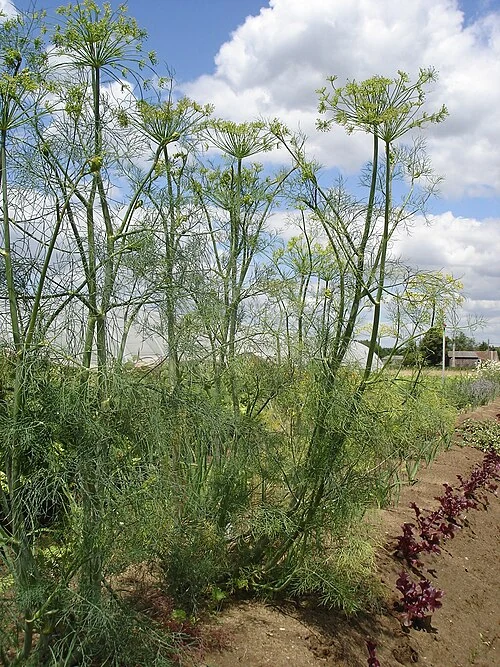
Dill (Anethum graveolens): tall stems, fine leaves and umbels. Resized and converted to WebP; no cropping or content edits.
Tepeyac · CC BY-SA 3.0 · Source · EXIF orientation respected; resized without cropping or upsampling; converted to WebP at quality 88. No other content edits.
A garden annual with two useful harvests
Dill is an annual with finely divided leaves, yellow umbels and flattened aromatic fruits. It has long been grown in European gardens for cooking and household medicine. The leafy green herb and the ripe fruits often called seeds have different flavours and are gathered at different stages.
Culpeper explicitly compares dill with fennel and notes that the resemblance can deceive. His observation remains relevant: a named garden crop was the herbalist's surest source.
A medicine for wind in the old household
Culpeper gives the fruits a stronger role than the leaves in preparations intended to dispel wind. He describes bruised fruits, wine decoctions, oils and external applications. The instruction to bruise a fruit before extraction is a practical detail: the aromatic material is less accessible while the fruit remains whole.
Fernie puts distilled dill water at the centre of a nursery tradition and records its reputation among mothers and nurses. His confident language belongs to the nineteenth century, and it documents the remedy's central place in the nursery.
Food, literature and household expectation
Fernie mentions dill leaves and fruits in pickles and cites literary associations with fragrance and protection. His examples include a charm-like verse in Walter Scott's fiction. A literary use shows how a plant's reputation was recognisable to readers.
Dill's culinary history is a direct route into practice. Leaves lend freshness to cooked vegetables, fish and sauces; ripe fruits bring a stronger flavour to seasoned foods.
Sources: [F]
How to handle the two harvests
Editorial collection guidance: Cut young leafy growth from a healthy cultivated plant as needed, leaving sufficient growth to recover. Wash it before food use and use it promptly; delicate leaves lose much of their fresh character with prolonged storage. For fruits, allow selected umbels to ripen, collect before excessive shedding and dry in a ventilated place. Rub out the dry fruits and remove stalks and debris.
A water infusion of ripe fruits and a distilled dill water are different preparations. An infusion steeps lightly bruised material in hot water, then strains it. A distilled water is collected from vapour produced during a controlled process. Essential oil is a more concentrated aromatic product again. The word water in an old recipe does not always mean a cup made like ordinary tea.
For a practical culinary demonstration, chop washed leaves into a freshly prepared sauce or a cooked potato dish. This preserves the garden-to-table connection that runs through the plant's history.
Present-day editorial handling guidance, not a recipe or a claim attributed to the historical author. Historical source supports identity, part and use only.
A fragile fruit crop and a strong kitchen flavour
Grieve describes cutting a fruit crop with as little shaking as possible to reduce losses, then threshing the dried material on a cloth. Her account makes the harvest a matter of handling as well as timing. The flat fruits can be lost before they reach the jar. She also records dill vinegar made by steeping fruits in vinegar for several days, and culinary uses in French pastry and German cucumber pickles.
The old recipes reproduced in her entry show different operations: a cauliflower pickle uses a strained vegetable liquor with dill, seasoning and vinegar, while a cucumber preparation layers the vegetables with ripe dill tops. These are useful descriptions of flavouring and arrangement, in which the vinegar preserved and the dill flavoured.
Sources: [G]
Culpeper's dill was more than a stomach tea
Culpeper's account differentiates herb and fruit and explicitly says to bruise the fruit if it is to be boiled. That instruction recognises a material obstacle: an intact aromatic fruit is not the same starting substance as one whose surface has been broken. He also describes preparations in wine, oils and plasters, and a bath-like external application for complaints associated with the womb. These belong to several routes of use.
His account of hiccup includes smelling material tied in a cloth as well as a wine preparation. This makes scent itself part of the medicinal operation, distinct from swallowing. The external oils and plasters were intended within a language of warming and dissolving humours.
He considers the root unprofitable and notes that the plant dies after producing seed. The negative observation is useful: not every part of a medicinal species was valued equally. The yearly cycle favoured leaf and fruit harvests rather than a permanent supply of roots.
Sources: [C]
The nurse's water and the poet's charm
Fernie's dill chapter begins with mothers and monthly nurses. Their presence places the aromatic water in the social world of household childcare and childbirth, where people sought relief from crying, wind and discomfort. He couples this with references to adult indulgence at the table. The same reputation for settling the belly could therefore be applied to very different patients.
The literary material occupies another register. Fernie links dill with Drayton and with the protective verse associated with Meg Merrilies in Walter Scott's fiction. Such passages show that the plant could carry a recognisable magical atmosphere for readers. They show how folklore was retold in literature.
The ordinary kitchen offers a clear practical encounter with the plant. For an immediate-use sauce, wash known dill leaves, dry off excess surface water, chop them and stir a modest amount into the finished sauce just before serving. For cooked potatoes, add the chopped leaves to the hot finished dish and mix gently. These are editorial culinary adaptations, not historical doses. The delicate leaf and the more concentrated flavour of the ripe fruit should be tried as separate ingredients rather than exchanged spoon for spoon.
This distinction is also helpful when reading a bottle labelled dill water. The old pharmaceutical water may have involved distillation, whereas a household steep merely brings plant and hot water together. The name records a type of preparation, not a guarantee that every bottle or home recipe has the same contents. That material history is central to understanding why such a familiar kitchen herb acquired a much broader medicinal reputation.
From the nursery to the pickle jar
Dill's history runs through the whole household. Culpeper valued its bruised fruits in wines, oils and plasters and tied it in a cloth to be smelled against hiccup. Fernie made its distilled water the remedy of mothers and monthly nurses and found it in pickles and in Walter Scott's charm. Grieve followed its fragile fruit crop, dill vinegar, French pastry and German cucumber pickles.
The delicate leaf and the stronger ripe fruit remain two distinct gifts of one garden annual: one for the table, the other for the old digestive waters.
Sources
- [C] Nicholas Culpeper. The Complete Herbal (1850). Dill
Historical preparation and use
Expanded 1850 edition, not present-day treatment advice.
- [F] William Thomas Fernie. Herbal Simples Approved for Modern Uses of Cure, second edition (1897). Dill, printed pp. 156–157
Recorded culinary and medicinal traditions
A period source with errors and obsolete claims, not a modern field guide. Harvest and kitchen hygiene notes are editorial.
- [G] Maud Grieve. A Modern Herbal: Dill (1931). Harvesting, uses and old-fashioned recipes
Harvest handling, dill vinegar and historical pickle operations
Historical compilation with outdated nomenclature and an erroneous family heading; old pickle formulas are not modern preservation guidance.