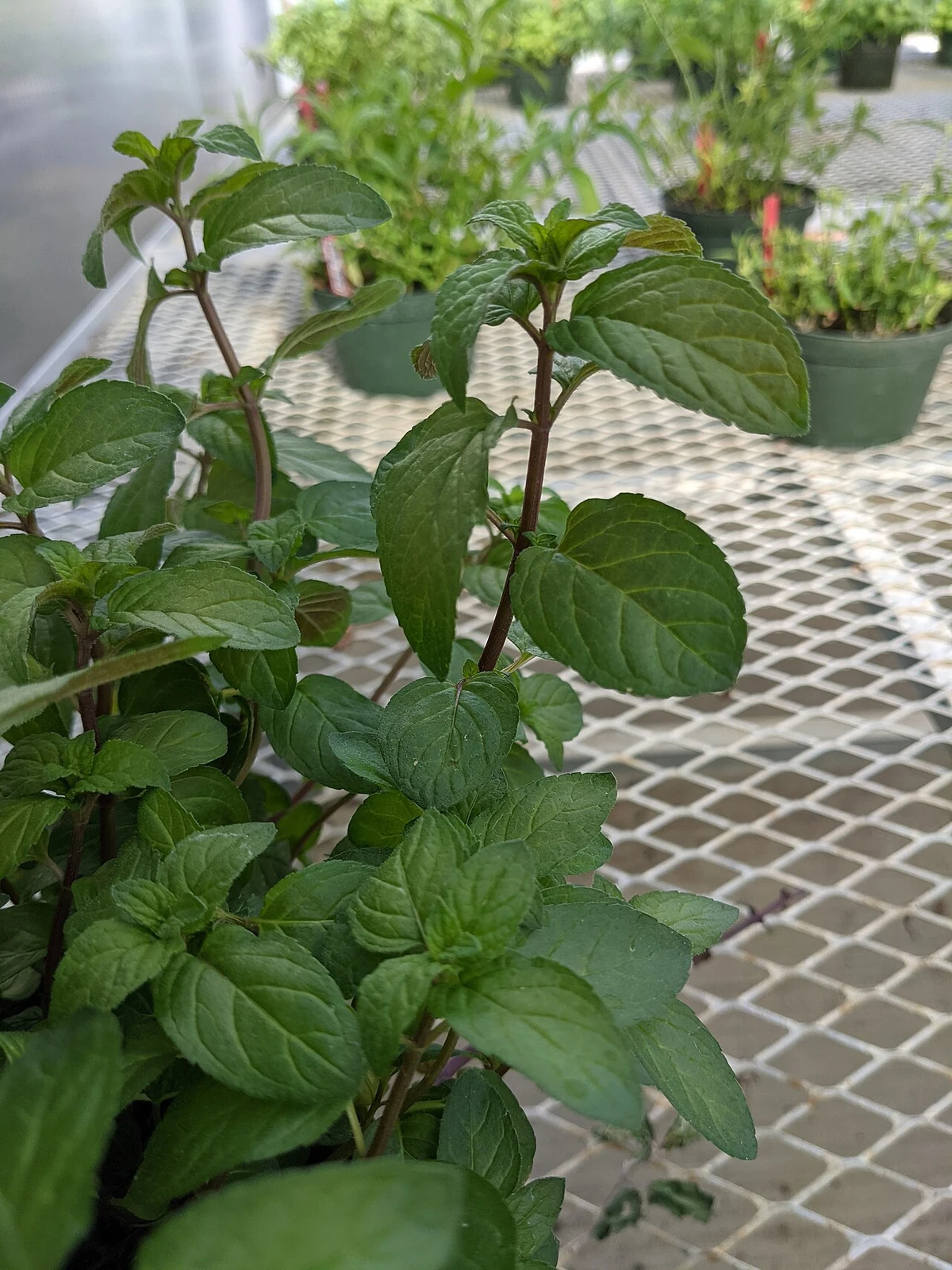
Leaves and stems of peppermint (Mentha × piperita). Resized and converted to WebP; no cropping or content edits.
Joshua T Polito · CC0 · Source · EXIF orientation respected; resized without cropping or upsampling; converted to WebP at quality 88. No other content edits.
A hybrid with a recognisable but complicated identity
Peppermint belongs to the mint family and is a hybrid, conventionally written Mentha × piperita. Its aromatic leaves, opposite leaf pairs and spreading underground stems explain its familiarity in gardens. Europe contains many mints and hybrids, so a mint-like smell alone is inadequate identification. Pennyroyal is a different mint with its own separate history.
The medicinal material considered here is the leaf. The flowering aerial parts appear in older accounts of cultivation and distillation, but that does not make every preparation equivalent. Culpeper's Mint entry explicitly foregrounds spear mint. It is evidence for earlier mint herbalism, not a secure seventeenth-century peppermint monograph.
From garden mint to a commercial aromatic
Fernie describes peppermint cultivation at Mitcham and the distillation of the harvested herb. His account reveals a plant that had moved beyond the household garden into specialised production. He distinguishes black and white peppermint by stem colour and discusses different oil yields. The value of the plant was simultaneously agricultural, sensory and medicinal.
The main domestic use in his account is carminative: a warm aromatic preparation for wind, colic and digestive discomfort. He also records external use of bruised leaves and the popularity of lozenges. The book goes further, recommending peppermint oil for tuberculosis, diphtheria and infected wounds, a sign of how late-Victorian enthusiasm for antiseptics carried a familiar herb into new areas of medicine.
Sources: [F]
Mint around Kraków: tea, broth and a troublesome indication
Udziela's entry explicitly headed Mentha piperita supplies a regional counterpart to Fernie's English account. In Bieżanów, Brzezowa, Radziszów and Skawina, the recorded direction is to infuse the herb without allowing the drink to boil. At Rzeszotary the drink could include rum. The contrast matters: a plain leaf infusion and an alcoholic addition are local variants, not interchangeable evidence that alcohol was necessary to extract the plant's useful qualities. His notes associate these preparations with abdominal pain and cramps, and with other, more serious complaints.
The same entry describes fresh leaves applied for headache in Wieliczka, softened herb used around a sore throat in Bogucice, and mint added to broth in Polanka Haller. It also records blessings on 15 August. Culinary, devotional and medicinal uses thus coexist within the same collection. Each use kept its own place in the household.
One observation deserves a place of its own: at Polanka Haller, informants reported peppermint for heartburn. It is a precise local record of what people in that village did, kept here as Udziela wrote it down.
Sources: [U]
A field crop on the edge of London
Fernie's Mitcham passage brings the reader to a different environment: cultivated mint grown for a distillation trade. Here the raw material has to reach an apparatus, and the desired product is aromatic oil. The accompanying condensed water may itself have a use, but the production aim and strength differ from those of a kitchen infusion. Harvest accounts of whole flowering tops therefore describe the distiller's crop rather than the leaf gathered for tea.
His discussion of black and white peppermint links visible plant differences, yield and commercial judgement. A high yield was economically attractive, and oil and tea remained different products. The account belongs to a wider Victorian marketplace in which mint could be sold as leaves, aromatic water, spirituous essence and lozenges. A single plant name on these goods concealed substantially different manufacturing processes.
Fernie follows peppermint with discussion of menthol and products circulating beyond Britain. The chapter is therefore evidence for trade and contemporary pharmacy as well as for rural tradition. It records a nineteenth-century trade as much as an inherited rural practice.
Sources: [F]
Why the older spear-mint chapter still matters
Culpeper's Mint entry is useful precisely because it does not securely describe this hybrid. He foregrounds spear mint, garden cultivation and spreading roots, then ranges through juice, vinegar combinations, external mixtures and distilled preparations. Keeping that species boundary visible lets his entry show the kinds of work a household performed with mint. Pressing fresh leaves, steeping dried leaf and distilling an aromatic water are different operations even when an author groups them under one familiar plant name.
Udziela's adjacent entries make the naming problem visible in another language. Bird mint, horse mint and a mint called kogutki receive separate records, some without a settled species name. A milk-related custom recorded under horse mint belongs to that plant, not to peppermint. The collector himself warns elsewhere that neighbouring villages may use several names for one plant, or one name for several plants. Botanical uncertainty is part of the historical evidence, not an inconvenience to conceal.
A household notebook that records the botanical name and the source of the planting stock beside each preparation preserves exactly the information that many older labels omit.
Leaf harvest and storage
Editorial collection guidance: Harvest healthy leaves or leafy tops during vigorous growth, generally before or around early flowering. In temperate European gardens the useful season often spans late spring and summer, with further cutting possible after regrowth. A fixed calendar date makes less sense than the condition of the plant. Avoid roadside dust, contaminated waterways and plants recently treated with garden chemicals.
Dry leaves promptly in a thin layer or small, loose bundles in shade with moving air. Strip out coarse stems for a leaf preparation. Store only when dry, in a closed, labelled container away from light and heat. Keep the leaves relatively whole until needed: crushing increases the surface from which the characteristic aroma can escape.
Present-day editorial handling guidance, not a recipe or a claim attributed to the historical author. Historical source supports identity, part and use only.
Sources: [F]
What a tea, tincture and mint water actually are
The European Medicines Agency's monograph on peppermint leaf, written for traditional herbal medicinal products, records the traditional adult tea as 1.5–3 g of dried leaf in 100–150 ml of boiling water, within traditional use for minor digestive complaints. The agency's tea-preparation template describes the method: the leaf is covered with freshly boiled water, left covered for five to fifteen minutes and strained. It is a fresh infusion rather than a decoction boiled down, the same distinction Udziela's informants drew when they let the drink infuse without boiling.
A leaf tincture was made with a measured water–ethanol solvent, followed by extraction and filtration; the monograph distinguishes 1:5 tinctures made with 45% and 70% ethanol. Fernie also describes essences made from peppermint oil and distilled peppermint water. An essence of this kind was not a leaf tincture, and the trade sold leaves, waters, essences and lozenges as distinct goods.
Garden, trade and household
Peppermint's history joins several worlds. In Fernie's account it was a field crop at Mitcham, distilled for oil and sold as waters, essences and lozenges. In Udziela's villages it was an infusion for abdominal pain and cramps, a fresh leaf laid on for headache, a softened herb around a sore throat, a seasoning for broth and a herb blessed on 15 August. Today the European Medicines Agency describes peppermint leaf preparations within its traditional-use framework, with its own conditions of age and use.
Few herbs show so clearly how food, garden craft, commercial distillation and household medicine became intertwined.
Sources
- [C] Nicholas Culpeper. The Complete Herbal (1850). Mint, printed pp. 117–118
Explicit focus on spear mint and historical mint preparations
Not species-specific evidence for peppermint.
- [F] William Thomas Fernie. Herbal Simples Approved for Modern Uses of Cure, second edition (1897). Mints (Pennyroyal, Peppermint, and Spearmint), peppermint subsection
Mitcham cultivation, leaf infusion, distilled water, essences and lozenges
Toxicology and infectious-disease claims are obsolete; page number omitted because the transcription contains an inconsistent page marker.
- [E] European Medicines Agency, HMPC. Menthae piperitae folium: summary and monograph (2020). Overview and risks; accessed 29 October 2026
Leaf preparation scope, reflux and biliary cautions
Does not cover all essential-oil preparations.
- [U] Seweryn Udziela. Rośliny w wierzeniach ludu krakowskiego, Lud 30 (1931). Entries 80, Mentha piperita, and 81–81b, other mints; field collection 1894–1899
Local infusion practice, compresses, culinary use, blessings and distinction between vernacular mint names
Other Mentha entries are not all botanically resolved; historical use for heartburn conflicts with current peppermint cautions.
- [M] European Medicines Agency, HMPC. European Union herbal monograph on Mentha × piperita L., folium, revision 1 (2020). Printed pp. 3–5, preparation definitions and section 4.2
Adult leaf-infusion quantity, tincture specifications and reflux warning
Leaf preparations only; quantities do not apply to essential oil or substitute mint species.
- [T] European Medicines Agency, HMPC. Patient Leaflet template concerning advice on the preparation of herbal teas as (traditional) herbal medicinal products by end-users (2016). Printed pp. 4–7, definitions and preparation templates
Usual infusion timing, covering, straining and preparation immediately before use
General method; a product-specific instruction takes precedence and plant quantities come from the individual monograph.