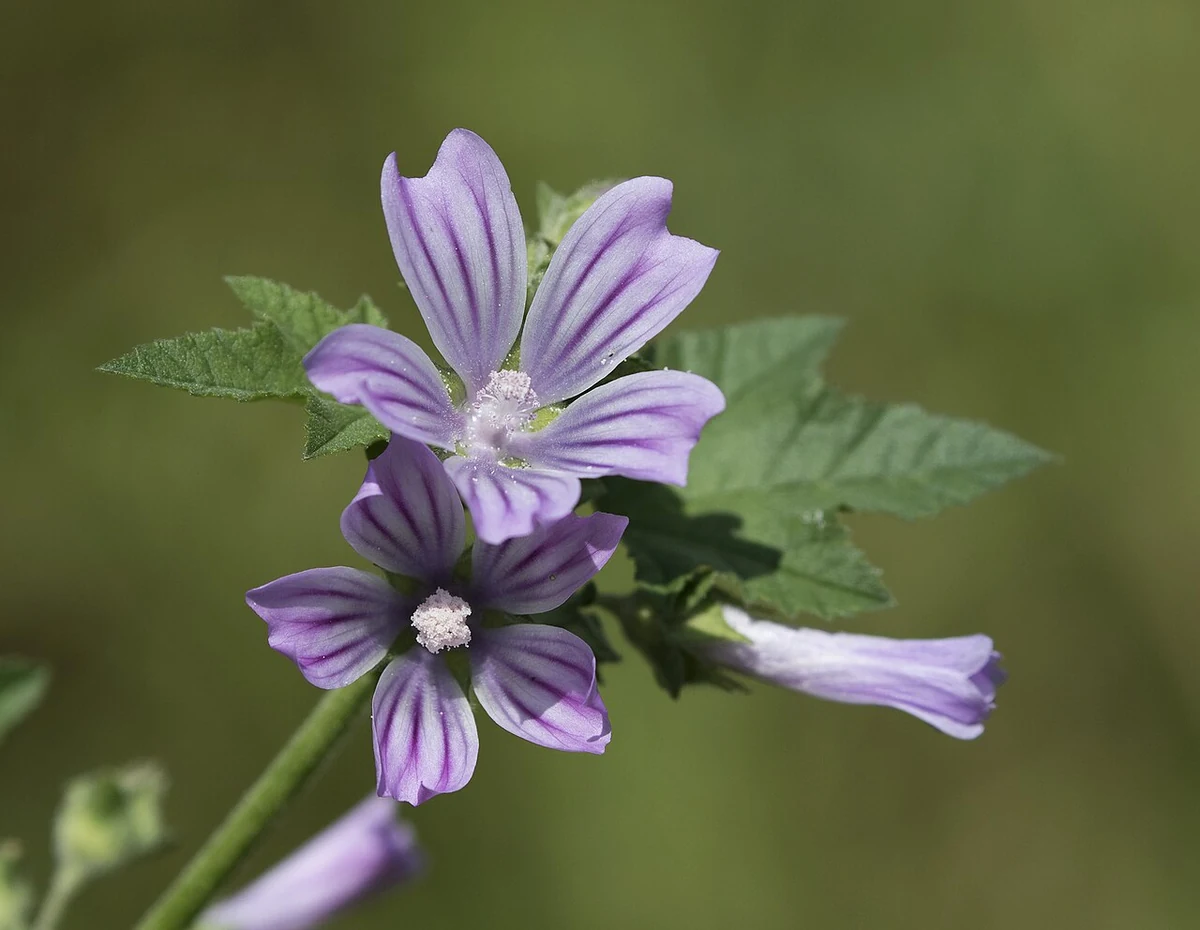
Common mallow (Malva sylvestris): purple flowers with darker veins. Resized and converted to WebP; no cropping or content edits.
Zeynel Cebeci · CC BY-SA 4.0 · Source · EXIF orientation respected; resized without cropping or upsampling; converted to WebP at quality 88. No other content edits.
A plant recognised by flowers and fruits
Common mallow carries rounded, lobed leaves and pink-purple flowers with darker veins. The flat, segmented fruits inspired comparisons with little cheeses. It grows in many parts of Europe on disturbed ground, field margins and around settlements. Such familiarity helped it become both a food plant and a household remedy.
It is not marshmallow root under another name. Malva sylvestris flowers and leaves are the relevant parts of this article, whereas the separate Althaea article concentrates on the root. Other mallows exist, each a plant of its own. Fernie assures his readers that the whole mallow family has no harmful properties.
Food, play and a softening medicine
Fernie records children eating the immature cheese-like fruits and mentions regional names such as pickcheeses. He also draws on classical food references and the use of mallow as a softening vegetable. These details place the plant in everyday activity, rather than only in the medicine chest.
Culpeper treats common mallow and marshmallow together, attributing cooling, softening and loosening effects to the preparations. His leaves could enter broth, a warm application or a compound poultice. The texture of a cooked or wetted plant helped support those explanations. His account also includes a personal story of curing a severe bloody bowel illness, told in full below.
Little cheeses in children's hands
The rounded fruit is central to Fernie's account of common mallow. Its divided disc suggested a miniature cheese, producing names such as pickcheeses and bread and cheese. In Norfolk and elsewhere, he reports, children knew it as something to gather and eat. That memory belongs to a landscape in which play, looking closely and learning the names of ordinary plants happened together.
Fernie reinforces the recollection with John Clare's poetry: the fruit becomes a tiny wheel in an imagined fairy carriage and an object of the poet's own childhood play. The image depends on the plant's physical form. It tells us why a modest weed could remain vivid in memory even when its flowers were less celebrated than a garden rose.
The source also gives the Sussex name maller and pairs it in local speech with ground ivy. That pairing records an association in local speech rather than botanical kinship. Fruit names, children's games and dialect preserve kinds of knowledge that an apothecary's list of ingredients does not.
Sources: [F]
Leaves, flour and oil in the household pharmacy
Culpeper's common-mallow passages often begin with material already softened by cooking. Leaves enter broth, are applied warm or are bruised into a compound with flour and oil. Flour changes the body's consistency; oil provides another carrier; the cooked leaf supplies moist plant material. Explaining these roles makes the historical preparation more intelligible than merely listing poultice among the possible products.
His treatment of milk, wine and water likewise reflects different household resources. A milk preparation belongs to a food-like sickroom drink, while wine carries other associations of strength and extraction. A syrup or conserve adds a sweet preserving medium. The original entry moves easily between these forms because it is organised around the plant's supposed softening character, not around one standard formula.
The distinction from marshmallow becomes especially important here. Culpeper groups the two plants, but gives marshmallow root particular prominence. Fernie is even more explicit about the root he prefers for a strongly mucilaginous preparation. Althaea root and common-mallow root therefore keep their separate places, and common-mallow leaves and flowers have their own substantial history.
A father's remedy and a challenge to learned medicine
Near the end of his combined mallow entry, Culpeper tells a personal story about his son's severe bowel illness. He says he was called back from the country, used bruised mallow boiled in milk and drink, and attributed the recovery to God's blessing. The passage combines parental urgency, a household ingredient, religious gratitude and criticism of physicians who, in his telling, had failed to understand the epidemic.
Its rhetorical purpose matters. He presents the remedy as knowledge worth leaving to posterity rather than reserving for a professional circle. Readers are being invited into a moral economy of shared help. The passage is a father's testimony, written so that others could use what he had learned.
Fernie's chapter looks back further, citing classical authors who associated mallow with food and relief of constipation. Those references reach this article through his compilation. They establish a long literary reputation around eating and softening.
Keep flower and leaf harvests distinct
Editorial collection guidance: Collect flowers as they open in dry conditions and leaves while they remain healthy and clean. Mallow can flower over an extended summer season, but latitude, drought and local disturbance alter the pattern. Harvest from a positively identified plant in a permitted clean place, avoiding busy verges, sprayed ground and waste sites.
Spread flowers thinly for drying, handling them gently. Dry leaves separately if they will be stored as a separate material, and label the part clearly. Moisture trapped in a mixed bundle can spoil the crop. Retain enough flowers for insects and seed production. The aim is a sound, traceable herbal material.
Present-day editorial handling guidance, not a recipe or a claim attributed to the historical author. Historical source supports identity, part and use only.
From the cooking pot to a flower infusion
The documented leaf tradition can still be followed in the kitchen (a present-day adaptation): identified young leaves are washed, trimmed of damaged material and coarse stalks, chopped and cooked in a soup or vegetable dish until tender, so that the softened leaf stays in the food.
The European Medicines Agency's monograph on mallow flower, written for traditional herbal medicinal products, records the traditional adult infusion as 1–2 g of dried Malva sylvestris flowers in 250 ml of boiling water. The agency's tea-preparation template describes the method: the flowers are covered with freshly boiled water, left covered for five to fifteen minutes and strained. The result is a water preparation, distinct from a marshmallow-root syrup.
Old poultices mixed softened leaves with flour or oil, while gargles could contain honey or alum: households adapted texture and consistency to the intended route.
A common plant in every part of life
Common mallow's history moves easily between play, the kitchen and the sickroom. Children gathered its little cheeses and named them pickcheeses and bread and cheese; John Clare made the fruit a fairy wheel; Culpeper cooked its leaves in broth, bound them with flour and oil and boiled them in milk for his son; and classical authors, through Fernie, knew it as food and as relief for constipation. Today the European Medicines Agency describes mallow flower preparations within its traditional-use framework for mouth and throat irritation with dry cough and for mild digestive discomfort, with its own conditions of age and use.
The plant's culinary and domestic history is as substantial as its medicinal one.
Sources
- [C] Nicholas Culpeper. The Complete Herbal (1850). Mallows and Marshmallows, pp. 111–112; common-mallow passages
Period herbal description and preparation history
Expanded 1850 edition; historical claims are not treatment advice.
- [F] William Thomas Fernie. Herbal Simples Approved for Modern Uses of Cure, second edition (1897). Mallows, printed pp. 322–325; common-mallow passages
Historical preparation and folklore
Contains obsolete claims and botanical conflations; practical harvest and hygiene notes are editorial.
- [E] European Medicines Agency, HMPC. Malvae sylvestris flos: public summary (2019). Definitions and safety sections, accessed 29 October 2026
Current boundary around specified preparations
Not validation of all historical claims.
- [M] European Medicines Agency, HMPC. European Union herbal monograph on Malva sylvestris L., flos (2018). Printed p. 4, section 4.2
Flower-infusion quantity and traditional-use scope
Flower monograph, not a recipe for every mallow leaf, root or ornamental species.
- [T] European Medicines Agency, HMPC. Patient Leaflet template concerning advice on the preparation of herbal teas as (traditional) herbal medicinal products by end-users (2016). Printed pp. 4–6, infusion definition and preparation
Usual infusion time, covering and straining
General preparation guidance, subordinate to a product's specific instructions.