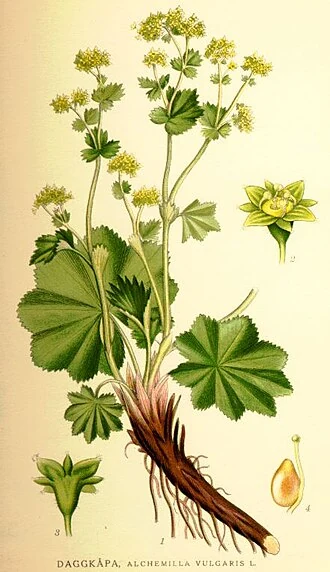
Lady's mantle labelled Alchemilla vulgaris in a historical botanical plate by Carl Axel Magnus Lindman. Resized and converted to WebP; no cropping or content edits.
Carl Axel Magnus Lindman · Public domain · Source · EXIF orientation respected; resized without cropping or upsampling; converted to WebP at quality 88. No other content edits.
A folded leaf is the starting point
Lady's mantle has rounded, lobed, pleated leaves with toothed edges and loose clusters of small yellow-green flowers. The genus Alchemilla contains a difficult set of related European taxa, and older writers often used a broad name. Alchemilla vulgaris in an old herbal is therefore best treated as a historical aggregate unless a specimen supports a more precise identification.
Culpeper describes the leaf's folds and its star-like outline, and locates the plant in pastures and woodland margins in several English counties. The leaf and flowering aerial parts are the relevant material. A large ornamental garden Alchemilla also holds droplets on its leaves but belongs to another species.
Sources: [C]
A reputation for binding wounds
Culpeper places lady's mantle among wound herbs and emphasises checking bleeding and drying moist sores. He describes drinking a decoction, washing with it and incorporating liquid into dressings. He also reports that German practitioners valued the plant in wound care. This is an English herbalist's report of continental practice.
The old claim extends into deep wounds and chronic fistulas. The historical principle was binding or drying, expressed in the vocabulary of bodily fluids and tissue condition, and it explains the plant's reputation.
Sources: [C]
Women's medicine and a plant's name
The same entry contains claims about breast size, conception and retaining a pregnancy. They are important evidence of how a plant named lady's mantle was drawn into women's medicine.
The historical text connects a feminine name, a plant shape and reproductive effects, and it shows how symbolism and practice could reinforce each other in the old herbal. The claims are recorded here as Culpeper made them.
Sources: [C]
A Polish ritual record with a different emphasis
Udziela's short Alchemilla entry records names including krzyżownik at Polanka Haller and gęsie wianki at Radziszów. Its explicit practices are blessing the herb on 15 August and including it in Corpus Christi wreaths. Unlike Culpeper's entry, this passage does not supply a detailed medicinal formula.
The difference is informative. One source organises the plant around remedies, while another records its place in a religious and domestic calendar. Different collectors preserved different aspects of a plant's life, and Udziela's record keeps its place in the calendar.
Sources: [U]
A mantle, a paw and a cup of water
Grieve assembles several ways of seeing the same leaf: a mantle's scalloped edge, a lion's or bear's foot, and a radiating star. She links the mantle name with Marian association and reports stories of alchemists valuing droplets held by the foliage. These are interpretations attached to a conspicuous leaf shape and its shining droplets.
Her account also distinguishes the flowering herb, dried for use, from a root sometimes used fresh. The pictured alpine lady's mantle on the webpage is a reminder that an illustration and a broad common-name heading may refer to different members of the group. The historical interest lies in how observers described and valued the plant.
Sources: [G]
The wound dressing in Culpeper's account
Culpeper's description includes more than a drink. He reports washing wounds with a decoction and dipping material into it before placing it within a wound. His term tents refers to wound-dressing material, not a shelter. This is a concrete glimpse of historical wound care.
The claimed action is drying excessive moisture and checking inflammation or bleeding. That language helps explain why the same plant could be associated with sores, fluxes and injuries after falls. The breadth comes from a shared description of bodily condition. A moist sore and an intestinal discharge could be connected through the older idea of binding.
Culpeper also attributes high regard for the plant to Germans. His statement is evidence of what an English herbal author said about continental practice. He names no specific village or practitioner, and the report is kept here at that level.
Sources: [C]
Two feast days and the significance of a short record
Udziela's Alchemilla entry is brief but precise about the calendar. The herb was blessed on the Assumption, 15 August, and incorporated in Corpus Christi wreaths. These are distinct occasions: one has a fixed summer date, while the other moves with the church calendar.
The names krzyżownik at Polanka Haller and gęsie wianki at Radziszów show local naming alongside the more general przywrotnik. The collector's botanical heading connects these reports for the reader. Names can preserve the shape of a leaf, a ritual association or a local way of recognising a plant without mapping neatly onto every modern species boundary.
The contrast with Culpeper is substantial. His entry is dominated by therapeutic and reproductive claims, while Udziela records blessings and wreaths. The sources reveal different selections from a plant's social life: one writer sought remedies; another recorded belief and custom in particular communities.
Preserving the plant as evidence as well as material
A useful non-medicinal preparation is a documented herbarium specimen from a legally available cultivated plant. As an editorial study method, photograph the living leaf and flowering stems, note the place and date, and press a small representative portion between absorbent sheets, changing damp paper until it is dry. Keep the most cautious defensible botanical name with it. This preserves the features that prompted the mantle and paw comparisons.
If studying a ritual wreath, record its separate components and the occasion before dismantling it. The cultural object is not just a bag of interchangeable herbs. Its arrangement, names and calendar can be part of the evidence even when no medicinal preparation is documented. That approach respects Udziela's actual contribution and leaves Culpeper's different medical claims available for comparison.
The specimen-making and documentation procedure is explicitly editorial, not attributed to either historical source.
Collecting, preserving and interpreting a decoction
Editorial collection guidance: For a cultivated or legally gathered specimen, identify the plant with suitable botanical help, collect sound leaves or flowering upper parts and leave enough growth for the plant to continue. Regional flowering time and local taxon matter more than a fixed date. Dry a thin layer in shade with good ventilation and label the material with the most reliable identification available.
Culpeper's decoction meant heating plant material in water before straining; his distilled water was another process, and the wash and the dressing used the decoction in their own ways.
A blessed wreath was a ritual object with its own place in the household, apart from the herbs kept for the kettle.
Present-day editorial handling guidance, not a recipe or a claim attributed to the historical author. Historical source supports identity, part and use only.
Sources
- [C] Nicholas Culpeper. The Complete Herbal (1850). Ladies' Mantle
Historical herbal description and preparations
Expanded historical edition, not current treatment guidance.
- [U] Seweryn Udziela. Rośliny w wierzeniach ludu krakowskiego, Lud 30 (1931). Entry 6, Alchemilla vulgaris, printed p. 39; fieldwork 1894–1899
Local ethnographic practices
Regional observation and reported belief, not proof of efficacy.
- [G] Maud Grieve. A Modern Herbal: Lady's Mantle (1931). Names, description and part used
Historical naming, droplet lore and flowering-herb harvest
Older broad taxonomy; name-origin and alchemical stories are attributed accounts, not independently proven origins.