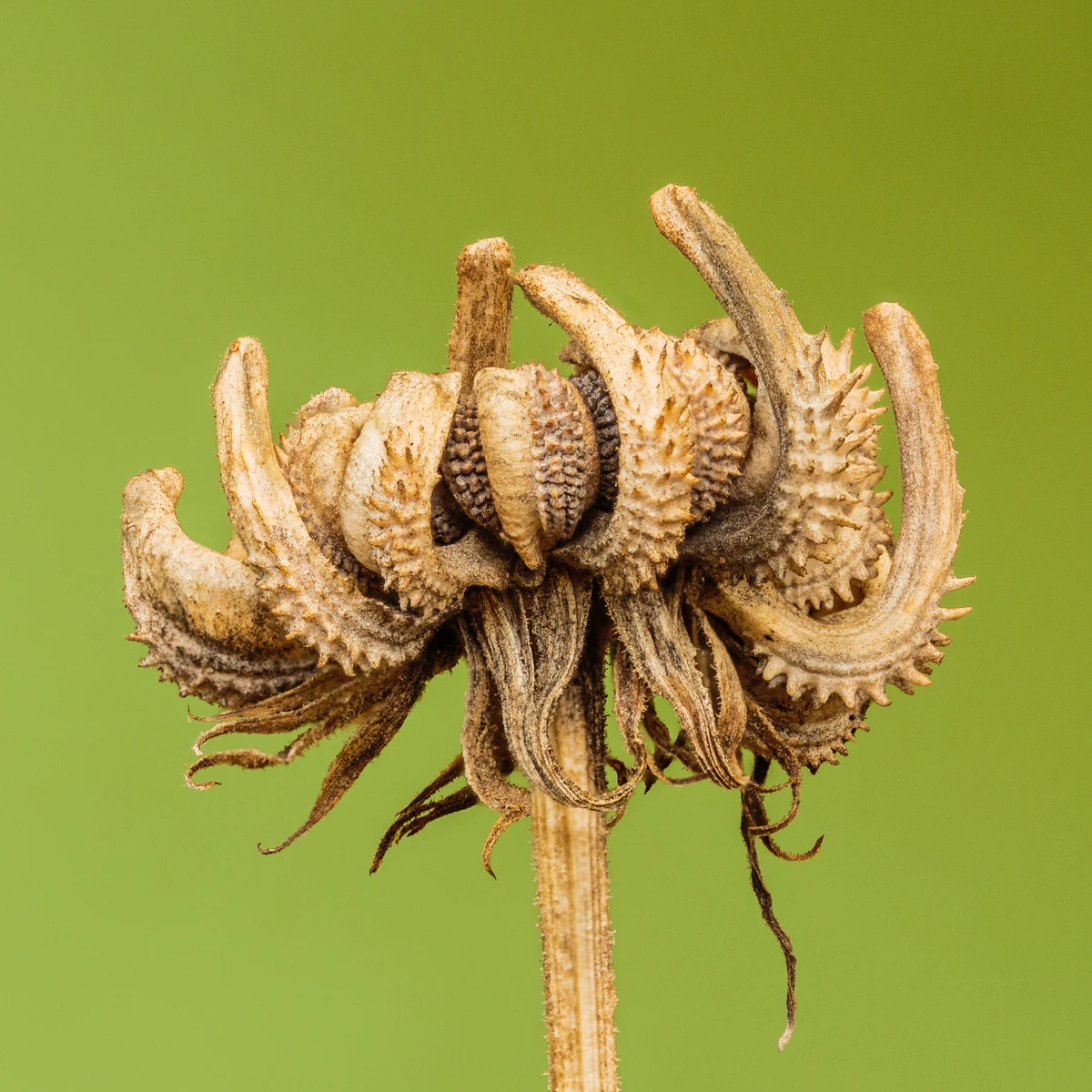
Seed head of pot marigold (Calendula officinalis), showing curved achenes. Resized and converted to WebP; no cropping or content edits.
Dominicus Johannes Bergsma · CC BY-SA 4.0 · Source · EXIF orientation respected; resized without cropping or upsampling; converted to WebP at quality 88. No other content edits.
A familiar garden flower still needs a name
Pot marigold is Calendula officinalis, a widely cultivated European garden annual or short-lived perennial with yellow to orange composite flower heads. Its sticky, aromatic foliage and curved fruits help distinguish it in a living plant. The medicinal material considered here is the flower, not an arbitrary handful of ornamental plants.
Common names create a particular trap: African and French marigolds are Tagetes, while marsh marigold is Caltha. They are different plants with their own histories. Culpeper could dispense with a description because he assumed a reader who already knew the garden plant. A modern article addressed to readers in many countries names the plant precisely.
Why the flower entered both food and medicine
Culpeper records fresh and dried flowers in broths, drinks and possets. A posset was a milk-based household preparation, often modified with other ingredients, not a modern standardised herbal product. The same flower could supply colour, flavour and a perceived comforting quality.
His entry also invokes the heart, fevers, smallpox and measles. Those claims reflect seventeenth-century medicine as transmitted in the later edition. The practical range extends outward as well: leaf juice with vinegar for swellings, and powdered flowers in a fatty, resinous plaster. A flower present in a soup and a plaster therefore had quite different carriers and routes of use.
Sources: [C]
Petals stored for the winter broth
Fernie gives unusually concrete directions for the culinary flower material. He selects a fine day when the heads are fully open, removes the green outer parts and spreads the yellow ray florets on cloth in an airy room. He says to turn them during drying, then keep them in paper bags or drawers. His method dried the separated petals, which dry far more readily than a whole thick flower head.
He quotes Gerard describing stores of dried marigolds in Dutch-land, even barrels held by grocers or spice sellers for sale in small quantities. The quotation is encountered here through Fernie; its regional expression belongs to Gerard's own time. Nevertheless, the passage describes a trade in a seasonal garden ingredient rather than only private gathering for medicine.
The use itself is straightforward: the dried ray florets went into broths and household drinks, contributing colour and their own flavour. Fernie's quotation from Charles Lamb's school memories is markedly unenthusiastic about marigolds floating in the broth. That dissent is worth keeping. A traditional ingredient could be common and valued by some people without being universally loved by those expected to eat it.
A butter salve in the Kraków countryside
Udziela records a preparation at Dobczyce in which calendula flowers were heated in butter together with comfrey for a wound ointment; a related Skawina report associates it with swollen glands. The record identifies both a fatty carrier and a second plant. Calling it simply calendula salve would erase half the formula.
At Wieliczka, flowers were rubbed onto warts. The entry then turns to cattle, with mixed herbs used around pregnancy or calving, before naming places where calendula entered the 15 August blessing bundle: Bieżanów, Dobczyce, Gdów, Radziszów, Skawina and Świątniki Górne. These are distinct observations about a working rural household. Each belongs to the village where it was recorded.
The method is informative: a readily available dairy fat could carry a flower preparation, and remedies for people existed beside remedies for livestock. The account gives ingredients and purpose rather than quantities or heating times.
Colour, comfort and changing medical systems
Culpeper assigns marigold to the Sun and associates it with the heart and spirits. His yellow flowers sit within a symbolic and humoral world, as well as in an actual bowl of broth. Fernie writes much later and adds pharmacy, tinctures, expressed juice and accounts of surgical use. The medical language changes, but he still transmits older assumptions and remarkable cures, including reports of American surgeons' enthusiasm for the plant, which reach this article through his compilation.
The material distinctions remain useful. Expressed juice comes from fresh plant tissue; a tincture uses a defined alcoholic solvent; a powder can be incorporated into a plaster; a flower can colour food. Fernie even describes dairy workers churning petals with cream to make butter yellow. That food-colouring practice is separate from Udziela's butter ointment, despite the shared ingredients. One is eaten and the other is applied externally.
The names require equal care. Fernie's broad Marigold chapter includes Caltha and a corn marigold as well as Calendula, and his use of African marigold does not match reliable modern retail naming. In this article the culinary and flower-preparation discussion stays with Calendula officinalis.
Harvesting flowers over a long season
Editorial collection guidance: Culpeper notes flowering through summer and sometimes in a mild winter. That observation fits the plant's ability to keep producing flowers in favourable gardens, but it does not guarantee a winter crop in continental Europe. For drying, choose open, healthy flowers after surface moisture has gone and avoid blooms damaged by mildew, decay or insects.
Dry in a thin layer with ventilation, paying attention to the thick base of each flower head: petals may feel dry while the centre still holds moisture. Store only fully dry material in a labelled container, protected from damp and light. Keep ornamental flowers treated with unsuitable garden chemicals out of the food or herbal supply. Harvesting from a known cultivated plant also avoids confusing calendula with another orange-flowered species.
Present-day editorial handling guidance, not a recipe or a claim attributed to the historical author. Historical source supports identity, part and use only.
Sources: [C]
Infusion, tincture and oily preparation
An infusion brought the flowers into contact with hot water; a tincture used alcohol and water; a fatty extract used an oil or another fatty base. The European Medicines Agency's monograph, written for traditional herbal medicinal products, lists these preparations separately, which shows why the term calendula extract needs its solvent and concentration to be complete.
The monograph records the traditional adult rinse as 1–2 g of flower material in 150 ml of water, used comfortably warm for rinsing the mouth or gargling and then spat out. An oil macerate or salve belonged to external care, continuing the fatty preparations of the old household: Culpeper's plaster of powdered flowers and the butter ointment Udziela recorded at Dobczyce.
From broth bowl to ointment jar
Calendula's history is unusually domestic. Culpeper put its flowers into broths, drinks and possets and its powder into plasters; Fernie described petals dried on cloth for winter broths, barrels of dried flowers in Gerard's Dutch-land and dairy workers colouring butter with the petals. Around Kraków the flowers were heated in butter with comfrey for wounds, rubbed onto warts and carried to the blessing on 15 August. Today the European Medicines Agency describes calendula flower preparations within its traditional-use framework, with its own conditions of age and use.
Culinary petals, an external ointment and a rinse each had their own purpose, ingredients and method, and together they kept the pot marigold in the kitchen garden for centuries.
Sources
- [C] Nicholas Culpeper. The Complete Herbal (1850). Marigolds, digitised 1850 edition
Period uses and forms of preparation
An expanded historical edition, not a current treatment guide.
- [E] European Medicines Agency, HMPC. European Union herbal monograph on Calendula officinalis L., flos, revision 1 (2018). Preparation definitions and safety sections; accessed 29 October 2026
Safety boundary for specified preparations
Not evidence that all historical remedies work.
- [F] William Thomas Fernie. Herbal Simples Approved for Modern Uses of Cure, second edition (1897). Marigold, especially printed pp. 327–329 on Calendula
Petal harvesting, drying, trade, broths, butter colouring and nineteenth-century preparations
Chapter also covers unrelated corn and marsh marigolds; its old medical, etymological and species assertions require qualification.
- [U] Seweryn Udziela. Rośliny w wierzeniach ludu krakowskiego, Lud 30 (1931). Entry 29, Calendula officinalis; field collection 1894–1899
Butter-based compound with comfrey, veterinary practices and named blessing localities
Describes historical practice, not a validated wound dressing or veterinary treatment.