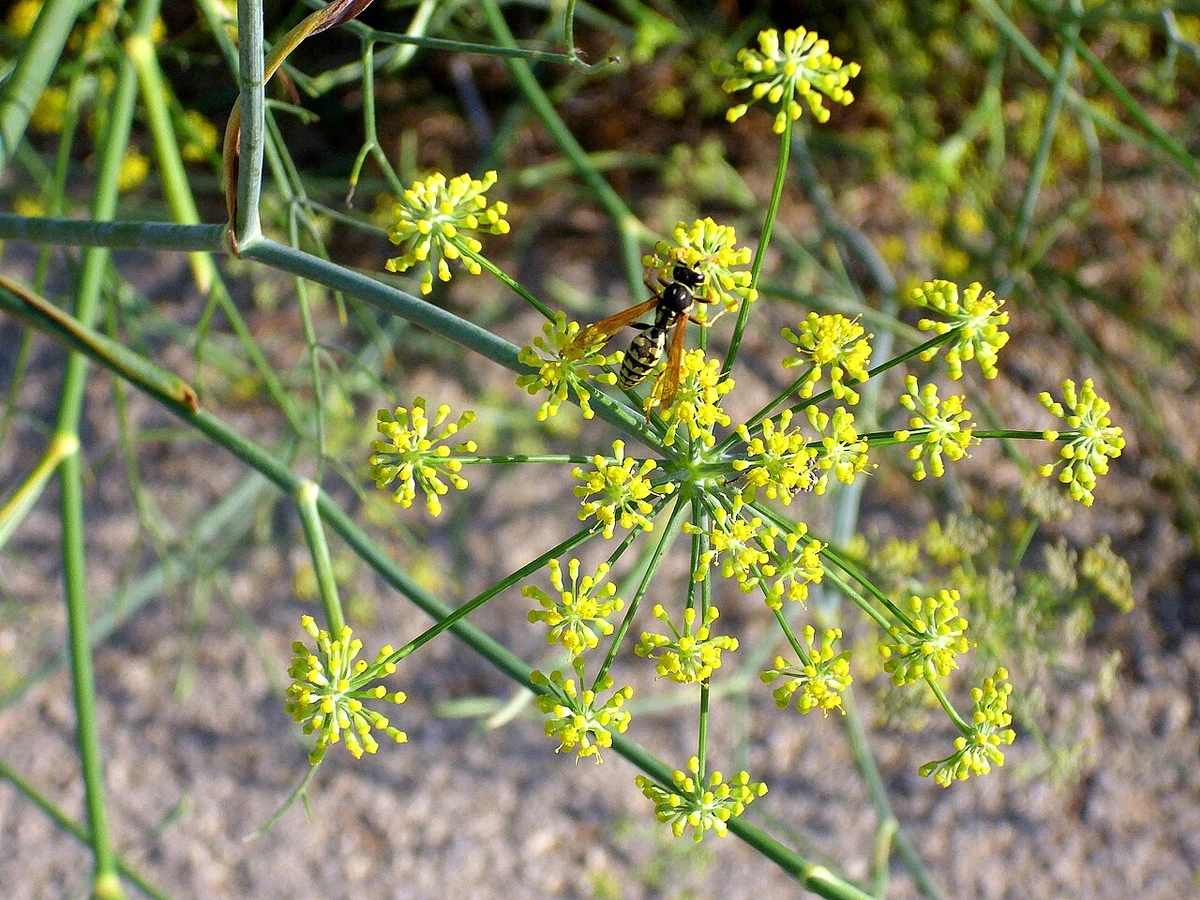
Yellow umbels of fennel (Foeniculum vulgare). Resized and converted to WebP; no cropping or content edits.
Javier martin · Public domain · Source · EXIF orientation respected; resized without cropping or upsampling; converted to WebP at quality 88. No other content edits.
Leaves, fruits and a familiar but misleading name
Fennel is a tall aromatic plant with finely divided leaves and yellow umbels. It belongs to the Apiaceae and is native around the Mediterranean, with long cultivation and naturalisation elsewhere in Europe. The ridged dry fruits are commonly called seeds. The leafy herb, swollen-base vegetable forms and medicinal sweet-fennel fruits are different harvests, even though they share the species name.
Dill is a separate plant. So-called water fennel and hog's fennel in old books may be different genera entirely. The same family includes poisonous species of similar appearance, so the known garden crop and its botanical name were the herbalist's starting point.
Why fennel accompanied fish
Culpeper begins with a culinary custom: boiling fennel with fish. He explains the pairing through humoral medicine and astrology, connecting the herb to the correction of fish's supposed cold, phlegmatic qualities. Fernie opens with fennel sauce for mackerel and adds bread seasoning and blanched stalks. These sources show cooking and medicine overlapping in a household's understanding of digestion.
The old medicinal repertoire emphasises wind, stomach discomfort, cough and milk production. It also reaches to the eyes and to snakebite. Fernie's story of serpents renewing their sight with fennel is particularly revealing as a narrative of how nature was thought to teach medicine, and it gave fennel water its old place among eye remedies.
Harvest according to the part
Editorial collection guidance: Fresh leaves can be clipped from a healthy cultivated plant during growth. Fruits need to mature on the umbels, usually later in the season, with timing dependent on latitude and the crop. Gather ripe heads before excessive shedding, finish drying them in a clean ventilated place and separate the fruits from stems and debris.
Store the dry fruits whole in a labelled, well-closed container, protected from moisture and light. Bruise only the portion needed just before preparation to release aroma. A green leaf harvest and a mature-fruit harvest should not be mixed under one vague label. Leave material for seed renewal and insects, and avoid collecting from contaminated coastal or roadside ground simply because fennel is abundant there.
Present-day editorial handling guidance, not a recipe or a claim attributed to the historical author. Historical source supports identity, part and use only.
Sources: [F]
A covered fruit infusion and its relatives
The European Medicines Agency's monograph on sweet fennel fruit, written for traditional herbal medicinal products, records the traditional adult infusion as 1.5 g of fruit in 250 ml of boiling water, steeped for fifteen minutes. The fruit is lightly bruised just before use and the vessel kept covered, then the drink is strained.
Historically, fennel also appeared in barley water, broths, expressed-juice syrups and distilled waters. A distilled water contains the volatile material carried through distillation and differs from an ordinary infusion, and an alcoholic compound spirit is another preparation again.
In the kitchen, chopped fennel leaves seasoned a cooked fish dish or sauce, the most direct continuation of the historical pairing.
A route through European kitchens
Fernie's chapter places fennel in several food cultures rather than reducing it to a universal digestive tea. He describes blanched stalks eaten in Italy, fruits incorporated into German bread, leaves used with pickled fish, and peeled stalks compared with celery. These are records in a late nineteenth-century compilation; each points to a different part and kitchen operation. A stalk prepared as a vegetable is not the same quantity or material as a spoonful of dry aromatic fruits.
He also repeats an account of Roman bakers putting fennel beneath loaves. That detail comes from his historical reading and stands at a greater distance from his own world than the familiar mackerel sauce with which he opens the chapter.
Culpeper's earlier explanation of the fish pairing is especially revealing. He ties fennel to Mercury and Virgo and places fish on the opposing side of his astrological argument. Within that system, seasoning helps correct the supposed qualities of the dish. The herb's taste and scent were experienced in a meal, and the explanation of why the combination was good belonged to his medicine and his astrology.
The pharmacy contained mixtures, not just fennel
An ingredient in a compound does not inherit every action claimed for the compound. Fernie mentions fennel within a liquorice powder that also contained senna. Describing that preparation simply as a fennel laxative would conceal a crucial ingredient. He also records a compound spirit involving fennel, juniper and caraway in the Edinburgh pharmacopoeial tradition. The names of the companions matter because the preparation was deliberately composite.
Aromatic waters occupied another category. Distillation could transfer volatile material into water, whereas bruising fruits and steeping them makes an infusion containing a different mixture. Fennel juice turned into syrup begins from expressed plant liquid and adds a sweetening and concentrating operation. These methods produced distinct materials with different practical uses.
Fernie's account also includes gum collected from cut stems in warmer climates, attributed to Matthiolus. That is a report about an exudate, not about the familiar dry fruit in a spice jar. The pharmacy's range becomes clear when each preparation keeps its plant part, carrier and companions.
Sources: [F]
Preparing fruit, leaf and stalk as different materials
The fruit infusion begins with measured, identified sweet-fennel material. Light bruising means breaking the fruits just before water is added, and the fifteen-minute covered steep in the monograph is a defined extraction step; straining then separates the plant solids from the drink.
The historical fish pairing can be explored with food-grade fennel leaves, washed, finely chopped and added in a modest seasoning amount to a sauce or cooked fish dish. This is an editorial kitchen adaptation of the recorded pairing, not Fernie's exact formula. Blanched stalks and mature fruits are separate ingredients with their own texture and intensity.
Fernie's serpents and Culpeper's eye waters belong to a tradition in which animal behaviour and analogy could suggest a remedy, and fennel's place at the table and in the eye-water bottle grew from the same reputation.
A herb of the fish dish and the digestive cupboard
Fennel's history joins the kitchen and the dispensary. Culpeper boiled it with fish and explained the pairing through humours and stars. Fernie followed it into mackerel sauce, Italian stalks, German bread, compound spirits, liquorice powder, distilled waters and the story of serpents renewing their sight, and the old repertoire turned to it for wind, stomach discomfort, cough and the flow of milk. Today the European Medicines Agency describes sweet fennel fruit preparations within its traditional-use framework, with its own conditions of age and use.
Its aromatic fruits remain one of the most familiar links between European cooking and household medicine.
Sources
- [C] Nicholas Culpeper. The Complete Herbal (1850). Fennel, pp. 73–74
Historical preparation and use
Expanded 1850 edition, not present-day treatment advice.
- [F] William Thomas Fernie. Herbal Simples Approved for Modern Uses of Cure, second edition (1897). Fennel, printed pp. 179–182
Recorded culinary and medicinal traditions
A period source with errors and obsolete claims, not a modern field guide. Harvest and kitchen hygiene notes are editorial.
- [E] European Medicines Agency, HMPC. European Union herbal monograph on sweet fennel fruit, revision 1 (2024). Preparation and safety sections; accessed 29 October 2026
Specific traditional-use preparation boundaries
Does not verify every historical indication.