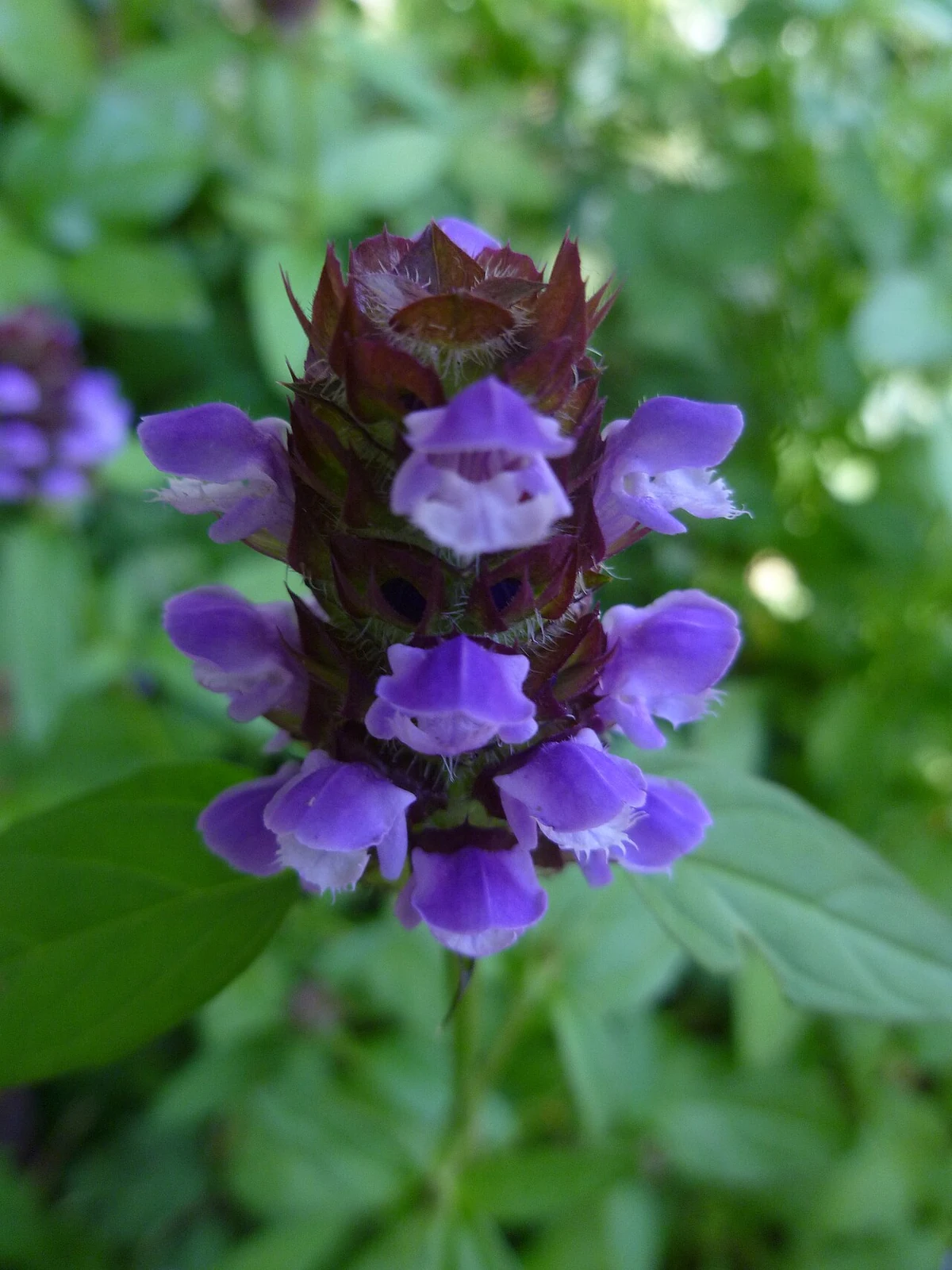
Purple flowers of selfheal (Prunella vulgaris) in a compact flower head. Resized and converted to WebP; no cropping or content edits.
Jesse Taylor · CC BY-SA 3.0 · Source · EXIF orientation respected; resized without cropping or upsampling; converted to WebP at quality 88. No other content edits.
Finding the plant behind the promise
Selfheal is a low perennial in the mint family, familiar in European grassland, lawns and open woodland. Opposite leaves grow on roughly square stems, and the purple flowers cluster in a short, compact head. Culpeper describes creeping growth and the distinctive flower arrangement. Flowering upper parts and leaves belong to the herbal tradition.
The name Prunella vulgaris gives the article a modern botanical anchor, and several low purple-flowered herbs share its habitat. Its capacity to live in closely cropped grass also explains why a household might encounter it close to home.
Sources: [C]
A wound herb in an older medical vocabulary
Culpeper praises the plant for wounds both inside and outside the body and repeats a proverb suggesting that someone with selfheal and related wound herbs has little need of a physician. The proverb is testimony to the plant's reputation.
His account belongs to a tradition in which plants were described as binding, drying or closing tissues. Blood loss, bruising, ulceration and internal injury were grouped in ways that do not map neatly onto modern diagnoses. The entry is best read in its own terms.
Sources: [C]
Syrup, wash, plaster and ointment
The entry describes internal preparations as well as washes and topical compounds. It mentions combination with bugle and sanicle, plants sharing a wound-herb reputation. A mouth and throat preparation uses the herb with honey of roses. These details show that the historical remedy was often a compound rather than a single plant applied alone.
A decoction heated the herb in water before straining. A syrup added a sweet preserving medium to an aqueous preparation. An ointment used a fatty base, while a plaster was a spreadable compound held against the body. Those distinctions help readers understand an old dispensatory.
Sources: [C]
A modest and careful harvest
Editorial collection guidance: If grown for study, allow part of the patch to flower and seed, cut only some sound aerial growth and leave the perennial base intact. Collection season follows local flowering rather than a universal calendar. Material from a sprayed lawn, roadside runoff or a place regularly fouled by animals is unsuitable for household preparations.
Dry clean, correctly identified flowering tops in a thin layer with air circulation and shelter from strong sun. Keep leaves and flower heads together with a label naming the species, part and date. Store only after fully dry, in a clean container protected from moisture. This is practical raw-material care.
A garden patch also offers a way to know the plant: the flower head, creeping growth and change through the season can be watched as the year turns.
Present-day editorial handling guidance, not a recipe or a claim attributed to the historical author. Historical source supports identity, part and use only.
Sources: [C]
A carpenter's herb among several healing names
Fernie's discussion illustrates how easily names migrate. His chapter begins with sanicle and then explicitly distinguishes Prunella vulgaris, although both have been called selfheal. It also brings in bugle, Ajuga reptans. The shared wound-healing reputation creates a group in the writer's argument, made of separate species.
Carpenter's herb, hook-heal and sicklewort connect the plant with injury from tools. Fernie suggests that the flower's profile resembles a billhook and explains the association through the doctrine of signatures. That is his interpretation of a name and shape. His Yorkshire name Black man adds a regional naming detail.
Culpeper's proverb about dispensing with physician and surgeon belongs to the same language of confidence. Read historically, the proverb tells us how high these wound herbs stood in popular and learned estimation.
The throat seen in a flower
Grieve quotes Cole's Adam in Eden of 1657 on a German throat complaint and a flower thought to resemble the affected part. The claim involves the doctrine of signatures: the shape was read as a clue to use. She also describes the compact head opening unevenly, with persistent calyces remaining after the purple corollas fall. The brownish head and the fresh flowering head are therefore stages of one structure, not necessarily different plants.
Her floral account includes the arrangement that brings visiting bees into contact with pollen. This gives the plant an ecological story alongside the medicinal one. Watching which flowers are open, which have fallen and which are visited can make a garden patch informative without harvesting it. The historical throat analogy and the observable flower structure are two readings of the same object.
Sources: [G]
Rose preparations and the route of application
Culpeper pairs selfheal juice with oil of roses for the temples and with honey of roses for mouth and throat uses. Those vehicles matter. Oil of roses and honey of roses belong to different preparation families, and neither is equivalent to adding a few drops of modern essential oil.
The wound preparations likewise use several forms. A syrup was swallowed for an internal complaint; an ointment or plaster was applied externally; a wash brought liquid into contact with the injured part. The source even mentions injecting a compound into ulcers. All these forms shared a plant, while each had its own route.
Fernie quotes Gerard's comparison with bugle and describes a wine-and-water decoction. This adds an earlier attributed voice to the reputation, with its sweeping phrase about making all wounds sound.
For practical documentation, make separate records for the living plant, the harvested aerial material and the historical preparation being discussed. Note whether a source names Prunella, sanicle or bugle and whether it calls for juice, decoction or a compound. This editorial method is particularly useful with selfheal because the name itself encourages readers to overlook distinctions that the history requires.
A small flower with a confident name
Selfheal connects a widespread, easily overlooked plant with a remarkably confident language of repair. Culpeper praised it for wounds inside and outside the body, in syrups, washes, ointments and plasters, and repeated the proverb that whoever had selfheal and its fellow wound herbs needed neither physician nor surgeon. Fernie followed its names, carpenter's herb, hook-heal and sicklewort, to the shape of a billhook, and Grieve recorded Cole's reading of the flower as a throat.
Its history lies in that confidence, carried by a small purple flower head growing in lawns and meadows across Europe.
Sources
- [C] Nicholas Culpeper. The Complete Herbal (1850). Self-Heal, printed pp. 170–171
Historical botanical description, attributed uses and preparation forms
Thomas Kelly expanded edition; not a modern treatment recommendation.
- [F] William Thomas Fernie. Herbal Simples, second edition (1897). Sanicle chapter, Prunella vulgaris discussion, pp. 509–510
Names, comparison with sanicle and bugle, attributed wound preparations
The chapter shifts species; the preceding sanicle doses do not apply to Prunella.
- [G] Maud Grieve. A Modern Herbal: Self-Heal (1931). Flower structure and quotations attributed to Cole and Gerard
Floral stages and historical throat-signature interpretation
Historical compilation; enthusiastic claims are not clinical evidence.