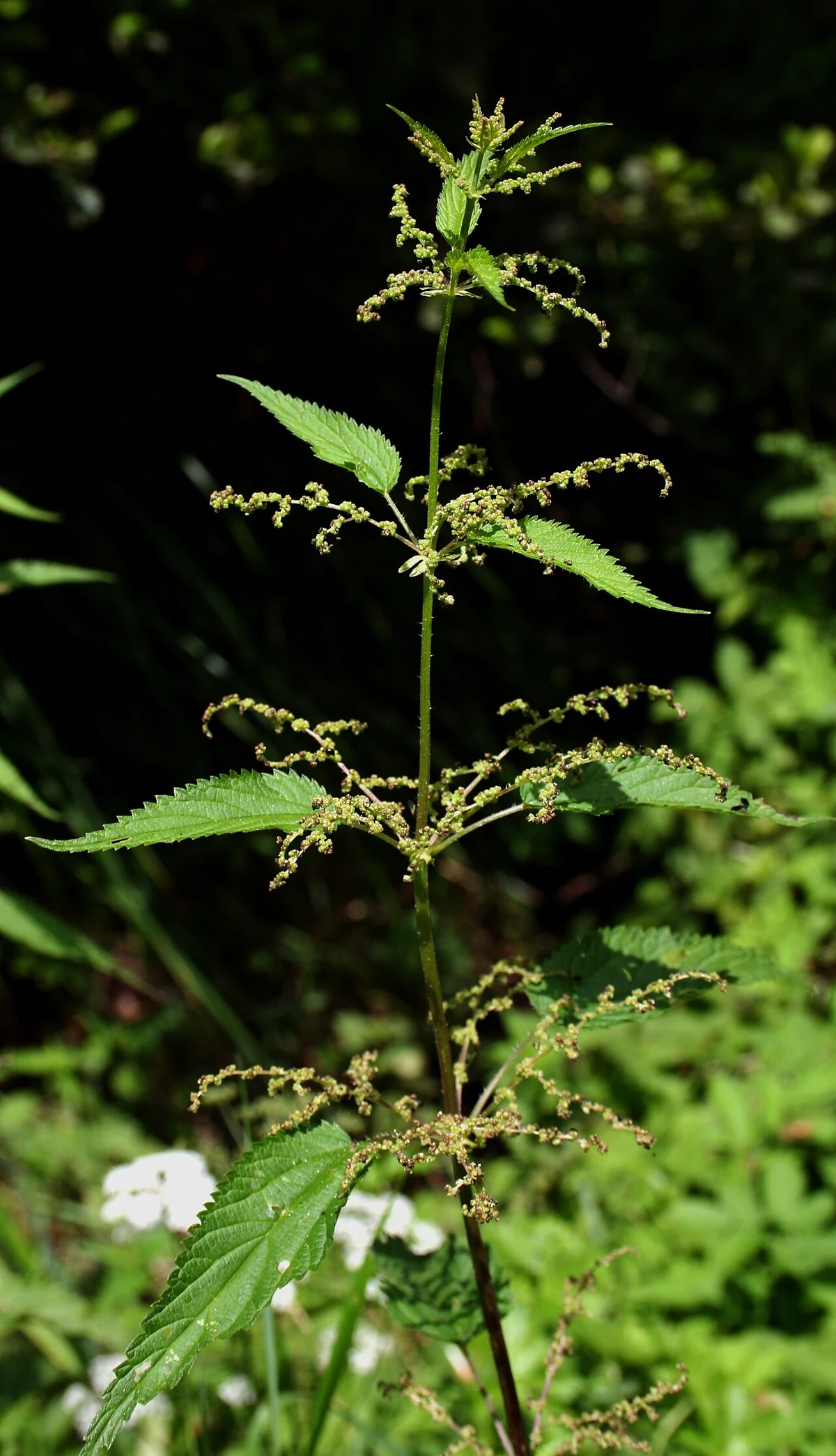
Stinging nettle (Urtica dioica): toothed leaves and small inflorescences. Resized and converted to WebP; no cropping or content edits.
Przykuta · CC BY-SA 3.0 · Source · EXIF orientation respected; resized without cropping or upsampling; converted to WebP at quality 88. No other content edits.
A familiar sting is not the whole identification
Stinging nettle, Urtica dioica, is a perennial with opposite toothed leaves, stinging hairs and inconspicuous flowers. Urtica urens is a smaller annual relative. Both grow in Europe and both appear in the medicinal definition of nettle herb. White dead-nettle and other Lamium species are different plants, even when their leaves look similar.
Fernie's opening description reverses the annual and perennial identities of the two Urtica species, and his later discussion moves into the dead-nettles. His book remains a rich record of customs, read alongside modern botanical names. Nettle herb here means the aerial parts; roots and seeds have their own separate histories.
Why spring mattered
Culpeper explains the eating of spring nettle tops through the contrast between winter's cold, moist qualities and the plant's warming character. In his medicine the young greens answered the season: they entered the diet just as gardens and hedgerows came back into growth.
Fernie describes cooked tops and an Italian dumpling-like dish, placing nettle in everyday food as well as in the dispensary, and he records its use for cloth and fibre. One abundant plant supplied a meal, a material and a medicine, and that breadth explains why nettle held such a lasting place in European households.
The history of urtication
Nettle's sting was itself a treatment. In urtication the body was struck or rubbed with fresh plants, and Fernie reports the practice for rheumatism and other complaints, including in Russian peasant medicine, together with his sources' confident assurances that it did no harm.
Culpeper's nettle entry ranges further still, from lung complaints to wounds, poisoning and rabies. The breadth of the list shows how high the herb's reputation stood in his time: a plant growing by every path was credited with help against some of the most feared conditions people knew.
Greens at the end of winter
Culpeper's spring passage describes the change of season in humoral language. Winter left cold and moist residues, and the nettle's qualities worked against them. The household action behind the theory was simple and concrete: eating the tender new growth as soon as it appeared.
Fernie's later account widens the picture of nettle as food. He mentions spring and early-summer greens and Italian herb dumplings in which nettles became part of a substantial cooked dish. The plant reached the table as a vegetable, not only as a strained tea.
Young tops and mature stems served different purposes. A soft tip suited a cooked dish; a tall, fibrous stem was material for spinning and weaving. The accounts of nettle cloth draw the same line between food and fibre. Fernie's anecdotes about Scottish weaving and a letter attributed to Campbell record the reputation of nettle textiles, although his description of the fibre as hairs reflects the understanding of his own day.
Juice, sweet electuary and an ointment base
Culpeper's nettle pharmacy is unusually varied. He describes roots or leaves boiled, and their juice worked into an electuary with honey and sugar; the part of the plant changed with the purpose. An electuary kept the herb in a thick sweet carrier, sometimes with plant solids, and was taken quite differently from a clear tea strained into a cup.
His ointment combined nettle juice, oil and a little wax for rubbing on the body. The recipe names each ingredient by its role: the plant liquid, the fatty carrier and the wax that set the consistency. It is a clear record of how a household salve was put together from what a kitchen could supply.
Fernie's expressed juice and spirit preparations belong to yet another set of methods. His whole-plant tincture appears within a homeopathic discussion, where dilution and the matching of remedy to symptoms are central to the argument. The passage opens a window onto a nineteenth-century medical system in which nettle held a recognised place, and it treats juice, tincture and tea as distinct remedies, each with its own preparation.
Flowers, roots and a local record
Udziela's nettle entry is short but valuable because it names different parts of the plant. At Wieliczka he recorded a tea of the flowers taken for breathlessness, and fumigation with the roots for toothache. The two observations from one town give an exact glimpse of village practice: a drink from the flowers and smoke from the roots, each for its own complaint.
Beside the long English entries, the brief Polish record shows how uneven the surviving archive is. A compiler such as Fernie could give a plant several pages while an ethnographer wrote down two observations. The difference reflects the sources, not the villages; nothing in it shows that one region knew the plant better than another. Even so, the documented history of nettle is broad: spring food, cloth, deliberate stinging and a whole range of preparations.
Kitchen greens and the herbal infusion
The cooked-green tradition recorded by Fernie can still be followed in the kitchen (a present-day kitchen note, not a transcription of his Italian recipe). Young tops are gathered with gloves from a clean, permitted place, sorted from other leaves and coarse stems, washed and cooked in water until thoroughly wilted and tender. They are then drained, chopped and added to soup, an egg dish or a dumpling mixture that is itself cooked.
For the herb cupboard, sound aerial parts are dried in a loose, airy layer and labelled with the species, part and date. Nettle herb also has a place in the European Medicines Agency's traditional-use monographs. The 2025 monograph records an adult infusion of 1.5 g of cut dried herb in 150 ml of boiling water for its traditional use in minor urinary complaints, prepared, as the agency's tea template describes, by covering the herb with freshly boiled water, leaving it for five to fifteen minutes and straining it. The same monograph gives a different quantity for minor joint pain.
Root extract, expressed juice, alcoholic tincture and a cooked dish of greens remain separate preparations, as they were in the old herbals. Their part, carrier and purpose define them more than the shared name of nettle.
Nettle's long continuity
Few plants show such continuity between old household practice and the present. The spring greens that Culpeper explained through the humours are still cooked. Fernie's rheumatic patients turned to the sting for their joints; the EMA's traditional-use monograph now records nettle-herb preparations for minor joint pain and minor urinary complaints, each with its own conditions of age and use.
Nettle moved from the hedge to the table, the loom and the medicine chest, and its story connects all four.
Sources: [E]
Sources
- [C] Nicholas Culpeper. The Complete Herbal (1850). Nettles, pp. 127–128
Historical descriptions and uses
Medical claims are historical; publication is the expanded 1850 edition.
- [F] William Thomas Fernie. Herbal Simples Approved for Modern Uses of Cure, second edition (1897). Nettle, printed pp. 382–387
Period practices and attributed customs
Not current medical advice; botanical errors are corrected in the article. Harvest and food-hygiene instructions are editorial.
- [E] European Medicines Agency, HMPC. European Union herbal monograph on Urtica dioica L.; Urtica urens L., herba, revision 1 (2025). Preparation and safety sections; accessed 29 October 2026
Boundaries of specified traditional-use products
Does not verify broad historical cure claims.
- [U] Seweryn Udziela. Rośliny w wierzeniach ludu krakowskiego, Lud 30 (1931). Entry 132, Urtica dioeca [historical spelling]; field collection 1894–1899
Two Wieliczka observations using flowers and roots respectively
A short local record; neither breathlessness treatment nor root fumigation is recommended.
- [T] European Medicines Agency, HMPC. Patient Leaflet template concerning advice on the preparation of herbal teas as (traditional) herbal medicinal products by end-users (2016). Printed pp. 4–7, definitions and preparation templates
Usual infusion timing, covering, straining and preparation immediately before use
General method; a product-specific instruction takes precedence and plant quantities come from the individual monograph.