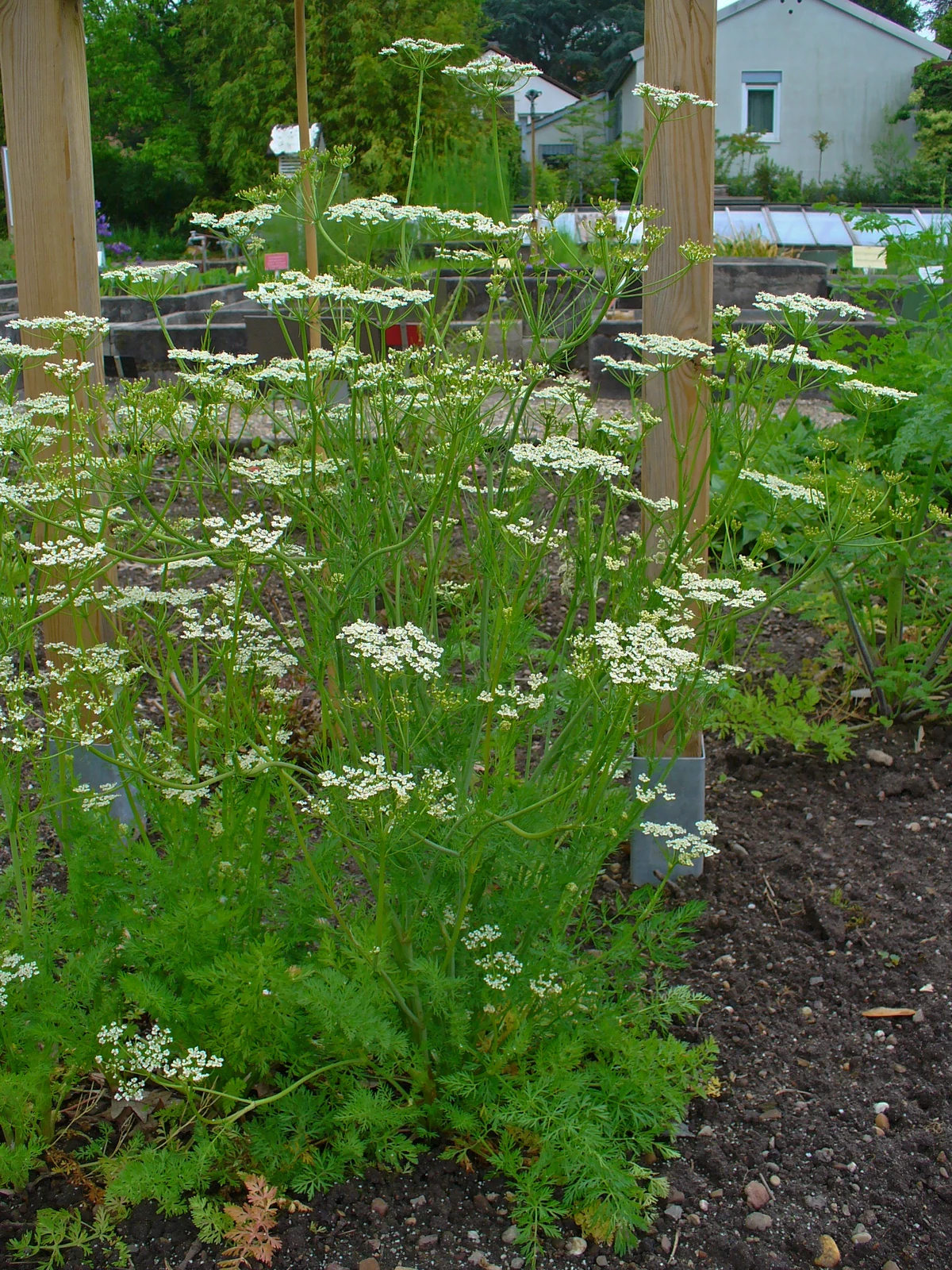
Caraway (Carum carvi): plant habit and pale umbels. Resized and converted to WebP; no cropping or content edits.
H. Zell · CC BY-SA 3.0 · Source · EXIF orientation respected; resized without cropping or upsampling; converted to WebP at quality 88. No other content edits.
The spice is a fruit
Caraway produces small curved, ridged dry fruits, usually called seeds in the kitchen. Its finely divided leaves and white or pale flowers belong to an umbelliferous plant familiar in European cultivation and grassland. The fruits, rather than unidentified green foliage, are the main material in this account.
Caraway is Carum carvi, not cumin, Cuminum cyminum, and not a collection of every spice sold as black cumin. Common names can conceal different species. A known spice or a labelled crop gave the herbalist a certainty that a wild umbellifer could not.
Bread and medicine shared the cupboard
Fernie places caraway in seed cake, sugar-coated comfits, cheese, soups, bread and sauerkraut. He records English commercial cultivation and continental food uses, showing that the fruit could be a local crop, a traded spice and a household medicine. Its principal medicinal reputation was for digestive wind and colic.
His etymological explanations vary, and he identifies one ancient military food as caraway. The clearest thread is the nineteenth-century account of aromatic fruits being cooked, sweetened or infused. A comfit was a fruit coated with sugar, which made an aromatic ingredient portable and palatable.
Sources: [F]
A local Polish comparison
Udziela records caraway in bread dough at Polanka Haller and in a simple soup or vodka preparation for stomach discomfort. At Wieliczka, a mixture of rye bread, crushed caraway and vinegar was applied at the temples for headache. He also records inclusion among herbs blessed on 15 August at Świątniki Górne.
These reports connect food, external remedy and religious calendar in a small geographical area. The evidence is valuable precisely because it keeps named places and a fieldwork period.
Sources: [U]
Harvesting and making an aromatic water extract
Editorial collection guidance: Allow the fruits of a known cultivated plant to ripen, collect the heads before the crop sheds excessively and finish drying with good airflow. Thresh or rub out the dry fruits, remove stalks and debris, and store whole in a labelled container away from damp. Whole fruits retain their recognisable form and can be lightly crushed just before use.
A herbal infusion was made by placing lightly bruised fruits in a vessel, adding freshly boiled water, covering and straining after steeping. In cooking, a modest amount of caraway went into bread, cabbage or soup, a different purpose served from the same jar.
Fernie's Kümmel and other cordial references concern alcoholic drinks. Essential oil, spirit and fruit infusion were distinct products. Fernie also records a bread poultice and an infant julep among the household uses.
Present-day editorial handling guidance, not a recipe or a claim attributed to the historical author. Historical source supports identity, part and use only.
The seed cake at the end of sowing
Among Fernie's most evocative details is caraway-seed cake at feasts given by farmers to labourers when wheat sowing ended. The fruit appears here in a working calendar, as part of a shared meal after a particular agricultural task. Fernie gives neither a named farm nor a cake formula. The detail nevertheless enlarges the plant's setting beyond a private medicine cupboard: an aromatic ingredient could mark hospitality and the completion of seasonal work.
His German examples include cheese, household bread and sauerkraut, while the Russian and German Kümmel references concern a liqueur. In Britain he names Kent and Essex as commercial growing areas. These observations connect cultivation, trade and everyday cooking without implying that every household prepared every form. The same crop could enter a baker's dough, a distiller's still or a medicinal packet, each with different expectations of flavour and strength.
The sugar comfit supplies another social setting. Its coating made a small fruit into a sweet that could be offered at table. Fernie's Shakespeare reference places caraways beside an apple in a scene of hospitality. A literary allusion establishes recognisability to an audience, whereas the agricultural anecdote describes a custom. Together they explain why an apothecary's aromatic could also be familiar as a treat.
Sources: [F]
Bread was both food and the body of a plaster
The Polish and British external remedies invite a particularly useful comparison. Udziela's Wieliczka report uses rye bread, crushed caraway and vinegar at the temples for headache. Fernie's earache example employs hot bread crumb, bruised fruits and spirit. The shared material is not merely caraway: bread makes a mass that can hold the other ingredients close to the body. The location, liquid and complaint differ. Each was recorded in its own country.
The sources record the operation, the ingredients and the complaint rather than temperatures or contact times.
In Polanka Haller the same fruit entered bread dough for flavour and a simple soup or spirit preparation for stomach discomfort. A single locality therefore gives more than one relationship between food and remedy. Świątniki Górne adds the herb blessing on 15 August. These named observations keep place and preparation attached to each report.
A measured infusion and the kitchen
The European Medicines Agency's monograph on caraway fruit, written for traditional herbal medicinal products, records the traditional infusion as 0.5–2 g of fruit in 150 ml of boiling water, taken one to three times daily for digestive complaints. The agency's general procedure describes the method: the fruits are lightly bruised, covered with freshly boiled water, left covered for five to fifteen minutes and strained, and the cup is made fresh.
In the kitchen, caraway is measured into a bread or cabbage recipe as seasoning; dispersed through the dough, it gives a different result from fruits left on the crust. This continues the bread of Polanka Haller and the seed cake of the sowing feast.
Whole fruits keep until needed, and light crushing just before use releases their aroma. That is why whole fruit, powdered spice and concentrated aromatic liquid were treated as different materials.
Bread, comfit and the digestive cup
Caraway's history follows the fruit from the field into many kitchens. Fernie found it in English seed cakes, sowing feasts, sugar comfits, German cheese, bread and sauerkraut, Russian and German Kümmel and a bread poultice for earache. Udziela found it in bread dough and a soup or vodka for the stomach at Polanka Haller, in a rye-bread plaster for headache at Wieliczka and in the blessing bundle at Świątniki Górne. Today the European Medicines Agency describes caraway fruit preparations within its traditional-use framework for digestive complaints, with its own conditions of age and use.
Few spices show more clearly how bread and medicine shared the same cupboard.
Sources
- [F] William Thomas Fernie. Herbal Simples Approved for Modern Uses of Cure, second edition (1897). Caraway, printed pp. 81–84
Recorded culinary and medicinal traditions
A period source with errors and obsolete claims, not a modern field guide. Harvest and kitchen hygiene notes are editorial.
- [U] Seweryn Udziela. Rośliny w wierzeniach ludu krakowskiego, Lud 30 (1931). Entry 34, Carum carvi, printed p. 46; fieldwork 1894–1899
Local food, spirit, poultice and blessing practices
Regional reports, not validated treatments.
- [E] European Medicines Agency, HMPC. Carvi fructus: public summary (2015). Preparation and safety sections; accessed 29 October 2026
Specific traditional-use preparation boundaries
Does not verify every historical indication.
- [M] European Medicines Agency, HMPC. European Union herbal monograph on Carum carvi L., fructus (2015). Preparation and restrictions, pp. 3–4
Measured fruit infusion and additional contraindications
Specified traditional-use medicine, not evidence for the historical poultices.
- [T] European Medicines Agency, HMPC. Draft template for a European Union herbal monograph: herbal teas (2016). Infusion procedure, pp. 4–7
Covered steeping and fresh preparation
General method; quantity is species-specific.