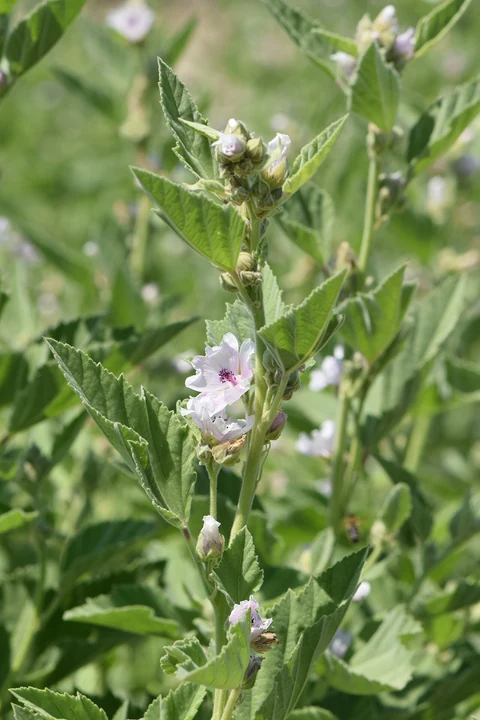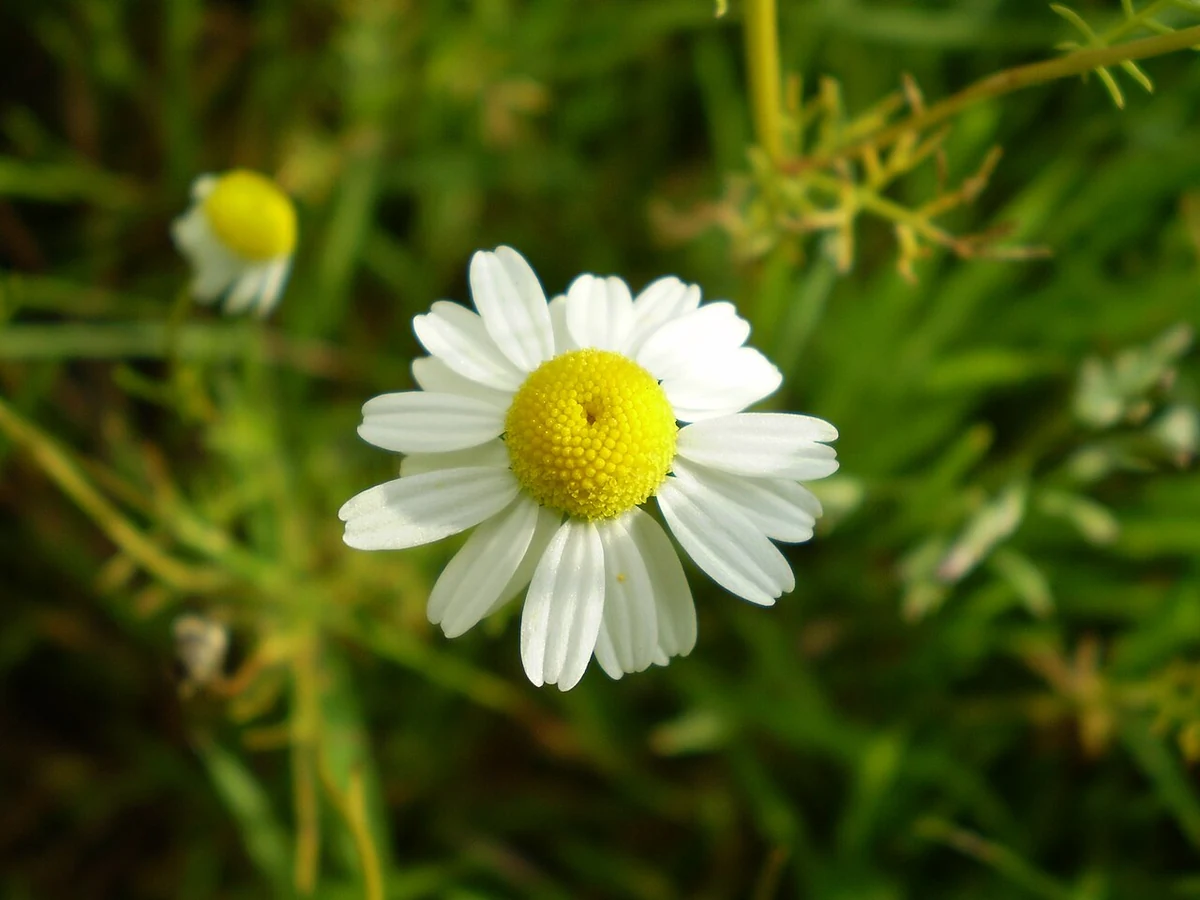
A German chamomile flower head, identified as Matricaria recutita, a synonym of Matricaria chamomilla. Resized and converted to WebP; no cropping or content edits.
Rob Hille · Public domain · Source · EXIF orientation respected; resized without cropping or upsampling; converted to WebP at quality 88. No other content edits.
One familiar name, several different plants
German chamomile is an annual member of the daisy family, grown in European herb fields and encountered on disturbed ground. The medicinal material is the flower head, not simply any white-and-yellow daisy. Its finely divided leaves and conical, hollow flower receptacle help distinguish it. Roman chamomile, Chamaemelum nobile, is a different, creeping perennial. Scentless mayweeds and other superficially similar plants complicate collection.
This distinction changes how old books should be read. Culpeper's entry headed Camomile does not provide a botanical description that settles the modern species. Fernie explicitly differentiates his favoured Anthemis nobilis from Matricaria chamomilla. His statements about one cannot all be silently transferred to the other. For Avonoria, the article concerns German chamomile; the older entries demonstrate the wider chamomile tradition and its naming problem.
A flower of the kitchen and sickroom
Culpeper records drinks made with the flowers, preparations in wine, flower oils, baths and warm applications. He explains them through humoral medicine: chamomile warmed, resolved and moved the humours of the body. Fernie describes an aromatic, bitter stomach drink and bags filled with flowers used as fomentations. Both authors also credit the plant with much wider powers, reaching as far as serious infections and internal stones, which shows how highly it was regarded in their medical worlds.
The enduring household pattern was simple. A small quantity of dried flowers could be stored through winter, infused without elaborate equipment and offered as a warm drink, and the same flowers could be used externally. Tea, infused oil and distilled essential oil were nevertheless different preparations, made by different processes and of very different strength.
The Kraków countryside: one flower, several settings
Udziela's late nineteenth-century field material makes the household setting unusually tangible. At Zakliczyn near Siepraw, flower tea was reported for stomach pain. At Skawina the record names a decoction for intermittent fever; at Wieliczka it names colds and a cool preparation during fever. These are separate local observations, each tied to its village. The term translated as intermittent fever belongs to the diagnostic vocabulary of the time.
Other applications crossed the boundary between kitchen, sickroom and stable. A Wieliczka account combined softened chamomile, vinegar and wheat bran in a facial application for toothache. At Gaj a mixture of chamomile and mallow was used to wash wounds in people, horses, cattle and pigs. The shared remedy shows how the same herbs served the people and the animals of one household.
Udziela also records chamomile among herbs blessed on 15 August. The same flower could therefore have ordinary sensory value, a remembered medicinal use and a place in a Christian ritual bundle. None of those roles cancels the others. Because the entry identifies Matricaria Chamomilla, it is a more direct witness for this article's species than an English reference which says only camomile.
Sources: [U]
Counting flowers in a Victorian kitchen
Fernie preserves a household direction attributed to the cookery writer Francatelli: thirty flower heads in a pint of boiling water, covered for ten minutes, then poured into another vessel and sweetened with sugar or honey. It is an illuminating description of equipment and sequence. The cook needs flowers, a jug, a cover, hot water and a second jug; straining separates the drink from material that would otherwise continue soaking. There is no elaborate apothecary apparatus.
Fernie's chapter favours Roman chamomile, which he calls Anthemis nobilis, so the thirty heads of this direction belong to that plant. His chapter also gives another, stronger preparation measured in ounces and discusses concentrated tinctures. Several formulas existed side by side, each suited to its own purpose and maker.
He contrasts cultivated double flowers with heads retaining more yellow disc florets and believes the former less medicinal. The observation connects commercial flower appearance with medicinal judgement: a more decorative crop was not automatically his preferred drug.
Sources: [F]
Warmth, bitterness and the language of old remedies
Culpeper's account places the flower among warming and resolving medicines. These terms concern the movement and balance of humours, the framework in which his readers understood the plant. His flower drinks, syrups and oils belong to that explanatory system. Fernie writes in a later idiom, discussing volatile aromatic material, bitter taste and stomach complaints, and still records far-reaching cures. The two books show the explanations around a recognisable domestic plant changing over time.
Fernie also quotes the familiar literary comparison between chamomile growing underfoot and youth being damaged by misuse. Such passages made the herb memorable beyond the dispensary. They are part of the plant's cultural history. Read alongside Udziela, the English books and Polish village notes reveal several overlapping traditions: literary symbolism, commercial flower production, practical warmth and drinks, and blessed seasonal gathering. Together they show a plant known in many ways across Europe.
Gathering, drying and keeping the flowers
Editorial collection guidance, adapted from the EMA GACP guideline rather than Fernie: collectors need to distinguish the intended species from similar plants and recognise diseased material. Assess contamination risks in the collection area. Harvest under dry conditions, avoiding dew, rain and unusually high humidity; limit damaged material and use clean containers. These points follow sections 4 and 11 (printed pp. 6, 10–11).
For natural drying, section 12 (pp. 11–12) recommends prompt processing, a thin layer on raised drying frames and adequate airflow. Avoid direct sunlight unless a specific requirement or evidence that quality is unaffected justifies it. Drying conditions must suit the plant part and its constituents. Inspect the material and remove foreign matter or substandard portions. These are general handling principles, not a chamomile-specific drying temperature or duration.
Record the botanical material, collection location and date, keeping the batch traceable (section 7, p. 8). Use clean, dry packaging and dry storage conditions. Material placed in airtight packaging must be sufficiently dried to prevent mould formation (sections 13–14, p. 13).
Modern handling guidance attributed to EMA GACP sections 4, 7 and 11–14; not to Fernie or the EMA infusion monograph. General principles do not establish a chamomile-specific harvest calendar, drying temperature or shelf life.
Sources: [G]
Infusion and external preparation
The traditional infusion is recorded in the European Medicines Agency's monograph on German chamomile flowers, written for traditional herbal medicinal products: 1.5–4 g of dried flowers in 150 ml of boiling water for an adult. The agency's tea-preparation template describes the method: the flowers are covered with freshly boiled water, left covered for five to fifteen minutes and strained. The monograph places this fresh infusion within traditional use for minor digestive complaints. Measured by weight rather than by the spoonful, it continues the household cup that Fernie's Victorian cooks counted out in flower heads.
A traditional fomentation was different. Fernie describes flowers held in a loose bag and moistened with hot water; the bag kept the soft plant material together while warmth and moisture reached the skin. The old flower oil was an infused fixed oil, made by steeping the flowers in oil, whereas steam distillation yields a much more concentrated essential oil. The historical records keep these three forms — tea, fomentation and oil — distinct.
A flower that never left the household
Chamomile's history runs from Culpeper's drinks, wines, oils and baths through Fernie's Victorian kitchen to the village remedies Udziela recorded around Kraków: tea for stomach pain at Zakliczyn, a decoction for fever at Skawina, a cool drink and a toothache poultice at Wieliczka, a wound wash for people and animals at Gaj, and flowers in the bundle blessed on 15 August. Today the European Medicines Agency describes chamomile flower preparations within its traditional-use framework, with its own conditions of age and use.
Warmth, aroma and a long domestic history kept the flower in the household cupboard for centuries, used inside and out, for people and for animals.
Sources
- [C] Nicholas Culpeper. The Complete Herbal (1850). Camomile, printed p. 39 in the digitised edition
Historical drinks, oils, baths and humoral framing
Later expanded edition; species is not securely identified in this entry.
- [F] William Thomas Fernie. Herbal Simples Approved for Modern Uses of Cure, second edition (1897). Chamomile, printed pp. 84–88 in the transcription
Species distinction, tea and fomentation descriptions
Contains obsolete therapeutic claims; primarily discusses Roman chamomile.
- [E] European Medicines Agency, HMPC. Matricariae flos: summary and monograph (2016). Overview and risks; accessed 29 October 2026
Current preparation distinctions, allergy and bath warnings
Traditional-use assessment is not proof of all historical indications.
- [U] Seweryn Udziela. Rośliny w wierzeniach ludu krakowskiego, Lud 30 (1931). Entry 77, Matricaria Chamomilla; field collection 1894–1899
Named village practices, flower tea, mixed applications, veterinary use and blessing on 15 August
Ethnographic record of reported practices; no measured doses or demonstrations of efficacy. Entry number verified in extracted text; no additional page claim.
- [M] European Medicines Agency, HMPC. European Union herbal monograph on Matricaria recutita L., flos (2015). Printed pp. 4–5, section 4.2; pp. 8–11, limitations
Species-specific adult infusion quantity and distinct routes of administration
Traditional-use specification, not evidence for every old indication; not a household prescription for children.
- [T] European Medicines Agency, HMPC. Patient Leaflet template concerning advice on the preparation of herbal teas as (traditional) herbal medicinal products by end-users (2016). Printed pp. 4–7, definitions and preparation templates
Usual infusion timing, covering, straining and preparation immediately before use
General method; a product-specific instruction takes precedence and plant quantities come from the individual monograph.
- [G] European Medicines Agency, Committee on Herbal Medicinal Products (HMPC). Guideline on Good Agricultural and Collection Practice (GACP) for starting materials of herbal origin, final revision 1 (2025). Adopted 9 July 2025; section 4, printed p. 6; section 7, p. 8; sections 11–14, pp. 10–13
Identification and contamination awareness; dry harvesting and clean containers; prompt processing, thin-layer drying, airflow and qualified avoidance of direct sun; traceability, clean packaging and dry storage
General professional starting-material quality guidance, not a chamomile-specific harvesting calendar, drying temperature, home storage validation or medicinal infusion monograph.