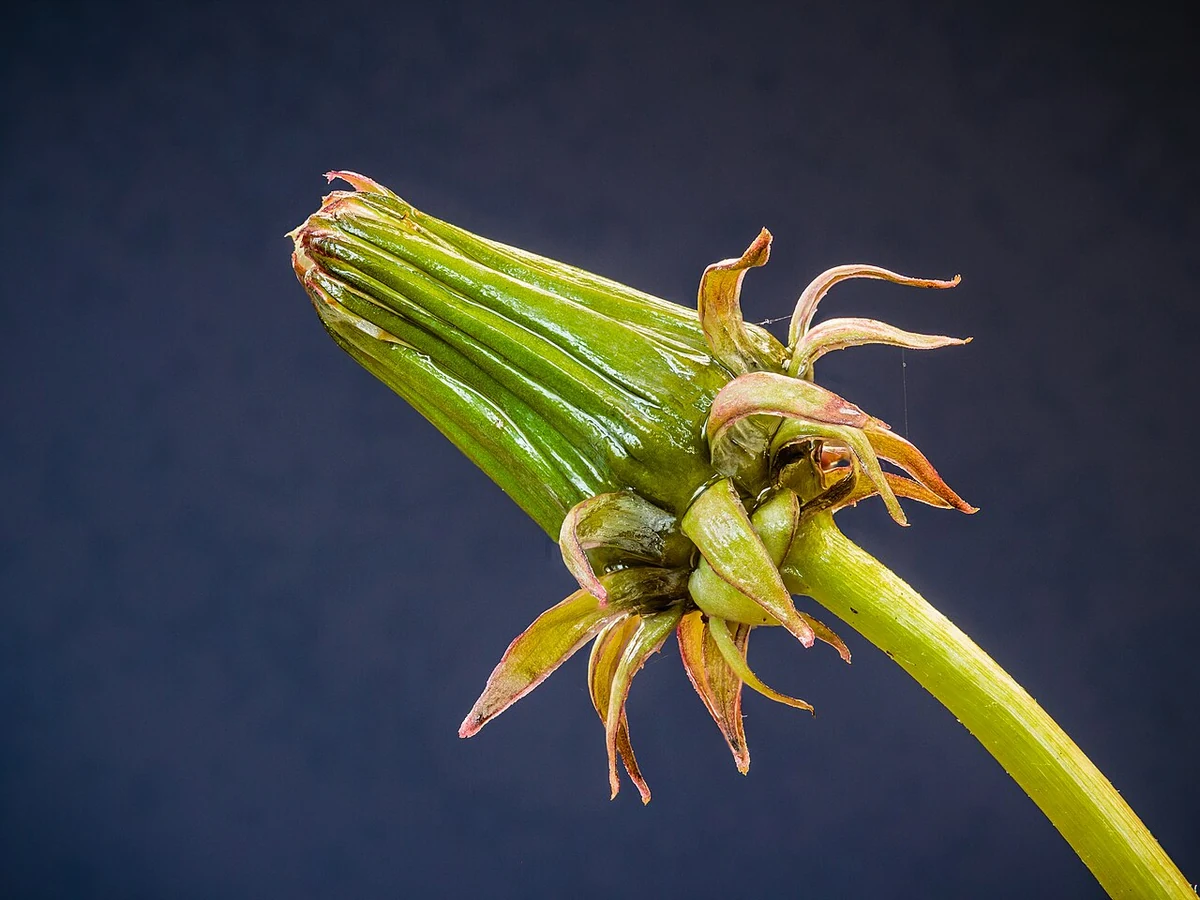
A closed fruiting head of a dandelion identified by the source as Taraxacum officinale. Resized and converted to WebP; no cropping or content edits.
Dominicus Johannes Bergsma · CC BY-SA 4.0 · Source · EXIF orientation respected; resized without cropping or upsampling; converted to WebP at quality 88. No other content edits.
More than any yellow flower
Dandelions form a basal rosette, with leafless hollow flower stalks, milky sap and yellow heads that later become familiar balls of wind-borne fruits. The common dandelion belongs to a taxonomically complex group of many closely related microspecies.
Culpeper carefully describes the jagged leaves, deep root and wind-carried seed head. Fernie warns that other roots entered the trade. Even a familiar plant had its trade substitutes. The leaf, root, flower and milky sap are different materials, each with its own preparations.
Spring food and an old theory of obstruction
Culpeper calls dandelion opening and cleansing, linking it to liver, gall and urinary complaints. He also describes leaves chopped into broth and notes spring eating among French and Dutch people. The food practice and the explanation through obstruction of the organs belong together in his medicine.
Fernie expands the repertoire with blanched leaves, root preparations and a roasted-root drink reported at Göttingen. He suggests that the yellow colour helped support a liver association through the doctrine of signatures. That is his own interpretation. His account also includes confident cures for jaundice and other serious illness.
Blanched leaves and a European spring table
Culpeper's chopped leaves enter a broth with other pot herbs, including alexanders. He then points to French and Dutch spring eating as an example of plant knowledge shared with ordinary people. The passage is partly a food description and partly a criticism of physicians whom he considers secretive. His enthusiasm for an accessible plant is therefore also an argument about who should possess medical knowledge.
Fernie describes a more deliberate kitchen-garden technique: covering the growing plant to exclude light, producing pale, tender leaf growth. This is horticultural blanching before harvest, not briefly plunging leaves into boiling water. He also mentions continental salads and leaves eaten with bread and butter. The two meanings of blanching describe different techniques.
The cooked-leaf tradition can still be followed in the kitchen (an editorial adaptation of the broth account): identified, clean young leaves are washed, trimmed of coarse or damaged material and chopped into a soup that is cooked in the usual way. Bitterness and personal taste decided whether the ingredient was welcome.
The root as a traded raw material
Fernie pays attention to seasonal differences in the root's taste and juice, favouring late-autumn material for some preparations. His account contrasts sweeter and more bitter phases and separately discusses the fresh plant gathered for a tincture. Each dandelion product therefore had its own collection season. A leaf food, fresh whole-plant extract and dried root commodity have different requirements.
He also reports adulteration with hawkbit roots and describes differences in toughness and milky juice. That warning is evidence of a commercial quality problem in his day, and it is why the living plant's identity mattered before the root was lifted.
The official preparation list in his account includes decoction, juice, fresh extract and a concentrated liquid extract. These terms reveal an apothecary's work beyond the household teapot. Expressing, drying, heating and reducing a liquid produce different materials. The root's accessibility in a field did not eliminate the need for skill and accurate labelling once it entered the medicinal trade.
A schoolchild's clock and an adult's medicinal nickname
Dandelion also belonged to childhood knowledge. Fernie describes the ripe seed head blown to tell the time in play, and repeats the image of the plant changing from a golden display to a priest's shaven crown. The visible sequence from flower to downy fruit head and then bare receptacle makes the comparison intelligible without requiring a hidden medicinal meaning.
Its earthy urinary nickname records another kind of popular association. Culpeper uses it in his heading, while Fernie notes related expressions across European languages. The nickname records a reputation for increasing urination. Together, the food accounts, traded root, children's game and medicinal name show how an ordinary plant could be known in several ways by the same household.
One plant, two harvest rhythms
Editorial collection guidance: Young leaves are most convenient for food early in the growing season, before they become coarse and very bitter. Fernie also describes blanching by excluding light. Roots were collected at a different stage, with autumn material especially prominent in his account. Local weather and soil change the timing, and the plant's long flowering season makes a single harvest date misleading.
If collecting roots legally from an appropriate site, identify the whole living plant first. Lift only what is needed, clean away soil thoroughly, slice the root so it can dry evenly, and keep it well ventilated. Root harvest removes the plant and should not be treated as ecologically costless. Avoid roadsides, sprayed lawns and contaminated ground; a common weed is not automatically clean food.
Present-day editorial handling guidance, not a recipe or a claim attributed to the historical author. Historical source supports identity, part and use only.
Root water, roasted drink and alcoholic extract
The European Medicines Agency's monograph on dandelion root, written for traditional herbal medicinal products, records the traditional adult decoction as 1–5 g of cut dried root in 150 ml of water. The agency's general guidance describes a decoction as the root brought to the boil in cold water and simmered gently, usually for 15–30 minutes, then strained. Fernie's household method also used sliced dried root and fifteen minutes of gentle boiling, with proportions that vary between his formulas. Root decoction depends on heating a tough material, quite unlike pouring water over a few delicate flowers.
For the roasted drink, cleaned root was sliced, dried, roasted, broken or ground, then brewed or simmered and filtered. Fernie reports this coffee substitute at Göttingen. Roasting changed the flavour and made the drink a different thing from the unroasted root water.
His fresh juice, tincture and thickened extracts represent other processes, and he notes that the juice ferments quickly. In Derbyshire, he reports, the milky latex was applied to warts, an external use quite separate from the root drink.
A bitter food and a household root
Dandelion's history is that of a common plant used in many ways at once. Culpeper chopped its leaves into spring broth and called it opening and cleansing for the liver, gall and urine. Fernie described blanched leaves, autumn roots for the apothecary, a roasted root drink at Göttingen, latex for warts and seed heads blown by children to tell the time. Today the European Medicines Agency describes dandelion root preparations within its traditional-use framework, with its own conditions of age and use.
The old word cleansing belonged to the medicine of its period, in which a bitter spring food helped the body turn from winter to the new season.
Sources
- [C] Nicholas Culpeper. The Complete Herbal (1850). Dandelion, vulgarly called Piss-a-beds
Historical descriptions and uses
Medical claims are historical; publication is the expanded 1850 edition.
- [F] William Thomas Fernie. Herbal Simples Approved for Modern Uses of Cure, second edition (1897). Dandelion, printed pp. 147–152
Period practices and attributed customs
Not current medical advice; botanical errors are corrected in the article. Harvest and food-hygiene instructions are editorial.
- [E] European Medicines Agency, HMPC. European Union herbal monograph on Taraxacum officinale F.H. Wigg., radix (2021). Preparation and safety sections; accessed 29 October 2026
Boundaries of specified traditional-use products
Does not verify broad historical cure claims.
- [T] European Medicines Agency, HMPC. Patient Leaflet template concerning advice on the preparation of herbal teas as (traditional) herbal medicinal products by end-users (2016). Printed pp. 4 and 6–7, decoction definition and preparation template
Covered simmering, usual decoction timing, straining and fresh preparation
General method; the plant-specific quantity and contraindications come from the dandelion-root monograph.