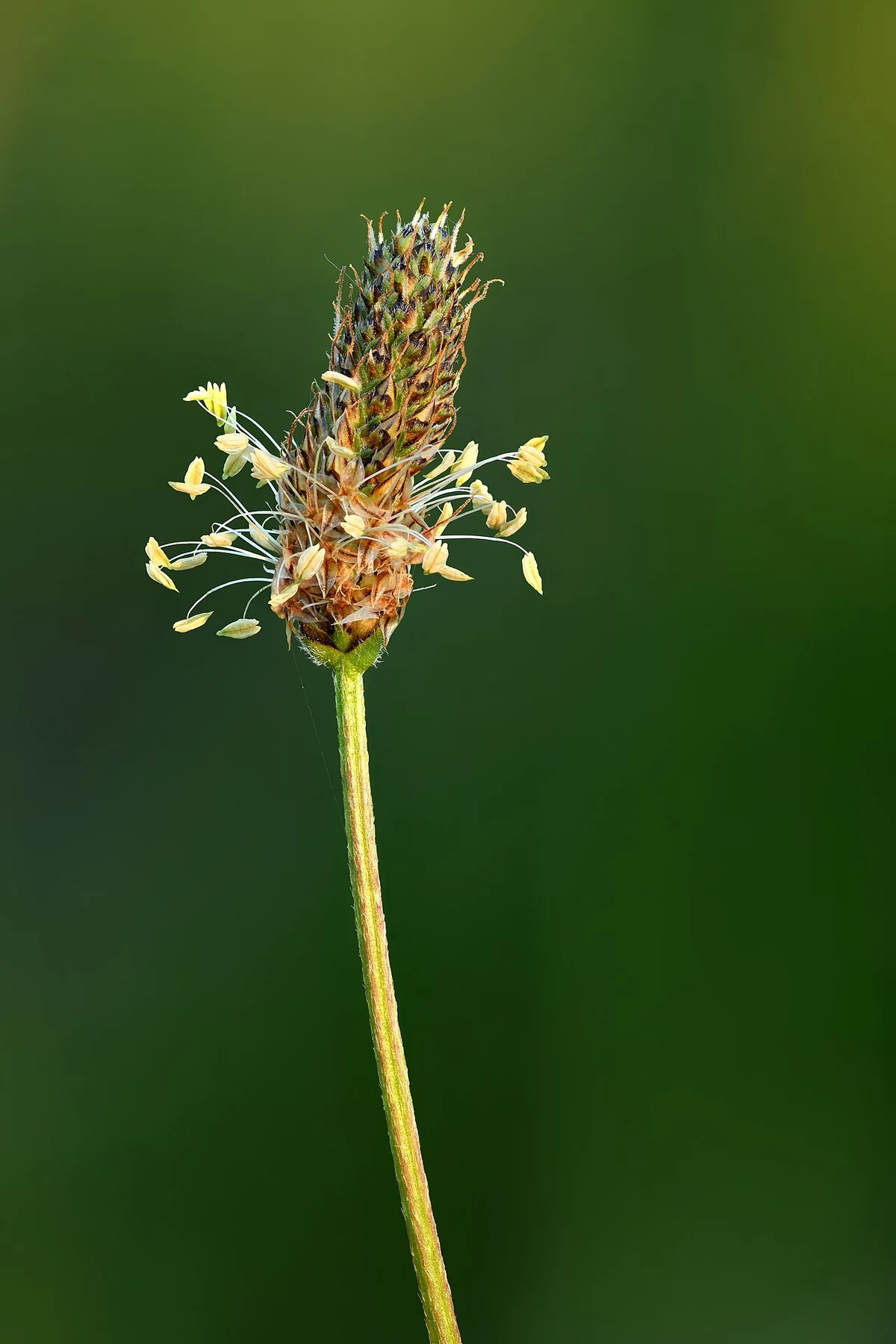
An inflorescence of ribwort plantain (Plantago lanceolata) on a long stalk. Resized and converted to WebP; no cropping or content edits.
Ivar Leidus · CC BY-SA 4.0 · Source · EXIF orientation respected; resized without cropping or upsampling; converted to WebP at quality 88. No other content edits.
Read the ribs, then check the whole plant
Ribwort plantain has narrow, lance-shaped leaves with conspicuous lengthwise ribs, arranged in a basal rosette. Its leafless stalks carry compact brownish flower heads, often ringed with pale protruding stamens. It is common in European grassland and disturbed ground. Leaves are the material considered here.
Broad-leaved plantain, Plantago major, shares some traditional uses but is a separate species. Psyllium husks and seeds are separate medicinal materials again. Fernie's chapter even includes water plantain, Alisma, which belongs to another family. A familiar English name therefore conceals several plants. The modern cough-preparation definition cited here is specifically Plantago lanceolata leaf.
A leaf close to everyday life
Culpeper locates plantain in fields, meadows and paths. Its availability helps explain why it entered household wound care. He describes juice, root and seed decoctions, external applications and a wide range of internal complaints. His general entry covers the plantains as a group rather than ribwort alone.
Fernie explicitly separates the ribwort subsection and associates its leaves with sores and wound dressing. He also records children's games in which the stalked heads were struck against one another. That detail locates the plant within ordinary play as well as medicine. A herb did not need to be rare or ceremonially gathered to acquire a prominent place in local knowledge.
From a cooling leaf to a throat preparation
The old wound reputation involved bruised leaves placed directly on the body, the image of a ready remedy picked from the path. Culpeper's entry goes much further, to lung ulcers, bleeding and fevers, and to applications for the eyes and ears.
The traditional preparations described today use the leaf for an irritated mouth or throat and the dry cough that goes with it, or a cough with a cold. They form the most enduring strand of the leaf's long medicinal history.
The stalks called soldiers
Fernie's ribwort subsection preserves a childhood world built around the flower stalks. He gives names such as soldiers, cocks and hens, hardheads and fighting cocks, and describes children striking one stalked head against another. The compact head and long handle make the game possible. Here the useful part is the flowering stalk, not the medicinal leaf, and success means remaining unbroken rather than treating a complaint.
He also records lamb's tongue in Sussex, a name that draws attention to the narrow leaf. The two sets of names select different visible features of the same plant: one notices a leaf's shape, the other the head's behaviour in play. This is a useful corrective to the idea that folk names always encode a medicinal secret. They can record ordinary observation, humour and children's activity.
The source's German divination reference and story about toads healing themselves belong to another evidential category. They show further beliefs attached to the plant, recorded briefly beside the well-described game.
Sources: [F]
A broad-leaved comparison from Polish villages
Udziela's entry headed Plantago major provides a close comparison, provided the species boundary is maintained. He records green leaves applied to wounds and burns in several Kraków-area villages. At Rzeszotary the handling could be more elaborate: the ribs were removed and the leaf soaked before use on chafed skin. Another preparation combined fresh leaves with scraped bacon fat or another unsalted fat. Those actions make the leaf a flexible covering and the fat a separate carrier.
These observations show what a ready household leaf remedy could involve, and they concern the broad-leaved species. The same entry describes leaves on the head during headache, leaves around sweaty feet and inclusion in the 15 August blessing at Świątniki Górne. Availability allowed a familiar plant to enter several kinds of care.
The English ribwort game, the Polish broad-leaf applications and the Plantago lanceolata cough preparations refer to related plants and uses. Naming the species, part and route keeps each tradition in its own place.
Culpeper's argument over the planet
Culpeper's plantain entry opens with disagreement. Other astrological physicians, he says, assign the herb to Mars; he assigns it to Venus and explains its action through sympathy and antipathy between planetary influences. The argument is central to how he organises the remedy. It is the framework in which his readers understood the remedy.
His practical list then ranges across clarified juice, roots, seeds, dried leaves, water and wine. He even questions the significance of a prescribed number of roots in an older fever remedy. This shows selective criticism within the historical tradition: an author could accept planetary medicine while rejecting a particular numerical rule as fanciful.
The entry joins concrete operations, pressing, clarifying, boiling and drying, to that planetary explanation, and it reaches as far as eye drops, serious bleeding and animal bites. It is evidence of a learned household pharmacy in which the common wayside plant occupied a remarkably broad place.
Sources: [C]
Why seeds and leaves need separate labels
Fernie's chapter ends with psyllium seeds, whose swelling mucilage belongs to a different practical tradition from ribwort-leaf tea. Earlier it also includes Alisma, the water plantain, which is not a Plantago. Those roots and seeds belong to other plants. A stored jar labelled Plantago lanceolata leaf conveys something quite different from plantain seed, and the old chapter becomes clearer when each plant and part is named.
Leaves, infusions and syrups
Editorial collection guidance: choose clean, undamaged leaves from a positively identified plant at a permitted, uncontaminated site. Leaf growth and flowering vary through spring and summer across Europe; the plant's condition is more useful than a universal month. Dry the leaves promptly in a thin layer with airflow, rather than compressing a wet harvest in a bag. Keep the dried material labelled and discard it if mould develops.
The European Medicines Agency's monograph on ribwort plantain leaf, written for traditional herbal medicinal products, records the traditional adult infusion as 1.4–2 g in 150–250 ml of boiling water. The agency's tea-preparation template describes the method: the leaf is covered with freshly boiled water, left covered for five to fifteen minutes and strained. A syrup incorporated a defined plant preparation into a sweet base, rather than leaving leaves indefinitely in sugar.
Cold macerates and expressed juices are also documented preparation categories, and the monograph describes the macerate as a preparation made for immediate use. Juice, macerate, infusion and syrup each kept their own method.
A leaf from the path
Ribwort plantain belonged to ordinary life. It grew in the fields, meadows and paths where Culpeper placed it; its leaves were laid on sores and wounds; its stalks were the soldiers of children's games; and its broad-leaved relative was pressed onto wounds and burns, soaked for chafed skin and carried to the blessing in Kraków-area villages. Today the European Medicines Agency describes ribwort leaf preparations within its traditional-use framework for an irritated throat and cough, with its own conditions of age and use.
Its ordinary leaf, its regional household practices and its defined modern preparation are related parts of one long story.
Sources
- [C] Nicholas Culpeper. The Complete Herbal (1850). Plantain; general historical entry, pp. 141–142
Historical descriptions and uses
Medical claims are historical; publication is the expanded 1850 edition.
- [F] William Thomas Fernie. Herbal Simples Approved for Modern Uses of Cure, second edition (1897). Plantain, printed pp. 434–437; ribwort subsection
Period practices and attributed customs
Not current medical advice; botanical errors are corrected in the article. Harvest and food-hygiene instructions are editorial.
- [E] European Medicines Agency, HMPC. European Union herbal monograph on Plantago lanceolata L., folium, revision 1 (2025). Preparation and safety sections; accessed 29 October 2026
Boundaries of specified traditional-use products
Does not verify broad historical cure claims.
- [U] Seweryn Udziela. Rośliny w wierzeniach ludu krakowskiego, Lud 30 (1931). Entry 90, Plantago major; field collection 1894–1899
Comparative evidence for broad-leaved plantain applications and named village handling methods
This is Plantago major, not proof that the same practices used Plantago lanceolata.
- [T] European Medicines Agency, HMPC. Patient Leaflet template concerning advice on the preparation of herbal teas as (traditional) herbal medicinal products by end-users (2016). Printed pp. 4–7, definitions and preparation templates
Usual infusion timing, covering, straining and preparation immediately before use
General method; a product-specific instruction takes precedence and plant quantities come from the individual monograph.