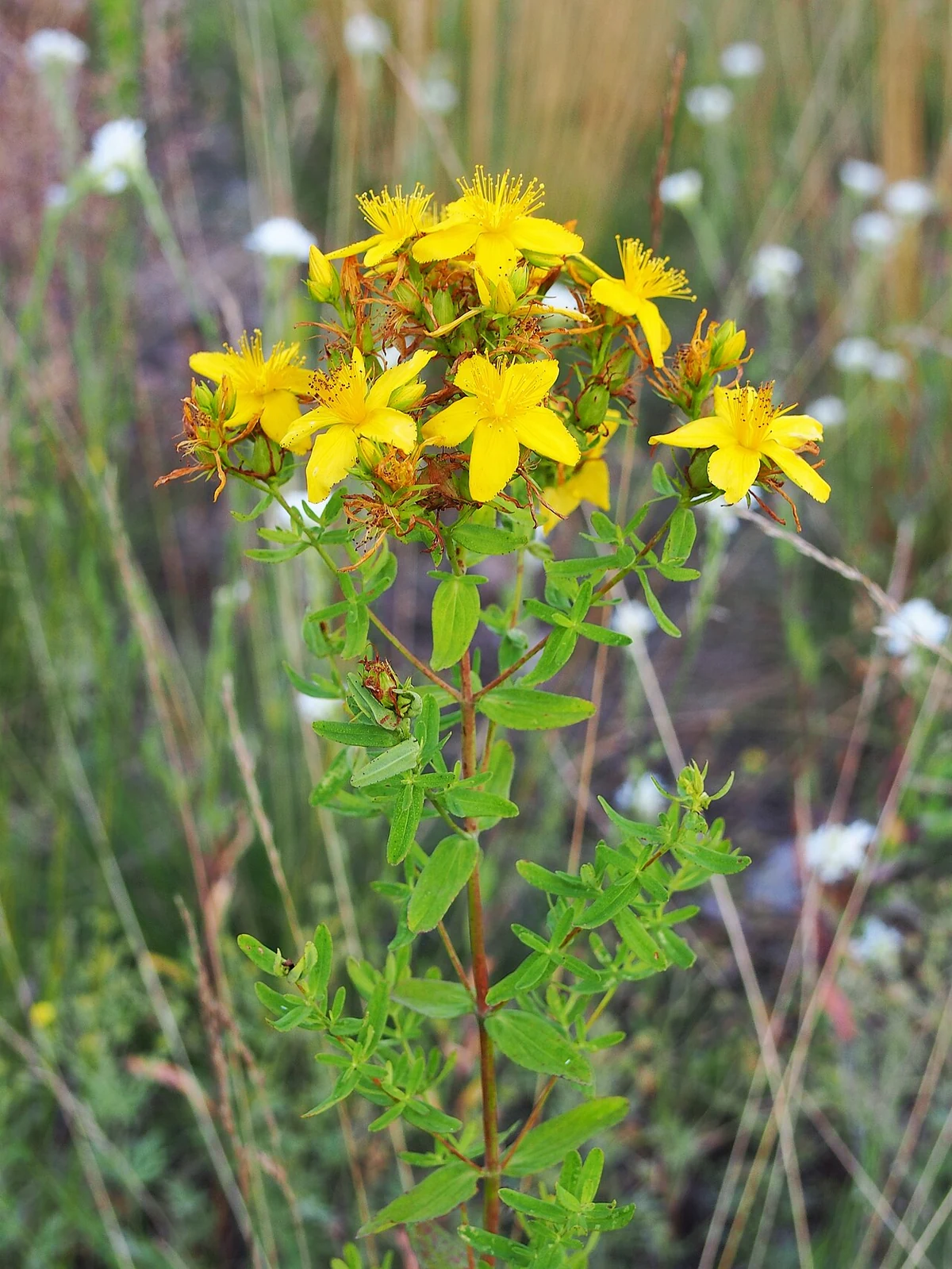
Yellow flowers of St John's wort (Hypericum perforatum) in a Wrocław meadow. Resized and converted to WebP; no cropping or content edits.
Agnieszka Kwiecień, Nova · CC BY-SA 4.0 · Source · EXIF orientation respected; resized without cropping or upsampling; converted to WebP at quality 88. No other content edits.
The perforated leaf and the red stain
St John's wort is a perennial with opposite leaves and yellow five-petalled flowers. Held to the light, the leaves show translucent glandular dots, giving the impression of tiny perforations. Crushed flowering material can produce a reddish stain. These features made it especially suggestive to earlier observers.
The species here is Hypericum perforatum. Fernie's chapter later turns to tutsan, Hypericum androsaemum, a separate plant with its own claims. A garden Hypericum with large ornamental flowers is a different plant again. The flowering aerial parts are central to the traditions discussed here.
A wound plant before a modern supplement
Culpeper gives St John's wort a strong wound-herb reputation and describes wine preparations, ointments and decoctions. Fernie develops the account of red oil, salves and alcoholic tinctures. Their medical claims extend far beyond minor skin care, including spinal injury, tetanus and internal bleeding. They show how highly the plant was valued as a herb for injuries.
The red colour encouraged analogies with blood and injury. Fernie explicitly discusses the doctrine of signatures, in which a plant's appearance was read as a clue to its use. In that reading, the red oil spoke of blood and healing. The plant's later association with mood came after this long external and symbolic history.
Midsummer in one source, August blessing in another
The English name connects the plant with St John's season, and Culpeper places flowering around midsummer and July in his setting. Fernie records protective sprigs at doors in Wales and other European stories. He offers more than one explanation for the saint's association; each is his own interpretation.
Udziela's fieldwork around Kraków, published in 1931, provides a different calendar and a more local view. His entry records inclusion among herbs blessed on 15 August, baths at Skawina and Radziszów, and protection from boginki around childbirth. Sprigs were placed by windows and doors or near a woman in confinement. This is evidence of named regional practice in the late nineteenth century, with Christian and folk elements together.
Harvesting and understanding red oil
Editorial collection guidance: Gathering traditionally focused on flowering material, but the actual flowering stage depends on latitude, weather and exposure. A saint's feast can organise a custom without guaranteeing identical plant maturity everywhere. Use positively identified plants, collect sparingly from a permitted clean site and leave abundant flowers and seed-producing stems.
For a dried herb, spread leafy flowering tops with ventilation and protect them from damp. A red oil is an oily extract of plant material, historically often exposed to sunlight; it is not a steam-distilled essential oil. Fernie describes colour passing into both spirit and expressed oils.
Present-day editorial handling guidance, not a recipe or a claim attributed to the historical author. Historical source supports identity, part and use only.
A woman's room in the Kraków district
Udziela's entry gives the protective plant a precise social setting. A woman in confinement was thought vulnerable to boginki, beings associated here with danger around childbirth. Dzwonki could be placed beneath a pillow, at a window or above a door. A further reported belief held that grasping the plant could make the beings release a woman they had seized. These are narratives about vulnerability, boundaries and protection, recorded as the beliefs of the families who held them.
The same entry moves between ritual and bodily care. It records baths for weak children or adults and applications associated with chills at Skawina and Radziszów. At Radziszów it also notes a preparation given to a cow after calving. Household, maternity and livestock care therefore stand close together in this regional record. The animal practice shows how reproductive vulnerability could organise a plant's uses across the farm.
Blessing on 15 August added a Christian calendar to these practices. The church blessing and the boginki stood side by side, and Udziela's material matters precisely because these layers coexisted. The account belongs to his late nineteenth-century fieldwork in named communities, published decades later.
Sources: [U]
Doors in Wales, milk in Scotland and a dangerous fairy ride
Fernie's compilation places sprigs above outer doors in Wales on the eve of St John's day. He also reports a Scottish practice involving milking over the herb to counter enchantment believed to spoil the milk. These details differ from Udziela's confinement-room protection even where the general language of warding off harm is similar. Each has its own object at risk, its own action and its own date.
His Isle of Man story takes a different turn: stepping on the herb after sunset was said to summon a fairy horse that carried the person through the night. In that account the plant is involved in a perilous encounter, not simply a reassuring charm. The story is told here as Fernie records it.
He gives competing explanations of the saint's name, connecting it with the flowering season and with blood-red colour. The alternatives are useful. They show how season, appearance and religious association could reinforce one another. His broad etymological and demon-expelling explanations belong to the same interpretation of inherited material.
Three colours, several products
The red stain has often dominated descriptions of St John's wort, but Fernie also mentions a yellow dye from flowers for silk or wool. Colour in a textile process and colour in an oil need not be produced by an identical preparation. His chapter separately discusses expressed oils, spirit extracts, a flower salve and a tincture from the fresh plant. The plant part, solvent and intended route vary; a red liquid is not a complete product description.
The oil was made by maceration: flowering material was kept in an oil carrier, sometimes in a glass vessel exposed to sunlight, and the coloured liquid was used externally. Fernie describes prolonged exposure to the sun as part of the method.
The older wound reputation also explains why punctures, injured nerves and the red appearance became linked in the doctrine of signatures. That intellectual connection is historically significant, and it explains why the plant was used for punctures and injured nerves. The richest history of this plant lies in keeping the pharmacy, the coloured materials and the protective stories together.
Red oil, midsummer and the protected household
St John's wort carries three histories at once: the wound herb of Culpeper and Fernie, with its red oil, salves and tinctures; the midsummer plant of doors in Wales, milk in Scotland and fairy horses on the Isle of Man; and the herb blessed on 15 August around Kraków, laid by windows, doors and the pillow of a woman in confinement to keep the boginki away. Its later reputation for mood is the most recent of these strands.
The United States National Center for Complementary and Integrative Health records that St John's wort taken by mouth reduces the effectiveness of a number of medicines, including hormonal contraceptives.
Sources
- [C] Nicholas Culpeper. The Complete Herbal (1850). St. John's Wort
Period herbal description and preparation history
Expanded 1850 edition; historical claims are not treatment advice.
- [F] William Thomas Fernie. Herbal Simples Approved for Modern Uses of Cure, second edition (1897). John's Wort, printed pp. 287–291
Historical preparation and folklore
Contains obsolete claims and botanical conflations; practical harvest and hygiene notes are editorial.
- [U] Seweryn Udziela. Rośliny w wierzeniach ludu krakowskiego, Lud, volume 30 (1931). Entry 63, Hypericum perforatum, printed p. 52; fieldwork 1894–1899
Named local practices, herb blessing and protection from boginki
Regional ethnography, not evidence of efficacy or universal Slavic practice.
- [N] National Center for Complementary and Integrative Health. St. John's Wort and Depression: In Depth (2017). Safety and More to Consider; accessed 29 October 2026
Important drug interactions and other safety limits
Used for safety only; this article is not a modern efficacy review.