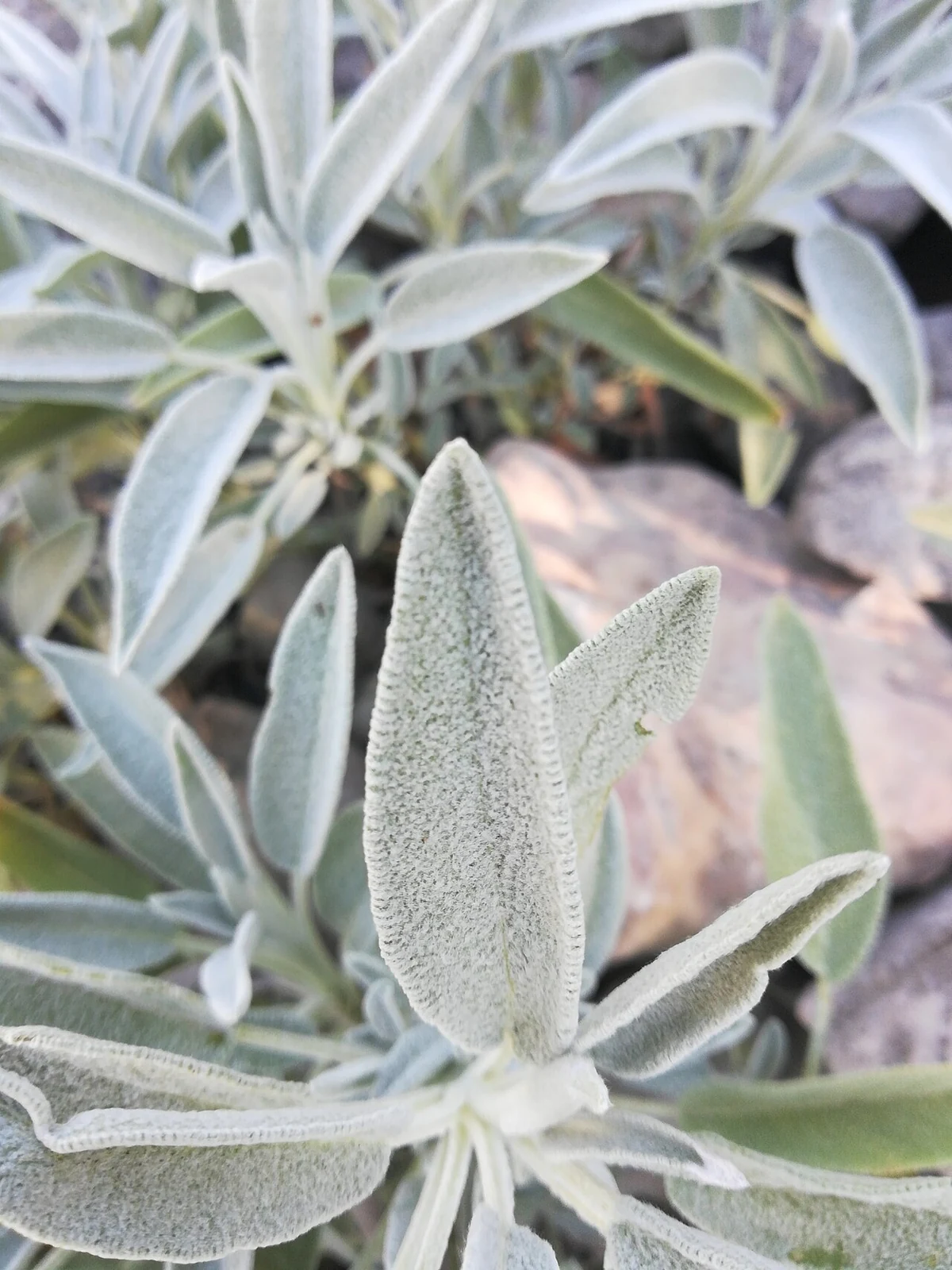
Hairy, grey-green leaves of sage (Salvia officinalis). Resized and converted to WebP; no cropping or content edits.
iNaturalist.org (Alina Majcen) (Alina%20Majcen) · CC0 · Source · EXIF orientation respected; resized without cropping or upsampling; converted to WebP at quality 88. No other content edits.
The sage in the kitchen garden
Common sage is a small, woody-based Mediterranean perennial with grey-green, textured, aromatic leaves and spikes of typically violet-blue flowers. It spread through European cultivation as both a cooking herb and a medicine. The leaves are the principal herbal material; Culpeper also values flowers preserved in sugar. A culinary cultivar can look different from a wild Mediterranean plant, so flower colour alone is not an identification test.
Fernie moves between common sage and other plants called sage. His wood sage is not Salvia officinalis. Nor does this article cover every ornamental Salvia or plants sold under fashionable common names. A reliable botanical label is particularly important when buying dried leaves, where the living plant's distinguishing features are gone.
A proverb of long life
Fernie repeats the old question of why anyone should die while sage grows in the garden, then records its equally telling correction: no garden plant defeats mortality. The pairing shows how a household herb became a symbol of health and long life. He connects sage with memory, the mouth and throat, culinary seasoning and domestic reputation.
Culpeper's entry is broader still. It places sage among warming remedies for the head and nerves, describes leaf decoctions and compound gargles, and recommends flower conserves. His explanations depend on a medical vocabulary of heat, cold and obstructed bodily processes. Within that framework he also extends sage to paralysis and serious infection, a measure of the trust his age placed in it.
A throat remedy with local variations
The Kraków-area evidence is unusually close to one familiar modern use, but the differences remain instructive. Udziela names sage decoctions used to rinse a sore throat in Brzezowa, Rzeszotary and Skawina, and during cough at Świątniki Górne. At Wieliczka one version included expressed beetroot juice. Another Wieliczka note describes holding a cool sage preparation in the mouth for toothache. Each detail belongs to a particular village household.
At Dobczyce sage was boiled with milk and drunk for chest complaints. Changing from water to milk changed the preparation and its place in the meal or sickroom. The short ethnographic entry records the method and its purpose rather than measurements or cooking times.
Sage also appears in the 15 August blessing bundle. Immediately after common sage, Udziela lists Salvia verticillata separately, with the name krzyżownik and a reported use in mixed herbs for cattle. Udziela's arrangement keeps the animal remedy with its own species.
Sources: [U]
Rich food, cheese and a garden household
Fernie's account is strongly culinary as well as medicinal. Sage accompanies rich roast duck and goose in the familiar combination with onions; he also mentions bread and butter and the colouring or flavouring of cheese. He explains that the aromatic bitterness helped people manage rich food, an account of digestion that kept sage beside the roast.
To understand this domestic use practically, distinguish a few chopped culinary leaves incorporated into a dish from a separate medicinal drink. The leaves are eaten with the food, the amount follows the recipe and the flavour is part of the result. A flower conserve, by contrast, treats the plant as material to preserve in a sweet base. A gargle is made to contact the mouth and be discarded. These are not three strengths of one universal sage medicine; they are three different kinds of household preparation.
Fernie reports a Buckinghamshire saying that vigorous sage signalled a wife's authority, and another belief connecting its success with the owner's business. These are social readings of a garden plant. They reveal how people could turn ordinary growth into commentary on household power and prosperity.
Long life, ritual numbers and remembrance
The proverb about sage defeating death is only one part of Fernie's folklore. He records a Sussex practice of chewing leaves on nine consecutive fasting mornings for ague. Here the number and repeated morning action are as important to the reported practice as the herb. It is a regional healing custom in which the ritual of repetition carried as much weight as the leaf.
He also passes on Pepys's account of sage planted on graves between Gosport and Southampton, and associates the herb with consolation in Franche-Comté. These references broaden sage's meaning beyond food and physical symptoms. A plant cultivated for health could also accompany death and grief. The older textual chain is named honestly: this article encountered those observations through Fernie, rather than by inspecting Pepys's original manuscript or conducting French fieldwork.
Culpeper's elaborate medicinal repertoire adds another layer. He mentions mixed pills, juice, wine preparations, external applications and baths, often under headings such as coldness, rheum and weakened senses. His entry reaches as far as seizures, haemorrhage and the complications of pregnancy, and its range shows why the plant acquired a reputation for versatility.
Leaves through the season
Editorial collection guidance: Use known garden sage rather than an unidentified wild substitute. Gather healthy leaves in dry conditions, with young leafy growth offering a convenient harvest before or around flowering. Flowering dates move with climate: a Mediterranean spring and an Irish summer are not equivalent calendars. Harvest modestly, leaving the woody framework and sufficient green growth; a severely cut old sage plant may recover poorly.
Spread the leaves thinly to dry in a ventilated, shaded place. When fully dry, keep them labelled and protected from moisture and strong light. Record the botanical name, part and harvest date. Discard mouldy material. The purpose is to preserve a recognisable aromatic leaf.
Present-day editorial handling guidance, not a recipe or a claim attributed to the historical author. Historical source supports identity, part and use only.
Sources: [F]
What people made
A leaf infusion extracts into water; a decoction keeps the herb at heat for longer. Culpeper's mixed gargles combined sage with other plants, sometimes with honey and alum, and illustrate the compound pharmacy of a household dispensary.
The European Medicines Agency's monograph on sage leaf, written for traditional herbal medicinal products, records the traditional gargle as 2.5 g of dried, cut leaf in 100 ml of boiling water. The agency's tea-preparation template describes the method: the leaf is covered with freshly boiled water, left covered for five to fifteen minutes and strained, and the warm liquid is used to gargle and then spat out. It continues the sore-throat rinses that Udziela recorded in Brzezowa, Rzeszotary and Skawina.
A flower conserve preserved soft plant material with sugar; a tincture extracted the leaf into a water–alcohol solvent; distilled sage oil was more concentrated again. The old households kept these forms apart by purpose: a seasoning, a gargle, a conserve and a spirit.
A herb for the kitchen, the throat and remembrance
Sage's history gathers many roles around one garden plant. Culpeper kept it for the head, the nerves and the throat, in gargles, juices, wines and flower conserves. Fernie recorded it beside roast goose and in cheese, in a Sussex ague cure of nine fasting mornings and on graves between Gosport and Southampton. Udziela's villagers rinsed sore throats with it, boiled it in milk for the chest and carried it to the blessing on 15 August. Today the European Medicines Agency describes sage leaf preparations within its traditional-use framework, with its own conditions of age and use.
The old proverb asked why anyone should die while sage grows in the garden. The records show why the question was asked: few plants were trusted in so many parts of daily life.
Sources
- [C] Nicholas Culpeper. The Complete Herbal (1850). Sage, digitised 1850 edition
Period uses and forms of preparation
An expanded historical edition, not a current treatment guide.
- [F] William Thomas Fernie. Herbal Simples Approved for Modern Uses of Cure, second edition (1897). Sage, printed pp. 489–493
Nineteenth-century herbal practice and reported customs
Medical claims and historical anecdotes require critical reading; harvesting and hygiene advice is editorial.
- [E] European Medicines Agency, HMPC. European Union herbal monograph on Salvia officinalis L., folium, revision 1 (2016). Preparation definitions and safety sections; accessed 29 October 2026
Safety boundary for specified preparations
Not evidence that all historical remedies work.
- [U] Seweryn Udziela. Rośliny w wierzeniach ludu krakowskiego, Lud 30 (1931). Entries 103, Salvia officinalis, and 104, Salvia verticillata; field collection 1894–1899
Named village throat and mouth applications, milk preparation and distinction from whorled sage
Records belief and practice, without a validated recipe or modern diagnosis.
- [T] European Medicines Agency, HMPC. Patient Leaflet template concerning advice on the preparation of herbal teas as (traditional) herbal medicinal products by end-users (2016). Printed pp. 4–7, definitions and preparation templates
Usual infusion timing, covering, straining and preparation immediately before use
General method; a product-specific instruction takes precedence and plant quantities come from the individual monograph.