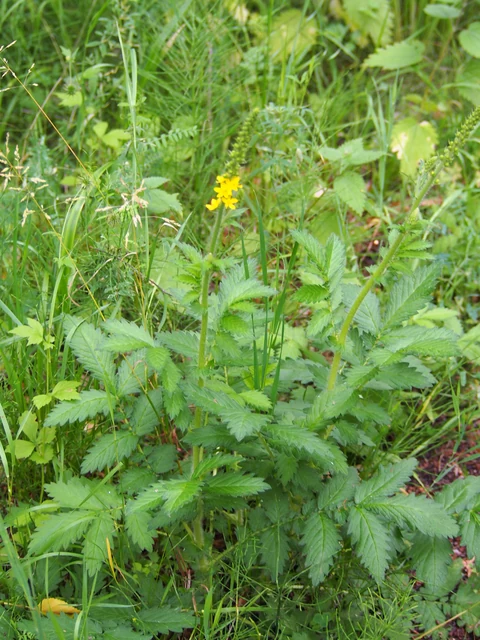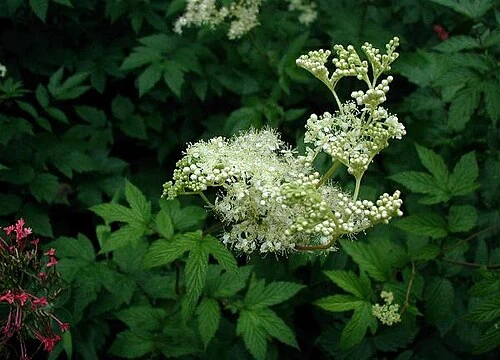
Meadowsweet (Filipendula ulmaria): pale flower clusters against green leaves. Resized and converted to WebP; no cropping or content edits.
Sten Porse · CC BY-SA 3.0 · Source · EXIF orientation respected; resized without cropping or upsampling; converted to WebP at quality 88. No other content edits.
The sweet scent belongs to a wet place
Meadowsweet is a perennial of damp meadows, stream margins and other moist European habitats. Its tall stems carry divided leaves and frothy clusters of small creamy-white flowers. Culpeper describes larger leaflets interspersed with smaller ones, pale undersides and flowers sweeter-smelling than the leaves. The combination of habitat, foliage and inflorescence matters more than fragrance alone for identification.
Older botanical works may call it Spiraea ulmaria. The modern name Filipendula ulmaria refers to the same species, but garden spiraeas are not interchangeable herbal material. Flower alone and flowering herb, including leafy upper growth, are also distinct materials. This distinction affects what a recipe means by a spoonful or a handful.
A historical medicine of scent and binding
Culpeper's name queen of the meadows conveys stature and abundance, while his description gives a practical observation: a leaf could flavour a cup of claret. He places the plant among remedies for bleeding, bowel flux and other complaints, and associates it with a merry heart. These are the uses of his period, organised by his medicine.
His instructions contain an instructive contrast. A warm wine preparation with honey was said to loosen the body, whereas a red-wine preparation was said to check flux. The carrier and the old medical theory mattered as much as the plant's identity. Historical herbalism did not always assign one fixed effect to a species.
Sources: [C]
Reading the summer calendar locally
Editorial collection guidance: Culpeper gives June, July and August as flowering months in his setting. That is a useful British seasonal reference, but altitude, latitude and weather change the flowering window across Europe. For flower or flowering-herb material, harvest sound upper growth while the flowers are in good condition, not brown and weathered.
Choose an uncontaminated site and respect access and habitat protection. Wet ground can be ecologically sensitive; do not uproot plants or trample a large area for a small harvest. Dry loose flowering tops in a ventilated shaded space, separating thick stems if necessary so that moisture is not retained. Label whether the container holds flowers alone or flowering herb. This practical distinction prevents accidental substitution between preparations.
Present-day editorial handling guidance, not a recipe or a claim attributed to the historical author. Historical source supports identity, part and use only.
Water and wine
The historical wine method extracted the plant into an alcoholic drink, sometimes with honey. It belongs to the same household world as herb-flavoured wines, where the amount of plant, the strength of the wine and the time of steeping all shaped the result, and a tannic red wine was itself an active part of the preparation.
A meadowsweet tea is made by placing measured flowering material in a vessel, adding freshly boiled water, covering, steeping and straining; flowers and flowering herb weigh and pack differently. A tincture is a separate defined extract.
Culpeper also describes external use, notes that the leaves raised blisters on the skin and recommends a water for the eyes.
The room, the wine cup and the medicinal chest
Meadowsweet's fragrance connected uses that a modern catalogue might separate into medicine, housekeeping and food. Grieve describes its use as a strewing herb and reproduces Gerard's account of decorating rooms with it. This was a use of the plant's scent in an inhabited space, distinct from swallowing an extract. She also separates the almond-like flower fragrance from the smell of the leaves. A dried bouquet and a medicinal packet may therefore come from the same plant without being the same product.
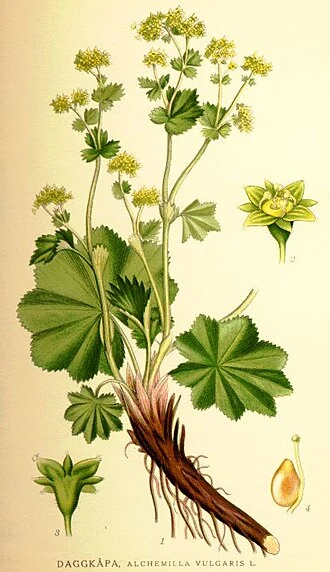
Grieve's entry moves between flower, herb and root: flowering material for an infusion, fresh tops in a preparation intended to provoke perspiration, and a historical root decoction in wine for fever. She distinguishes the dry-ground dropwort from wet-ground meadowsweet. Her accompanying discussion covers other spiraeas, and the willow-leaved spiraea pictured beside her text is a different plant. She also names meadowsweet as one of three herbs held sacred by the Druids.
Culpeper's claret detail offers a smaller, more concrete window onto the household. It identifies a single leaf as an aromatic addition to an existing drink. This is a different operation from boiling a medicinal quantity of flowers in wine. The first changes the flavour of the cup; the second was described in relation to a complaint.
Why two wine preparations could carry opposite promises
The apparent inconsistency between loosening and restraining the bowels is part of the evidence. In Culpeper's account the warm preparation includes honey, whereas the other employs red wine. The historical author was presenting combinations within a medical system, in which the carrier counted as much as the herb.
His range of uses also crosses several categories now kept apart. Bowel flux, bleeding, vomiting and menstrual complaints sit beside ulcers and periodic fever. The old term flux names an observable discharge rather than one securely identified disease. Quarten ague belongs to a periodic-fever vocabulary. Both words belong to the medical vocabulary of their time, and they show what practitioners thought a binding or comforting plant could do.
Culpeper assigns meadowsweet to Venus while discussing this repertoire. That attribution reminds us that smell, taste, celestial correspondences and the carrier were integrated in the explanation. His promise of a cheerful heart also belongs in that setting. Keeping the language close to its setting makes the tradition more intelligible.
Sources: [C]
Preparing a cup
A labelled tea gives the plant part and measured quantity that a loose handful lacks. The European Medicines Agency's general infusion procedure describes the method: the measured material is covered with freshly boiled water in a heat-resistant cup, left covered for five to fifteen minutes, stirred, strained and cooled to drinking temperature, and the cup is made fresh. This is the water method that sits beside Culpeper's wine preparations.
A packet may contain flowers or flowering herb. Flower-rich material and a mixture containing leafy stems have different proportions and pack differently into a spoon, which is why the quantity is weighed.
For a collection intended for study, a pressed botanical voucher or clear photographs with the date and habitat, kept apart from the consumable material, connect the wet-meadow plant, the harvested part and the preparation. This is an editorial documentation practice.
Queen of the meadows
Meadowsweet's record joins fragrance and medicine. Culpeper's queen of the meadows flavoured a cup of claret, was steeped in wine with honey or in red wine, and was used for flux, bleeding and a merry heart. Grieve describes it strewn on floors and decorating rooms, and its flowering tops infused. The plant contains salicylate-related constituents, and the European Medicines Agency's assessment describes meadowsweet preparations within its traditional-use framework, with its own conditions of use.
It can be understood as a fragrant flowering herb of the wet meadow with a long and varied preparation history.
Sources
- [C] Nicholas Culpeper. The Complete Herbal (1850). Queen of the Meadows, Meadow Sweet, or Mead Sweet, pp. 147–148
Period herbal description and preparation history
Expanded 1850 edition; historical claims are not treatment advice.
- [E] European Medicines Agency, HMPC. Assessment report on Filipendula ulmaria (L.) Maxim., herba and flos (2011). Definitions and safety sections, accessed 29 October 2026
Current boundary around specified preparations
Not validation of all historical claims.
- [G] Maud Grieve. A Modern Herbal: Meadowsweet (1931). Description, medicinal action and other species
Strewing, scent, flower versus root preparations and distinction from dropwort
Historical compilation; the page also contains unsupported ancient-origin claims and an illustration of a different species.
- [T] European Medicines Agency, HMPC. Draft template for a European Union herbal monograph: herbal teas (2016). Preparation definitions, pp. 4–7
General infusion procedure and fresh preparation
General method, not a meadowsweet-specific dose or indication.