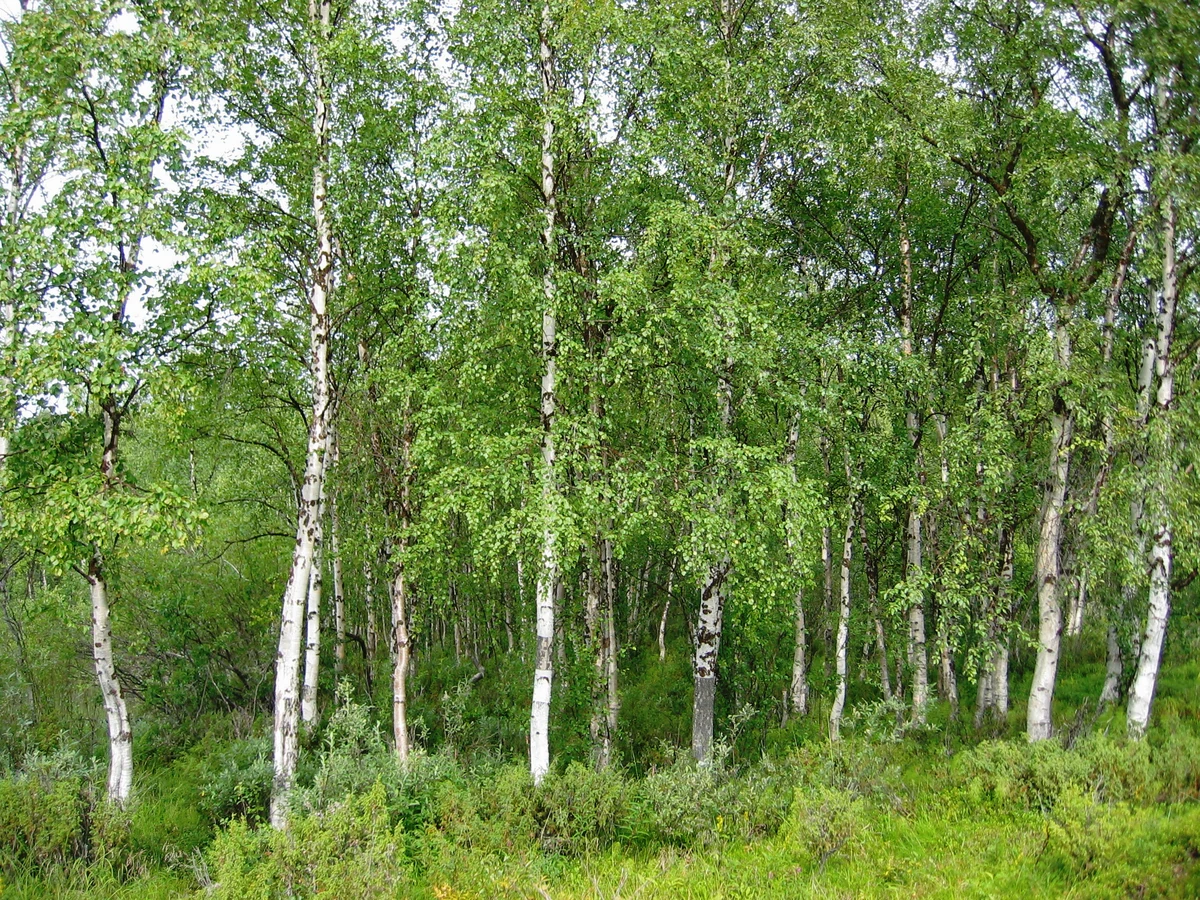
Silver birches (Betula pendula) in Finland. Resized and converted to WebP; no cropping or content edits.
Percita at Flickr · CC BY-SA 2.0 · Source · EXIF orientation respected; resized without cropping or upsampling; converted to WebP at quality 88. No other content edits.
One tree name, several botanical and material identities
Birch is familiar enough that its name can conceal important differences. Silver birch, Betula pendula, and downy birch, Betula pubescens, are the principal European species considered here. Their hybrids also occur. White bark alone does not identify a tree, and ornamental birches introduce further possibilities. A reliable identification considers leaves, twigs, buds, bark, growth and habitat together.
Older books commonly use Betula alba. That historical name should not be silently replaced by B. pendula in every quotation. Kluk's eighteenth-century entry is evidence about the birch he described, but its name does not settle every modern taxonomic question. The EMA, by contrast, explicitly defines its leaf material as B. pendula, B. pubescens or their hybrids.
The part is as important as the species. Spring sap, a leaf infusion, bud spirits, bark tar and an essential oil are different preparations. Their sources, chemistry and handling differ, and each has its own history.
What the older authors actually say
The sources do not tell one continuous, unanimous story. Gerard's birch chapter, in Johnson's 1633 revision, discusses material uses and says that medicinal virtues are not known to the author. His interest lay in the tree's materials.
Culpeper's account, read here in the 1850 Thomas Kelly edition, is different. It discusses juice from young leaves, distilled leaf water and liquid obtained by boring the tree. He associates these with stones in the kidneys and bladder and with washing a sore mouth.
Kluk's Dykcyonarz roślinny adds a practical economic perspective. His entry covers the spring liquid and products made from it, but also bark, tar, colouring and everyday materials. Read together, the three writers show changing emphases: a tree of useful materials, a medicinal tree and a resource within a rural economy. Their differences are evidence worth retaining.
Spring sap: collection and season
Birch sap is a seasonal flowing liquid, collected around the period before full leaf development. Its availability follows weather and tree physiology, not a date printed on a calendar. A warm lowland spring and a cool northern one can differ substantially. Modern Finnish observations also show variation among trees, stands and years.
Historically, collection involved making an opening in the trunk and directing the liquid into a vessel, a wound the tree then had to heal. Today food-grade sap is also collected and sold.
The historical descriptions give the practice rather than drilling sizes; those belong to local forestry knowledge, and the living tree remained part of the cost of every bottle.
Fresh drink, fermentation, vinegar and syrup
Kluk describes a family of sap products: fresh liquid, fermented drinks, vinegar, beer, wine and syrup. These are separate transformations. Fermentation uses microorganisms to change sugars; vinegar production introduces another transformation; syrup concentrates soluble material by removing water. A bottle cannot be assumed to have undergone one process merely because it tastes slightly sour or sweet.
The list is valuable evidence of household ingenuity. A brief seasonal resource could be turned into products with different flavours and uses. It also explains why historical sap culture was more than drinking liquid straight from a tree. The same resource entered a kitchen, a store room and a medical imagination.
Fresh sap was perishable, and the many transformations, fermenting, souring into vinegar and boiling down into syrup, turned a brief seasonal flow into something that could be kept.
Kluk also records medicinal claims for the sap, reaching as far as consumption, urinary complaints and chronic abdominal disease.
Sources: [K]
Leaves: the most clearly defined medicinal material
Birch leaf has a more specific modern traditional-use framework than sap. The Polish collection manual describes gathering sound, developed leaves around May and June, then drying them thinly with ventilation. These months are a regional guide. The useful observation is the leaf's condition and stage, adjusted to local climate, rather than a fixed day.
Gather only where permitted, take a limited proportion and avoid damaged, polluted or diseased foliage. Record the species as precisely as possible and keep leaves separate from buds and bark. Drying a thick pile encourages deterioration; fully dried material should be protected from moisture and clearly labelled.
The European Medicines Agency describes birch leaf within its traditional-use framework for flushing the urinary tract in minor urinary complaints. Its monograph distinguishes cut leaf, powdered leaf and several extracts, and the infusion described below concerns the cut dried leaf.
Buds and a sharply located folk record
Udziela records fresh sap against consumption at Wieliczka. In the same entry, young leaf buds steeped in spirits were used on cloths in a practice intended to stop bleeding. At Brzezowa birch was blessed on 15 August, and a blessed twig appeared in a healing belief involving a child with a serious illness.
These details come from a regional ethnographic collection, principally based on fieldwork in 1894–1899. The spirit preparation was a bud macerate, distinct from leaf tea and from distilled birch oil, and the cloth application belongs to the history of wound care.
The record also shows why preparation and belief cannot always be separated neatly. A household could value a tree's liquid, its opening buds and a blessed branch for different reasons. Keeping the locality and route of use visible preserves that complexity.
Sources: [U]
Bark, tar, twigs and the non-medicinal economy
Kluk includes bark and tar among birch's useful products. Bark could be a material; destructive heating could yield tar; twigs could become brooms. These activities belong to a broader woodland economy, not simply a dispensary. Their inclusion helps explain why birch was close at hand when medicinal or ritual uses arose.
Tar is not sap: it is the product of a very different process, destructive heating with fire and smoke. The old sources also record internal and skin uses of tar.
Catkins and pollen can be observed as reproductive structures; the sources consulted here record no birch-pollen remedy.
The misleading phrase birch oil
A bottle called birch oil can refer to materially different products. Sweet birch, Betula lenta, associated with methyl salicylate-rich oil, is not the same species or preparation as European birch-leaf tea. A tar-derived product is different again. The name alone is therefore insufficient for deciding how a substance should be used.
Infusing leaves in a carrier oil does not produce the same thing as distilling volatile constituents or collecting tar; species, plant part and process together define the product.
This distinction is particularly important for families who keep several homemade preparations. Clear labels should state more than birch: the part, solvent or base, date and intended non-food or food role all matter.
Preparing a defined leaf infusion
The European Medicines Agency's monograph on birch leaf, written for traditional herbal medicinal products, records the traditional adult infusion as 2–3 g of cut dried leaf in 150 ml of boiling water, up to four times daily, within traditional use for flushing the urinary tract over two to four weeks. The agency's general preparation template describes the method: the leaf is covered with freshly boiled water, left covered for five to fifteen minutes and strained. Drinking plenty of fluid belongs to the traditional use itself.
The leaf infusion carries forward, in a measured form, the old association between birch and the urinary passages that runs from Culpeper's young-leaf juice to the present.
Why an extract cannot be measured like a cup of tea
An extract label needs more than the word birch. The EMA distinguishes a dry water extract from liquid preparations made from fresh leaves, including one stabilised and extracted using ethanol. Their drug-to-extract ratios and individual directions differ. A ratio describes the relationship between starting material and extract; it does not make a spoonful of one product interchangeable with a spoonful of another.
Culpeper's young-leaf juice adds another category. Pressing fresh plant tissue produces a liquid from that material, whereas an infusion adds water to dried leaves. His distilled liquid involves a further process. These distinctions explain why every old water was not a tea and every spirit not the same strength of tincture.
The Wieliczka bud preparation illustrates the problem particularly well. It involved a different part and an external purpose. Recording the part, solvent, route and intended use is the simplest way to keep those histories separate.
Sap in a kitchen with more than one kind of vessel
Kluk's list of fresh sap, beer, wine, vinegar and syrup can be read as a sequence of possible kitchen transformations rather than a list of interchangeable drinks. Fresh collection brings a perishable seasonal material into a vessel. Fermentation changes it biologically; concentration changes it by removing water. A fermented drink may then become the starting material for a different transformation. Each step demands knowledge of the material at that stage.
Grieve's later wine account makes the flavouring more tangible: honey, cloves and lemon peel accompany the sap, with yeast used for fermentation. She also gives confident figures for large yields and describes tapping as harmless to the tree, while the Finnish tapping observations show how much yields vary.
The historical account shows what kind of result the household sought: a fermented, flavoured sap drink, made with yeast and spices, quite unlike a leaf infusion or a bark extract.
A leaf calendar is different from a sap calendar
The first spring visit to an identified birch may concern swelling buds and the sap season before full leaf development. A later visit concerns expanded foliage. The Polish guidance's May–June leaf window and the spring tapping season are therefore two separate calendars. These are different biological events, even when one household used both materials.
For a small permitted leaf collection, keep the gathering loose and move it promptly into a thin drying layer with ventilation. Treat buds and leaves as separate lots. An editorial record can then note the species, place, collection date, developmental stage and drying conditions. This is present-day handling documentation, not a claim that Kluk or Udziela used those exact labels.
The date of a blessed branch is different again. Udziela's 15 August observation belongs to a religious calendar. The sap, the leaf and the blessed branch each had their own season, and one tree held all three.
The branch, the cloth and the meaning of care
Udziela's birch entry places three markedly different actions close together: drinking fresh sap, applying cloths associated with a bud spirit, and using a blessed branch in a belief concerning a sick child. The last practice includes striking with the branch; it is recorded here as a historical belief, in the collector's own disease language.
The cloth in the wound account is also significant. The preparation was not simply a substance in a bottle: its reported use involved a dressing and a sequence of coverings. This places it within household management of an injury.
These distinctions help explain why ethnographic material should retain both place and action. Wieliczka and Brzezowa do not supply a single universal birch cure. They supply examples of a drink, an external intervention and a religiously charged act, each with a different claimed purpose.
Sources: [U]
Woodland usefulness beyond the medicine bottle
Grieve's account places birch in thread mills, barrels, brooms and leather dressing. Those uses widen the picture of a tree often reduced to a spring drink. Twigs, wood and processed bark entered different trades and domestic tasks. Her association of birch tar with the smell of Russia leather is especially useful for understanding why a material might be recognised by scent as well as name.
Kluk's economic account likewise joins colouring, brooms and tar to sap products. Gerard's reluctance to assign medicinal virtues therefore does not make his birch unimportant: material usefulness was already ample reason to describe it. The disagreement between the herbals is not a puzzle requiring a hidden lost cure. They were attending to different kinds of value.
For a heritage display, a broom, a labelled craft sample and a reproduction of the historical entry convey that breadth well. The craft and medical histories illuminate one another while remaining distinct.
The many lives of one tree
Birch's history shows a single tree serving many needs. Kluk described its sap turned into drinks, beer, wine, vinegar and syrup, and its bark, tar, colouring and brooms. Culpeper used young-leaf juice, distilled leaf water and bored-tree liquid for stones and a sore mouth; Gerard valued its materials; and around Kraków its fresh sap was drunk against consumption at Wieliczka, its buds were steeped in spirits for bleeding and its branch was blessed on 15 August at Brzezowa. Today the European Medicines Agency describes birch leaf preparations within its traditional-use framework, with its own conditions of age and use.
A spring drink, a leaf medicine, a bud spirit, a tar product and a blessed twig belong to different practices. Birch becomes more interesting, and its history more accurate, when those differences are preserved.
Sources
- [K] Krzysztof Kluk. Dykcyonarz roślinny, volume I (1786). Entry 168, Betula alba, printed pp. 70–71; PDF image 60, inspected by source-research task
Sap, fermented products, bark, tar and material uses
Historical name cannot be assigned exclusively to B. pendula; old medical claims are not established effects.
- [G] John Gerard; revised by Thomas Johnson. The Herball or Generall Historie of Plantes (1633). Book III, chapter 114, Birch, printed p. 1478; EEBO-TCP transcription, checked by source researcher
Material uses and author's explicit lack of known medicinal virtues
Do not attribute sap treatment claims to this entry.
- [C] Nicholas Culpeper. The Complete Herbal (1850). The Birch Tree, printed p. 24
Young-leaf juice, distilled liquids and tapped sap in historical medicine
Expanded Thomas Kelly edition; kidney-stone claim is not advice.
- [U] Seweryn Udziela. Rośliny w wierzeniach ludu krakowskiego, Lud 30 (1931). Entry 25, Betula alba, printed p. 44; fieldwork 1894–1899
Wieliczka sap and bud spirits; Brzezowa blessing and healing belief
Regional reported practices, not efficacy evidence.
- [H] Katarzyna Bączek, Zenon Węglarz, Olga Kosakowska and Ewelina Pióro-Jabrucka. Ekologiczny zbiór dziko rosnących roślin (project 2016–2021). Printed pp. 12–13, birch leaves; source researcher checked
Leaf collection, drying and responsible gathering
Polish collection guidance; seasons vary by region.
- [E] European Medicines Agency, HMPC. Birch leaf: overview and assessment (accessed 2026). Overview; assessment report pp. 16–18 checked by source researcher
Specified leaf preparations, traditional-use scope and contraindications
Does not assess sap, tar or every birch oil.
- [T] Jari Miina and Mikko Kurttila. A model for the sap yield of birches tapped by citizen scientists (2022). Silva Fennica 56(2), article 10679
Seasonal sap variation and tapping context
Finnish data, not a universal yield or harmless-tapping guarantee.
- [O] Environment and Climate Change Canada; Health Canada. Draft screening assessment: Salicylates Group (webpage accessed 2026). Sweet birch oil discussion, source researcher checked
Distinction involving methyl salicylate-rich B. lenta oil
Not a monograph for European birch leaf or sap.
- [EM] European Medicines Agency, HMPC. European Union herbal monograph on Betula pendula Roth and/or Betula pubescens Ehrh. as well as hybrids of both species, folium (adopted 2014; published 2015). Printed pp. 3–6, preparations, infusion, contraindications and precautions; full document inspected
Specified leaf preparations, 2–3 g in 150 ml infusion and conditions of traditional use
Leaves only; traditional-use framework, not evidence that sap, buds or tar treat the same complaints.
- [P] European Medicines Agency, HMPC. Patient Leaflet template concerning advice on the preparation of herbal teas as (traditional) herbal medicinal products by end-users (2016). Printed pp. 4–7, definitions and preparation templates
Usual infusion timing, covering, straining and fresh preparation
General method; the specific medicinal product's directions take precedence.
- [MG] Maud Grieve. A Modern Herbal: Birch, Common (1931). History, wine and material-use paragraphs in online transcription
Historical wine ingredients, craft economy and leather association
Contains outdated claims about harmless tapping and confused oil chemistry; neither is adopted. Botanical names and cross-species claims require caution.