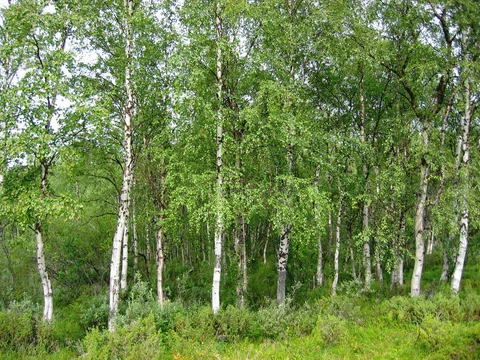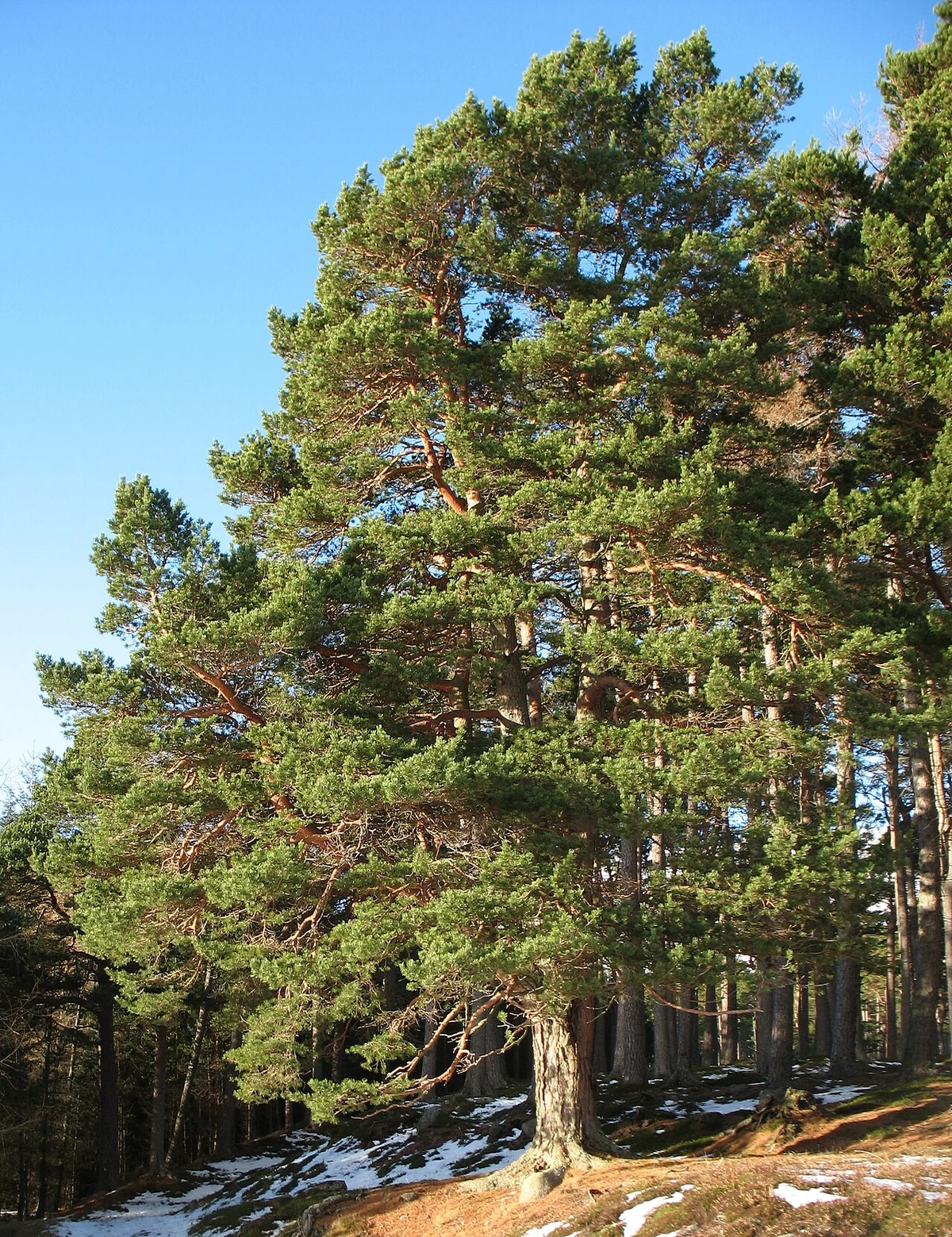
Scots pine (Pinus sylvestris) in Glen Muick, Scotland. Resized and converted to WebP; no cropping or content edits.
Hello, I am Bruce on Flickr · CC BY-SA 2.0 · Source · EXIF orientation respected; resized without cropping or upsampling; converted to WebP at quality 88. No other content edits.
Identifying the tree before interpreting a recipe
Scots pine, Pinus sylvestris, bears needles in pairs and develops characteristic cones and bark as it matures. Kluk's entry explicitly describes paired needles, giving the historical account a useful botanical anchor. Other pines share paired needles too, so the whole tree completes the identification.
Older English books often gather several conifers under broad pine names. Gerard's chapter on pine includes large edible seeds; that passage belongs to another pine. His following wild-pines chapter is broader still. Spruce, fir, larch and pine each have their own histories.
A recipe for the needles, resin or seeds of one species belongs to that species, and ornamental conifers and yew are different plants altogether.
Three spring materials
A closed pine bud, an elongating young shoot and a male pollen-bearing structure are different things. Buds are the compact structures present before active extension. Young shoots are the soft new growth that lengthens as spring advances. Male strobili produce pollen and are associated with new growth, but they are not simply unopened leaf buds.
The Polish collection manual discusses early spring buds, with March as an approximate regional guide. The Tuchola syrup tradition describes young shoots collected later, around May. The pollen season in Poland is often around May and early June, varying with weather and place. These dates are not contradictions: they concern different materials at different stages.
A useful field notebook records the observed stage, species, location and weather. It is more informative than an instruction to collect pine in May, which leaves the reader uncertain about what is actually being gathered.
Buds and young tops in Kluk's pharmacy
Kluk describes young shoot tips used as a tea and records the historical qualities attributed to them, including promoting sweat and urine and cleansing the blood. He also mentions distillates from pine material. These are the claims and preparation categories of an eighteenth-century herbal.
A water preparation and a distillate are different. The first extracts into water; the second collects volatile material carried through a distillation process. A modern essential oil is more concentrated still than an ordinary household drink.
The history nevertheless reveals a practical seasonal logic. Tender growth was easier to process than mature woody tissue and arrived at a predictable stage of the forest year. The household's knowledge was therefore partly observational: knowing which part was soft, resinous or opening could matter as much as remembering a plant name.
Sources: [K]
The Tuchola Forest syrup tradition
The Polish traditional-product register documents a Pomeranian syrup associated with the Tuchola Forest, registered on 3 July 2015. It describes resinous young shoots gathered in May at approximately 5–10 cm long. Scales are removed, the shoots are layered with sugar in a jar and the contents are pressed lightly. The jar is left for seven to fourteen days and shaken repeatedly. The liquid is then strained, the shoots pressed, and the syrup transferred to jars for cool storage. These are the method's recorded stages.
The register describes a clear amber, sweet, resin-scented liquid used in household respiratory care and in cakes or desserts; it may also become an ingredient in a spirit preparation. The register records the stages of the method rather than every quantity and temperature.
Sources: [R]
Gathering without taking the tree's future growth
Editorial collection guidance: removing a leader shoot can alter a young tree's development. The collection guidance therefore matters as much as the calendar. Prefer legally available material from appropriate pruning, obtain the land manager's permission and leave the main growing point intact. Do not strip all buds or shoots from a branch or collect from protected sites.
For a study specimen, a few photographs of successive stages can replace harvesting altogether. If authorised material is dried, separate buds from needles and shoots, spread it thinly with ventilation and label each part. A mixed jar labelled pine is difficult to interpret later. Resinous material also needs careful handling and storage away from heat sources.
Woodland ownership, conservation measures and local collection rules can differ between places. The practical aim is a traceable material obtained with minimal damage, not the largest possible bag of spring growth.
Where pine pollen really comes from
Pine pollen comes from male strobili, the small pollen-bearing structures often clustered near the base of new shoots. The familiar woody cones are female seed cones that develop and mature over a longer period. Shaking a brown woody cone is therefore not the same activity as collecting pollen from a male structure.
Kluk describes the yellow dust of the male structures and distinguishes it from the development and ripening of seed cones. His account also notices successive ages of cones on the tree. This is valuable botanical observation within an economic herbal, and it prevents the common phrase pollen from pine cones from hiding two different reproductive structures.
For observation, a dry day during local pollen release makes the yellow dust conspicuous. A small amount can be seen on a clean sheet beneath a male structure.
What the eighteenth-century pollen use actually was
Kluk records pine pollen as an apothecary material for dusting pills. The function is technological: a fine powder helped in the handling or finishing of a prepared medicine. The pollen served the making of the medicine.
The distinction between an ingredient's role and a claimed health effect is important. A powder can be used as a coating, a carrier or a processing aid without being prescribed as a tonic. Kluk's passage records exactly that kind of role.
Sources: [K]
Needles, cones and seeds: related, but not interchangeable
Needles are the tree's leaves; cones are reproductive structures; seeds are the contents eventually released from mature female cones. A needle preparation, a young-cone preserve and a seed food are not one category. Kluk's entry provides botanical and economic observations, but every modern pine recipe should still specify which part and species it uses.
Gerard's large edible pine seeds are a particular warning. They belong to another pine than Scots pine, and the historical name needs interpretation.
The sources describe these parts botanically and economically rather than as measured remedies.
Resin, turpentine, tar and light
Kluk's pine account extends beyond medicine to resin, tar and resin-rich wood used for lighting. These materials explain pine's importance in a household and craft economy. Resin is an exudate; turpentine is associated with processing resinous material; tar results from destructive heating. Their different origins should remain explicit.
Historical salves and other resinous preparations belong to the record. Turpentine, made by processing resin, is a solvent; the United States NIOSH guide lists irritation, neurological and kidney effects and a serious aspiration hazard for it.
Tar-making and distillation were work of fire and vapour, and resin was taken by cutting the living bark, a wound to the tree.
Bark and hunger
Kluk records historical use of inner tissues in Sweden and bark in conditions of hunger. Such passages are evidence of adaptation to scarcity.
The context changes the meaning of the practice. People facing food shortage may use materials requiring special processing or carrying disadvantages they would not otherwise accept. The hunger context is the heart of the source's meaning.
Pine's history is therefore more than a catalogue of beneficial compounds. It includes shelter, light, craft, food scarcity, seasonal sweetness and pharmacy.
Sources: [K]
Following one branch through spring
A close observation of one identified branch resolves much of the confusion around pine gathering. The compact bud is visible before extension begins. As growth progresses, the new shoot lengthens; the material described in the syrup tradition belongs to that tender stage. Pollen-bearing male structures may appear around the base of developing growth, but they have a reproductive role rather than being a supply of unopened leaves.
Kluk's description brings several stages together without making them one material. His account of yellow pollen and differently aged cones shows a tree carrying more than the current season's growth. The observer must look at position, texture and development, rather than assume every small brown or yellow structure is a young cone.
For practical documentation, photograph the whole branch and then the individual structures. Add a ruler to the image if it can be done without damaging the tree, record the date and locality, and note whether pollen is actually being released. These are editorial observation suggestions. They let a reader compare a living tree with a historical passage.
What sugar extraction changes
The syrup account describes sugar in direct contact with shoots, followed by the appearance of liquid and separation of the solids. This is materially different from Kluk's tea, in which water is the starting liquid. It is also different from a distillate. The familiar pine smell does not make these products equivalent: their ingredients, process and final composition differ.
The historical record gives a clear answer to how people made this particular syrup, from the layered jar to the pressed shoots.
A spirit preparation made using the syrup is yet another product. Its alcohol content depends on the quantities and strength of its ingredients. A sweet dessert ingredient and an alcoholic drink were different products, even when both carried the word pine.
Pollen in the apothecary's workshop
The pill-dusting passage is one of the most revealing details in Kluk's pine entry because it concerns the making of medicine rather than a disease treated by the tree. An apothecary needed materials for handling and finishing preparations as well as substances intended to act on the patient. Pine pollen could enter that workshop in a technical role.
The source describes that workshop use and no other.
For a heritage demonstration, a photograph of male strobili beside Kluk's passage connects botanical observation with pharmacy.
Resin became several products in several trades
Grieve describes a material chain in which processing crude resin separates volatile turpentine from the rosin left behind. She connects rosin with violin bows, sealing wax and other crafts, while turpentine also appears as a solvent. These are specific product roles, and Grieve also records medical doses from her period.
The same entry is a warning about names. Its list moves among pines, firs, spruces and larches under older combinations. A reference to a conifer beer or an edible seed elsewhere in that list belongs to the species named there.
Kluk's resin-rich lighting wood and tar belong to the same broad economy of useful woodland materials. A tree could be valued for illumination, coating, construction or workshop work without every product being a household medicine. This is why an account of natural preparations needs process names as well as plant names. A solvent made from resin and a sugar extract of young shoots stood at opposite ends of that economy.
What to preserve in a family recipe record
A family recollection of pine syrup is most useful when the original details remain visible. Record the speaker's locality and the period they remember, whether the material was a closed bud or a soft shoot, and whether sugar was added directly or a water preparation was made first. Keep the remembered quantities and uncertainties separate from any later editorial correction. These are suggestions for documenting testimony, not a claim that the ministry register supplies each family's method.
The same care applies to a word such as szyszki, or cones. A speaker may be using an everyday term broadly. A drawing or photograph can establish whether they mean young female cones, mature woody cones or male pollen structures. Recording both the original word and the object keeps the linguistic evidence and the botany together.
A record can also distinguish culinary use from a remembered medicinal purpose. Syrup poured over a dessert and syrup given during a cough may be the same household product but different uses. Preserving testimony makes the tradition more precise.
Editorial method for documenting future oral history; the cited sources provide examples of the distinctions, not the proposed interview instructions.
A usable seasonal overview
For a European reader, the sequence is more reliable than fixed dates: closed buds before extension; tender shoots during spring growth; male pollen structures during local shedding; mature seed cones on their own longer cycle; needles present through the year but varying in age. Identify the stage before deciding what a historical passage describes.
A carefully observed tree, a jar of shoot syrup and a documented craft material each open a different part of that year.
The old sources support a rich, specific story. They do not need embellishment. Kluk's paired needles, yellow pollen, pill dusting, shoot tea, resin and famine bark already show how closely a rural author could attend to a tree—and how important it is to preserve the purpose of each observation.
Sources
- [K] Krzysztof Kluk. Dykcyonarz roślinny, volume II (1787). Entry 1019, Pinus sylvestris, printed pp. 186–188; PDF images 225–226, visually checked by source researcher
Needles, reproductive structures, shoots, pollen in pharmacy, resin, tar and famine materials
Historical preparation claims are not safety or efficacy evidence.
- [G] John Gerard; revised by Thomas Johnson. The Herball or Generall Historie of Plantes (1633). Book III, chapters 41–42, pp. 1355–1361; source researcher checked
Different historical pine categories and large edible seeds
Chapter 41 cannot securely be treated as Scots pine.
- [H] Katarzyna Bączek, Zenon Węglarz, Olga Kosakowska and Ewelina Pióro-Jabrucka. Ekologiczny zbiór dziko rosnących roślin (project 2016–2021). Printed pp. 18–19, pine buds; source researcher checked
Early spring bud collection and protecting the leader
Polish guidance, not a universal date or permission.
- [R] Polish Ministry of Agriculture and Rural Development. Syrop z pędów sosny (registered 2015; webpage 2018). Traditional-product entry, Pomeranian region, registration 3 July 2015
Tuchola Forest shoot syrup method and food uses
Documentation of tradition, not validated domestic shelf life.
- [B] University of Nebraska–Lincoln, School of Natural Resources. Scots pine identification (accessed 2026). Reproductive structures, checked by source researcher
Male pollen strobili versus female seed cones
Botanical identification, not supplement efficacy.
- [L] Przemysław Świerblewski, Krotoszyn Forest District, State Forests. Tajemnica żółtego pyłu (2017). Seasonal account, checked by source researcher
Approximate Polish pine-pollen season
Used only for local phenology and reproductive structures. The page incorrectly states that pine does not cause allergy; that claim is rejected in favour of the cited allergenicity study.
- [T] CDC, National Institute for Occupational Safety and Health. Pocket Guide to Chemical Hazards: Turpentine (accessed 2026). Exposure routes, symptoms and first aid
Toxicity, irritation, kidney injury and aspiration hazard
Occupational chemical safety, not a medicinal regimen.
- [MG] Maud Grieve. A Modern Herbal: Pine, various species (1931). Opening commercial-products discussion and species list
Historical separation of resin, turpentine, rosin and craft products; mixed conifer nomenclature
Unsafe medicinal doses and outdated taxonomy are not adopted. The list includes conifers now placed in several genera, so claims cannot all be assigned to Pinus sylvestris.