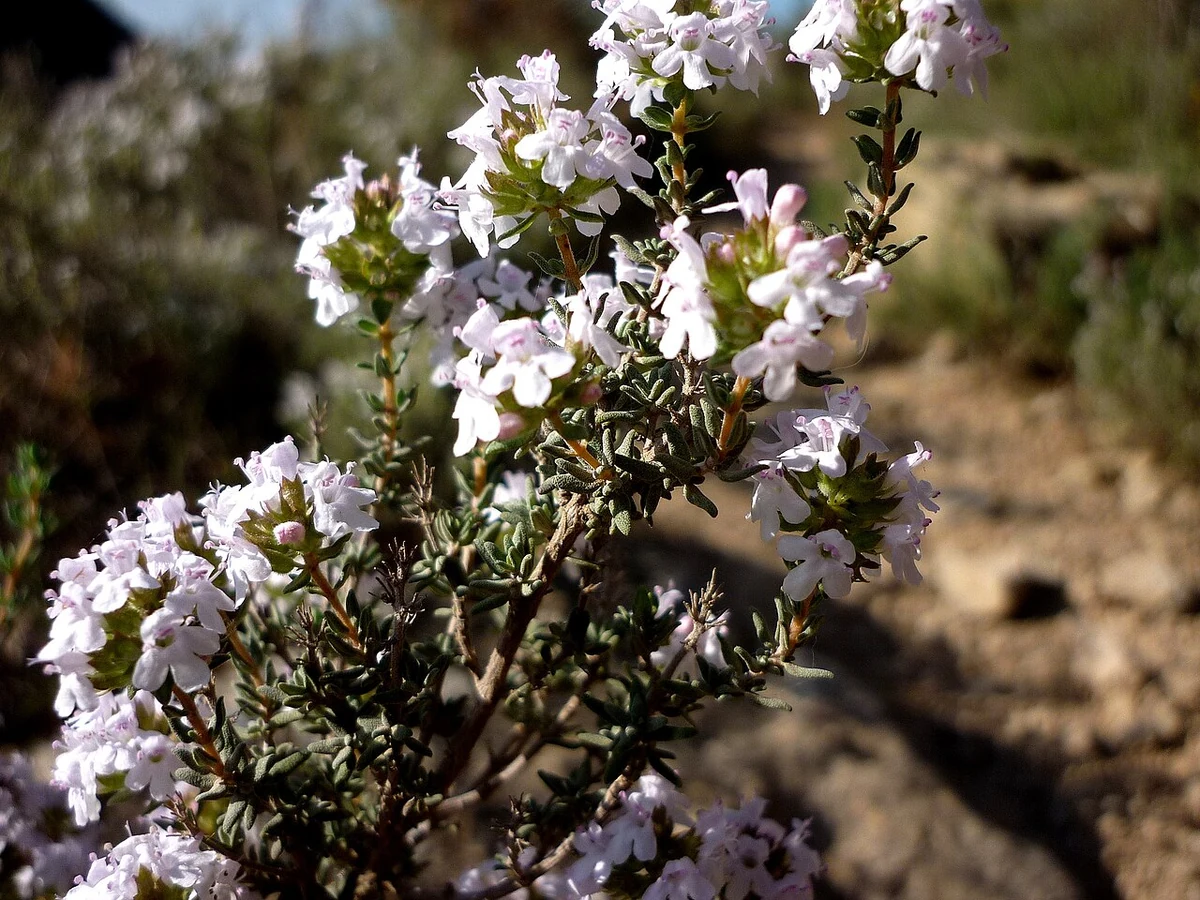
Pale flowers and small leaves of thyme (Thymus vulgaris). Resized and converted to WebP; no cropping or content edits.
Isidre blanc · CC BY-SA 4.0 · Source · EXIF orientation respected; resized without cropping or upsampling; converted to WebP at quality 88. No other content edits.
Garden thyme and wild thyme are not one specimen
Garden thyme is a small woody-based plant of the mint family, with tiny opposite leaves and pale pink or lilac flowers. It is native to parts of southern Europe and widely cultivated farther north. The leaves and flowers are the relevant herbal material. Creeping wild thymes, often grouped loosely under Thymus serpyllum in older literature, are related but not automatically interchangeable with garden thyme.
Fernie opens his Thyme entry with wild thyme and only later turns to the garden plant. The contemporary European medicinal definition cited here covers Thymus vulgaris and Thymus zygis. This matters because a story attached to a wild thyme bank, a kitchen sprig and a commercial extract may concern different botanical material. The article keeps those identities visible.
How the old reputation was built
Culpeper associates thyme with the lungs, phlegm and the stomach, arranging the plant around broad bodily qualities rather than a narrowly defined illness. His entry also gives thyme a role in childbirth.
Fernie adds aromatic tea, wine preparations, conserves, external applications and literary associations with courage, fragrance and labour in summer heat. He also records thyme preparations for whooping cough and epilepsy and chemical disinfectant formulas, which belong to late-nineteenth-century medicine. The steady domestic thread running through both books is an aromatic drink for a chesty cold and digestive wind.
Macierzanka in a village landscape
A comparison with wild thyme is especially useful when its limits are explicit. Under Thymus serpyllum, Udziela records macierzanka as an important herb for blessing on 15 August. In Dziekanowice it was called the aunt of all herbs. That kinship language gives plants positions within a remembered household order; it is more specific than calling every aromatic herb sacred. The record describes a Christian custom of the late nineteenth century.
His village notes also describe wild-thyme baths for weak children in Dobczyce, Radziszów and Skawina, mouth rinsing at Skawina, and warm applications for abdominal pain at Polanka Haller. These records explain why leaves and flowering shoots could be gathered in a quantity larger than a single cup required. The entry also names dysentery among the conditions treated.
At Rzeszotary the herb lined a hen's nest, where it was believed to discourage vermin and produce healthy chicks. This is a distinct agricultural use, involving dried or gathered plant material in the animal's surroundings rather than medicine swallowed by a person. Kept beside the bathing and blessing customs, the record reveals a plant woven into several kinds of domestic work.
Sources: [U]
Fragrant ground, bees and literary memory
Fernie's thyme chapter moves between the countryside and the library. He evokes low, scented growth on hills and heaths, quotes the Shakespearean thyme bank and repeats Bacon's suggestion of planting walks that release fragrance underfoot. These references help explain why thyme could signify a place as much as a remedy: a warm bank, a garden path or a flowering patch recognised by its scent. They are literary witnesses as presented by Fernie; this article has not independently checked every classical or early modern edition he names.
He also discusses thyme-associated honey from Hymettus and a claim that sheep grazing thyme acquire a special flavour. Significantly, he challenges the latter claim within his own account. A historical herbal is not a uniform store of unquestioned folklore: its author may repeat one tradition and dispute another. The same caution applies to his alternative explanations for the word thyme and to the embroidered bee-and-thyme emblem he attributes to chivalric culture. Those are reported interpretations, given as Fernie gives them.
This distinction preserves the richness of the material. Bees, courage, perfume and domestic remedies belong to different strands of the chapter. Each can be followed on its own, and together they show how many associations one small plant gathered.
Sources: [F]
From a leaf drink to a chemical antiseptic
Culpeper's chest remedy is explained through phlegm and the strengthening of bodily organs. Fernie retains that old reputation but adds the late Victorian language of antisepsis. He discusses essential oil, isolated thymol, spirituous preparations and preparations intended for specialised apparatus. A reader encounters a substantial change of scale: the handful of aromatic plant and the measured chemical substance no longer represent the same kind of remedy.
The change matters when reconstructing what people made. A flowering shoot can be dried and infused; oil has to be separated by a different process, and thymol is not merely a stronger tea. Fernie's enthusiasm for chemical disinfection, including formulas for inhalants and infected skin, belongs to the nineteenth-century history of the plant. Beneath the new chemistry the older continuity remained: the aromatic plant's place in care for an ordinary cold.
Harvesting the scented upper growth
Editorial collection guidance: For a cultivated plant, take healthy leafy tips around the beginning of flowering, leaving the woody base and enough foliage for regrowth. In southern Europe this may be considerably earlier than in cool northern gardens. Rain, altitude and the particular thyme species shift flowering time, so a description such as late spring or summer is only a regional guide.
Collect on a dry day once surface moisture has gone. Loose sprigs can be dried in shade with good airflow, then stripped from coarse stems and stored in a labelled container. Avoid overharvesting wild patches: their flowers are important to insects, and species identification can be difficult. Dried thyme intended as a culinary herb should still have a known source and be free of mould and foreign material.
Present-day editorial handling guidance, not a recipe or a claim attributed to the historical author. Historical source supports identity, part and use only.
Sources: [F]
Preparing an aromatic water extract
The European Medicines Agency's monograph on thyme, written for traditional herbal medicinal products, records the traditional adult infusion as 1–2 g of the dried, cut leaves and flowers in 150 ml of boiling water, within traditional use for a productive cough accompanying a cold, the chesty cold of Culpeper and Fernie. The agency's tea-preparation template describes the method: the material is covered with freshly boiled water, left covered for five to fifteen minutes and strained.
A historical syrup added a sweet base to an infusion, juice or extract. A conserve, mentioned by Fernie, kept the soft plant material with sugar rather than simply sweetening a strained liquid, so the two forms had different textures and water contents. An ointment carried plant-derived material in fat or oil for external use. Tinctures and concentrated extracts required specified solvents and manufacturing conditions, and steam-distilled oil and isolated thymol belonged to another category again: products of the distiller and the chemist rather than the kitchen.
A herb of the kitchen, the chest and the meadow
Thyme's record spans the garden and the wild bank. Culpeper and Fernie made it a herb for the chest and the stomach. Udziela's villagers used wild thyme in baths for weak children, as a mouth rinse and as a warm application for abdominal pain, laid it in hens' nests and carried it to the blessing on 15 August as the aunt of all herbs. Today the European Medicines Agency describes thyme preparations for coughs with colds within its traditional-use framework, with its own conditions of age and use.
From kitchen sprig to blessed bundle, the plant kept its place in household care across Europe.
Sources
- [C] Nicholas Culpeper. The Complete Herbal (1850). Thyme and Wild Thyme, digitised 1850 edition
Historical uses and preparation categories
Expanded historical edition; therapeutic claims are not modern recommendations.
- [F] William Thomas Fernie. Herbal Simples Approved for Modern Uses of Cure, second edition (1897). Thyme, printed pp. 560–565
Historical preparation and cultural context
Contains obsolete claims and occasional botanical errors. Harvest and hygiene guidance is editorial, not a verbatim period recipe.
- [E] European Medicines Agency, HMPC. thymi-herba: summary and monograph (2016). Overview, risks and linked monograph; accessed 29 October 2026
Current safety and boundaries of traditional-use preparations
Does not establish all historical claims.
- [U] Seweryn Udziela. Rośliny w wierzeniach ludu krakowskiego, Lud 30 (1931). Entry 121, Thymus serpyllum; field collection 1894–1899
Wild-thyme customs in named Kraków-area villages, blessings, baths and poultry nesting material
Comparative evidence for macierzanka, not a species-specific record of Thymus vulgaris; historical medical and veterinary claims are unverified.
- [M] European Medicines Agency, HMPC. Community herbal monograph on Thymus vulgaris L. and Thymus zygis L., herba (2013). Section 4.2, comminuted herbal substance; adopted 12 November 2013
Species-specific infusion quantity and differentiation of extracts
Traditional use for productive cough associated with colds; not evidence for treating whooping cough or pneumonia.
- [T] European Medicines Agency, HMPC. Patient Leaflet template concerning advice on the preparation of herbal teas as (traditional) herbal medicinal products by end-users (2016). Printed pp. 4–7, definitions and preparation templates
Usual infusion timing, covering, straining and preparation immediately before use
General method; a product-specific instruction takes precedence and plant quantities come from the individual monograph.