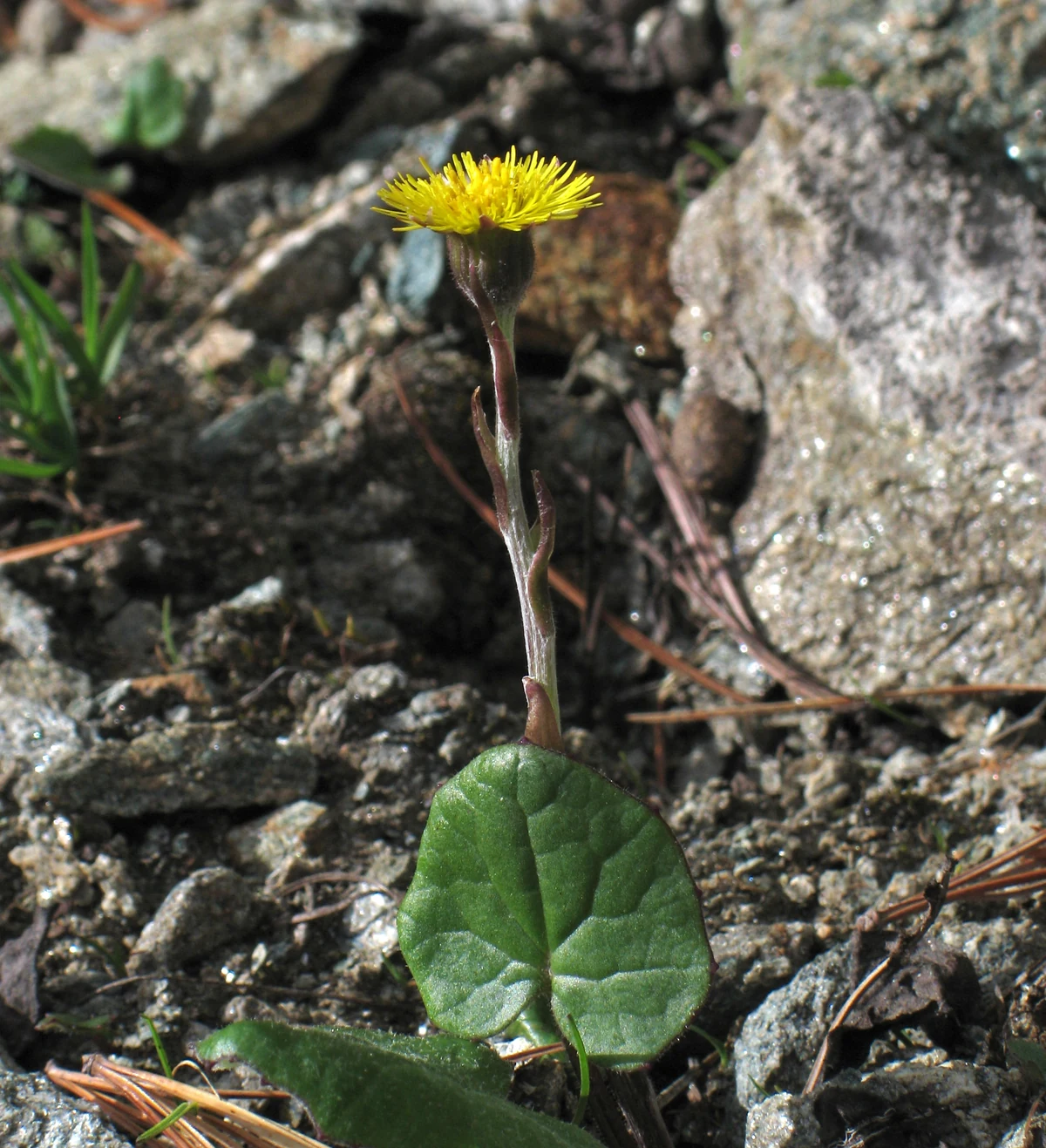
Coltsfoot (Tussilago farfara): a yellow flower head and leaf on rocky ground. Resized and converted to WebP; no cropping or content edits.
Robert Flogaus-Faust · CC BY 4.0 · Source · EXIF orientation respected; resized without cropping or upsampling; converted to WebP at quality 88. No other content edits.
Flowers first, leaves afterwards
Coltsfoot produces yellow flower heads early in the season, followed by broad, roughly rounded leaves with pale felted undersides. The sequence is one reason a casual collector can fail to connect the flower with the later leaf. Culpeper describes the spreading underground growth and distinguishes the leaves from larger butterbur foliage.
The plant occurs on disturbed and often damp ground across Europe. Its leaves and flowers have separate collection times. The name Tussilago farfara anchors this article.
Sources: [C]
A name shaped by cough medicine
Culpeper lists coughwort among the names and distinguishes fresh leaves or juice from dried leaves. He describes syrup, distilled water and external applications, fitting them into a distinction between hot dry coughs and coughs attributed to thin fluids descending onto the lungs.
This classification explains why one plant could be recommended in different forms for apparently opposite conditions. The source also includes smoking the dried material for the chest.
The old cough remedy preserves valuable evidence about household care and its many routes.
Sources: [C]
A detailed regional cupboard
Udziela records leaf applications to wounds at Świątniki Górne and Polanka Haller, sweetened leaf tea for breathlessness or cough, and a compound abdominal application with wormwood at Dziekanowice. At Wieliczka a cough preparation combined leaf tea with a jelly made from boiled calves' feet.
The last detail matters because it places the remedy in an actual food economy. Animal-derived nourishment, warmth, sweetness and the herb could all be understood as part of care.
At Polanka Haller men dried and cut coltsfoot, mixed it with tobacco and smoked it while claiming benefit for the chest. The mixture joined the plant's cough-related name to the familiar habit of smoking.
Sources: [U]
Monitored leaf in modern herb growing
Modern herb growing has developed coltsfoot clones whose leaf is analytically monitored for pyrrolizidine alkaloids, and the European Food Safety Authority has assessed these constituents in herbal products. Leaf for today's herbal trade therefore comes from named, monitored cultivars rather than from a wild patch, a change from the gathering described in the old herbals.
A spring plant in an industrial landscape
Fernie's account opens on railway banks. Freshly exposed heavy ground could carry the familiar yellow heads, bringing an old medicinal plant into the landscape of Victorian engineering. He speculates that ancient seeds were being awakened by the cuttings. The observation of plants on disturbed ground comes with his own theory of their age.
His discussion of the flowers appearing before the leaves gives the plant a second family of names, expressing a child arriving before its parent. Hoof names, by contrast, describe the later leaf. The two naming systems reveal what different observers noticed at different seasons. Fernie also records Yorkshire's Cleats and the use of the silky seed-head material for stuffing pillows in the Highlands. These are attributed reports, without a precise village or collection date.
A seasonal notebook can follow one colony through flowering, seed dispersal and leaf development. Culpeper's February and March dates describe his English setting.
Sweetness, mucilage and commercial names
Fernie describes the leaves as bitter and mucilaginous. His examples of sweetened preparations include liquorice and honey, while the Kraków-region record brings in sugar and calves' feet jelly. These combinations show several ways a harsh plant material could be incorporated into a soothing or nourishing household preparation. Texture, flavour and the experience of being cared for belong to the history alongside the hope of cure.
The Victorian confectioner's coltsfoot rock introduces a different setting: a purchased sweet sold in fluted brown sticks and flavoured with an aromatic ingredient. Fernie's description is evidence for that commercial form.
His sharpest example is a proprietary Essence of Coltsfoot which, he says, contained balsamic preparations and alcohol but no coltsfoot at all. He repeats Dr Paris's criticism of its irritating alcoholic character. The passage shows disagreement within historical medicine, and how an old product name could promise a plant it did not contain. An essence, a leaf syrup and a sweet could occupy adjacent shelves while representing very different materials.
The route of a remedy could change its meaning
The smoking tradition runs through several layers of the record. Culpeper places dried material within a theory of thin rheums; Fernie gives a later British herbal-tobacco mixture and invokes classical authorities; Udziela describes men mixing the leaves with tobacco in one Polish locality. Similarity between these reports shows a recurring practice.
Fernie also cites the white down on leaves as something valued by Sussex peasants. That detail directs attention to a particular surface and texture rather than an abstract chemical extract. His external poultice, internal drink and smoke preparation are therefore best catalogued separately, with their plant part and route attached.
Distilled water was another preparation again
Culpeper distinguishes a simple distilled water from a compound water involving other plants. This matters because the name of the main herb does not identify the entire mixture. His suggested uses include cloths wetted with the liquid, making the cloth and site of contact part of the preparation history. A distilled water is not the same as leaves steeped in a cup. The compound water also included nightshade among its plants.
Sources: [C]
Name, season and the hope of easy breath
Coltsfoot's historical importance lies in the close connection between name, season, texture and respiratory hope. Culpeper's coughwort was syrup, distilled water and smoke. Fernie's railway-bank flower went into liquorice-sweetened preparations, coltsfoot rock and herbal tobacco, and its down stuffed pillows in the Highlands. Around Kraków its leaves covered wounds, sweetened teas were drunk for cough and breathlessness, a calves' foot jelly carried it at Wieliczka and men at Polanka Haller smoked it with tobacco.
The surviving records show how household remedies combined plant, food and smoke in the care of the chest.
Present-day editorial handling guidance, not a recipe or a claim attributed to the historical author. Historical source supports identity, part and use only.
Sources
- [C] Nicholas Culpeper. The Complete Herbal (1850). Coltsfoot, pp. 53–54
Historical descriptions and preparation forms
Expanded Thomas Kelly edition; not contemporary advice.
- [U] Seweryn Udziela. Rośliny w wierzeniach ludu krakowskiego, Lud 30 (1931). Entry 130, Tussilago farfara (OCR Tussilage), p. 69
Local practices recorded principally in 1894–1899
Reported use does not establish efficacy.
- [A] C. Wawrosch, B. Kopp and H. Wiedenfeld. Permanent monitoring of pyrrolizidine alkaloid content in micropropagated Tussilago farfara (2000). Acta Horticulturae 530, pp. 469–472; abstract
Toxic alkaloid content and monitored selected clones
Not a guarantee for wild or untested cultivated plants.
- [E] EFSA CONTAM Panel. Risks for human health related to pyrrolizidine alkaloids in honey, tea, herbal infusions and food supplements (2017, amended 2019). Abstract, risk characterisation and conclusions
Health concerns from exposure to toxic pyrrolizidine alkaloids
Group risk assessment, not a coltsfoot recipe.
- [F] William Thomas Fernie. Herbal Simples Approved for Modern Uses of Cure, second edition (1897). Coltsfoot, pp. 116–120
Victorian accounts of habitat, names, confectionery, smoking, household preparations and a misleading proprietary essence
Historical compilation containing untested medical claims and speculative natural history; quoted earlier authorities were not independently inspected.