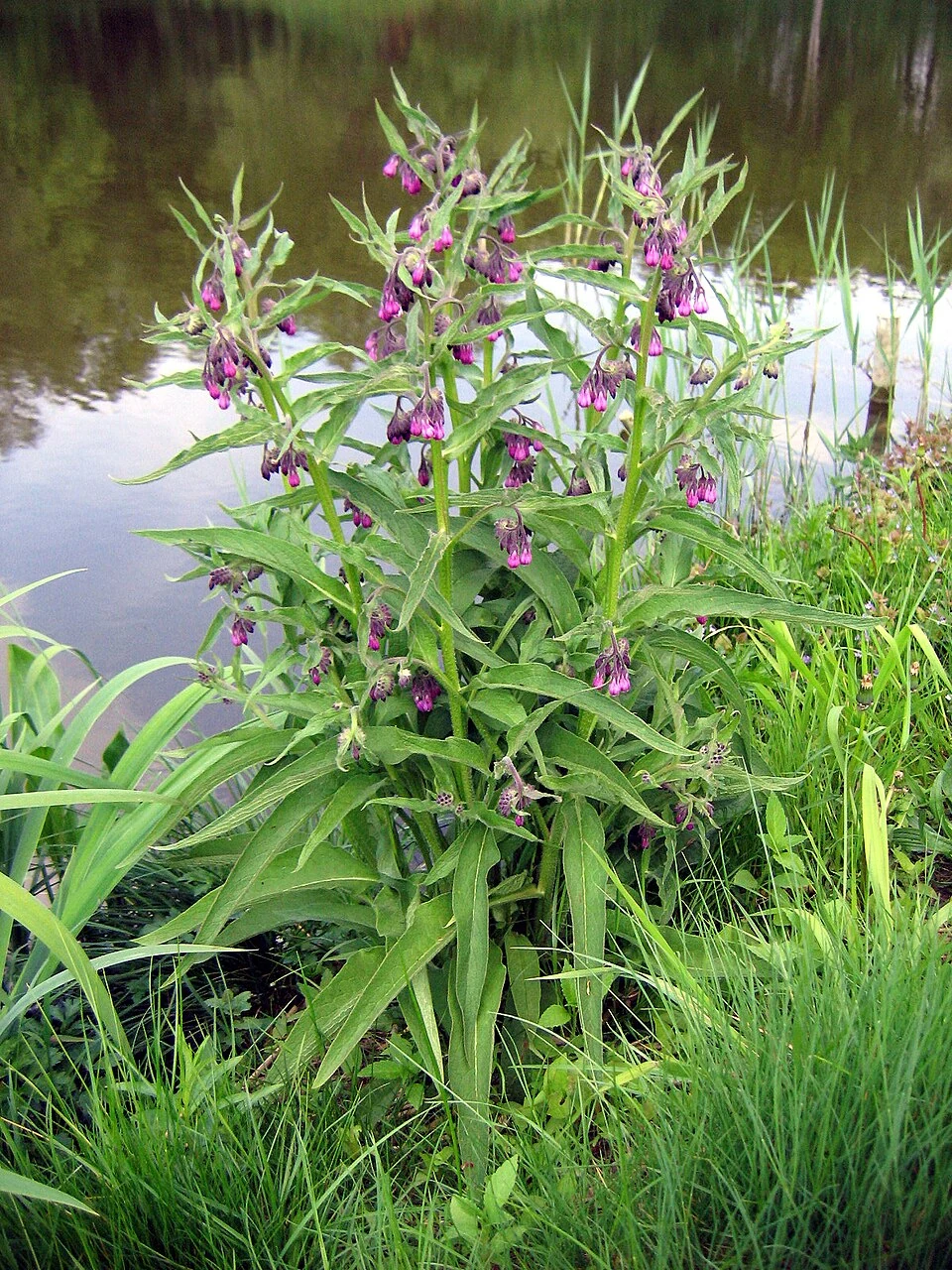
Flowering comfrey (Symphytum officinale) beside a pond in Wrocław. Resized and converted to WebP; no cropping or content edits.
Agnieszka Kwiecień ( Nova ) · CC BY 2.5 · Source · EXIF orientation respected; resized without cropping or upsampling; converted to WebP at quality 88. No other content edits.
A root associated with joining
Comfrey has large rough leaves, drooping tubular flowers and substantial roots dark outside and pale within. Culpeper emphasises the root's sticky texture. That physical quality helps explain a reputation for consolidating wounds and joining damaged parts.
The species here is Symphytum officinale. Garden comfreys include hybrids and other taxa. Root and leaf are distinct materials.
Knitbone and the imagination of repair
Culpeper recommends comfrey for internal injuries, bleeding, wounds, fractures and joint complaints. He repeats the striking claim that pieces of flesh boiled with the root would join again. This memorable image expresses the consolidating reputation.
The entry includes water and wine decoctions, syrup, distilled water and crushed-root applications. Internal and external routes are freely interwoven. Comfrey was taken by mouth as well as laid on the body.
The plant's name and texture made a powerful combination. A household could see a sticky root and understand why a herbalist called it a joining medicine.
Sources: [C]
Food, drink and ointment in a regional record
Udziela records comfrey fried in fat and eaten or drunk for chest illness described as consumption at Wieliczka. He describes applications and a decoction for oberwanie, a folk category associated with strain or injury. At Polanka Haller an ointment was regarded as useful for broken limbs in people and animals.
These observations show a reputation crossing between household medicine and veterinary care. Oberwanie remains visible as a historical category in its own word.
A village fatty preparation and a manufactured cream containing a specified extract are materially different objects, even though both can be called comfrey remedies.
Poultice, ointment and extract
An old poultice retained crushed plant material against the body. An ointment dispersed plant material or extract in fat. A manufactured medicine uses a specified extract made under its own controls, which the European Medicines Agency describes for its traditional topical products.
The difference between a kitchen jar and an assessed product lies in composition and manufacture as well as in tradition.
Sticky roots, leather and the idea of joining
Culpeper's most striking observation is physical: a root dark outside, pale within and full of clammy material. Fernie likewise makes mucilage central to the plant's reputation. The sensation of stickiness could make a consolidating remedy intuitively persuasive. It offered an everyday analogy for joining tissue.
Fernie's material uses extend beyond medicine. He reports a strong decoction used in Germany for tanning leather and a glue-like product associated with fibre work at Angora. These attributed accounts show why comfrey's texture could be noticed and valued in crafts as well as in care of injuries.
The preparation spread on leather in Culpeper's account brings those material worlds together. Leather serves as a support for the crushed root, holding it against a body part. This is a concrete historical dressing arrangement, in which support, texture and purpose worked together.
The Teddington finger
Fernie repeats a story, attributed through Cockayne, about a locksman at Teddington with a painful broken finger. A passing doctor is said to have directed him to comfrey growing nearby, after which the man reported rapid recovery. The anecdote is valuable as a story of recognition, local availability and trust in an accessible remedy.
The narrative's force comes partly from its setting. A plant seen beside the place of work becomes the answer to an injury that has troubled the worker for weeks. That makes it memorable and easily retold. It is told here as Fernie transmits it.
His chapter also moves to a highly productive prickly comfrey introduced from the Caucasus and makes strong veterinary claims. That passage concerns another taxonomic and agricultural context. It belongs to the history of a fodder crop rather than to the medicinal root of Symphytum officinale.
Sources: [F]
Oberwanie, consumption and the village ointment
Udziela's compact entry contains three rather different kinds of illness language. Consumption points to serious chest or wasting illness; oberwanie names a folk category of strain or injury; a broken arm or leg names a more visibly structural problem. The common thread is a plant believed to restore damaged or weakened parts.
The Wieliczka material includes both taking a preparation internally and applying it. The Polanka Haller ointment is described for people and animals. The village repertoire was broad, reaching from internal remedies to ointments for broken limbs in people and animals.
For historical study, each recipe keeps its category, root decoction, fatty ointment, crushed-root dressing or expressed preparation, with the part and route the source actually states.
Knitbone through the centuries
Comfrey's reputation grew from a root that felt as if it could join things. Culpeper used it in water and wine decoctions, syrup, distilled water and crushed-root dressings spread on leather for wounds, bleeding, fractures and joints, and told of flesh rejoined in the pot. Fernie added tanning, glue for fibre work and the Teddington locksman's mended finger. Around Kraków it was fried in fat for the chest at Wieliczka, applied and boiled for oberwanie, and made into an ointment for broken limbs at Polanka Haller. Today the European Medicines Agency describes specified topical comfrey root products within its traditional-use framework for minor sprains and bruises, with its own conditions of use.
The name knitbone carries that whole history: a sticky root, a household's hope of repair and a remedy shared between people and their animals.
Sources
- [C] Nicholas Culpeper. The Complete Herbal (1850). Comfrey, p. 54
Historical descriptions and preparations
Thomas Kelly expanded edition; not current treatment advice.
- [U] Seweryn Udziela. Rośliny w wierzeniach ludu krakowskiego, Lud 30 (1931). Entry 118, Symphytum officinale, p. 66
Named local practices, fieldwork 1894–1899
Reported traditional use, not evidence of efficacy.
- [E] European Medicines Agency, HMPC. Comfrey root: HMPC overview (webpage accessed 2026). Overview and risks
Scope and limitations for specified herbal medicines
Does not validate homemade preparations.
- [F] William Thomas Fernie. Herbal Simples, second edition (1897). Comfrey, pp. 120–122
Root texture, material uses, attributed Teddington anecdote and names
Uncontrolled testimony and obsolete internal and veterinary claims; other comfrey taxa appear in the chapter.