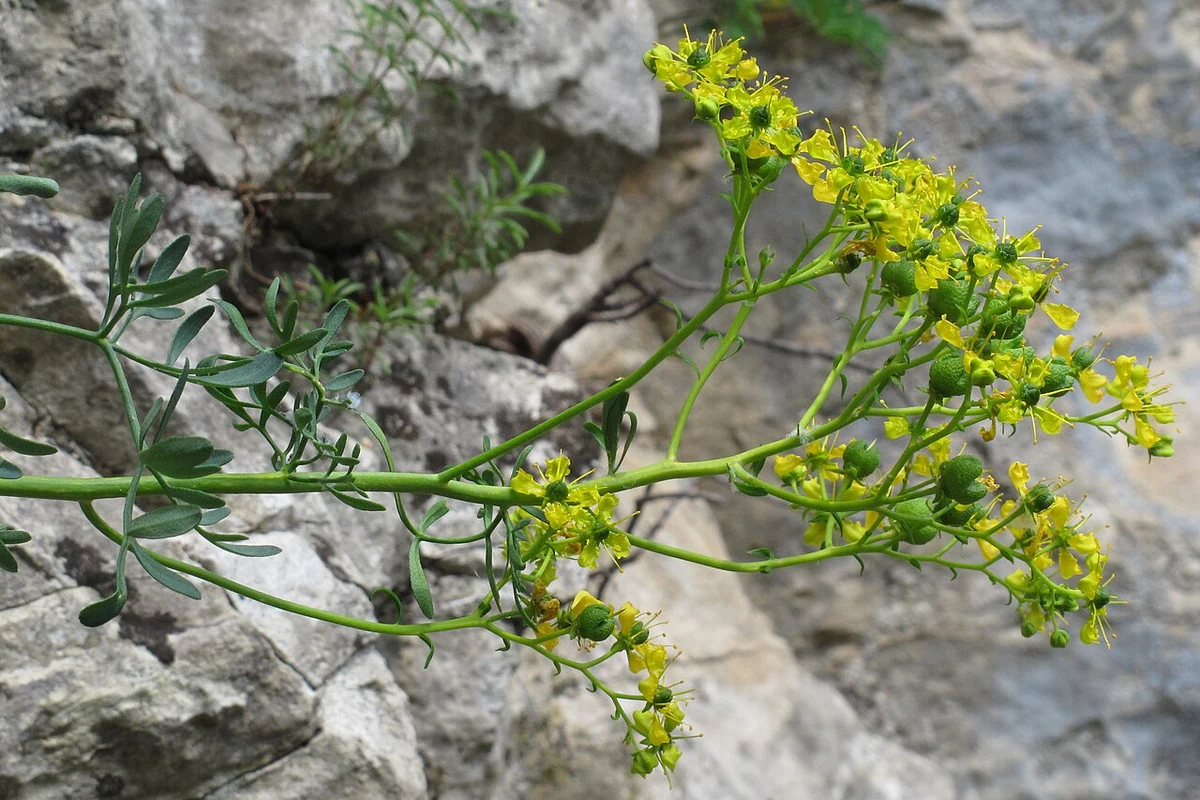
Yellow flowers of common rue (Ruta graveolens) against rocks. Resized and converted to WebP; no cropping or content edits.
Robert Flogaus-Faust · CC BY 4.0 · Source · EXIF orientation respected; resized without cropping or upsampling; converted to WebP at quality 88. No other content edits.
The garden plant behind the name
Garden rue is a small, increasingly woody plant with divided blue-green foliage and yellow flowers. It belongs to the Rutaceae, the citrus family. Its appearance, strong smell and persistence help explain its familiarity in European gardens.
It is not wall-rue, a fern, meadow-rue, a Thalictrum, or the unrelated plant sold as Syrian rue. Culpeper treats several rue names separately. This account follows Ruta graveolens, principally its leaves and aerial parts.
The prestige of an ancient antidote
Culpeper calls rue herb of grace and associates it with the Sun and Leo. His entry includes compound antidotes attributed to Mithridates, with rue among familiar kitchen ingredients. He also assigns it digestive, menstrual, respiratory and external uses.
The ancient ruler's name lends authority to the remedy. The familiar ingredients make it seem accessible. The historical interest lies in prestigious medical lore entering a household herbal.
Sources: [C]
A household and religious calendar
Udziela records rue applications for children's stomach complaints at Dobczyce and a drink for palpitations at Polanka Haller. He also describes vapour from a decoction in eye and dental practices.
At Brzezowa the plant was given to cattle with bread at Easter and in a wafer at Christmas. It also appeared in herb blessings on 15 August. Medicine, religion and household management overlap in the record. The Christian details are part of the practice as it was lived.
These observations belong to named places and a particular period.
Sources: [U]
Preparations
The sources describe decoctions, infused oils, expressed juice and compounds with sweet or fatty bases. A water preparation and an oil extraction drew different mixtures from the same plant.
For study, a photograph, a labelled specimen or the description of a historical wreath preserves the plant's place in the garden and the household.
Sources: [C]
A protective sprig in the courtroom
Fernie describes rue placed in courts at assizes as supposed protection against infection brought from gaols. The plant is present as a fragrant protective object in an institutional space, not only as a cottage remedy. The practice reflects fear of contagion and confidence in aromatic materials.
His account of holy-water brushes supplies another setting for the name herb of grace. Here the plant is connected with a religious action and an explanation of its name. The passage is a historical compiler's report. Udziela's much more local Easter and Christmas cattle practices provide a useful comparison precisely because they name different actions and communities.
Literature adds a further layer. Rue appears alongside euphrasy in Milton's account of clarified sight and carries symbolic meaning in Shakespeare. Such uses depend on a reputation recognisable to readers. They help explain why the plant's cultural authority extended beyond a medicine bottle.
Mithridates and the household counter-poison
Culpeper not only reproduces the prestige of Mithridates but defends the ruler against what he considers a false account of protection through habitual poisoning. His own explanation still rests on a powerful compound and the correct astrological character of its ingredients. The dispute shows a writer evaluating competing stories.
Figs, walnuts and other familiar materials make the counter-poison sound like something a household could assemble. Their familiarity is part of the recipe's persuasive appeal. The counter-poison was trusted against plague, infection and deliberate poisoning.
Other compounds in the entry reveal how broad the category of natural remedy could be. A topical preparation includes ceruse, a lead compound. Its presence shows how an old herbal could mix plants with mineral substances.
Sources: [C]
Rue at the manger and at the household threshold
The Brzezowa record gives the plant in bread at Easter and in a wafer at Christmas. The carrier and feast day both matter. Bread and the wafer locate the practice within ordinary feeding and a Christian festive calendar, while the herb was intended to help protect or maintain the animals.
At Dobczyce, rue appears after calving and in a warm external application for children's stomach pain. At Polanka Haller a decoction was drunk for palpitations and its vapour used in eye or dental practices. These are distinct actions and purposes. Each has its own purpose and route.
A reader of inherited notebooks should retain both the botanical name and the route alongside the old common name. Wall-rue, meadow-rue and Syrian rue belong elsewhere botanically. An inherited instruction naming only rue is read with that in mind.
Grace, protection and the household calendar
Rue's authority came from many directions. Culpeper called it herb of grace, gave it to the Sun and Leo and placed it in Mithridates' famous counter-poison. Fernie found it in assize courts against gaol infection, in holy-water brushes and in Milton's and Shakespeare's verse. Around Kraków it was laid on children's stomachs at Dobczyce, drunk for palpitations at Polanka Haller, fed to cattle in bread at Easter and in a wafer at Christmas at Brzezowa, and blessed on 15 August.
Its garden presence, antidote associations, Christian name and local ritual calendar show the several ways in which a plant could acquire authority in European life.
Sources
- [C] Nicholas Culpeper. The Complete Herbal (1850). Garden-Rue, pp. 159–160
Historical descriptions and preparations
Thomas Kelly expanded edition; not current treatment advice.
- [U] Seweryn Udziela. Rośliny w wierzeniach ludu krakowskiego, Lud 30 (1931). Entry 102, Ruta graveolens, pp. 61–62
Named local practices, fieldwork 1894–1899
Reported traditional use, not evidence of efficacy.
- [N] North Carolina State Extension. Ruta graveolens, Plant Toolbox (accessed 2026). Description and handling precautions
Identity and safe handling
Not an oral medicinal monograph.
- [F] William Thomas Fernie. Herbal Simples, second edition (1897). Rue, pp. 475–478
Courtroom protection, literary associations and historical preparations
Includes hazardous doses and uncertain ancient-origin stories; these are not recommendations.