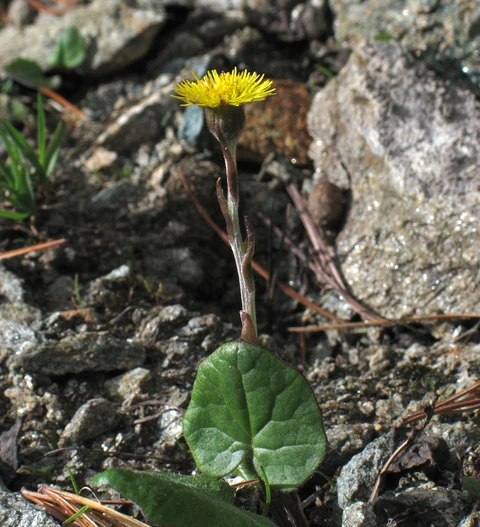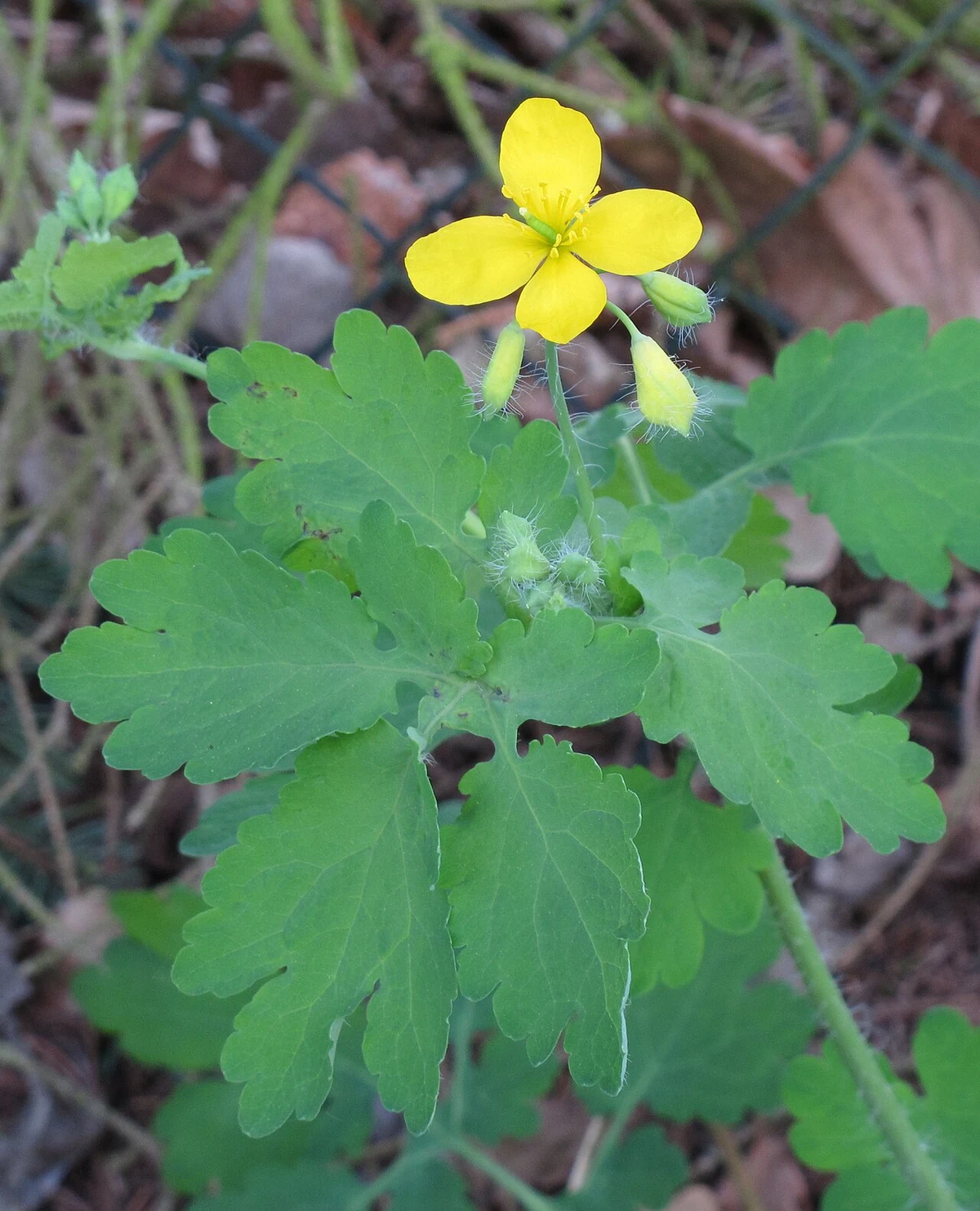
Greater celandine (Chelidonium majus): a yellow flower and lobed leaves. Resized and converted to WebP; no cropping or content edits.
Robert Flogaus-Faust · CC BY 4.0 · Source · EXIF orientation respected; resized without cropping or upsampling; converted to WebP at quality 88. No other content edits.
Yellow sap and a distinct botanical identity
Greater celandine is a brittle-stemmed plant with lobed leaves, small four-petalled yellow flowers and narrow seed pods. Broken tissue releases conspicuous yellow-orange sap. Culpeper describes that colour in both aerial parts and roots and locates the plant around walls, hedges and uncultivated ground.
Lesser celandine is a different plant, now placed in Ficaria, and belongs to another family. Culpeper himself questions their shared name. Their wart, liver and haemorrhoid traditions belong to separate plants. This article concerns Chelidonium majus, not every yellow spring flower called celandine.
Sources: [C]
The swallow story and the eye
Culpeper connects Chelidonium with the Greek name for a swallow and discusses a belief about young birds regaining sight. His wording contains a revealing qualification: he does not know whether the birds accomplish this with the herb. Fernie's later account presents the familiar herb-bearing swallow tradition more straightforwardly. The two tellings differ in their confidence.
Animal observation, inherited story and human medicine are joined here. Culpeper also attacks competing eye treatments while expressing great confidence in his own, a lively record of a medical dispute.
Liver, skin and the doctrine of visible signs
The yellow sap made the plant memorable in a medical culture attentive to correspondences between appearance and bodily conditions. Culpeper records preparations for jaundice and obstructions of the liver or gall, alongside external uses for warts and skin complaints.
The source documents wine preparations, expressed juice, dried root and oil or ointment forms. It also gives sweeping claims about pestilence and the powers of alchemical separation. The practical description and the grand promise sit side by side in his entry.
The colour, part and preparation are recorded here together with the effects Culpeper claimed for them.
Sources: [C]
The tradition and the modern regulator
The European Medicines Agency reviewed oral products containing greater celandine after reports of liver and biliary reactions, and in its public statement declined to establish a Community herbal monograph for oral use; no monograph was adopted for use on the skin either. The old oral tradition therefore has no modern traditional-use monograph in the European Union.
The herb's medicinal history survives in the herbals and village records rather than in a current traditional-use product.
Heavenly names in two neighbouring communities
Udziela's very short entry adds evidence which the English herbals cannot supply. In Bieżanów he records the name Niebospad; at Wieliczka, Z-nieba-spad. Both evoke something falling from heaven. He also records fresh leaves rubbed and applied to wounds at Wieliczka, and inclusion among herbs blessed on 15 August at Bieżanów. The plant thus appears both in practical care and in a Christian ritual calendar.
The entry gives no story behind the names. Fernie's Latinised Coeli donum, or gift of heaven, carries a strikingly similar meaning, and the resemblance is left here as the records leave it.
The local treatment used leaves, whereas the best-known English descriptions repeatedly emphasise the coloured sap and root. Plant part matters even when the species agrees. This Polish entry is evidence of a wound practice using the leaf.
Toothache, fear and the authority of a story
Fernie recounts a story of Elizabeth I's severe toothache and reluctance to submit to extraction. A physician offered a celandine treatment; the Bishop of London then had a tooth extracted in her presence to encourage her. The scene is memorable because the problem is partly pain and partly fear of the instrument. It is reported here as Fernie's historical anecdote.
He also mentions a Suffolk toothache fomentation. That regional note is narrower than the royal story: it records a preparation category and a county, without supplying an observed outcome. Culpeper's root-powder dental claim belongs to another textual context. Together they show that celandine's reputation extended beyond liver, eyes and warts.
Fernie's collection of names includes some also familiar from other herbs, fenugreek among them, so the botanical name, the quoted name and the author's context are kept together here.
An alchemical promise and a seasonal observation
Culpeper's account moves from recognisable observations of brittle stems, pods and coloured juice to the promise of an extraordinary preparation produced through alchemical separation. These passages do different jobs. The plant description helps a reader recognise the material; the promised universal medicine expresses the author's theory and confidence.
His planetary associations and astrologically chosen gathering conditions are likewise part of that explanatory world. The more modest seasonal observation is that flowering and seed formation extend through summer in his setting. A botanical record can note which stage was observed.
The contrast also helps explain why the historical language of purification was so persuasive: removing an unwanted fraction promised a purer and stronger medicine.
Sources: [C]
A summer record rather than an August recipe
The August blessing in Bieżanów supplies a ritual date. Culpeper's summer description, meanwhile, includes both flowers and seed pods. Udziela's wound passage does specify fresh leaves, but it does not say that these were the same material previously blessed. The two observations stand side by side in the entry.
Yellow sap, swallows and heaven-fallen names
Celandine's story is one in which an arresting colour and a compelling animal legend sustained a medicinal identity. Culpeper used its yellow sap, juice, root and wine for jaundice, the liver and gall, warts and the eyes, and promised still more from alchemical separation. Fernie told of swallows restoring their nestlings' sight, a physician's remedy for Elizabeth I's toothache and a Suffolk fomentation. Around Kraków the plant was Niebospad and Z-nieba-spad; its fresh leaves were laid on wounds at Wieliczka and the herb was blessed on 15 August at Bieżanów.
From the walls and hedges where Culpeper found it, the plant carried a reputation far larger than its small yellow flowers.
Present-day editorial handling guidance, not a recipe or a claim attributed to the historical author. Historical source supports identity, part and use only.
Sources
- [C] Nicholas Culpeper. The Complete Herbal (1850). Celandine, pp. 42–44; distinguish Lesser Celandine
Historical descriptions and preparation forms
Expanded Thomas Kelly edition; not contemporary advice.
- [E] European Medicines Agency, HMPC. Public statement on Chelidonium majus L., herba (adopted 2011, published 2012). Printed pp. 2–3, conclusions
Negative oral benefit-risk assessment for a monograph and reported liver-biliary reactions
Not a blanket statement about every skin preparation; no EU monograph was adopted.
- [F] William Thomas Fernie. Herbal Simples Approved for Modern Uses of Cure, second edition (1897). Celandine (Greater, and Lesser), pp. 92–93
Swallow lore, yellow signatures, Suffolk toothache report and a historical dental anecdote
A late compilation, not independent verification of the royal anecdote or its earlier authorities; recipes are not present advice.
- [U] Seweryn Udziela. Rośliny w wierzeniach ludu krakowskiego, Lud 30 (1931). Entry 37, Chelidonium majus, pp. 46–47; entry begins on p. 46 and uses continue on p. 47
Names Niebospad and Z-nieba-spad, fresh-leaf wound application at Wieliczka and blessing at Bieżanów
Short local record, principally from fieldwork in 1894–1899; no evidence of clinical benefit or a universal Polish practice.