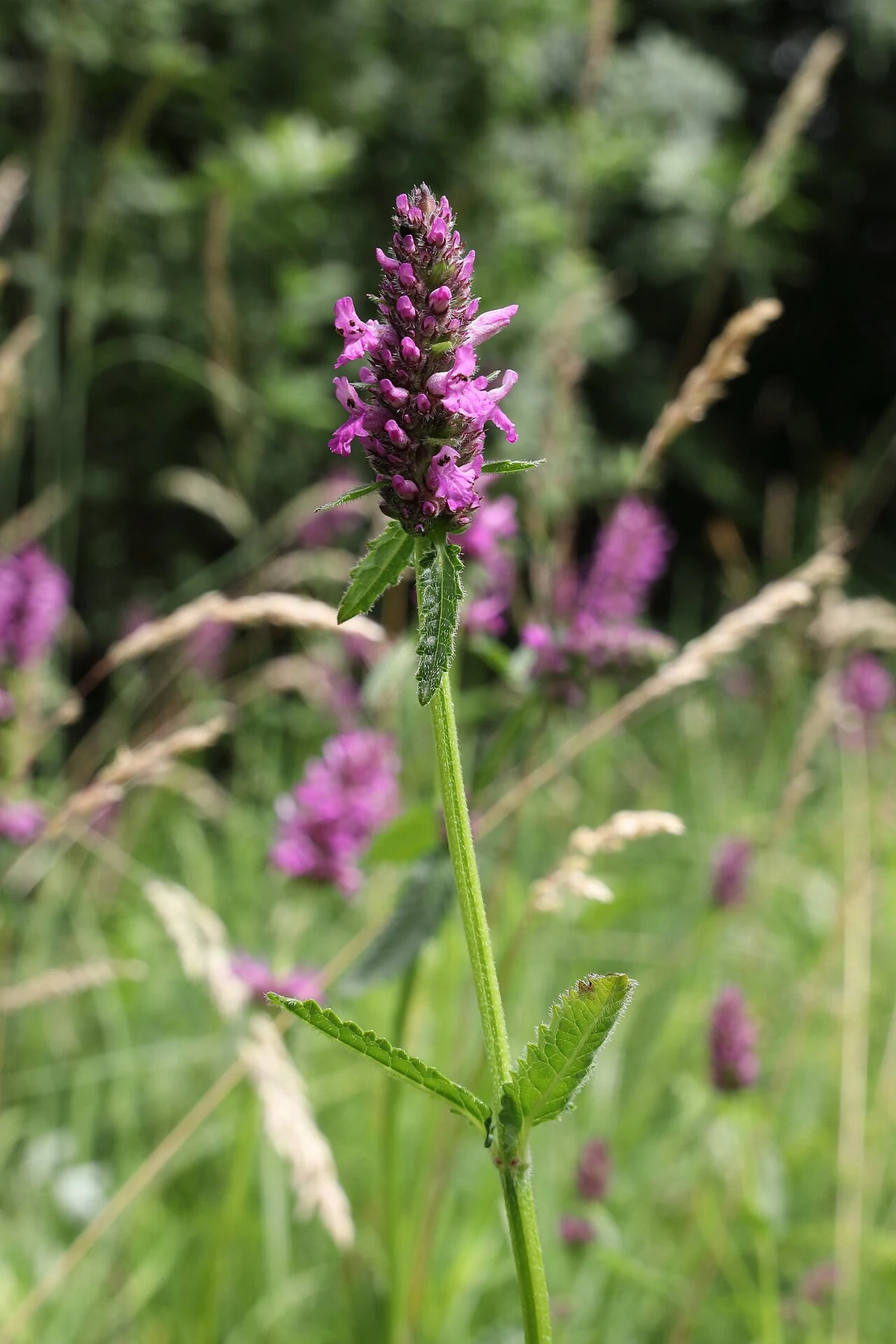
Wood betony (Betonica officinalis, syn. Stachys officinalis): a purple flower spike and toothed leaves. Resized and converted to WebP; no cropping or content edits.
T. Kebert · CC BY-SA 4.0 · Source · EXIF orientation respected; resized without cropping or upsampling; converted to WebP at quality 88. No other content edits.
A perennial of grassland and woodland margins
Wood betony has a basal group of toothed leaves, square flowering stems and dense heads of pink-purple flowers. Culpeper describes a perennial root and surviving basal leaves, with flowering stems dying back. His habitat emphasis is woodland and shade, a reminder that historical writers described the landscapes familiar to them.
Modern names include Betonica officinalis and the synonym Stachys officinalis. The synonym is useful when searching catalogues, and other Stachys species are distinct plants. Leaves and flowering tops dominate the pleasant-tasting preparations in the old account; Culpeper explicitly distinguishes the less agreeable root.
Sources: [C]
A reputation reinforced by named authority
Culpeper attributes a celebrated account of betony's virtues to Antonius Musa, physician to Augustus. The attribution is part of the source's claim to authority.
The list is expansive: digestion, head complaints, respiratory symptoms, wounds, fatigue and protection from witchcraft all appear. Some serious illnesses are included. The list shows how a highly regarded household herb accumulated applications over time.
The old author praises betony as worth keeping in the house. Its importance was therefore practical as well as textual: different preserved forms could make one plant available across seasons.
Sources: [C]
A cupboard of preparation forms
The entry describes green or dried material in food and drink, flower conserves, syrups, powders, electuaries, waters, oils, ointments and plasters. A conserve preserved plant material in sugar; an electuary suspended a powder or other ingredients in a thick sweet base. A syrup and a distilled water were distinct preparations, even when the same plant name headed the bottle.
Culpeper also mentions compounds with other herbs, including pennyroyal. In such compounds every ingredient shaped the medicine.
The entry also includes applications to the ear and remedies for bites and severe injuries.
Sources: [C]
A local ritual record with a different focus
Udziela gives names such as botonijka and betanijka in Bieżanów and Brzezowa. At Brzezowa the herb was burned in a practice directed at a cow whose milk was spoiling. He also records blessing it on 15 August.
This is a much narrower record than Culpeper's medicinal catalogue. The account shows how household concern about food and animals could be expressed through a valued plant.
The Christian blessing and the protective practice belong together in the observed culture.
Sources: [U]
Praise that became a proverb
Fernie presents betony's reputation through proverbial language as well as medical authorities. One Italian saying values the plant above a coat; another compares a person's virtues with betony's many supposed virtues. The sayings show how the plant's reputation could become an everyday measure of excellence. Fernie supplies them as part of a late compilation.
He also repeats the attribution to Antonius Musa and quotes later British writers. These are linked stages of praise. The reputation itself is the historical fact being documented: successive readers encountered a plant already furnished with an impressive pedigree.
His chapter nevertheless contains a reservation. After surveying the enthusiasm, he questions whether chemical investigation has revealed a distinctive constituent to justify it. He then continues to recommend uses. The tension is instructive. A Victorian medical writer could doubt the explanation behind a reputation while remaining attached to the remedy. Historical books contain disagreements and hesitations as well as confident declarations.
Breakfast, snuff and the head
Head complaints dominate several of Fernie's selected examples. He quotes a milk preparation taken at breakfast from Medicina Britannica, dated 1666, and another recommendation involving leaves and tops. These passages place repeated household consumption within a daily meal. They are accounts quoted by Fernie.
His mention of a commercial British herb snuff moves the plant into a different sensory practice. Sneezing was treated as meaningful action in a remedy directed at the head. The same discussion also recommends smoking the herb.
The flower conserve represents another way of keeping the plant available. Sugar preservation and a dried powder do not preserve the same texture or create the same exposure. Culpeper's distinction between agreeable leaves and flowers and an unpleasant root gives an additional reason to record the plant part.
Neighbouring entries
Both Culpeper and Fernie place water betony close to wood betony in their books. The neighbouring entries invite confusion, especially when a reader searches for a single word and copies a passage without its heading. Water betony belongs to a different botanical group, associated in these accounts with figwort. Its preparations belong to that plant.
Fernie's chapter proceeds into a long figwort discussion, including names, gland-related signatures and other claims. Those paragraphs are not additional evidence for wood betony. This boundary is particularly important in a digital transcription, where page breaks and long paragraphs can make one entry seem to flow into another.
Seasonal notes also deserve precise reading. Culpeper mentions July flowering but says the plant is in its prime in May. The two dates mark different stages of the same plant's year.
A household concern preserved in a few lines
At Brzezowa, Udziela's account centres on a cow and spoiling milk. It records a response to an economically important household problem. Alongside the blessing in Bieżanów and Brzezowa, it shows that betony's value was not confined to the ailments printed in English herbals. Preserving that small, local episode adds something a generic list of benefits cannot supply: a named community, an animal, a practical concern and the action people associated with the plant.
Sources: [U]
How authority worked in herbal tradition
Editorial collection guidance: For study, identify a flowering plant, leave the perennial base intact and collect only limited legal aerial material. A cultivated specimen is preferable where wild populations are sparse. Dry flowering tops thinly with ventilation and label the botanical name, part and collection date. Keep flowers, leaves and roots distinct in notes because the old author did so.
Betony offers a particularly clear view of how authority worked in herbal tradition: an admired plant, a famous medical attribution, many preservable forms and a place in the household calendar reinforced one another. Few plants show that process so clearly.
Present-day editorial handling guidance, not a recipe or a claim attributed to the historical author. Historical source supports identity, part and use only.
Sources
- [C] Nicholas Culpeper. The Complete Herbal (1850). Wood Betony, pp. 21–23
Historical descriptions and preparation forms
Expanded Thomas Kelly edition; not contemporary advice.
- [U] Seweryn Udziela. Rośliny w wierzeniach ludu krakowskiego, Lud 30 (1931). Entry 24, Betonica officinalis, p. 44
Local practices recorded principally in 1894–1899
Reported use does not establish efficacy.
- [F] William Thomas Fernie. Herbal Simples Approved for Modern Uses of Cure, second edition (1897). Betony, pp. 48–50; ensuing water-betony discussion belongs to figworts
Proverbs of esteem, historical breakfast preparations, snuff and the author's reservations about inherited praise
Earlier works are quoted through Fernie, not independently inspected. His historical botanical and therapeutic assertions require caution; water betony is distinct.