A promising research question is not a proven therapy
Experiments show that some birch-polypore extracts and isolated compounds affect cancer cells under controlled laboratory conditions. The targeted search did not locate reliable human trials demonstrating tumour response, longer survival or improved quality of life from F. betulina. It should therefore be described as a research subject, not a cancer treatment.
What was actually tested
Bożek and colleagues studied an ethanol extract against WM115 and A375 melanoma cells and Hs27 skin fibroblasts. Several assays and membrane models were used. The response varied with concentration and cell type; lower effects on one normal-cell line do not prove whole-body safety. This was not a study of people with melanoma. M05
Nowotarska and colleagues used a water extract in cancer and normal-cell models, with additional tests in plants. The paper reported reduced viability and colony formation in selected systems. Its title refers to tumours, but the experimental work does not demonstrate tumour shrinkage in treated patients. Cress and onion results are biological assays, not cancer outcomes. M06
Sofrenić and colleagues isolated triterpenoids and tested them against HL60 leukaemia cells. Examples from the abstract include IC50 values of 10.9 µM for dehydropachymic acid and 11.0 µM for pachymic acid. Selectivity was assessed against MRC-5 cells. These are concentrations of purified compounds in a test system, not amounts in tea or recommended doses. M07
The 2018 study compared fruiting-body and mycelial preparations, including prostate cancer and melanoma cell assays. It also examined inflammatory responses in an A549 model. This combination of chemistry and cell biology helps identify questions for further experiments, but it does not establish a single interchangeable “anticancer extract”. M04
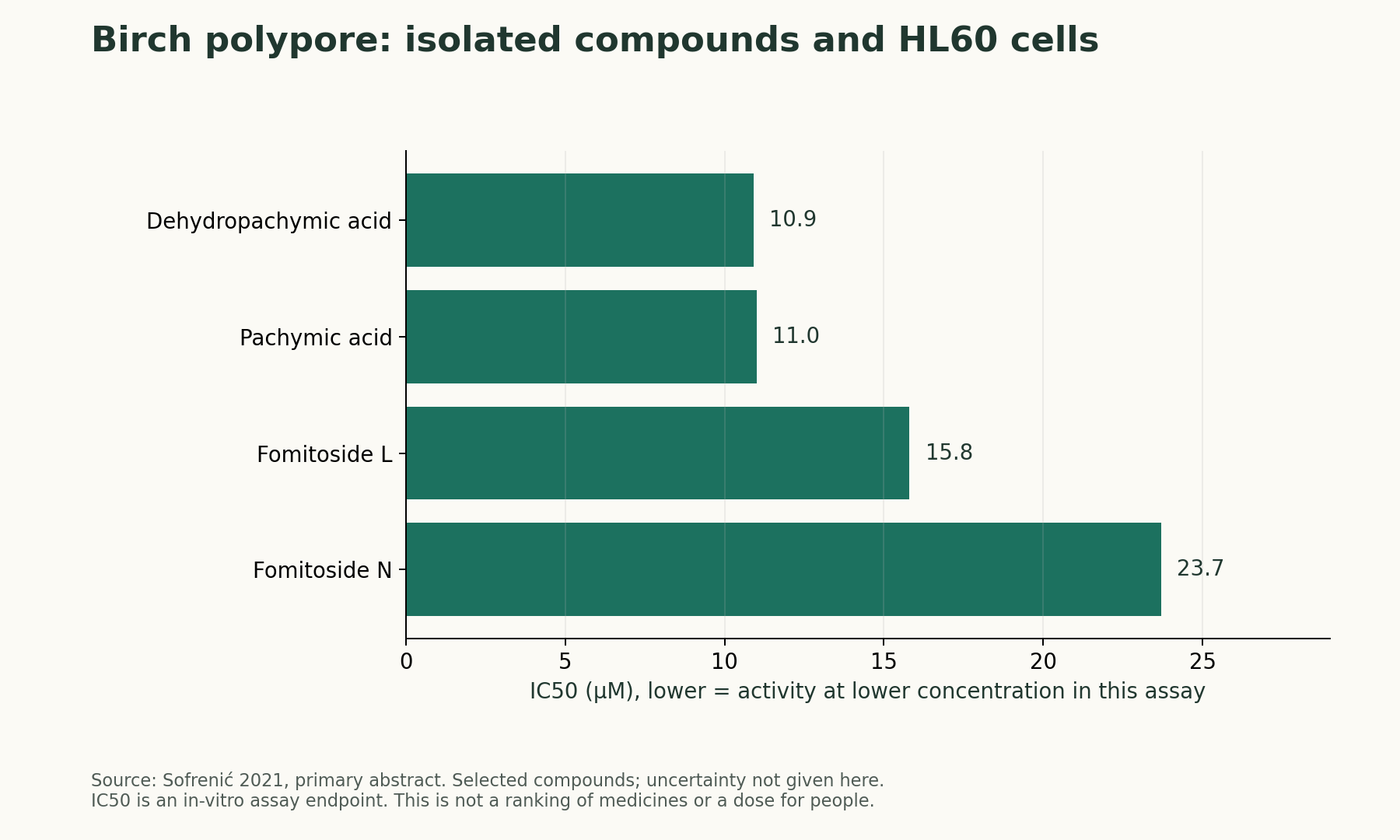
Source: Sofrenić 2021, primary abstract. Selected compounds; uncertainty not given here. IC50 is an in-vitro assay endpoint. This is not a ranking of medicines or a dose for people.
How to interpret the measurements
IC50 denotes the concentration associated with a 50% reduction in a specified assay outcome under specified conditions. Lower values do not automatically mean a better medicine. The assay, exposure time, solvent, cell line, comparator and effects on other cells all matter.
An MTT result mainly reflects a metabolic readout. LDH release, apoptosis markers and colony formation answer different questions. Extract colour or redox properties can complicate some assays, so independent methods and suitable controls are valuable. Cell studies also bypass digestion, absorption, metabolism and tissue distribution.
What the next research stage needs
Researchers need reproducible composition, authenticated starting material, dose–exposure information, toxicology and suitable animal work before meaningful clinical trials. Human studies would need to measure clinically relevant benefit and harms, including interactions with established treatment. A chart of laboratory potency must never be relabelled as a human cure rate.
For someone receiving oncology care, replacing or delaying treatment with a homemade extract is not supported by these findings. Whether a particular supplement can safely be used alongside treatment is a separate, individual question for the oncology team. This review provides no anticancer dosing schedule.
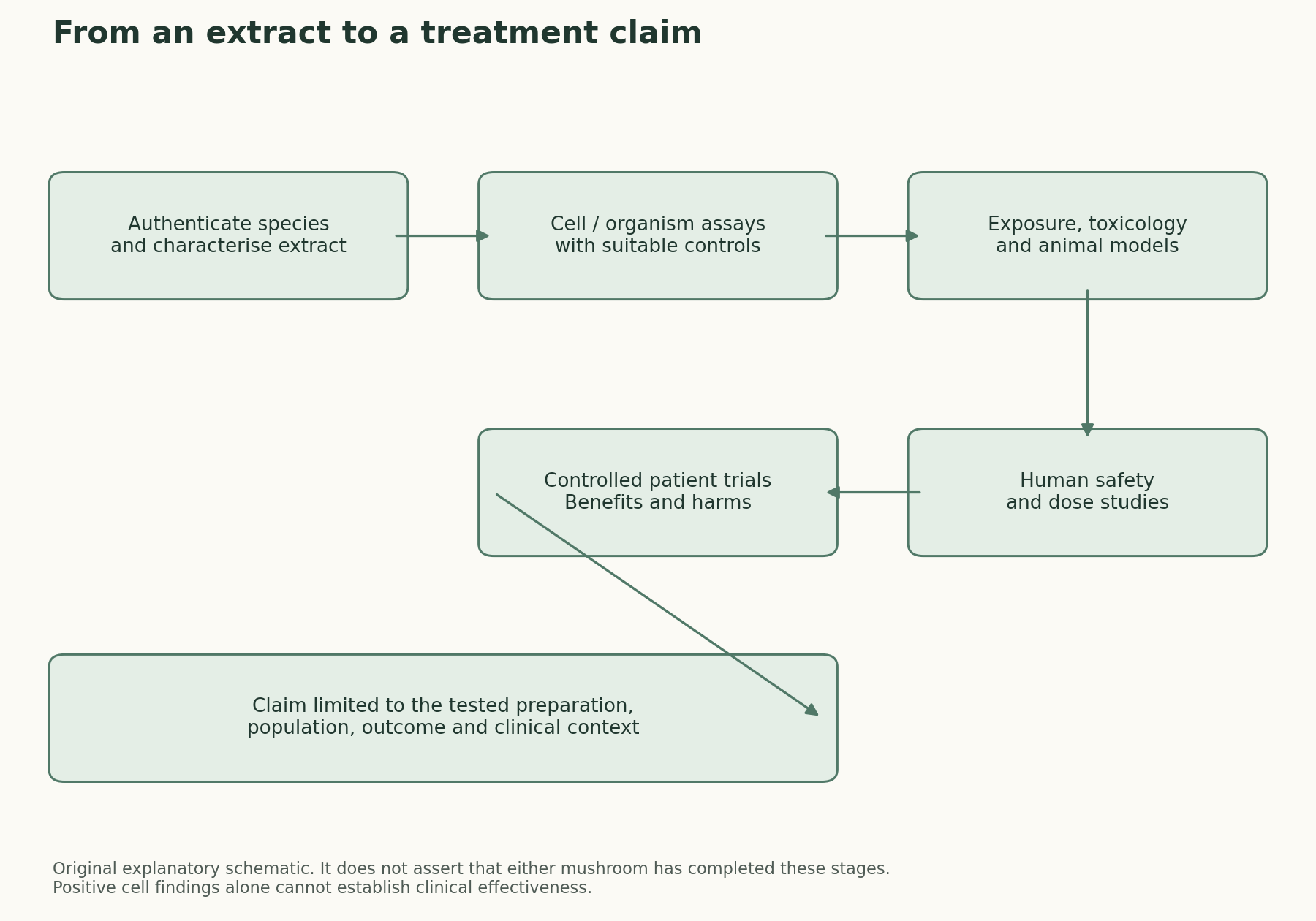
Original explanatory schematic. It does not assert that either mushroom has completed these stages. Positive cell findings alone cannot establish clinical effectiveness.
Sources & access limits
Follow each link to the original record. Results remain specific to the preparation, study population and outcomes described.
- [M05] Bożek et al. (2022). Ethanolic extract, melanoma cells and membrane models. DOI 10.3390/ijms232213907Primary paper reviewed.
- [M06] Nowotarska et al. (2024). Aqueous extract of F. betulina and cancer cell models. DOI 10.3390/nu16193316Primary paper reviewed.
- [M07] Sofrenić et al. (2021). Cytotoxic triterpenoids and sugar esters. DOI 10.1016/j.phytochem.2020.112580Abstract reviewed; full-method limits apply.
- [M04] Sułkowska-Ziaja et al. (2018). Chemical composition and biological activity of F. betulina. DOI 10.1007/s11033-018-4420-4Primary paper reviewed.
Najważniejsze informacje po polsku
Badania onkologiczne białoporka: czerniak, linie raka płuca i jelita, białaczka, selektywność oraz luka kliniczna.
To pomocnicze streszczenie. Pełny tekst, ograniczenia badań i źródła znajdują się powyżej.