Preparation changes the material
A powder contains ground starting material. An infusion or decoction transfers a fraction into water. A tincture uses a water–ethanol solvent. A dry extract is obtained after removing solvent, and a purified compound requires further separation. These names should not be used interchangeably.
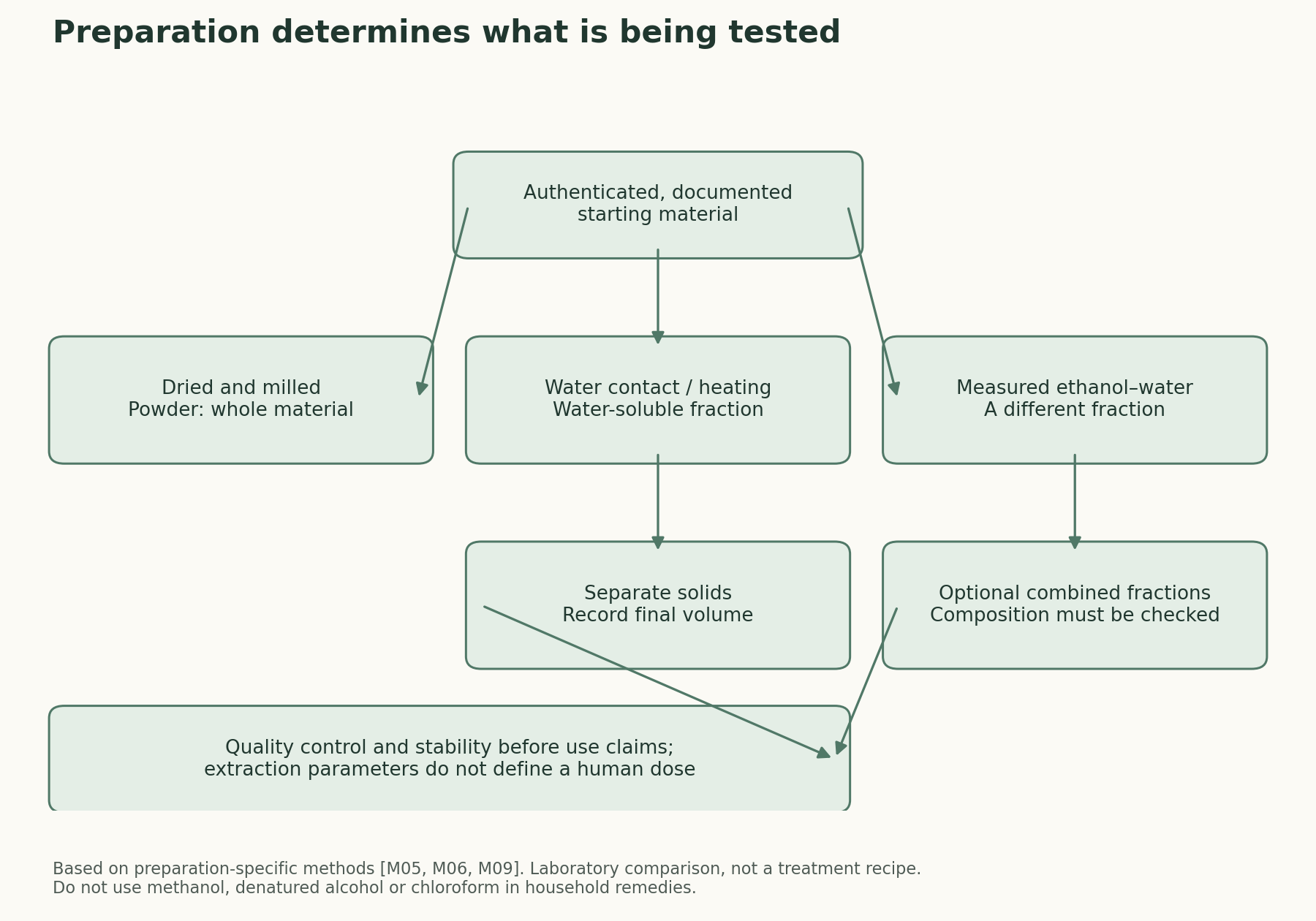
Based on preparation-specific methods [M05, M06, M09]. Laboratory comparison, not a treatment recipe. Do not use methanol, denatured alcohol or chloroform in household remedies.
Methods actually reported in research
| Primary study | Starting material and method | Why it matters |
|---|---|---|
| Nowotarska 2024 | 5 g milled fruiting body, water added to a final total mass of 50 g; approximately 95°C for 10 minutes; cooling, centrifugation and 0.22 µm filtration | A defined laboratory water preparation for cell experiments; not a validated oral dose M06 |
| Bożek 2022 | 14.3 g dried, diced material and 300 mL ethanol, 4 hours in a Soxhlet apparatus | Hot laboratory extraction; not equivalent to room-temperature household maceration M05 |
| Zaichenko 2026 | Powdered cultured mycelium, material-to-solvent ratio 1:10 w/v, 48 hours at 30°C with agitation; centrifugation and filtration | One strain and a controlled analytical method; not a fruiting-body recipe or a clinical comparison M09 |
The last study compared water, 70% and 96% ethanol and other laboratory solvents. Its phenolic assay measured 8.01, 19.39 and 10.85 mg gallic-acid equivalents per gram of dry mycelium, respectively. Water and 70% ethanol both showed high DPPH inhibition. These are different endpoints: more measured phenolics did not simply mean a proportionally larger antioxidant result. M09
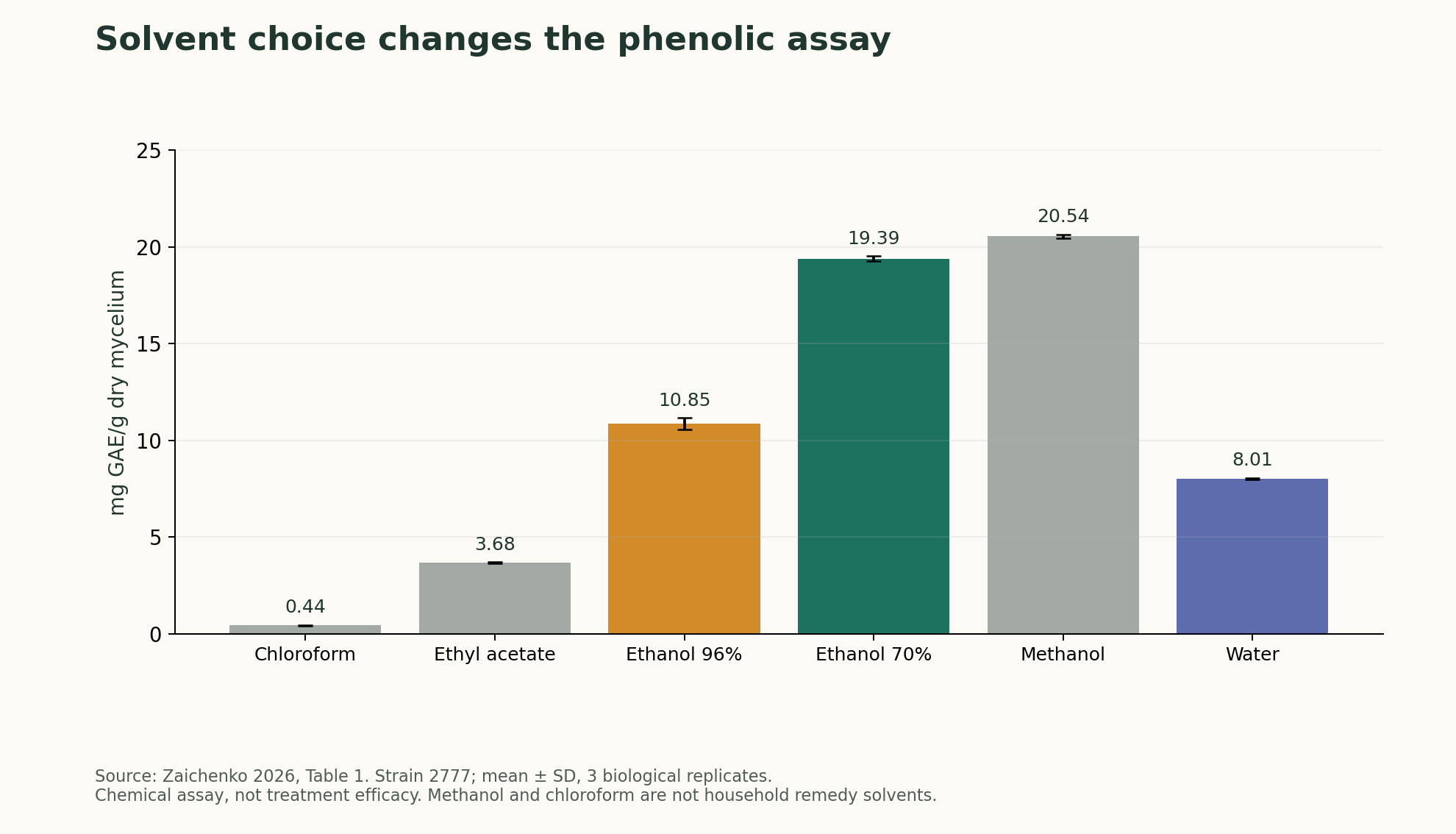
Source: Zaichenko 2026, Table 1. Strain 2777; mean ± SD, 3 biological replicates. Chemical assay, not treatment efficacy. Methanol and chloroform are not household remedy solvents.
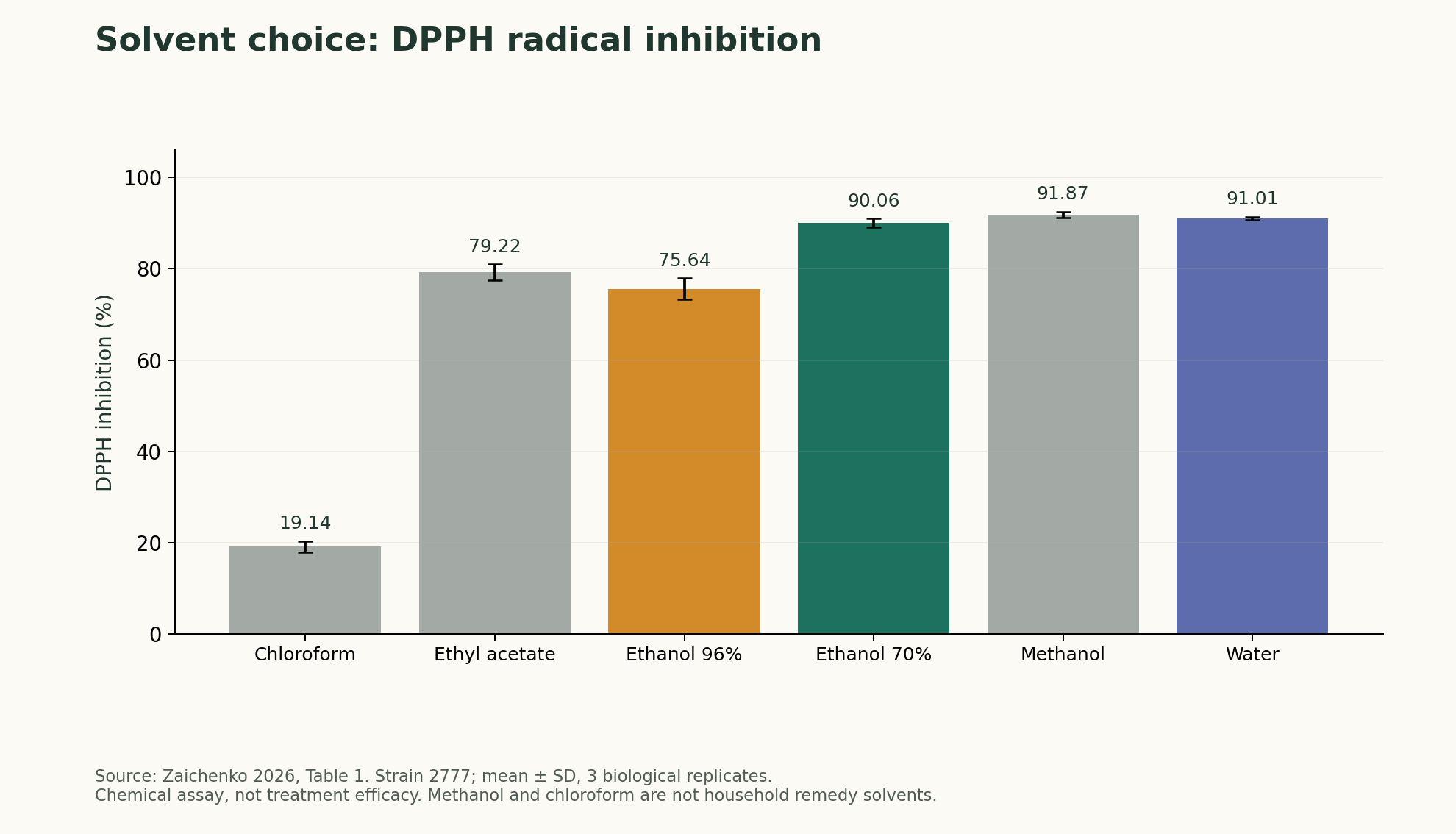
Source: Zaichenko 2026, Table 1. Strain 2777; mean ± SD, 3 biological replicates. Chemical assay, not treatment efficacy. Methanol and chloroform are not household remedy solvents.
A practical description of the forms
Dried pieces and powder. Start with reliably identified, sound material. Remove debris, slice while the material can be cut, dry thoroughly and store dry in a labelled container. Milling produces powder, not a standardised extract. Record the species, source, date and whether the material is fruiting body or mycelium. Appearance or a strong taste cannot quantify active ingredients.
Infusion. Hot water is poured over material and left in contact before straining. No clinical study located here validates a particular household infusion as a treatment. It should not be described as equivalent to a measured study extract.
Decoction. Material is heated in water and then strained. The 2024 water method above supplies a reproducible experimental example, with its laboratory context retained. Household straining does not reproduce sterile filtration or chemical quality control. Do not infer a daily drinking amount from the 5 g research batch.
Tincture or hydroalcoholic macerate. Prepared material is placed in a suitable closed container with a measured food-grade water–ethanol solvent, kept away from heat and ignition, then separated by filtration. A documented process records dry mass, solvent volume and strength, contact time and final volume. The reviewed literature does not establish a clinically effective household maceration schedule. Do not heat alcohol in an open kitchen setup.
Combined water and alcohol extraction. The two fractions may be made separately and combined after cooling. Final alcohol strength depends on both fractions. “Dual extract” does not prove that every useful compound is recovered, that the mixture is stable, or that it works better clinically. Diluting a tincture changes its preservation properties.
Glycerites, capsules, syrups and topical preparations. These are possible formulation categories, but no validated disease-specific recipe was identified. A capsule is a delivery form, not evidence. A water-containing cream or syrup needs microbial stability assessment. Traditional use of fungal material as a dressing does not make a homemade product sterile; do not place raw fungus or unvalidated extracts into wounds.
Solvent and storage boundaries
Methanol, denatured alcohol, chloroform and laboratory extraction solvents are not ingredients for a drink or household remedy. A laboratory paper's use of them describes analytical work. Solvent removal and residual-solvent testing are controlled processes, not something established by smell or taste.
No shelf life was validated for a household preparation in the studies reviewed. The 2026 storage conditions were for short laboratory analysis, not a consumer shelf-life study. Labelling a jar “one year” without stability and contamination data would be invented. Do not use visibly spoiled material.
What can be claimed
The defensible claim is that different methods produce different preparations and measurable chemical profiles. This research does not provide a validated dose for cancer, parasites, infections, blood pressure or prevention. For a commercial product, authentication, contamination testing, solvent residues, batch composition and applicable regulatory checks would be separate requirements.
Sources & access limits
Follow each link to the original record. Results remain specific to the preparation, study population and outcomes described.
- [M06] Nowotarska et al. (2024). Aqueous extract of F. betulina and cancer cell models. DOI 10.3390/nu16193316Primary paper reviewed.
- [M05] Bożek et al. (2022). Ethanolic extract, melanoma cells and membrane models. DOI 10.3390/ijms232213907Primary paper reviewed.
- [M09] Zaichenko et al. (2026). Free radical inhibition and phenolic content under different cultivation conditions. DOI 10.3389/ffunb.2026.1735209Primary paper reviewed.
Najważniejsze informacje po polsku
Jak powstają preparaty: opis technologii, dokładne parametry wybranych badań i granica między ekstrakcją a dawkowaniem.
To pomocnicze streszczenie. Pełny tekst, ograniczenia badań i źródła znajdują się powyżej.