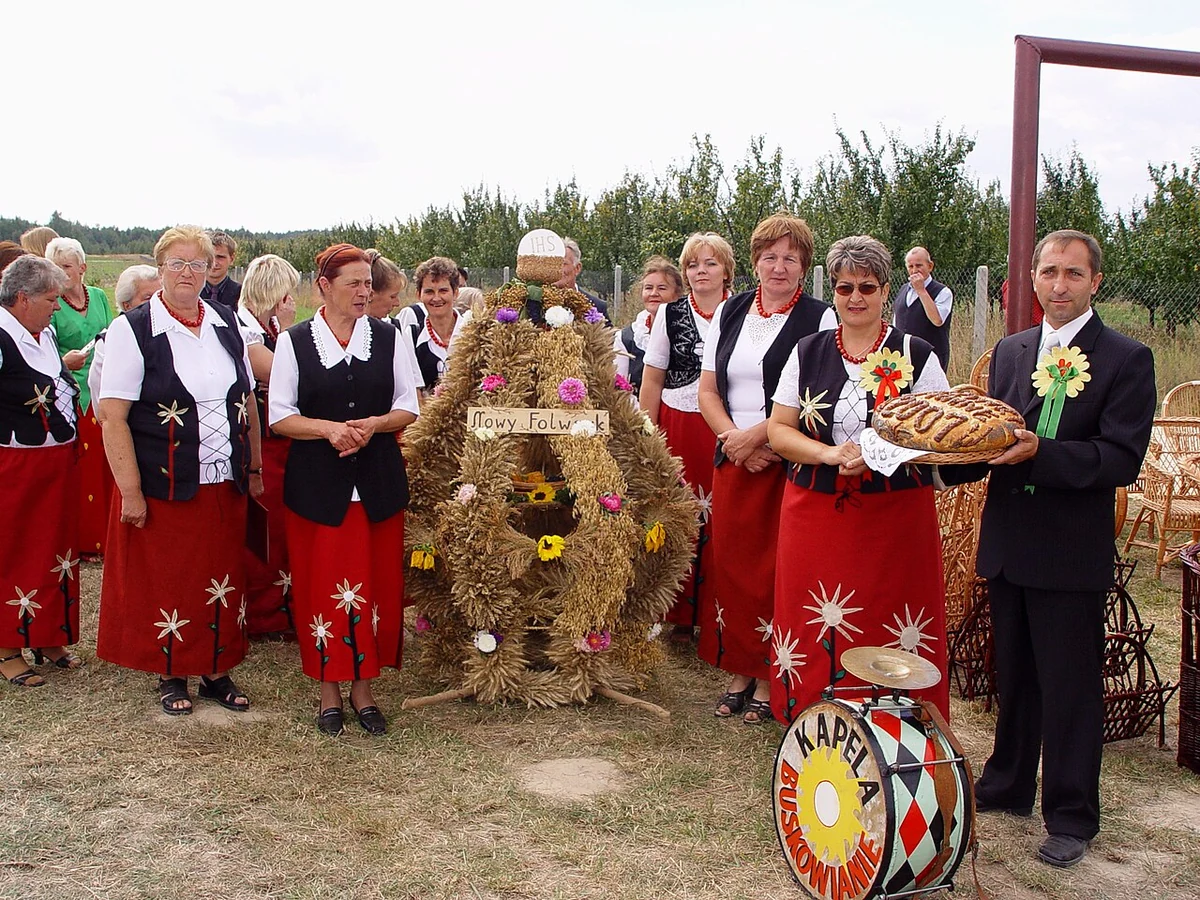
A harvest wreath, bread and participants at the harvest festival in Nowy Folwark, 2 September 2007; a modern continuation of the custom. Resized and converted to WebP; no cropping or content edits.
Jrkruk · CC BY-SA 3.0 · Source · EXIF orientation respected; resized without cropping or upsampling; converted to WebP at quality 88. No other content edits.
The end of work has more than one name
Dożynki marks a completed stage of agricultural labour. In Gloger's entry, related names include wyżynki, obrzynki, zarzynki, wieniec and okrężne. Their presence warns against treating the festival as a single fixed performance. Communities named and arranged the end of harvest in different ways.
The practical calendar matters more than an abstract date. Cutting grain, gathering the last crop and bringing all produce into storage are not identical moments. Gloger distinguishes the later autumn sense of okrężne from the celebration associated with finishing the grain harvest.
This is a festival made meaningful by work already done. The objects carried in procession are not merely picturesque symbols of nature. They come from fields whose cultivation and harvesting required skill, endurance and the coordinated labour of many people.
Sources: [G]
The patch left for the quail
One of the entry's most distinctive details is the final clump of rye left standing for the przepiórka, the quail. Its upper stalks are gathered together, weeds are cleared from the base, and bread and salt are placed on a flat stone. The small remaining patch interrupts the otherwise completed field.
Gloger connects the quail's call with changing stages of the agricultural year. People hear its sound as words appropriate to weeding, reaping and the eventual absence of grain. The bird becomes a seasonal commentator through human interpretation of its voice.
The bread and salt place household food back within the field that supplied it. Gloger explains the gesture through the wish that old bread should last until the new harvest. That is a recorded symbolic relationship, not evidence that the offering influenced yields. Its force lies in making the gap between one year's provisions and the next year's crop visible.
Sources: [G]
A wreath made from more than ears of corn
The harvest wreath can take the form of a cone or crown. Ripe wheat and rye provide its main structure, with other cereals and decorative materials appearing in the account. Flowers, apples, nuts, viburnum and gingerbread extend its associations beyond a single field.
This mixture gathers several parts of the rural economy into one object: grain, orchard produce, woodland gifts and prepared food. It is a compact display of things people have grown, collected or made. Some of its grain may later be used in sowing, linking the completed harvest with work still to come.
The article does not support one mandatory recipe for an authentic wreath. Materials vary with place, household resources and the wishes of those making it. The important continuity is the transformation of harvested plants into an object that can be carried, presented and remembered.
Sources: [G]
The leading harvester and the procession
In the Narew account, girls weave the wreath on a Saturday evening. A leading female harvester carries or wears it at the head of the procession. Gloger records names including przodownica, postatnica and sternica for this prominent role.
Her position gives public recognition to competence in the field. The procession does not simply honour an anonymous season; it brings a particular worker forward. Songs accompany the movement towards the manor and address the people who will receive the group.
The verses call for gates to open, offer greetings and expect hospitality. This makes the procession a negotiated approach to a household with resources and authority. The workers arrive bearing a carefully made object and a collective voice, and the hosts are expected to answer with food, drink, music and acknowledgement.
Sources: [G]
Water at the gate and expectations for the next year
Gloger describes young men pouring water over the wreath as it arrives. The action is associated with the hope that drought will not damage the following year's crop. The finished harvest thus immediately opens towards another uncertain season.
The setting is significant: the gate is where the procession meets its hosts. Water adds surprise and play at the point of reception, but it also expresses an agricultural concern that everyone present can understand. A successful harvest does not remove dependence on future weather.
The belief should be described in its own terms without being presented as a practical technique for ensuring rain. Nor should the gesture be treated as proof that every rural water custom had the same origin. Its meaning here is tied to this wreath, this threshold and the coming crop.
Sources: [G]
A feast that recognises labour and displays hierarchy
The host greets the company and dances with the leading harvester; the hostess may dance with an older peasant. Music, food and the arrangement of space bring different social ranks into contact. Gloger's account also describes celebrations outdoors, by open windows or in a barn when weather requires shelter.
Such contact does not abolish hierarchy. The manor remains the place to which the workers come, and the hosts retain the resources that make the feast possible. Recognition and dependence can exist together. A responsible reading avoids both a sentimental picture of perfect harmony and an assumption that the workers' pleasure was unreal.
The celebration gives labour a public conclusion. Its songs and gestures allow those who worked to be seen, while the setting makes the estate's social structure visible.
Sources: [G]
Memories, fiction and national claims inside one entry
Gloger combines several kinds of evidence. A memoir by Franciszek Salezy Dmochowski recalls an 1807 celebration at Świesz in Kujawy, where a wreath is received and dancing continues into the night. This is a specific remembered event, even though it reaches readers through a later compilation.
The entry also draws on Krasicki's Pan Podstoli. Its ideal household and orderly hospitality belong to a literary and moral project. A fictional model of good estate management should not be used as a statistical picture of village life.
Elsewhere Gloger advances broad claims about Polish agricultural precedence and the transmission of customs to neighbouring peoples. Those claims are not established by the wreath and feast he describes. His references to Lithuanian practices likewise require attention to Baltic history rather than automatic inclusion in a single Slavic category.
Sources: [G]
The tools and workers behind the wreath
In the sixth song of Kochanowski's Sobótka cycle, heat cracks the dry ground and cattle seek shade and running water. The changing colour of rye announces the approaching harvest. The poem then distributes tasks: sickle and scythe have their places, younger workers carry sheaves and others arrange them in stacks. Only after the last cutting does the host receive the grain wreath.
This sequence gives the object a practical foundation. The wreath comes after coordinated bodily work in difficult weather; it is not merely a decoration attached to a date. The singer also postpones rest until the crop has been gathered and storage filled. Cutting and securing the food are connected but separate achievements.
Kochanowski's scene is literary, yet its concrete vocabulary allows a useful comparison with Gloger's procession. Both make the finished object stand for labour extending beyond its own manufacture. The wreath's beauty depends on fields, tools, carriers and storage, even when the ceremonial moment briefly brings only one leading harvester to the foreground.
The doorway does not lead to a socially level room
Gloger's quotation from Krasicki provides an unusually ordered picture of the feast. An older man speaks for the harvesters; the host replies; the priest blesses the meal. Seating and company remain differentiated: the male household head joins the farmers, the hostess the women, and younger people gather with their counterparts. Hospitality creates contact while preserving recognisable divisions.
The passage is from an exemplary literary household, so its order expresses a view of how a good landowner should behave. It does not prove that every estate offered comparable welcome. Indeed, the appeal to the ancestors implies that the author wants readers to renew a practice he considers vulnerable.
The memoir of Świesz supplies a different kind of detail: after the reception at the porch, the company dances in a large downstairs room. Read together, these accounts show why the route from field to gate to interior matters. Access to the manor becomes part of the celebration, though neither text turns that temporary access into equality of property or authority.
Sources: [G]
Small bundles beside the grand crown
The imposing wreath is not the only grain object in Gloger's entry. He also describes równianki made from rye and wheat, brought with the wreath as representations of sheaves and sometimes used to provide grain for renewed sowing. One arrangement stands on a plate with nuts. The ceremonial display can therefore contain several forms rather than a single enormous centrepiece.
This detail draws attention to scale and handling. A large crown is suited to procession and public recognition; smaller bundles can be displayed, retained and broken down for their grain. Their materials carry the harvest forward in a more practical, intimate way. The source records possibilities, not a mandatory rule that all retained grain must be sown.
Gloger relates his illustration to an earlier description of customs in the Tykocin region and compares the wreath's shape with one from Mogilany near Kraków. That is a particular comparison offered by the collector. It is more informative than calling every crown identical, but it still does not establish a single workshop tradition or direction of borrowing between the regions.
Sources: [G]
A loaf wrapped in cloth offers another form of presentation
The entry also reports a Lithuanian-area custom of bringing the landowner a loaf made from the first new rye, wrapped in a towel or a piece of home-made linen. Grain has already passed through several transformations before it reaches the recipient: harvesting, preparation and baking. Cloth makes the gift presentable and adds another kind of household labour to it.
Gloger speculates about a connection with offerings of first bread to a ruler. That proposed genealogy should remain attributed to him. The described loaf itself does not prove that a rural presentation copied a royal ceremony, and the broad geographical designation does not identify the ethnicity of every community involved.
The comparison nevertheless widens the material history of harvest celebration. A wreath displays the crop in recognisable ears; bread offers it as something ready to share. Linen, nuts, apples and flowers further show that the rural year's products could be brought into relation. The festival's meaning emerges through these choices, rather than through one object possessing an exclusive claim to authenticity.
Sources: [G]
The rural ideal includes work that the procession leaves behind
Kochanowski's final maiden praises a household supplied by orchards, bees, sheep, fields, fishing and woodland activity. The hostess prepares the evening meal, counts returning cattle and helps with their care. Children learn from their elders. This is a vision of abundance sustained by many different tasks, some highly visible and others carried out around the home.
The poem idealises that world and contrasts it with risk and dependence elsewhere. Its confidence should not be used as evidence that rural life was easy or that every household was self-sufficient. What it does reveal is the cultural prestige of a well-ordered provisioning household. That ideal helps explain why a harvest gift could signify more than the quantity of grain cut.
Reading this domestic scene beside the leading harvester gives women more than a decorative place in the account. They reap, weave, carry, sing, prepare food and manage animals in the texts' different settings. The ceremonial honour paid to one worker belongs within that larger field of activity, even where the surviving sources give us few individual names.
The harvest as a bridge between years
The strongest thread through these details is the relationship between ending and beginning. The last standing stalks remain in the field; grain is carried into a wreath; some seed may return to the soil; water invokes the next season's needs. The feast closes one demanding period while admitting that the cycle will resume.
This interpretation grows from the documented actions. It does not require a reconstructed universal harvest deity or an unbroken line back to a medieval sanctuary. Comparisons with other harvest celebrations can be valuable, but direct descent needs evidence beyond a shared interest in food and fertility.
Dożynki preserves a particularly material form of memory: hands that cut and bind grain also make an object that tells the community its work has reached a milestone.
Sources: [G]
Sources
- [G] Zygmunt Gloger. Encyklopedia staropolska ilustrowana (1900–1903). Entry Dożynki
Regional harvest terminology, wreath materials, last rye patch, procession, songs and feast
Compilation of regional descriptions, earlier writing and authorial reconstruction; proposed ancient origins are not independently established.
- [J] Jan Kochanowski. Pieśń świętojańska o Sobótce (sixteenth century; first published 1586). Panna VI and XII; Polish text inspected
Literary representation of harvest tools, divided labour, the grain wreath, storage, hospitality and household work
Renaissance poetry with an idealising rural perspective, not an account of a named harvest celebration.