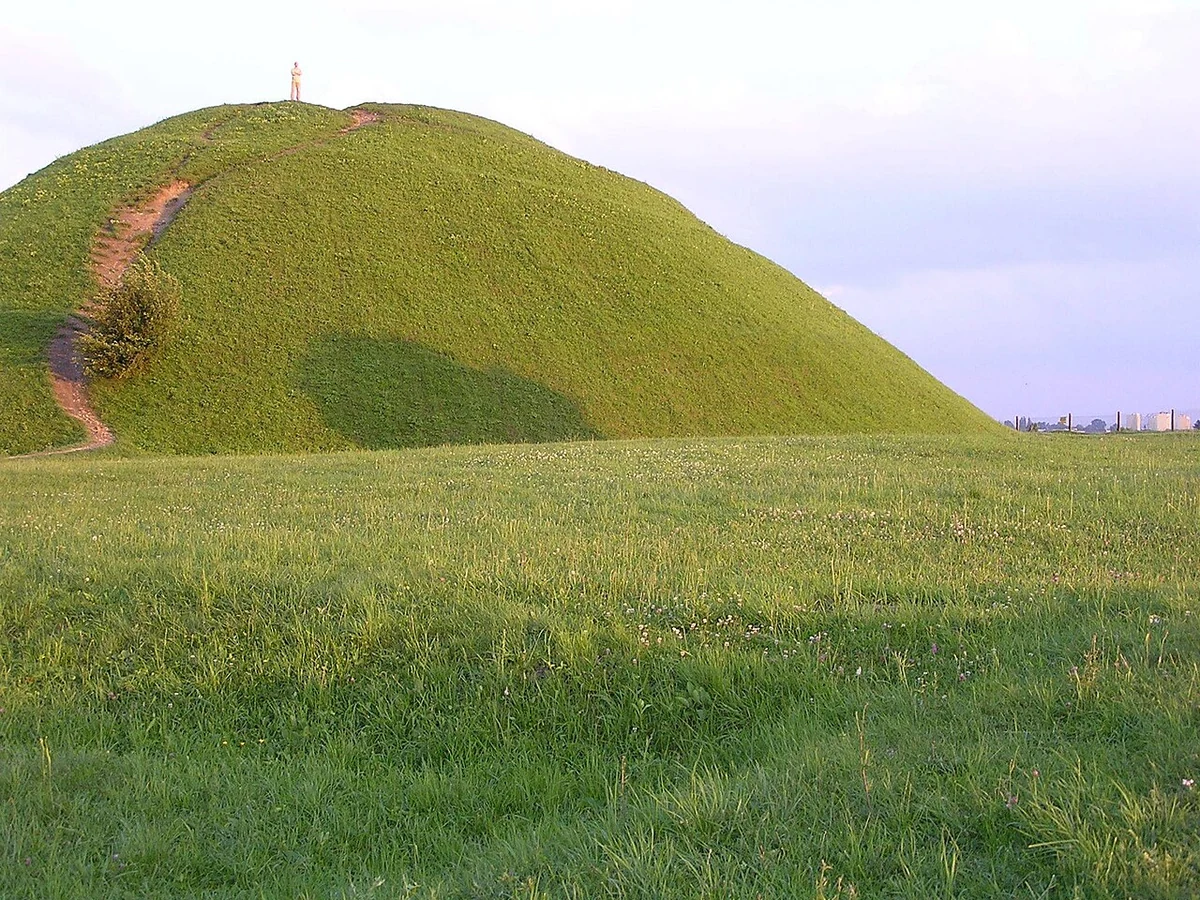
A modern view of the Krakus mound, the setting associated with Kraków's Rękawka. Resized and converted to WebP; no cropping or content edits.
WiWok · CC BY-SA 3.0 · Source · EXIF orientation respected; resized without cropping or upsampling; converted to WebP at quality 88. No other content edits.
A city moves towards a mound
Gloger places Rękawka on the third day of Easter: Tuesday afternoon. Residents of Kraków cross the Vistula and make their way towards the Krzemionki heights and the Krakus mound. The journey matters. Ordinary city space opens into a prominent landscape already rich in stories, and a holiday crowd gathers where a mound gives the ground an exceptional shape.
The record is most concrete when it describes this movement of people and provisions. It is less secure when it explains how the occasion began. The mound's association with Krakus, the legendary founder of Kraków, provides a powerful narrative setting, but it does not turn an Easter gathering into direct testimony about an ancient burial.
Rękawka can therefore be read on two levels: as a described urban custom and as a story told about the deeper past of the city.
Sources: [R]
What people brought and where it went
The foods in Gloger's account are recognisably festive and portable: bread, rolls, gingerbread, apples, nuts and Easter eggs. They travel from household stores into a public gathering. The variety is important. This is not only a ceremonial loaf or one sacred ingredient; it is an assortment of things that people can carry, distribute, catch and eat.
Gloger distinguishes an older charitable distribution from the later throwing of food down the slope. In his description of the latter, boys below compete for what people above release. The geography of the hill turns giving into a spectacle, with the crowd divided by height and by access to provisions.
The article preserves both abundance and inequality. Those who bring food and those who scramble for it do not occupy the same position. A pleasant holiday image can conceal that difference unless the mechanics of the custom remain visible.
Sources: [R]
Easter leftovers become public generosity
Gloger interprets the earlier practice as a generous sharing of remaining blessed Easter food with the poor. The movement from a family table to a communal place extends the feast beyond those who could afford it. In this reading, the holiday's material surplus becomes a public obligation.
The term leftover need not imply rubbish or something without value. Food associated with the Easter table retains ceremonial and emotional importance. Passing it to someone else can express respect, charity and participation in the same season. Its meaning changes with the way it is given.
This is why the difference between handing food to a person and throwing it towards a struggling crowd matters so much to Gloger. He sees a moral transformation inside what might otherwise be described simply as continuity of custom.
Sources: [R]
Bread, play and the collector's judgement
The author invokes an older reverence for bread: even a fallen crumb could be lifted and kissed. Against that ideal, the throwing of provisions appears to him as a loss of respect. His account is consequently not a neutral inventory. It compares present behaviour with a valued image of the past.
Readers need not adopt every part of that judgement to recognise the question it raises. When does a communal game preserve a custom, and when does it change the relationship between participants? A distribution that becomes entertainment may still retain its name and location while altering the dignity of those involved.
Gloger's criticism also reveals his own priorities. He values inherited manners, generosity and national memory. The text tells us about Rękawka, but also about what an early twentieth-century collector wished Polish society to preserve.
Sources: [R]
The founder's funeral: a reconstruction inside the story
The entry imagines an original feast connected with the burial of Krakus. It links the mound's construction with people carrying earth in their hands or sleeves, and uses that scene to explain the name Rękawka. It also considers the labour of maintaining a mound and the gathering that such work might require.
These are explanations offered by the author, not an excavated record of a named founder's funeral. The story joins a striking monument, a remembered ruler, an unusual word and a surviving festival into a coherent sequence. Its coherence helps explain its appeal; it does not independently verify each link.
A heritage article should therefore preserve the legend as a legend and the proposed etymology as a proposal. It should not announce that archaeologists found Krakus's grave, that the word's origin is settled, or that an unchanged ceremony can be traced across every intervening century.
Sources: [R]
A useful comparison with meals for the dead
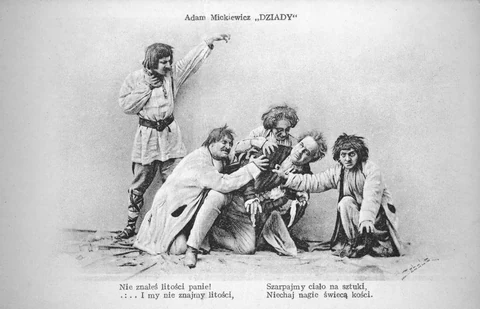
In his discussion of Dziady, Gloger places Rękawka beside regional meals associated with the deceased. The comparison draws attention to food, commemorative places and the relationship between living communities and their dead. It helps explain why a mound festival could attract a funerary interpretation.
There are also substantial differences. The Polesie account involves families eating at graves after Easter. The Kraków description concerns a public gathering, a monumental landscape and the distribution or throwing of provisions. Similar materials and a related calendar do not erase different participants and actions.
The comparison is strongest when it remains a question about cultural patterns. It is weakest when resemblance is treated as proof that one rite must have evolved directly from another.
Why the landscape outlasts an explanation
A prominent mound can gather new meanings without losing old associations. People may visit because of a founder's legend, a religious holiday, a family habit, an entertaining crowd or the pleasure of being outdoors. The source does not require every participant to arrive with the same theory of the occasion.
That flexibility helps explain the durability of a named gathering. A place gives the custom a recognisable centre even when gestures and interpretations change. Rękawka's history is consequently more than a search for its first ceremony: it is also the history of how successive city dwellers used and explained the same distinctive ground.
Gloger's appeal to preserve tradition belongs to that process. By writing about the festival, criticising its changes and supplying an ancient narrative, he himself contributes to the meanings later readers inherit.
Sources: [R]
An 1860 engraving brings the crowd into view
A page of Tygodnik Illustrowany dated 7/19 May 1860 carries an engraving captioned as the celebration of Rękawka in Kraków. The drawing is credited to Pillati and the engraving to Hähle. A church stands behind a line of spectators along the higher ground. Below them, a crowded slope fills with people reaching, bending, running and holding out hats.
The image gives a different entry into the custom from Gloger's later prose. It distributes attention across many bodies instead of following one continuous explanation. Some figures watch; others compete for objects descending or lying on the ground. The slope is not a passive backdrop. It creates the event's visual structure, separating those who can stand and look from those who must move quickly.
The engraving should be read as a made image. Its crowded arrangement and emphatic gestures serve intelligibility and spectacle. We cannot identify each small object as a particular coin or food, or recover the private circumstances of each figure. What can be observed securely is the contrast of positions and actions which the artist chose to make visible.
Hats, baskets and the mechanics of receiving
Several figures in the engraving use their hands or hats as receptacles, while others stoop towards the ground. These gestures make receiving an active, uncertain task. A gift released from above does not necessarily reach the person who needs it most; speed, balance and position affect who obtains it. The image thus helps a reader understand the practical basis of Gloger's concern about throwing provisions.
Clothing and posture also make the crowd varied. The engraving does not present a row of identical ritual participants. People are absorbed in different small actions, and the audience at the top remains part of the scene even where it is less physically animated. Watching is one of the event's roles.
This is an interpretation of the composition, not a claim that the artist set out to deliver a social critique. It nevertheless allows the account to move beyond a picturesque list of Easter foods. The material passage of an object from one person to another creates a relationship, and the manner of passage can turn assistance into entertainment for somebody else.
The church in the picture belongs to the evidence
The church visible behind the crowd is a reminder that the recorded festival occupied a Christian urban landscape. Gloger's calendar likewise places it within Easter. These features do not settle the earliest origin of Rękawka, but they do establish that a nineteenth-century representation cannot honestly be stripped of every later religious association to produce a purely pagan scene.
The engraving's caption identifies the event and city; it does not label every building or provide a measured topographical plan. A precise reconstruction of the route or a claim about when the gathering shifted between particular slopes would require additional maps and dated records. The image alone should not carry those conclusions.
Read at the scale it supports, however, it is valuable evidence for the coexistence of sacred architecture, holiday spectatorship and vigorous play. Those elements occupy the same composition without the artist needing to explain them as mutually exclusive traditions. The visible scene is richer than a modern division between religion on one side and entertainment on the other.
The name also lived in verse and a printed riddle
Gloger does not rely only on the gathering to explain the word Rękawka. He quotes a use in Kochanowski's poetry connected with heaping up a commemorative mound, and reproduces a charade attributed to Bobrowicz in Pszczółka krakowska for 1820. In the riddle, parts of the word are separated and recombined, while the whole is praised as something able to resist the power of time.
These examples show the name circulating beyond the annual crowd. It could belong to literary commemoration and to readers' wordplay. The riddle assumes an audience for whom the completed word has recognisable local charm and significance.
They do not prove the etymology Gloger proposes. A later poem or puzzle can draw strength from an already familiar explanation without independently confirming it. Their historical value is instead evidence of reception: Rękawka was something people could name, evoke and celebrate in print. The custom's memory was maintained by readers and writers as well as by those who climbed the hill.
Sources: [R]
Repairing a mound is an appealing but unverified explanation
One of Gloger's most practical suggestions concerns erosion. Melting snow, he reasons, would damage a fresh earth mound, so people receiving a commemorative meal might also have repaired it in spring. This connects seasonal weather, labour and hospitality in an intelligible way. It offers a material mechanism for the return of a gathering to the same place.
The passage remains a hypothesis. Gloger does not present a dated account of workers repairing Krakus's mound in return for food. Its plausibility should not be mistaken for documentation, and the engraving cannot confirm it: the pictured participants are engaged in the festival, not demonstrably maintaining the earthwork.
Keeping this distinction makes the history more precise without making it less interesting. The source preserves an early twentieth-century attempt to explain how a monument and a meal might belong together. That attempt is part of the intellectual history of Rękawka. The described Easter crowd, the printed image and the proposed ancient origin answer different questions and should be allowed different levels of certainty.
What the record allows us to carry forward
The secure core of this account is vivid enough without an invented certainty: an Easter Tuesday journey, food from festive households, people gathering above and below a slope, charity mixed with play, and an author worried about the treatment of bread and the poor.
For a present-day interpretation, those details offer several honest points of connection. A shared meal, a discussion of the city's legends or a dignified gift of food can acknowledge the historical custom. None needs to imitate the humiliation of scrambling below a crowd or claim to restore Krakus's actual funeral.
Rękawka is a particularly revealing example of heritage because its remembered past and its recorded practice are visibly intertwined. Reading them separately allows both to remain interesting.
Sources: [R]
Sources
- [R] Zygmunt Gloger. Encyklopedia staropolska ilustrowana (1900–1903). Entry Rękawka
Tuesday Easter gathering, distribution and throwing of food, Gloger's moral commentary and origin theory
Compilation of regional descriptions, earlier writing and authorial reconstruction; proposed ancient origins are not independently established.
- [D] Zygmunt Gloger. Encyklopedia staropolska ilustrowana (1900–1903). Entry Dziady
Comparative accounts of meals for the dead
Compilation of regional descriptions, earlier writing and authorial reconstruction; proposed ancient origins are not independently established.
- [I] Pillati, drawing; Hähle, engraving, as credited in the caption. Obchód Rękawki w Krakowie, Tygodnik Illustrowany, no. 34 (7/19 May 1860). Printed p. 304; illustration and caption visually inspected; issue date checked on p. 301
A nineteenth-century visual representation of spectators and scrambling participants on a slope, with a church behind them
An engraved composition, not a photograph or a record of each person's identity. The archive's generic HTML heading says 1859; the scanned issue masthead identifies 1860.