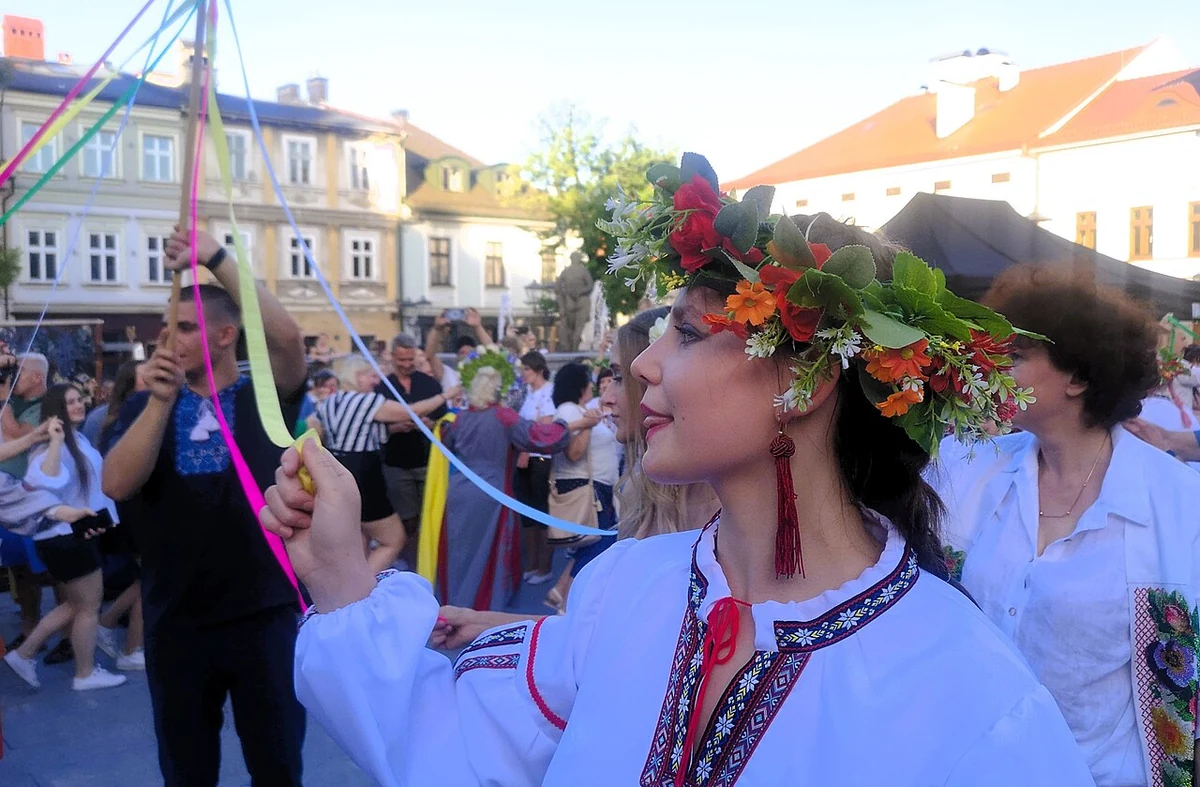
A participant wearing a wreath at Ukrainian Ivan Kupala celebrations in Bielsko-Biała, 8 July 2023; a contemporary celebration. Resized and converted to WebP; no cropping or content edits.
Silar · CC BY-SA 4.0 · Source · EXIF orientation respected; resized without cropping or upsampling; converted to WebP at quality 88. No other content edits.
One familiar name, several calendars
A summer fire, a wreath on moving water and a gathering after sunset form a compelling picture of Sobótka. Yet the records do not describe one ceremony performed identically across the Slavic world. Gloger's encyclopaedia places related customs around both Pentecost and the eve of St John. Local calendars, church festivals and the practical life of a community all matter.
The name Kupalnocka belongs particularly to the account he gives from the Narew country of Mazovia and Podlasie. Other names and locations appear elsewhere in his discussion. Keeping the regional name makes the evidence more useful: it identifies a remembered gathering rather than supplying a universal script for a supposedly unchanged ancient festival.
Even the word Sobótka invites competing explanations. Gloger connects it with Saturday vigils, while interpreting the fires through a much older religious past. Etymology, seasonal resemblance and documented performance are different kinds of argument. None alone fixes the original date or purpose of every summer fire.
Sources: [G]
Meeting beside the stream
In the Narew account, women and girls assemble on a meadow beside water as the sun goes down. The setting joins several ordinary features of rural life: a place to gather, plants within reach, flowing water and enough open ground for a fire and dancing. The ceremony develops through the evening rather than appearing as one isolated act of divination.
The gathering also has a social boundary. Attendance is noticed. Gloger records the suspicion that an absent woman might be a witch. This detail complicates a purely idyllic picture of female companionship. A custom could create solidarity and, at the same time, make non-participation dangerous to someone's reputation.
Food, drink, movement and song hold the company together. They are not incidental decorations around a mysterious rite. They give the occasion its duration and make it a shared event in which neighbours see one another, exchange expectations and renew familiar relationships.
Sources: [G]
Herbs divided between the fire and the house
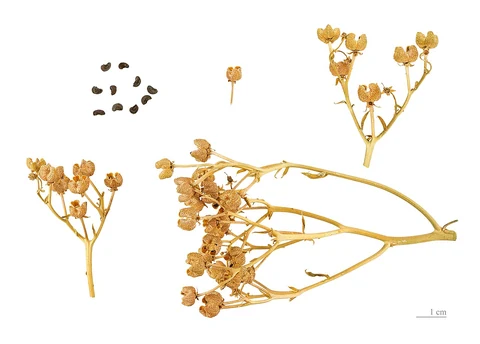
The participants bring bunches of plants. A branch from each is placed in the fire, while the remaining material is taken home. Gloger describes the smoke and the retained herbs within a protective system of belief. The plants later belong in the thatch of houses, barns and stables, extending the evening's significance to people, animals and stored provisions.
This division is an important feature of the account. Burning everything would produce a different ritual. Here a portion passes through the communal fire and a portion remains available for the household. The rite connects an outdoor gathering with the spaces where daily work and vulnerability are concentrated.
The source does not justify turning those bunches into a modern medicinal mixture. A plant used as protection in a roof has a different role from a plant swallowed as a remedy. Nor does the account establish that every participant selected an identical botanical list. The most secure observation is the movement of herbs between meadow, fire and home.
Sources: [G]
The midnight fire and the floating wreath
Towards midnight, the account describes a larger fire and the pouring of leftover drink into it. A girl sends a wreath, including mugwort, onto the stream while the company sings. Water carries the object beyond the place where it was made, giving the gathering a visible ending and opening the possibility of reading movement as a sign.
Modern summaries often reduce such customs to a simple marriage prediction. Gloger's particular sequence is richer: assembling, checking who is present, feasting, dancing, burning selected herbs, retaining others, tending a later fire and finally releasing the wreath. The order shows how the river act belongs to a whole evening of communal activity.
A contemporary interpretation may emphasise youth, courtship, seasonal change or the uncertainty of the future. Those are productive readings when labelled as readings. The surviving description does not give us every participant's private explanation, and it should not be made to speak with a single ancient voice.
Sources: [G]
A very different Sobótka in the street
Kitowicz's account of customs under Augustus III gives a contrasting view. His Sobótka is conspicuously urban: young people, especially young men, gather around street fires on St John's Eve after evening devotions or at dusk. Jumping across the flames brings danger, excitement and public disorder into the description.
His attention falls on burns, threatened buildings and the decline or suppression of the practice. He associates its disappearance in Warsaw with official control. That is a claim about a particular urban setting, not evidence that summer observances vanished everywhere.
Reading Kitowicz beside Gloger prevents the women's riverside gathering from becoming the sole authentic form of the festival. It also prevents the unruly street fire from swallowing the quieter household use of herbs. Both texts concern related seasonal practices, but their participants, spaces and authors' judgements differ.
Poetry, church criticism and the search for origins
Gloger brings literary and older written testimony into his entry, including Kochanowski's St John's Eve poetry and a hostile early modern discussion of women's fires and mugwort. These passages show that summer observances attracted artistic celebration and religious criticism. They do not all function as field notes.
Kochanowski's poetic world is shaped by literary purpose. A clerical or medical writer condemning a custom selects details that support condemnation. Gloger, writing much later, arranges such evidence within his own account of national tradition. The distance between an event, its first description and its later interpretation needs to remain visible.
His confident explanation in terms of ancient sun worship is therefore best presented as Gloger's theory. The fire is real within the recorded custom; a complete prehistoric theology reconstructed from it is much less secure.
Sources: [G]
Twelve singers in a carefully arranged poetic landscape
Kochanowski's opening places the fire at Czarny Las, with guests and members of the household gathering around it. Music carries into the orchards. The company sits on the grass before six pairs of similarly dressed girls rise, their waists bound with mugwort. This is a composed scene: setting, sound, clothing and the number of performers establish order before individual songs begin.
The arrangement differs from Gloger's Narew gathering, where the women first check who is absent. In the poem, the singers have learned their songs and take their turns within a deliberate artistic sequence. Their appearance cannot therefore be treated as a census of how many women normally attended Sobótka, or as a recovered rule requiring twelve ritual specialists.
What the poem does preserve is an early literary association between the summer fire, female performance and a household welcoming others. Mugwort belongs visibly to the singers' clothing. Its presence in this setting can be compared with the plant carried home in Gloger's account, while the different actions remain distinct. Wearing a plant, burning a portion and storing it under a roof are three uses, not interchangeable details of one universal ceremony.
The first song argues for the right to rest
The first maiden invites her companions to join hands and sing, asks for a calm night and recalls a custom transmitted through mothers. Her speech then becomes an argument about work. Earlier people, she says, honoured holy days and still completed their tasks; present people work without stopping yet suffer poor yields, hail, heat and high prices.
This is not a simple hymn to the sun. The speaker explicitly invokes God and piety, making observance of the holiday part of a Christian moral economy. Labour alone cannot guarantee bread. The passage gives the summer gathering a practical urgency: the community must recognise a time when work yields to song and shared rest.
The complaint also complicates the familiar picture of a uniformly happy pastoral world. Bad harvests and anxiety over provisions enter the opening celebration. The promise of a better year answers those anxieties rather than erasing them. Read beside Gloger's preservationist account, the poem shows that an appeal to ancestral custom can serve an immediate social argument about how people should live and work.
Several summer dates, several kinds of authority
Gloger's entry places observances around more than one Christian summer feast. He cites criticism of night dances before holidays, a prohibition associated with Pentecost at Łysa Góra and the St John's setting of Kochanowski's poem. His evidence therefore already contains a moving calendar, despite his confidence in a single solar origin.
The distinction matters when describing the festival's history. A reference to a summer vigil does not automatically identify the exact night of the astronomical solstice. Nor does a prohibition tell us everything that participants did. It shows that an authority objected to some reported conduct and wished to regulate it. Gloger's summaries of older statutes require verification in those statutes before their dates and wording are repeated as independently checked facts.
The literary and ethnographic material is more specific about its own scenes: the poem names St John, and the Narew description places the gathering after sunset on the eve of his feast. These local anchors provide a firmer narrative than an assertion that all summer fires everywhere followed one unchanged timetable.
Belonging could be enforced as well as celebrated
The Narew women in Gloger's account do not merely enjoy one another's company. They check whether everyone has arrived and suspect an absent woman of witchcraft. This small detail changes the emotional texture of the scene. Attendance can signal belonging, while absence exposes a person to a dangerous interpretation.
The account does not tell us whether a particular woman was accused, how seriously every participant took the suspicion or what consequences followed. It would be wrong to invent a persecution from the brief statement. Nevertheless, the stated rule shows that the gathering carried expectations as well as pleasures. A community could affirm its cohesion by watching its own margins.
This makes a useful contrast with the first maiden's invitation in Kochanowski. Both texts present women gathering around a fire, but one gives a poetic appeal to shared song and the other records a mechanism of suspicion. Neither should be selected as the sole truth of the tradition. Keeping both allows the historical celebration to retain the tensions of actual social life.
Why the poet's fauns are not new Slavic gods
The final maiden's praise of rural life includes fields, orchards, bees, livestock, fishing, household management and evening recreation. It also introduces woodland fauns dancing to a shepherd's music. These figures belong to the poem's classical literary vocabulary. Their appearance in a Polish summer setting does not establish a local cult of fauns or provide missing members of a Slavic pantheon.
The combination is valuable in a different way. It shows a learned poet making rural life intelligible through several imaginative traditions at once. Familiar labour and household abundance sit beside inherited classical imagery. The cycle's cultural history includes that act of composition, just as later romantic poems and ethnographic collections add their own forms of interpretation.
Sobótka thus reached readers through more than surviving fires. It also travelled through printed verse, arguments about good living and later selections of memorable passages. A responsible retelling can celebrate that long afterlife without confusing the poet's artistic world with an untouched ritual surviving outside history.
What a careful revival can preserve
Gloger ends with an appeal to preserve and revive beautiful customs. He is not merely recording a disappearing world; he wants his readers to act upon it. That preservation agenda helps explain the warmth of his account and the way he selects memorable scenes.
For readers today, the strongest inheritance is the richness of the local sequence: company, songs, plants, shared food and attention to the summer landscape. A modern gathering can acknowledge its inspiration without claiming to reproduce an intact pagan liturgy. Participation can be voluntary, and a symbolic light or a wreath displayed on land can carry the story without reproducing dangerous fires or leaving material in waterways.
The historical record becomes more interesting when its differences remain intact. Narew Kupalnocka and Kitowicz's street Sobótka reveal several ways communities made a summer evening exceptional.
Sources
- [G] Zygmunt Gloger. Encyklopedia staropolska ilustrowana (1900–1903). Entry Sobótka
Regional summer customs and Gloger's preservation agenda
A retrospective compilation combining regional observations, earlier quotations and the author's interpretations; not direct evidence for a uniform pre-Christian religion.
- [K] Jędrzej Kitowicz. Opis obyczajów i zwyczajów za panowania Augusta III (late eighteenth-century account of the reign 1733–1763). Chapter XIII, §5, O Sobótce
Urban St John's Eve fires, participants, hazards and the author's account of their decline
Retrospective moral and social commentary; explanations of pagan and Christian origins are reported interpretations.
- [J] Jan Kochanowski. Pieśń świętojańska o Sobótce (sixteenth century; first published 1586). Opening frame and Panna I, VI and XII; Polish text inspected
Literary staging of the summer gathering, inherited observance, holy-day rest, harvest work and the ideal rural household
Authored Renaissance poetry, not a transcript of a village ritual. Classical imagery and the poet's idealisation must remain visible.