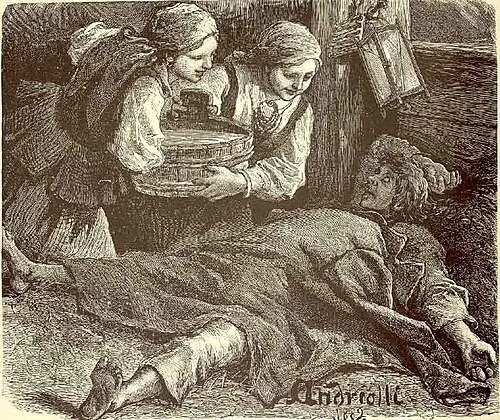
Dyngus in a nineteenth-century engraving by Michał Elwiro Andriolli; a later portrayal of the custom described by Kitowicz. Resized and converted to WebP; no cropping or content edits.
Michał Elwiro Andriolli · Public domain · Source · EXIF orientation respected; resized without cropping or upsampling; converted to WebP at quality 88. No other content edits.
The water changes with the company
Kitowicz's Dyngus is immediately recognisable as an Easter water custom, but its social range is wider than a single cheerful image suggests. Among polished admirers, the water may be perfumed and offered in a small quantity. In a more boisterous company, pots and buckets replace delicate containers and a whole room can be drenched.
The contrast is central to his account. Water remains the common material, yet its meaning changes with the vessel, the quantity, the relationship between participants and the possibility of escape. A gesture of courtship can shade into competitive display or coercion.
The author describes the reign of Augustus III retrospectively. His vivid scenes are valuable evidence for how he remembered and interpreted that social world. They should not be expanded into a claim that every Polish household celebrated in the same fashion.
Sources: [K]
Easter Monday, Tuesday and the length of permission
The reported arrangement gives men the first turn on Easter Monday and women a responding turn on Tuesday and subsequent days. Kitowicz mentions a claim that the licence continued until Pentecost, while indicating that in practice the main activity lasted only a few days.
This difference between a proverbial entitlement and ordinary behaviour is revealing. Customs often have an expansive account of what is permitted, alongside a more limited pattern of what people actually do. The calendar creates a temporary exception to everyday manners, but the boundaries of that exception are open to negotiation.
The source therefore supports neither an unlimited season of water throwing nor one universally fixed day. It describes an Easter sequence in which gendered roles are announced, reversed and contested.
Sources: [K]
Rosewater and the language of attention
In elite settings, Kitowicz describes scented water applied with small flasks or squirting devices. Hands and clothing become the targets of a restrained gesture that can communicate interest. The material itself helps distinguish the act: perfume, a fine container and a small amount of liquid suggest controlled expense and attention.
Courtship gives the gesture a possible meaning, but not an automatic one. The relationship between the people involved still matters. A ritual convention can provide an excuse for approaching someone, and its ambiguity may be part of the attraction.
These details also show that the custom belongs to material culture. Access to perfume, specialised vessels, servants and spacious interiors shapes what participants can do. The difference between rosewater and a bucket is a difference in resources as well as manners.
Sources: [K]
When the room becomes part of the game
In the more exuberant version, ordinary water is brought in large quantities. Servants carry supplies, participants arm themselves with household vessels and the company becomes thoroughly wet. Furniture may be moved or protected, and people may wear clothes chosen because they can endure the treatment.
Preparation reveals anticipation. Some households expect a level of disorder and arrange their possessions accordingly. The game temporarily changes how a room is used: a place for receiving guests becomes a field of pursuit, attack and retreat.
That practical detail prevents the custom from floating free of everyday life. Water has to be obtained, carried and later cleared away. The labour behind the spectacle is unevenly distributed, especially where servants supply what other people throw.
Sources: [K]
The limits of a playful description
Kitowicz also describes women caught in bed, restrained and soaked. Early rising and secured rooms become strategies for avoiding an unwanted encounter. In the countryside, young women may be carried to streams, ponds or troughs. On streets, people who are not willing participants can be caught in an ambush.
These scenes should not be softened into a timeless permission to ignore refusal. The source itself makes unequal physical strength and the difficulty of escape visible. A nominal reversal of roles on the next day does not necessarily create equal power.
Kitowicz reports illness following severe cold soaking, but his observations are not a modern clinical study. The historically secure point is that he noticed distress and consequences, not merely laughter. A full account of the custom includes those experiences alongside flirtation and companionship.
Sources: [K]
Origin stories the author does not resolve
The chapter records competing explanations. One is a polemical biblical story connected with news of the Resurrection; another links the custom with collective baptism in Poland. These are stories about origins that circulated in the author's world, not events demonstrated by his account of eighteenth-century practice.
The first explanation carries religious hostility within it and should not be repeated as a factual account of Jewish behaviour. Attribution is essential. Reporting that an author heard a prejudicial story does not require endorsing or embellishing it.
Kitowicz explicitly limits his purpose: he is describing the custom of the reign and the explanations he encountered, rather than establishing its genealogy. That restraint is useful. A modern heritage article can be equally interested in origins while admitting that the source does not settle them.
Sources: [K]
Water beside fire in the written account
The following section turns to Sobótka and summer fires. The proximity allows Kitowicz to move from one conspicuous seasonal custom to another, with similar interest in youthful excess, public order and the responses of authorities.
The arrangement is the author's, not proof that the two practices belonged to one prehistoric ritual system. Easter water and St John's Eve fire have different calendars and actions in his text. Their pairing tells us something about how he organises a description of manners.
Reading both sections also reveals his evaluative voice. He is alert to amusement, but repeatedly asks when it becomes damaging. His account preserves a social argument about custom as much as a catalogue of customary behaviour.
Sources: [K]
Going from house to house was not the same as soaking someone
Gloger supplies a distinction missing from a purely watery picture of Easter. In the Mazovian usage he describes, boys go po dyngusie from house to house, sing songs appropriate to the feast and collect what households give them in a basket. He compares this movement with Christmas visiting. Śmigus, in the same account, names the reciprocal water custom on the second and third days of Easter.
The distinction changes the range of actions attached to the familiar name. Visiting requires a route, an approach to a doorway, a performance and a household response. Water throwing may accompany or be associated with the season, but it is not the only thing taking place.
The basket is as useful a historical object as the bucket. One receives gifts; the other carries the means of soaking somebody. Their relation can be playful or coercive, depending on whether provisions are freely offered or demanded to avoid an unwelcome encounter. Gloger's entry preserves that connection while also showing that local speakers could keep the two names and practices apart.
Sources: [G]
A voice on the tavern roof in Kujawy
In the Kujawy scene recorded by Gloger, a young man climbs onto the village tavern roof with a basin. He strikes it and publicly announces which girls will be soaked, exaggerating the quantities of sand, washing material, tools, water and soap supposedly needed to clean each one. The performance is audible before the water arrives.
This is a different form of seasonal theatre from Kitowicz's crowded drawing room. The elevated speaker addresses the village and names individuals, turning a private person's reputation into a public joke. The basin serves first as an instrument for attracting attention rather than simply as a vessel.
The source does not preserve every announcement or every girl's response. It should not be expanded into a universal script for Kujawy. The detail it does give is enough to reveal how humour and social scrutiny could work together. A festival could provide a temporary platform for comments that might be unwelcome on an ordinary day, and public laughter did not necessarily mean every named person enjoyed the attention.
Gifts, demands and the older prohibitions quoted by Gloger
Gloger quotes an ecclesiastical prohibition from the time of Władysław Jagiełło which addresses demands for eggs and other gifts as well as dragging people to water. The pairing matters. The disputed conduct is not merely the use of a harmless seasonal symbol; it concerns what people require from one another and what happens when those expectations are enforced.
The quoted text is evidence here through Gloger's compilation. Its manuscript history and precise dating have not been independently established in this article. It can therefore support a discussion of the material he assembled, but should not be presented as a newly verified medieval document.
Read beside Kitowicz, it suggests a useful continuity of concern: authorities and commentators could object to coercive encounters while the custom remained socially attractive. That does not demonstrate an unchanged performance across centuries. Eggs, gift-seeking, visiting, gendered play and water can combine differently. The historical question is how a particular source connects them, not which single ingredient defines every occurrence of the feast.
A mother's memory and the history of the names
Gloger invokes the recollection of his ninety-year-old mother when describing Podlasie usage. She remembered the Easter water custom being called śmigus in both rural households and manors. This is a different evidential voice from a quoted statute or a theory about ancient origins: it is family memory used to establish a remembered name.
The recollection is valuable but bounded. It does not supply a map of every village or a recording of every generation. It shows what one elderly witness recalled and what the compiler considered worth preserving. Other names in the entry, including forms meaning pouring or drenching, further suggest that local vocabulary was not exhausted by the familiar paired label.
Gloger also discusses competing German derivations and strongly rejects the idea that a borrowed name proves a borrowed custom. The general caution is sensible: words and practices need not travel together in a simple package. His own confident story of transmission, however, requires more evidence than the etymology alone can provide. The dispute belongs to the history of scholarship as well as to the history of Easter.
Sources: [G]
Why distant water festivals do not settle the origin
At the beginning of his entry, Gloger retells an account attributed to the traveller Michael Symes of a water celebration in Burma. The comparison includes sudden drenching, courtly participants and reciprocal play. It allows the compiler to place Polish customs within a much wider human use of water at seasonal transitions.
Resemblance is interesting without proving descent. The report comes through Gloger's quotation, and the calendars, religious settings and routes of transmission are not established by the shared presence of water. His period's language about the origins of peoples should not be adopted as an explanation of how the custom reached Poland.
The comparison is most useful as a question: why do communities use an ordinary necessity to create a temporary exception to ordinary behaviour? Kitowicz's account offers several local answers—attention, competition, hospitality and licence. Gloger's visiting songs and proclamations add more. Together they reveal a varied Easter social world whose richness does not depend on choosing one speculative birthplace for every act of drenching.
What a living custom can choose to inherit
The historical richness of Dyngus lies in its range: delicately scented attention, reciprocal play, household preparation, servants' work, street disorder and resistance. Reducing that range to either innocent fun or nothing but aggression would misrepresent the source.
A present-day celebration can retain the Easter association and the pleasure of shared play while making participation explicit and voluntary. That is a modern choice, not a claim that Kitowicz's society already used the same rules. Traditions are transmitted through decisions about what to repeat.
His description remains useful precisely because it shows those decisions have consequences. The same water can welcome, tease, court or humiliate, depending on who controls the encounter and whether the other person can decline.
Sources: [K]
Sources
- [K] Jędrzej Kitowicz. Opis obyczajów i zwyczajów za panowania Augusta III (late eighteenth-century text describing 1733–1763). Chapter XIII, §4 O dyngusie; comparison with §5 O Sobótce
Calendar, social differences, equipment, courtship, coercion and reported explanations of origins
A retrospective observer's account with moral judgements; neither origin legend is verified by the description.
- [G] Zygmunt Gloger. Encyklopedia staropolska ilustrowana (1900–1903). Entry Dyngus, śmigus; full entry inspected
Regional distinctions between gift-seeking and water customs, Kujawy proclamations, family memory and the compiler's etymological arguments
Mixed compilation of earlier quotations, local recollections and speculative origin theories. Quoted medieval sources were not independently checked here.