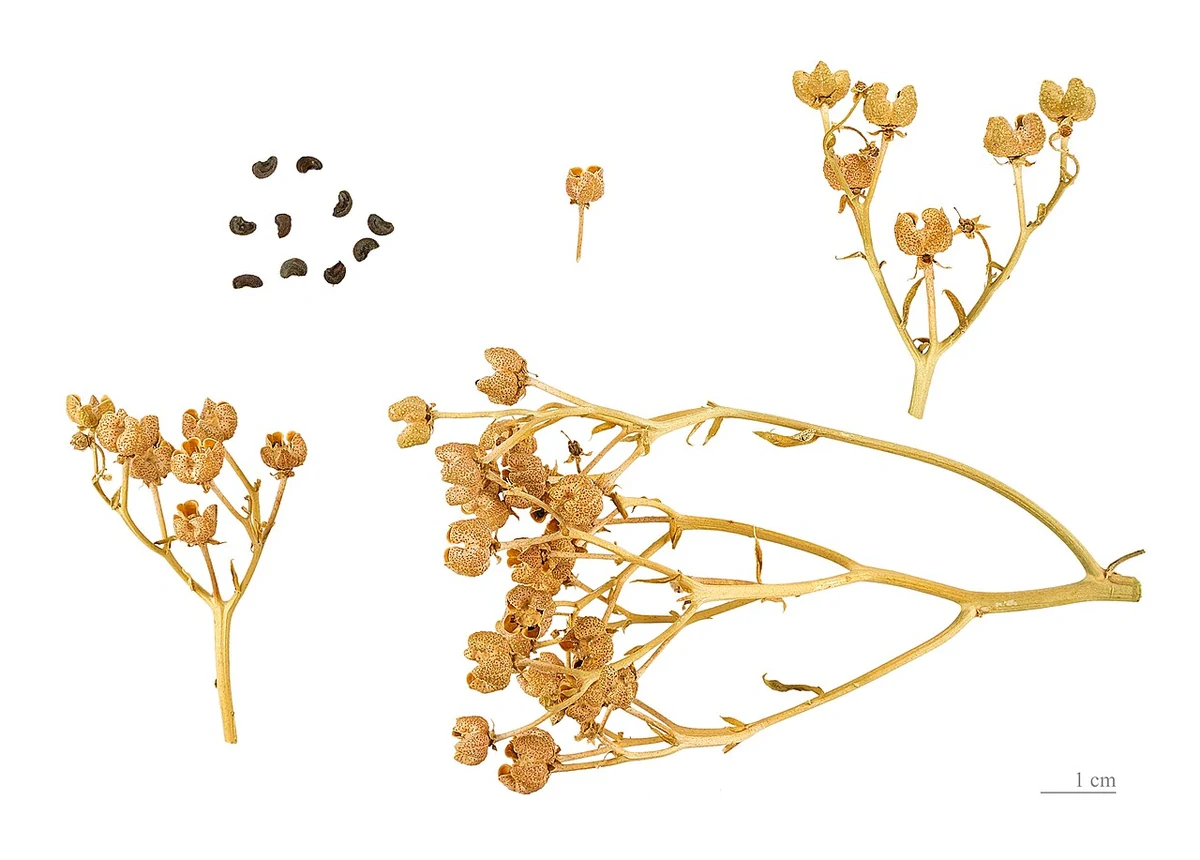
Capsules and seeds of common rue (Ruta graveolens) from a botanical collection; the photograph documents the plant discussed in the article, not a historical wedding wreath. Resized and converted to WebP; no cropping or content edits.
Didier Descouens · CC BY-SA 4.0 · Source · EXIF orientation respected; resized without cropping or upsampling; converted to WebP at quality 88. No other content edits.
An object that announces a change
A wedding wreath is small enough to hold, yet in Gloger's account it carries a large social meaning. It marks the bride's place within a community and helps stage her passage into married life. Its making, presentation, wearing and removal give that change a sequence of visible acts.
The wreath should not be isolated from the people around it. Women gather to weave; relatives appear in songs; attendants arrive; representatives of the two families exchange words and objects. The ceremony turns a private relationship into something publicly acknowledged.
Gloger often writes as though the symbolism were uniform and ancient. His entry is more useful when read as a collection of described practices and expectations. It reveals strong norms, but it does not prove that every woman, village or period experienced those norms in the same way.
Sources: [G]
The evening of weaving
The girls' or maiden's evening gives the wreath a social history before the wedding itself. The work requires gathering material, arranging it and binding it into a form that can be worn or presented. Companionship and song transform preparation into an occasion of its own.
In the song examples reported by Gloger, rue is placed on a table and members of the family are named in turn. Father, mother, brother and sister do not complete the expected action; the groom becomes the person whose arrival changes the answer. Another sequence sends the wreath across the table through a similar pattern of questions and replies.
The repetition is not empty ornament. It gives singers a shared structure and allows the bride's relationships to be named publicly. Family members remain present in the song even as the narrative moves towards the new couple.
Sources: [G]
Why rue belongs to the story
Rue is closely associated with maidenhood and marriage in the entry. Gloger explains part of its suitability through its persistent greenery and its availability beyond the height of summer. The plant can therefore connect a household garden with a ceremony that may occur at another point in the year.
The expression about sowing rue also appears within the language of remaining unmarried. Here a plant becomes a social metaphor. Cultivation, waiting and the expectation of marriage are brought together in a phrase that listeners would recognise.
This symbolic role is different from medicinal use. A wedding song mentioning rue does not supply evidence for a remedy, and a wreath tradition should not be converted into a recipe. For readers concerned with material reconstruction, an illustrated or artificial wreath can convey the pattern without assuming that handling every historically named plant is necessary.
Sources: [G]
A wreath can belong to the groom too
Popular pictures often make the wreath exclusively the bride's possession. Gloger's account includes wreaths for both bride and groom. That detail widens the ceremony: the object can identify the pair and their relation, not only the status of one woman.
Attendants arrive with formal movement, speech and sometimes dance. The next stage can include an address by a ceremonial leader and a symbolic purchase involving the bride's brothers and the groom's representatives. The exchange makes family participation visible through negotiation and performance.
It should not be flattened into a literal commercial transaction or, at the other extreme, presented as harmless theatre without social meaning. The performance draws on a world in which families had strong interests in marriage. The source gives us gestures and roles, while leaving the participants' individual feelings largely unrecorded.
Sources: [G]
Oczepiny and the power of a public sign
The removal of the wreath at oczepiny marks a transition in dress and status. In Gloger's description, married women's head covering replaces the visible sign associated with maidenhood. Hair and its arrangement therefore become part of the community's language of belonging.
Such symbolism could be affectionate and celebratory, but it could also police behaviour. The entry includes expectations about virginity and examples of degrading alternatives or sanctions when a woman was judged to have violated them. These details should be acknowledged as historical social pressure, not repeated as standards that readers should accept.
A wreath is consequently more than an attractive accessory. Because others interpret it, it can confer recognition, expose someone to judgement or make a change difficult to refuse. Reading the ceremony fully means keeping that power beside the songs and flowers.
Sources: [G]
Plants change, and markets enter the ceremony
Gloger records changes in the materials used for wedding wreaths. Rosemary and then myrtle appear alongside or in place of rue in different social settings. He also notices purchased wreaths made from paper and metallic ornament, particularly in Kraków.
These substitutions reveal a living custom adapting to availability, fashion and commerce. A bought wreath still participates in a wedding, even when it no longer comes directly from a family garden. The change affects who makes the object, what labour is visible and how local plants relate to social aspiration.
The entry sometimes treats change through the language of loss. Readers can recognise the author's concern while asking a broader question: which parts of the ceremony depend on a particular species, and which can survive through a different material? The historical evidence shows adaptation rather than a single unalterable botanical formula.
Sources: [G]
Other wreaths are not the same wreath
Gloger's larger entry also discusses harvest wreaths, summer wreaths released onto water and small fragrant wreaths blessed during the Corpus Christi octave. Their common shape does not give them one common function. They belong to different calendars, participants and movements between household and public space.
The blessed household wreath may be kept by images, doors or domestic equipment and associated with protection. The harvest wreath carries field labour into a communal feast. The wedding wreath takes part in a change of marital status. A good interpretation begins with these differences before asking about broader resemblances.
Likewise, a number of plants or an especially memorable local arrangement should not be made obligatory everywhere. The source itself ranges across places and social groups.
Sources: [G]
A small wreath could carry a large public claim
Gloger describes the older rue wreath as small enough to fit within a hand. Its significance does not depend on spectacular size. A compact, recognisable object can communicate status more effectively than an elaborate decoration if the surrounding community knows how to read it. The same is true of the change from an uncovered head to a married woman's covering.
This helps explain why the ceremony includes so much speech. The plant object does not act alone: songs, addresses and witnesses attach a social interpretation to it. The table on which rue is scattered becomes a place where that interpretation is rehearsed. Before the bride wears the wreath, the company has already named the people and expectations around her.
The distinction between physical size and social weight is useful when imagining the occasion. A modern photograph dominated by a large floral crown can obscure the quieter object Gloger describes. The historical account asks us to notice who makes, receives and removes the wreath, rather than assuming that visual splendour was always its principal purpose.
Sources: [G]
Gryfina's uncovered head as a reported public argument
Among the older stories he gathers, Gloger recounts Długosz's account of Gryfina, wife of Leszek the Black. She is said to have removed the head covering of a married woman and appeared with her head uncovered while publicly alleging that the marriage had not been consummated. Gloger locates the chronicle's report under 1271. Here the sign associated with marital status is used to challenge the status itself.
The account reaches us through Gloger's selection of a much later chronicler's narrative. It is not an eyewitness statement from Gryfina, and the present article does not claim independent verification of the medieval passage. Its inclusion nevertheless reveals what Gloger thought headwear could communicate.
The story complicates the idea that women merely received a fixed symbolic identity from others. In this reported episode, changing the covering becomes an argument made before an audience. That does not establish general freedom from marital constraints. It shows, within the source's narrative, that a familiar sign could be used in a dispute over a woman's position.
Sources: [G]
The collector's exceptions challenge his opening rule
Gloger begins with sweeping language about wreaths as signs of maidenhood, but his own examples soon widen the picture. He mentions wreaths worn by clergy at weddings and dances, together with ecclesiastical attempts to forbid the practice. He also cites a king's preference for wearing a rose wreath in summer. Those uses cannot all be explained as declarations of unmarried female status.
This internal variety is a useful guide to reading the entry. A wedding wreath can have a strong and specific meaning without that meaning exhausting every use of the circular form. The role of the wearer, the occasion and the materials matter. An object does not retain exactly the same social message whenever it appears.
The older prohibitions are presented here as reports within Gloger's compilation, not as statutes independently inspected for this article. Even with that limit, they show why a simple claim that only unmarried girls ever wore wreaths would misrepresent the source. Its memorable opening generalisation is narrower than the evidence it goes on to assemble.
Sources: [G]
Empty stalks and the language of refusal
Not every wreath described in the entry is an honour. Gloger contrasts ears full of grain with threshed straw, and reports a wreath of empty pea stalks as a sign of a suitor's rejected hopes. The material's condition matters: fullness can suggest a successful yield, while an emptied plant can be used to convey failure or exclusion.
The pea-stalk wreath appears beside other indirect ways of refusing a proposed match, including food offered at a meal. These signs allowed a family to communicate a decision through a shared social code. Their apparent politeness did not remove the disappointment or the unequal power involved.
Such examples also show the limits of a purely botanical interpretation. Rue, rosemary and myrtle matter as actual materials, but an empty stalk can be selected for a verbal and social association rather than its fragrance or medicinal properties. Reading the wreath requires attention to what people say and do with it. The same general shape can welcome a marriage, mark a transition or announce that a hoped-for marriage will not take place.
Sources: [G]
A river song changes the wreath into a head covering
The summer-wreath song reproduced in Gloger's entry offers a revealing comparison with the wedding sequence. A girl laments that water has carried away her pair of wreaths. A young man promises that two white swans will retrieve them. The birds return without the wreaths, but with cloth for a married woman's cap. The song moves from loss to a change of status through a small material substitution.
This is not a report that swans participated in an actual wedding ceremony. It is the imaginative language of the song. Yet its movement helps explain why the wreath and the cap could be heard as related signs: losing one may anticipate receiving the other.
The comparison connects summer singing with marriage expectations without proving that the two occasions were once a single rite. It also preserves emotional uncertainty. The girl's anxiety is not erased by an easy recovery of the object. The song changes the terms of the outcome, allowing listeners to recognise both attachment to a familiar status and the possibility of another life beyond it.
Sources: [G]
A tradition heard through its voices
The most distinctive evidence in this subject is often the song. Its repeated names, questions and answers show relationships being rehearsed in public. The wreath moves through a network of kin, companions and attendants before it becomes a symbol in an encyclopaedia.
Gloger's claim that some practices are purely Slavic goes beyond what a regional description alone can establish. Similar ceremonial objects elsewhere do not diminish the value of the Polish material. Its interest lies in the particular words, roles, plants and changes that the record preserves.
The wedding wreath offers a history of skilled preparation and celebration, but also of expectation and judgement. Holding those aspects together gives the custom the human complexity that a decorative image alone cannot convey.
Sources: [G]
Sources
- [G] Zygmunt Gloger. Encyklopedia staropolska ilustrowana (1900–1903). Entry Wieniec, wianki
Wedding wreaths, weaving songs, ceremonial exchange, changes of plant materials and distinctions from other wreath customs
A broad retrospective account with normative generalisations and claims of ancient or exclusively Slavic origins that are not independently demonstrated.