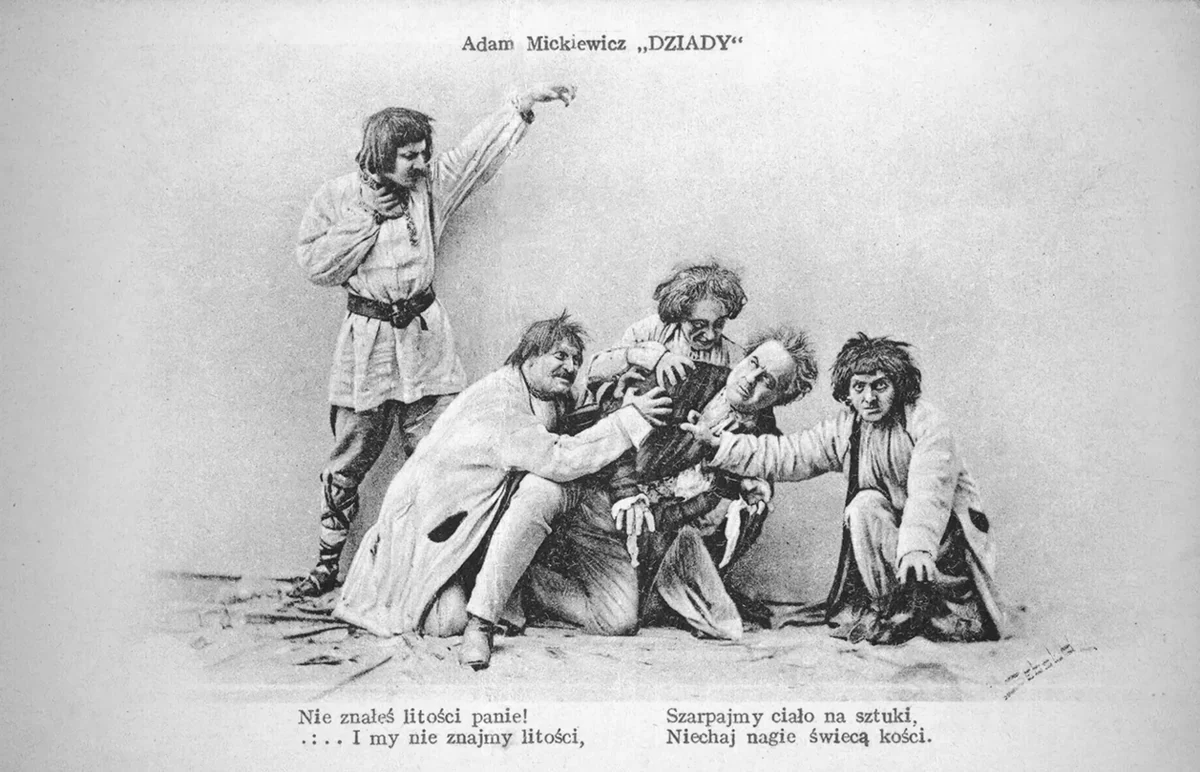
A scene from Stanisław Wyspiański's 1901 Kraków production of Dziady, photographed by Józef Sebald and reproduced on a postcard. Resized and converted to WebP; no cropping or content edits.
Józef Sebald · Public domain · Source · EXIF orientation respected; resized without cropping or upsampling; converted to WebP at quality 88. No other content edits.
A name that joins family and memory
Dziady evokes the ancestors, but the sources gathered under that name are not a single set of instructions. Gloger's entry moves between a poet's introduction, regional funeral hospitality, meals at graves and an argument about older religious survival. Those layers explain why the subject feels familiar while remaining difficult to reduce to one date or ceremony.
A useful starting point is the meal. Food allows the living to express a relationship with people who can no longer eat beside them in ordinary life. Preparing, carrying, sharing or setting aside food turns memory into an action. The act can belong within Christian prayer, local beliefs about the returning dead, family obligation, or several of these at once.
Calling all such practices a single pan-Slavic festival erases the distinctions that make the historical evidence valuable.
Sources: [G]
Mickiewicz enters the record as a poet
Gloger opens with material from Mickiewicz's introduction to Dziady. The attribution matters. The poet describes observances in a broad historical region, including Lithuania and neighbouring territories, and connects them with gatherings for the dead. Night, a chapel near graves, food, drink and the summoning of spirits belong to this account.
Mickiewicz's explanation also supplies an origin story involving an older feast and its ritual leader. These claims have influenced later popular descriptions, but they are not made stronger by losing their literary setting. Gloger quoting Mickiewicz is not the same as Gloger attending the ceremony or verifying every proposed ancient term.
The drama transforms the material further. It gives encounters with the dead a moral and imaginative architecture. The literary work can illuminate nineteenth-century ideas about memory and justice without serving as a transcript of every village observance.
Sources: [G]
Historical Lithuania is not a modern ethnic label
The geographical language in these accounts belongs to a historical world of overlapping political, linguistic and religious identities. Lithuania in an older Polish text cannot simply be replaced with the borders or population of the present-day Lithuanian state. Nor should every custom mentioned within that historical space be labelled ethnically Polish or uniformly Slavic.
This is especially important for a heritage article. A regional practice may have been shared, translated, adapted or described by an outsider. The source needs to retain its own place names and the limits of its information. Where the entry does not identify the language of participants or the precise village, a modern author should not invent them.
The result is a more open history: neighbouring communities could recognise similar obligations to the dead while explaining and performing them differently.
Sources: [G]
Autumn commemoration and household hospitality
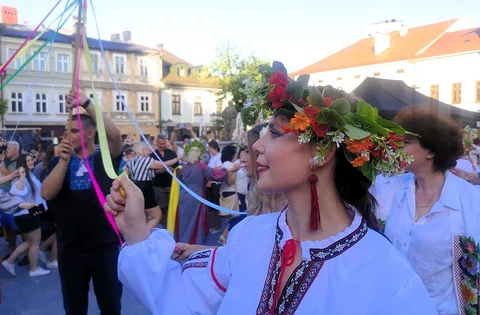
Gloger associates practices in Mazovia and Podlasie with the Christian season of All Souls. He mentions commemorative meals and the reception of clergy in wealthier rural households. These are socially organised occasions: a family provides food, guests gather and remembrance takes a recognisable place in the sacred calendar.
The setting differs from the secluded nocturnal ceremony that readers may imagine from the drama. A meal in a farmhouse, attended by a priest, demonstrates that Christian observance and older forms of hospitality were not necessarily experienced as separate systems. The participants did not need to remove one layer before inhabiting the other.
It also makes economic differences visible. The ability to host depended on resources. A description of a prosperous household should not become a claim that all families held the same feast on the same scale.
Sources: [G]
An Easter meal among the graves
A particularly concrete passage comes through Gloger's quotation of Maria Rodziewiczówna in Rok Polski of 1900. In the country of the Prypeć and Muchawiec, the Thursday after Easter is described as Nawskij dzień. Families carry remaining blessed Easter food to the graves and eat there in company with the remembered dead.
This evidence shifts the calendar decisively. The dead are commemorated in the spring cycle of Easter, not only in an autumn observance. Blessed food crosses from the festive household to the burial place. A grave becomes, for the duration of the meal, a point of contact between family history and the renewal celebrated by the living.
The passage is a named writer's regional description, preserved in a later compilation. It supports that particular practice and its setting. It does not establish one obligatory spring rite across Polesie, much less across all Slavic-speaking lands.
Sources: [G]
Food as a relationship rather than a spectacle
The shared element in these accounts is not a theatrical appearance of a ghost. It is the practical work of maintaining a bond: keeping a date, preparing provisions, travelling to a grave, inviting others and making space for the absent. This reading follows the actions described rather than assuming that all participants held an identical theory of the soul.
Food also links private grief to the wider community. A household meal involves guests; a graveyard gathering puts families beside other families. Generosity, reputation and obligation can enter the observance alongside affection. Remembering the dead is consequently both intimate and public.
The source does not allow us to reconstruct every gesture at the meal or every formula spoken over the food. Those absences should remain open rather than being filled with attractive modern ritual language.
Sources: [G]
Why Rękawka is a comparison, not proof of descent
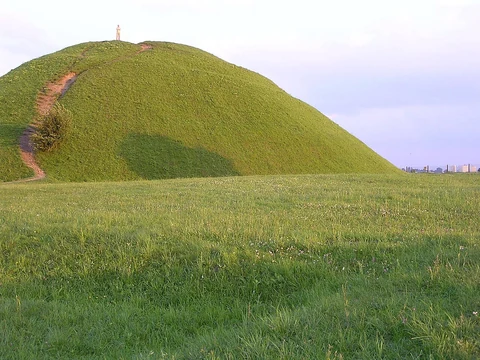
Gloger compares these meals with Rękawka at the Krakus mound in Kraków. The resemblance is suggestive: Easter food, a prominent place associated with the dead and a public distribution or consumption of provisions. Such a comparison can help readers notice a recurring cultural problem—how to feed memory through the material life of the present.
It cannot by itself prove that one custom descended from the other, or that both preserve an uninterrupted prehistoric funeral ceremony. Gloger's account of the mound's ancient feast is partly reconstruction. The local nineteenth-century behaviour is a firmer foundation than the proposed original event.
A careful heritage narrative therefore uses comparison to open questions, not to manufacture a lost universal liturgy.
The chapel is a stage of organised expectation
In the opening of Mickiewicz's drama, the Guślarz orders the chapel closed and its windows covered. A chorus of villagers responds, while an elder carries out instructions. Darkness is produced deliberately, and repeated words make uncertainty audible. The scene is not simply a lonely person meeting a ghost: it is a community waiting under a leader's direction.
The invitation names souls suffering in different conditions and offers prayer, alms, food and drink. Christian language is present from the outset. Later dismissals invoke the Father, Son and Holy Spirit and display the cross. These features cannot be removed while claiming to reproduce the play's rite faithfully.
Mickiewicz says in his introduction that he drew much of the ritual language from popular poetry, sometimes closely. That statement describes his declared method; it does not identify the origin of every line. The drama arranges the material into a sequence of encounters with distinct moral problems. Its theatrical structure is itself part of the evidence for nineteenth-century reception of folk belief.
Sources: [M]
Two children ask for bitterness rather than a feast
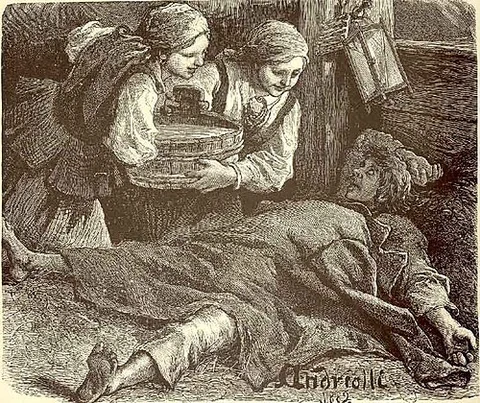
The spirits of Józio and Rózia recognise their mother and describe a bright, playful existence. Yet their abundance does not bring completion. Offered sweet foods, milk, fruit and berries, they ask instead for two mustard seeds. The small, sharp-tasting object supplies the bitterness their lives lacked.
The episode turns the expected generosity of a feast into a question about what another being actually needs. More sweetness would not help these visitors. The living must listen and give an appropriate, modest thing. That reversal is central to the drama's meaning and should not be reduced to a list of foods supposedly required at every Dziady observance.
The children's speech is a literary moral about experience, not a judgement that bereaved families should apply to real children. Its value for cultural history lies in the way an ordinary seed becomes a tangible form of an abstract lesson. The audience hears the lesson repeated by the chorus, so the encounter educates the assembled living as well as assisting the fictional dead.
Sources: [M]
The hungry lord and the testimony of those he harmed
The former lord appears outside the chapel, tormented by birds that prevent him from receiving food. Their voices reveal the history of his hunger. A raven recalls being punished after taking fruit while starving; an owl recalls a woman and child driven from the gate into winter cold. The birds are not merely frightening ornaments. They speak for people denied compassion during the lord's life.
The structure reverses social power. The man who controlled access to provisions now asks those below him for help, while his victims determine whether he can benefit. The offered plates cannot undo the relation he created. Food becomes a measure of conduct towards other people, rather than a substance that automatically resolves every spiritual difficulty.
This scene gives the drama a sharper social edge than a general account of ancestor worship suggests. The dead include an oppressor, and remembrance includes accusation. The community's relation to its past is not necessarily affectionate. It may require hearing stories that the powerful once suppressed, even though the episode remains a poetic construction rather than testimony about a named estate.
Sources: [M]
Zosia and the difficulty of belonging to the earth
Zosia arrives with the imagery of a shepherdess: wreath, lamb, light movement and an elusive butterfly. She describes having enjoyed admiration without forming a reciprocal attachment. Now she cannot touch the earth or reach heaven. Her request is bodily and social: she wants young people to draw her down into contact with the world she had held at a distance.
The episode differs from the lord's punishment. She has not committed his cruelty, and the Guślarz predicts that her condition will end after a further period. The drama therefore distinguishes kinds of incompleteness rather than treating all the returning dead as one category.
Its expectations about a young woman's love and marriage also belong to its historical world. Readers can analyse the ideal of mutual involvement without accepting that refusing a suitor is a moral failure. This distinction preserves the force of the literary scene while allowing the gendered judgement within it to remain visible. The text is a source for cultural expectations, not an authority over present-day relationships.
Sources: [M]
A silent apparition breaks the expected pattern
After the recognisable encounters, a final apparition refuses the established exchange. It does not explain its need, accept the food or obey the formulas of dismissal. It points towards the heart and attends to a young woman. When she is led outside, it follows. The chorus's uncertainty returns without the clear resolution supplied by the earlier moral speeches.
This ending matters for the authority of the Guślarz. He can organise the gathering and interpret several spirits, but he cannot make every presence fit his procedures. The drama leaves a remainder that exceeds the community's explanations. A summary that turns Dziady into a perfectly functioning ritual manual misses this deliberate failure of closure.
Placed beside Gloger's meals at family graves, the play reveals a different kind of cultural work. The meal sustains a relationship through a repeated communal act; the drama uses an encounter with the dead to explore responsibility, desire and the limits of understanding. They meet around food and memory, but their purposes and forms are not identical.
Reading Dziady without stripping away its later life
Christian prayer, Easter food, All Souls, literary imagination and regional custom all belong to the recorded history. Removing them to reveal a supposedly pure pagan core would discard much of the actual evidence. Equally, treating the literary drama as the whole subject would conceal the quieter work of family remembrance.
Dziady is most revealing when approached as a changing field of relationships with the dead. The surviving accounts preserve different calendars and different spaces, yet repeatedly make memory tangible through food and company. That continuity of concern is meaningful even where a direct line of ritual descent cannot be demonstrated.
For a modern reader, the essential distinction is between a historical description, a poet's transformation and a present-day act of remembrance. Each can have value while retaining its own name.
Sources: [G]
Sources
- [G] Zygmunt Gloger. Encyklopedia staropolska ilustrowana (1900–1903). Entry Dziady
Different textual layers and regional commemorations of the dead
A retrospective compilation combining regional observations, earlier quotations and the author's interpretations; not direct evidence for a uniform pre-Christian religion.
- [R] Zygmunt Gloger. Encyklopedia staropolska ilustrowana (1900–1903). Entry Rękawka
Gloger's comparison with the Kraków Easter custom
A retrospective compilation combining regional observations, earlier quotations and the author's interpretations; not direct evidence for a uniform pre-Christian religion.
- [M] Adam Mickiewicz. Dziady, część II (1823; Wolne Lektury digital text based on the Czytelnik 1974 edition). Author's introduction and episodes of Józio and Rózia, the former lord, Zosia and the final silent apparition
The drama's transformation of food offerings, remembrance, social judgement and ritual authority
Literary drama and its author's explanatory introduction; neither is an unmediated transcript of a single historical ceremony.