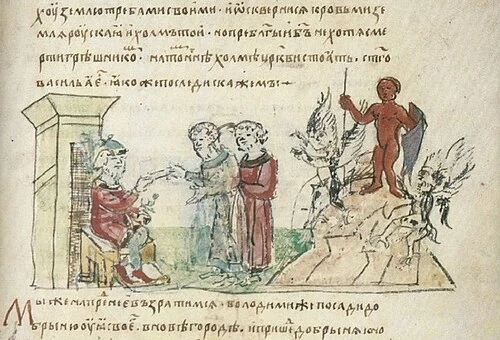
Perun's hill in a miniature from the Radziwiłł Chronicle; a medieval representation of the chronicle narrative. Resized and converted to WebP; no cropping or content edits.
Unknown medieval manuscript illustrator · Public domain · Source · EXIF orientation respected; resized without cropping or upsampling; converted to WebP at quality 88. No other content edits.
A hill, a prince and a list of names
The Primary Chronicle places a group of idols outside Vladimir's princely residence in Kyiv under the year 980. It names Perun, Khors, Dazhbog, Stribog, Simargl and Mokosh. Perun's wooden image is singled out with a silver head and golden moustache in the translated passage consulted.
The list is among the most frequently repeated pieces of evidence for pre-Christian religion in Rus'. Its familiarity can make it seem more complete than it is. It gives names and a setting, but it does not provide a systematic account of each deity's function, relationships, festivals or worshippers.
The location beside princely power is significant. The text presents the images within a narrative about Vladimir's rule. An interpretation of public religious display is therefore better grounded than a claim that the passage inventories every belief held by everyone in the surrounding countryside.
Sources: [K]
Why the material description matters
Wood, silver and gold give Perun's image a particular presence in the narrative. It is made, displayed and distinguished from the other named figures. The description permits discussion of workmanship and visible status without requiring an invented portrait of the whole sanctuary.
The source does not tell us every measurement, colour or architectural arrangement. A modern illustration should therefore distinguish details actually supplied from artistic choices. Giving each deity an elaborate costume, animal companion and emblem may produce an attractive image, but those additions are not contained in the 980 passage.
Máchal's early twentieth-century synthesis retells the description while drawing on related material. His work is useful for tracing the history of scholarship, but its confident language should not replace the narrower wording of the chronicle. A later synthesis and its underlying witness remain different sources.
Mokosh and the discipline of leaving space
Mokosh is especially important because the name appears in the list without the explanatory detail modern readers often expect. The passage does not describe her appearance or explicitly assign spinning, fertility, moisture or a particular domestic sphere. Those associations require evidence from elsewhere and an explanation of how the connection is argued.
Leaving that space open is not a failure to tell a story. It is an accurate account of the surviving evidence. A short attestation can establish that a name belonged to this narrated group while leaving its meaning uncertain.
The same care applies to the other figures. A neat modern chart in which every deity has one exclusive department can obscure the unevenness of the record. Some names are better attested than others; some identifications remain debated; and a chronicle list is not a surviving catechism.
Sources: [K]
The story changes direction
The chronicle later narrates Vladimir's adoption of Christianity. Its account includes the consideration of different religions, the report of envoys impressed by worship in Constantinople and the eventual removal of idols. These episodes form a conversion story with a clear Christian destination.
The narrative is not a neutral comparison of religions. It praises the chosen faith and treats alternatives through polemical language. A modern article should identify that perspective rather than repeat the judgements as descriptions of the communities involved.
The contrast between the prince who establishes images and the prince who removes them gives the story dramatic structure. The same authority appears capable of redirecting public worship. This is an interpretation of the narrative's design, not proof that every household changed belief instantly at a ruler's command.
The humiliation of Perun's image
In the conversion account, Perun's image is dragged towards the river and struck. The narrator explains the act as an affront to the power represented, rather than pain inflicted on insensible wood. Máchal retells the episode and the image's removal downstream in his chapter on Perun.
This scene is more than disposal of an obsolete object. It is a public reversal of the image's former status. What had been elevated and honoured becomes something moved, beaten and expelled. The interpretation offered here is that the narrative makes religious change visible through the treatment of a material object.
That does not tell us exactly how every observer felt. The chronicle and later retellings frame responses to fit their larger story. A responsible heritage presentation can describe the public act while acknowledging that the interior experience of ordinary people is much less accessible.
Baptism, obedience and the limits of an event date
The account presents public baptism in the Dnieper and princely pressure to attend. It joins religious transformation to collective action and political authority. The year 988 is therefore a major narrative marker, but it should not be treated as a switch that erased all earlier practices everywhere.
A chronicle event and the long transformation of household custom are different scales of history. Later folklore cannot simply be called unchanged pagan survival, yet neither does a baptism scene demonstrate immediate uniformity of belief. Both overstatements go beyond the source.
The polity of Rus' also should not be reduced to one present-day national identity. Kyiv, its rulers and their connections belong to a medieval historical setting. Modern political borders and labels cannot be projected backwards without explanation.
Reading a Christian witness for pre-Christian history
The compiler condemns the earlier cult and describes it through Christian categories. This affects the language of sacrifice, pollution and salvation. Such framing must be visible, especially when discussing accusations of violent ritual. The article reports what the chronicle says without treating every hostile judgement as independently verified observation.
At the same time, the text preserves names and a sequence of public acts that would otherwise be difficult to recover. Critical reading does not mean discarding it. It means separating a name attested in the text, a narrated action, a theological judgement and a modern inference.
For readers exploring Slavic heritage, that separation is productive. It provides an honest foundation for further questions rather than a finished system assembled from confident guesses.
Novgorod makes the setting larger, but not universal
The chronicle's account of the images in Kyiv is followed by another act of patronage. Vladimir appoints his uncle Dobrynya at Novgorod, where a Perun image is erected by the Volkhov. This supplies a second named urban setting. It is evidence that the compiler's story of princely religious action extends beyond the Kyiv hill, not that every Slavic settlement had an identical group of six images.
The distinction is important for reconstructing the scene. The list of names and precious-metal details belongs to the Kyiv passage. A reader cannot simply duplicate its entire arrangement at Novgorod. Nor does the presence of a river there authorise importing every later water-related legend into the original installation.
Léger's translation calls Perun's golden facial feature a beard, while the English anthology consulted uses moustache. Rather than settle the image's exact design through confidence alone, a visual reconstruction should flag the wording of its chosen translation. Even a small material detail can acquire false certainty after repeated illustration. The surviving description is valuable precisely because it is limited enough to check.
An embassy arranged to see and hear
In the religious-choice narrative, Vladimir's advisers observe that each visitor praises his own faith. They propose sending people to investigate worship for themselves. This creates a story about testing testimony through experience. Yet the experience is carefully staged: at Constantinople the emperor asks the patriarch to prepare the church and clergy for the visiting envoys.
The resulting scene is sensory. Vestments, incense, choral sound, the building and the movement of ministers all contribute to the envoys' response. They are given a place from which to observe, and the worship is explained to them. The chronicle makes their astonishment persuasive through the combination of sight, sound and ceremony, rather than through a catalogue of doctrines alone.
Their reported rejection of other forms of worship is written within a triumphal Christian account and should not be repeated as a fair ethnographic assessment of those communities. What can be analysed securely is the narrative contrast. The chosen worship is made unforgettable, and remembered beauty becomes an argument for religious allegiance. When the envoys return, the prince hears them before advisers and elders, turning private impressions into a public deliberative scene.
Sources: [L]
Anna enters a story often told only about Vladimir
The Kherson episode joins military pressure, marriage and baptism. Vladimir besieges the city; information about its water supply helps bring about surrender. He then demands the emperors' sister in marriage. Their answer makes baptism a condition of the union. The chronicle's religious turning point is therefore entangled with force and dynastic negotiation.
Anna's reluctance deserves a place in the account. The text represents her as grieving at departure and comparing the prospect with captivity. Her brothers persuade her by presenting the journey as a way to bring the Rus' people towards repentance and avert further war. These are speeches shaped by the chronicler, not an unmediated transcript of her private thoughts. Even so, they prevent the episode from being reduced to the prince's uncomplicated personal choice.
The narrative then gives Anna a religious role in Vladimir's illness. His sight is restored in connection with baptism, and the reported miracle encourages members of his following to accept the rite. The bodily change reinforces the spiritual interpretation: seeing becomes a sign of recognising the true faith in the narrator's account. The story can be explained as conversion narrative without treating miraculous healing as independently demonstrated history.
Sources: [L]
Places remembered, and places disputed
The chronicle does not merely narrate a baptism and move on. It points to a church, a marketplace and princely lodgings at Kherson, presenting features of the landscape as confirmation for later readers. It also rejects other reported baptism locations, including Kyiv and Vasiliev. This explicit disagreement is valuable evidence that the place of the event was already a matter of competing accounts within the text's horizon.
A heritage presentation should retain that disagreement. Naming 988 and one location without explanation can make the evidence look like a contemporary certificate, while the actual narrative is arguing for its own version. The buildings and named places function as anchors of memory within that argument.
Back in Kyiv, the river acquires a similarly explanatory role. Perun's expelled image is carried beyond the rapids, and its landing place is connected with a remembered name. This is a story about the landscape retaining traces of religious change. It does not mean that a modern place-name by itself proves every detail of the disposal scene, but it shows how the chronicler made the past visible in geography.
The day after baptism: buildings, books and households
The public river scene is not the chronicle's final word on conversion. Vladimir orders churches and clergy to be established, and the former place of the images is associated with a church of St Basil. The physical location is reused while its meaning is changed. In the narrator's design, a new religious order occupies the spaces of the old.
The account then turns to children of leading families being taken for instruction in books. Their mothers weep, a response which the narrator explains through their incomplete establishment in faith. That moment complicates the preceding picture of collective joy. Institutional change reaches into households, separating children from familiar expectations and generating grief as well as the happiness the compiler celebrates.
These episodes give conversion a material and social aftermath. Priests need places to serve; children are introduced to textual learning; families respond. They still do not let us measure how quickly every local custom changed. What they do show is that the chronicle itself moves beyond a single ceremony towards the building of institutions. A fuller account of the Kyiv images must therefore follow their removal into this next stage, where religious allegiance is expressed through buildings, instruction and everyday relationships.
Sources: [L]
What a careful reconstruction can show
A responsible visual or written reconstruction can show a princely hill setting, Perun's described materials and the named group, while marking unspecified forms as artistic interpretation. A companion panel can explain the later destruction and baptism story, including the Christian author's viewpoint.
It should not claim that the six names constitute the complete religion of all Slavs or that every later folk figure descends directly from one of them. Nor should it supply a fully developed biography for Mokosh and cite only this short list.
The strongest story is already present: public images connected to rule, a narrator who turns against them, and a dramatic change in the meaning of a city landscape. The hill and river become stages on which the chronicle explains a new religious order.
Sources
- [K] Compilers of the Primary Chronicle; classroom anthology using named translations. Primary Chronicle selections (early twelfth-century compilation; online anthology undated). PDF p. 6, entry 980; translator/source footnote on pp. 6–7
Named idols and Perun's appearance
A mixed translated teaching excerpt, not manuscript inspection.
- [V] Compilers of the Primary Chronicle; translated excerpts by C. T. Evans. Russian Primary Chronicle Excerpts (medieval text; webpage 2006). Entries 986–988
Narrative of religious selection, removal of idols and baptism
Christian polemical account; this article paraphrases selectively, not as an unmediated transcript.
- [M] Jan Máchal, translated by F. Š. Hrbek. Slavic Mythology, The Mythology of All Races, volume III (1918). Part III, chapter I, Perun, printed pp. 293–295; digitised full text
Historical scholarly comparison of oath and idol-removal passages
Secondary scholarship of 1918; speculative conclusions are not current consensus.
- [L] Compilers of the Primary Chronicle; translated by Louis Léger. Chronique dite de Nestor (1884). Chapters XXXVIII and XLI–XLIII: idols, envoys, Kherson, baptism and subsequent institutions; digitised text inspected
Narrative sequence, Dobrynya at Novgorod, Anna, sensory worship, rival baptism locations and the building of churches and schools
Nineteenth-century French translation of a medieval Christian compilation; OCR consulted and chapter locators used. Narrative claims are not independent eyewitness verification.