Begin with a treaty rather than a family tree of gods
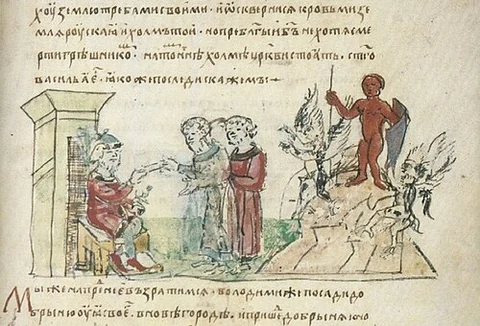
One of the most revealing appearances of Perun and Volos comes in a diplomatic narrative. The Primary Chronicle describes an agreement between Oleg's forces and the Byzantine emperors. The parties confirm their peace by different sacred acts: the emperors kiss the cross, while Oleg and his men swear by their weapons and named gods.
This setting matters. The passage is not a creation story, a priest's explanation of doctrine or a complete catalogue of divine beings. It records the authority invoked when human promises needed binding force. Reading it first as an oath allows the religion to remain connected to trade, warfare, political negotiation and the possibility of betrayal.
The chronicle calls Volos a god of cattle. That short description is evidence; a much larger modern portrait of an underworld ruler, magician or opponent in a cosmic battle requires additional argument and sources.
Sources: [P]
The world around the oath
The surrounding account is concerned with tribute, supplies, merchants, access to Constantinople and the conduct of visiting groups. It describes arrangements for lodging, provisions and regulated entry. These details show why a promise mattered: the agreement governed repeated practical contact, not only the end of a single confrontation.
The narrative also contains dramatic episodes, including ships fitted with wheels and the refusal of supposedly poisoned food. A reader should not assign every element identical evidential weight. The chronicle is a composed story about princely power and success, and its memorable scenes help make that story persuasive.
Even so, the oath's placement is instructive. Sacred authority appears at the point where negotiated obligations become publicly binding. The interpretation offered here is that religion functions within diplomacy, rather than as a separate realm detached from ordinary exchange.
Sources: [P]
What weapons contribute to the scene
The weapons are not incidental scenery. They stand alongside divine names in the act of swearing. A warrior's equipment can embody the means of protection and violence on which his position depends. Calling on that equipment in an oath makes the promise materially visible.
Máchal's 1918 discussion brings in another treaty passage, associated with Igor, in which pagan oath-taking before Perun is contrasted with Christian oath-taking in a church. He also discusses curses involving a person's own weapons. These comparisons help explain why an oath is more than a spoken assurance, although his synthesis remains a later scholarly interpretation.
The sources do not provide a universally applicable reenactment script. They describe particular political communities and narrated occasions. Reconstructing exact gestures, clothing or ritual words beyond the surviving account would create a modern performance, which should be labelled as such.
Perun and Volos: what can be stated securely
Within this passage, Perun and Volos are invoked by name, and Volos receives the cattle association. The chronicle does not explain their relationship, provide their biographies or describe a battle between them. The absence is not proof that no such story ever existed; it is a limit on what this witness can establish.
Perun also appears in the chronicle's account of idols erected in Kyiv in 980, where his image receives particular material description. That is a separate piece of evidence and should be cited separately. Combining passages can reveal patterns, but it cannot turn missing narrative into surviving text.
Names also travel through transliteration. Volos and Veles are often discussed together in scholarship, but the spelling in a cited passage should remain visible. A reader deserves to know when an article follows the witness's wording and when it adopts a broader scholarly identification.
The Christian compiler's position
The Primary Chronicle was compiled after the events it narrates and from a Christian perspective. Its treatment of pre-Christian religion is therefore not the voice of a participant explaining his own gods to a sympathetic interviewer. Christian judgements shape the account, including the language used for pagan belief.
That does not make the document useless. A hostile or retrospective witness may preserve names and practices unavailable elsewhere. It does mean that description, interpretation and moral judgement should be distinguished. The fact that an oath is described is one claim; the compiler's evaluation of those who swore it is another.
The online teaching selection introduces additional annotations, including a distinction between the annal's date and treaty chronology. An article should not erase those editorial layers by presenting a single date as if a contemporary clerk had stamped the scene.
Comparison without constructing a single Slavic church
It is tempting to turn a few well-known divine names into a uniform religious system covering every Slavic-speaking region. This oath does not support that move. Its political setting is early Rus' in contact with Byzantium. The Baltic sanctuaries described by Thietmar and Saxo belong to other places, periods and institutions.
The comparison can still be fruitful. One may ask how communities made sacred authority visible, how rulers participated and how outsiders described them. But a white horse from Arkona cannot be inserted into Oleg's oath, nor can a Kyiv idol's appearance supply the missing details of every Perun image.
A disciplined comparison preserves difference. It produces a map of attested practices rather than a fictional handbook in which all fragments automatically fit together.
A second treaty brings the oath into sharper focus
The longer agreement associated with Igor in the chronicle's entry for 945 makes the practical setting much clearer. Its opening identifies envoys and merchants, including representatives of princely family members. The promise concerns a political network rather than only one warrior speaking for himself. The document then distinguishes baptised and unbaptised participants in its sanctions. Religion is already plural within the Rus' party represented by the text.
The accompanying narrative describes Igor receiving Byzantine envoys and arranging confirmation of the agreement. On the following morning, the pagan participants go to the hill where Perun stands; weapons and gold enter the scene. Christian participants swear at the church of St Elijah. This comparison is valuable precisely because the two groups are joined in one diplomatic undertaking while using different sacred settings.
It would overstate the passage to call it modern religious equality. The text describes particular people making a particular agreement, not a general declaration of rights. Yet it does complicate a simple story in which Rus' was uniformly pagan until one later baptism. The oath narrative already accommodates Christians among the people whose commitments the prince must secure.
Documents, seals and the recognition of strangers
The Igor agreement discusses how incoming representatives are to be recognised. It contrasts earlier seals carried by envoys and merchants with written credentials specifying the ships sent by the prince. People arriving without the required document could be detained while their status was checked. This is a world in which movement across political boundaries required more than an assertion of good intentions.
That administrative detail belongs beside the sacred oath. A god's name helped articulate the seriousness of a promise, while names, documents and officials helped establish who was entitled to act under it. The text does not force a choice between ritual and bureaucracy; it places both within the arrangement.
The agreement also regulates entry into Constantinople, supervision by an imperial official and the handling of purchases. These provisions make the peace tangible. A merchant's opportunity to enter, buy and leave depended on a framework which sought to restrain violence and make responsibility traceable. Perun's appearance is therefore not an isolated survival floating outside social life. It occurs in a narrative about people, goods, identification and the prevention of disputes.
Sources: [L]
The people whose freedom entered the bargain
The same treaty material addresses fugitives, captives and ransom. It assigns different payments in specified cases and regulates claims when someone cannot be found. These clauses are uncomfortable evidence of a society in which human freedom could be negotiated as part of interstate relations. They should not disappear from a celebratory retelling of successful trade or heroic diplomacy.
An oath also appears in a dispute over a missing enslaved person: the text differentiates the form available to Christian and non-Christian Rus'. This is a narrower legal use than the great public confirmation of peace. Sacred testimony could enter the handling of a particular claim as well as the announcement of a collective agreement.
The chronicle further discusses theft, injury, killings and ships driven ashore. These concerns show what the peace was expected to manage after the ceremonial moment ended. A treaty did not abolish conflict; it attempted to define responses to it. Reading the divine invocation alongside these provisions gives the gods a place within the obligations of a troubled human world, without romanticising that world's violence or coercion.
Sources: [L]
When protection is turned against the oath-breaker
The sanctions associated with Igor repeatedly reverse the expected role of a warrior's equipment. Shields are to fail him; his own weapons are to bring destruction. The force of the curse comes from turning familiar means of survival into instruments of punishment. The interpretation offered here follows the wording's structure: a broken promise threatens the very resources on which the speaker relies.
The agreement associated with Sviatoslav in 971 invokes Perun and Volos again, while declaring continuing peace and obligations towards Byzantine territories and allies. Its curse also includes perishing by one's own weapons. The recurrence strengthens the case that the weapon-oath association matters, although the surviving text is still mediated by the chronicle and its transmission.
Léger's nineteenth-century French translation gives the reader another way into these passages, but not an escape from textual history. Its spellings, dating conventions and explanatory notes differ from modern English selections. The article therefore uses chapter references and identifies the translation rather than presenting a newly assembled English formula as the exact words spoken at the original ceremony.
Sources: [L]
Why Volos need not be squeezed into a symmetrical pair
Perun and Volos appear together in some oath passages, but that pairing does not itself establish a complete dualistic theology. The treaty narrative does not say that every promise required two opposing cosmic powers, or that one god represented warriors while the other represented every farmer and trader. Those tidy divisions would require evidence beyond the words preserved here.
The cattle association attached to Volos is meaningful without being made exhaustive. It gives one explicit point of description, while the invocation shows relevance to the binding promise. Perun's image and the separate hill ceremony provide another kind of evidence, connected with a visible cult object. The records are uneven: a short epithet for one figure, a material and ritual setting for another.
That unevenness is worth retaining in a modern account of heritage. A reconstructed pantheon often gives every figure an equally detailed biography, costume and realm. The surviving treaty scenes offer something less symmetrical but more specific: named powers called upon by people who were trying to secure obligations across differences of faith and political interest.
Why this small passage deserves a long reading
The oath offers something more concrete than a modern list of divine attributes. It places named gods beside weapons, rulers, merchants and enforceable obligations. It also shows two parties using different sacred forms within one diplomatic relationship.
For a museum label, school discussion or heritage retelling, the strongest approach is to stage the question of trust: what made a promise binding when the parties did not share one religious framework? The source supplies a specific answer in this narrated case, while leaving much of the wider theology unstated.
The resulting picture is partial but substantial. Perun and Volos are not merely decorative names from a lost mythology. In this witness they help articulate an agreement between people whose peace, goods and movements depended on the promise being kept.
Sources
- [P] Compilers of the Primary Chronicle; University of Oregon online teaching selection. Primary Chronicle: Oleg's campaign and treaty (early twelfth-century compilation; entry assigned to 907). Section on Oleg's campaign, mutual oaths; website distinguishes annal date from treaty chronology
Weapons, Perun and Volos in the oath; commercial and political context
Later Christian compilation, translated excerpt with modern editorial annotations.
- [M] Jan Máchal, translated by F. Š. Hrbek. Slavic Mythology, The Mythology of All Races, volume III (1918). Part III, chapter I, Perun, printed pp. 293–295; digitised full text
Historical scholarly comparison of oath and idol-removal passages
Secondary scholarship of 1918; speculative conclusions are not current consensus.
- [K] Compilers of the Primary Chronicle; classroom anthology using named translations. Primary Chronicle selections (early twelfth-century compilation; online anthology undated). PDF p. 6, entry 980; translator/source footnote on pp. 6–7
Named idols and Perun's appearance
A mixed translated teaching excerpt, not manuscript inspection.
- [L] Compilers of the Primary Chronicle; translated by Louis Léger. Chronique dite de Nestor (1884). Chapters XXI–XXII, XXVII and XXXVI: Oleg, Igor and Sviatoslav treaty narratives; digitised text inspected
Treaty obligations, separate Christian and non-Christian oaths, weapons, written instruments, captives and divine sanctions
Nineteenth-century French translation of a medieval compilation; OCR consulted, with chapter locators rather than unverified scan-page numbers. Dates follow the edition's presentation and need comparison.