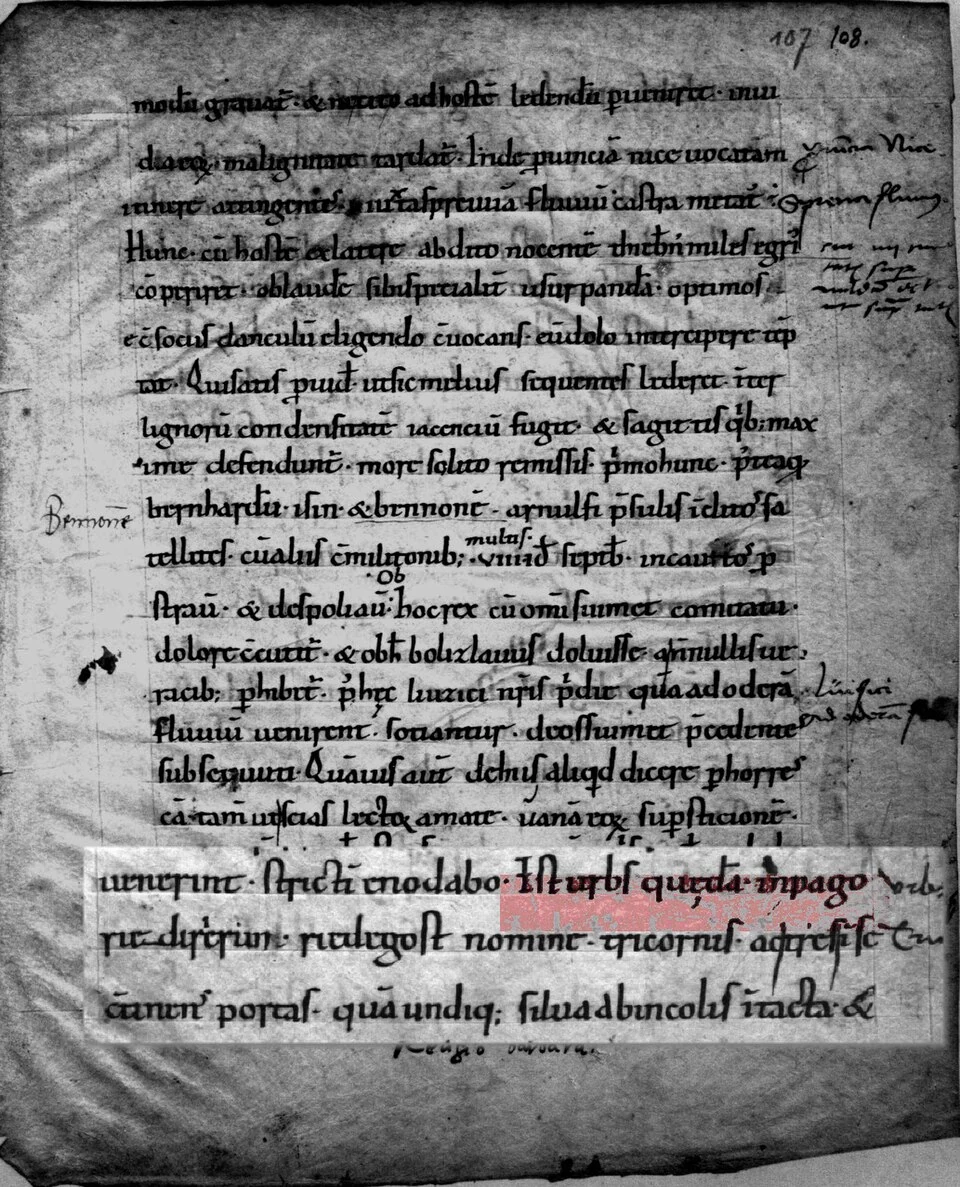
A photograph of a manuscript page of Thietmar's chronicle, identified by the source as the beginning of the Riedegost description. Resized and converted to WebP; no cropping or content edits.
Kurt der Nachtkautz · CC BY-SA 3.0 · Source · EXIF orientation respected; resized without cropping or upsampling; converted to WebP at quality 88. No other content edits.
An ally the chronicler disliked describing
Thietmar introduces the Liuticians in a military setting and openly expresses distaste for their religion. That admission is an essential part of the evidence. He is not a priest of the sanctuary explaining its meaning from within, but a Christian bishop describing people whose political presence he cannot ignore.
His account therefore contains both valuable detail and hostile interpretation. It names a place, describes structures and practices, and judges them through Christian categories. Reading the passage well means retaining all three layers instead of accepting the description as a neutral field report or dismissing it altogether.
The sanctuary is associated with the Redarians within the wider Liutician setting. It should not be introduced as the central temple of every Slavic people. The source itself describes a landscape with multiple districts and cult places.
Three gates and a surrounding grove
In the German edition consulted, the fortified place is called Riedegost and described as having three gates, surrounded by a large grove held sacred by local people. Two gates are accessible to those entering; the smaller eastern one leads towards water and is given a fearful character by the narrator.
The description makes the sanctuary part of a controlled landscape. Routes, entrances and a grove organise movement before the reader even reaches the images. It is reasonable to interpret these features as a distinction between ordinary approach and a more charged sacred space, while recognising that the precise experience of participants is not recorded.
The old translation uses a word rendered as sea for the water. That should not be used by itself to fix a modern archaeological location. Textual names, later identifications and excavation claims are separate evidential problems.
Sources: [T]
Wood, horns and figures in armour
Thietmar describes a wooden sanctuary with animal horns associated with its base and carved divine figures on the exterior. Inside are images bearing names and presented with helmets and armour. Zuarasici is singled out as the foremost figure. The spelling is worth retaining beside any modern identification with Svarožič or Swarożyc.
These details suggest a cult represented through crafted and martial objects. They do not provide enough information for an exact architectural model. The unusual reference to horns, in particular, should be reported as the chronicler's description rather than translated into a confident modern engineering diagram.
The source's place name Riedegost and the divine name Zuarasici also should not be casually collapsed. Later traditions and scholarly discussions of Radegast require their own sources. This passage is more precise than the popular habit of treating every similar name as interchangeable.
Sources: [T]
Banners between sanctuary and battlefield
Military standards are kept at the sanctuary and removed when needed for war. This detail connects sacred space with collective action. The images do not exist only for private devotion; objects associated with the sanctuary accompany the community into danger.
One interpretation is that the banners make sacred authority portable. They can connect a campaign with the place from which they came and make the group's affiliation visible. That is an inference from the described movement of objects, not a quotation of what participants believed.
Thietmar's wider account also describes gifts and offerings around departure and successful return. Together, these details place warfare within a sequence of consultation, action and acknowledgement. They do not establish that every military decision was made identically or that all Liutician groups shared one administrative system.
Lots and the sacred horse
The continuation describes priests consulting lots and then leading a sacred horse across crossed spears. Agreement between the signs is important: the account says action follows when the indications coincide, while disagreement leads to abandonment of the undertaking.
This is a procedure for handling uncertainty. The description gives more than a picturesque animal scene; it presents a sequence in which two methods are compared. Priests control access to the process and interpret its result, giving the sanctuary a role in decisions that affect the community.
A modern reenactment must not silently fill gaps in the source. The passage does not provide a complete liturgy, an exact performance script or every rule governing the horse. Nor should Arkona's explicitly white horse and its particular stepping sequence be imported here. Similar ritual categories do not make the two accounts identical.
The boar emerging from the water
Thietmar also reports a portent involving a great boar with shining white tusks emerging from the water when prolonged internal conflict threatens. The animal's movement and the shaking ground make the omen dramatic. This is a reported belief within the chronicle, not an event the article asserts occurred.
The scene shows another way uncertainty could be represented: a disturbing sign in the landscape announces danger to the social order. Unlike the controlled consultation of lots and horse, the boar is narrated as an extraordinary appearance. The contrast between managed divination and unsolicited portent is analytically useful.
It would be tempting to identify the animal with a named god or a universal Slavic underworld symbol. The consulted passage does not do so. Its value lies in the particular image and the condition it was said to announce.
Sources: [T2]
Offerings, violence and the hostile witness
The chronicler describes offerings and makes claims about human and animal blood. Such statements must be attributed directly, especially because accusations of violent ritual can serve a hostile author's moral argument. This article does not turn one report into an independently verified frequency, scale or universal practice.
Critical caution is not the same as automatic disbelief. The account is evidence that Thietmar represented the sanctuary in this way. Assessing the underlying practice more fully would require comparison with other witnesses and material evidence, each with its own limitations.
The same principle applies to the author's judgement that the worship is empty or deceptive. Those are theological evaluations. They are not neutral descriptions of the participants' understanding of their actions.
The assembly beyond the sanctuary
The continuation of Thietmar's account describes the Liuticians as having no single ruler over all of them. Necessary decisions are debated in an assembly and followed by common action. This is important context for the sanctuary: the political community described by the bishop is not simply a kingdom with a temple beside a monarch's palace.
The passage does not, however, describe effortless agreement or unrestricted freedom of dissent. Thietmar says that opposition within the assembly could bring blows, while resistance outside it could lead to destruction of property or a payment assessed according to status. The report combines collective deliberation with coercive enforcement. A modern celebration of ancestral democracy would be misleading if it retained the assembly and omitted those sanctions.
Nor should the bishop's account be turned into a complete constitution. It gives selected features which serve his narrative and judgement. The useful comparison is between two forms of collective decision described in adjoining passages: consultation through an assembly and consultation through religious signs. The text does not explain every institutional connection between them, but their proximity shows why the shrine belongs within a political history as well as a history of belief.
Seated priests, standing participants and concealed lots
Thietmar's ritual description contains bodily arrangements that can be lost in a short summary. The attendants responsible for the cult sit while the others stand. They murmur among themselves and work with lots in the earth; after the casting, green turf covers the lots before the horse is brought into the procedure. The account gives the consultation a sequence and distinguishes those conducting it from those awaiting its result.
Those details permit a cautious interpretation of specialised authority. The participants do not all perform the same action at the same moment. Some handle the signs, some observe or wait, and the result bears on a proposed undertaking. Yet the chronicler does not preserve the words murmured, the full system of signs or the participants' own explanation of why the procedure worked.
The agreement required between lots and horse is especially revealing. A favourable indication from one method alone is insufficient in the described account. This makes the scene more than an evocative horse procession: it includes a condition under which action is abandoned. The disappointment the text attributes to the people also matters, because the consultation could frustrate a desired plan rather than merely endorse whatever had already been decided.
Sources: [T2]
A peace gesture made from the body and the ground
The assembly passage adds a brief description of making peace: hair is cut from the top of the head and offered with grass in the right hand. Thietmar then accuses the people of being easily induced by money to break peace. The material gesture and the hostile judgement should be separated. One is a reported act; the other evaluates the reliability of the people performing it.
The combination of hair and grass is striking, but the text does not explain its symbolism. It would be unwarranted to assign the hair to one deity, the grass to another, or to claim that the action represented a universal Slavic bond between person and land. The available evidence supports a narrower statement: the bishop reports a bodily and material gesture in the making of peace.
Placed beside the banners and oracles, this glimpse expands the account's social range. Sacred or solemn action was not confined to the interior with its images. The narrated community also expressed commitments through objects handled in relations with others. That comparison links ritual to diplomacy without pretending that the surviving fragment contains a complete oath ceremony.
Why the military alliance troubled the narrator
Thietmar describes these warriors as people who had formerly been subordinated and were now free, interpreting the reversal through the sins of his own side. They nevertheless arrive to assist the king. His religious hostility therefore exists alongside an acknowledged military relationship. The people he warns the reader against are not distant figures of fantasy; they enter the campaign he is narrating.
This creates a distinctive tension in the source. The bishop wishes to condemn the cult while explaining events in which its adherents serve as allies. His instruction to the reader to avoid their worship follows immediately after the political and ritual description. The move reveals how he wants the material to be received.
It also helps explain why a critical reader should preserve his first-person interventions. Removing every insult might make the text seem fairer, but it would hide the standpoint from which the description was selected. Repeating the insults as neutral facts would be equally mistaken. The account is most informative when the alliance, the religious unease and the detailed observations remain visible together.
Sources: [T3]
A comparison with Arkona that retains the differences
Riedegost and Arkona both appear in Christian narratives with images, military connections and horse divination. At Arkona, however, Saxo supplies a white horse, a harvest vessel, a large cake and a detailed sequence of priestly actions. Thietmar's Riedegost passage gives the paired consultation of lots and horse, the grove and gates, and the extraordinary boar omen. The most productive comparison asks why each witness describes those particular features.
It does not require making one sanctuary a damaged copy of the other. The accounts come from different moments and political settings, and their authors are telling different kinds of campaign story. Keeping the distinction also protects the names: Zuarasici in Thietmar's sanctuary cannot be replaced by Svantovit merely because both places used an oracular horse.
The resulting picture is a varied religious landscape with some comparable forms of action. That is a stronger historical conclusion than a single reconstructed liturgy assembled from whichever details happen to survive.
What Riedegost contributes to Slavic heritage
The passage offers a rare combination of landscape, architecture, named image, military objects and decision-making ritual. It is richer than a list of gods, because it shows a sanctuary embedded in the life of a political community.
For a heritage presentation, the most honest structure is a source-led walk: approach through the grove, encounter the gates, consider the crafted images and banners, then examine the consultation of signs. At each stage, distinguish what the chronicle says from modern reconstruction.
The result remains partial, but it has substance. Riedegost appears as a place where collective hopes, danger, authority and material objects met. Its history does not need to become a universal blueprint for Slavic religion to deserve close attention.
Sources
- [T] Thietmar of Merseburg. Chronicle, German edition Die Chronik des Thietmar von Merseburg (early eleventh-century text; edition 1879). Book VI, chapter 17 in this edition (VI.23 in newer numbering), printed p. 200
Riedegost, sacred grove, gates, images, Zuarasici and banners
Hostile Christian narrator; German translation, not manuscript inspection.
- [T2] Thietmar of Merseburg. Chronicle, German edition Die Chronik des Thietmar von Merseburg (early eleventh-century text; edition 1879). Printed p. 201, continuation of chapter 17 and chapter 18
Lots, horse divination, boar omen, temples and offerings
Hostile Christian narrator; German translation, not manuscript inspection.
- [X] Saxo Grammaticus. Gesta Danorum, book XIV (written around the turn of the thirteenth century). XIV.39.2–11; destruction XIV.39.31–34
Arkona's sanctuary, image, annual rite, horse and divination
Latin text mirror; Christian Danish conquest narrative, not neutral participant testimony.
- [T3] Thietmar of Merseburg. Die Chronik des Thietmar von Merseburg (early eleventh-century text; German edition 1879). Printed p. 202, continuation of VI.18 in this edition and beginning of VI.19; transcribed page inspected
Liutician assembly, sanctions against dissent, peace gesture and the chronicler's hostile comments on military allies
Christian episcopal perspective and nineteenth-century German translation; not a neutral account of constitutional rules.